

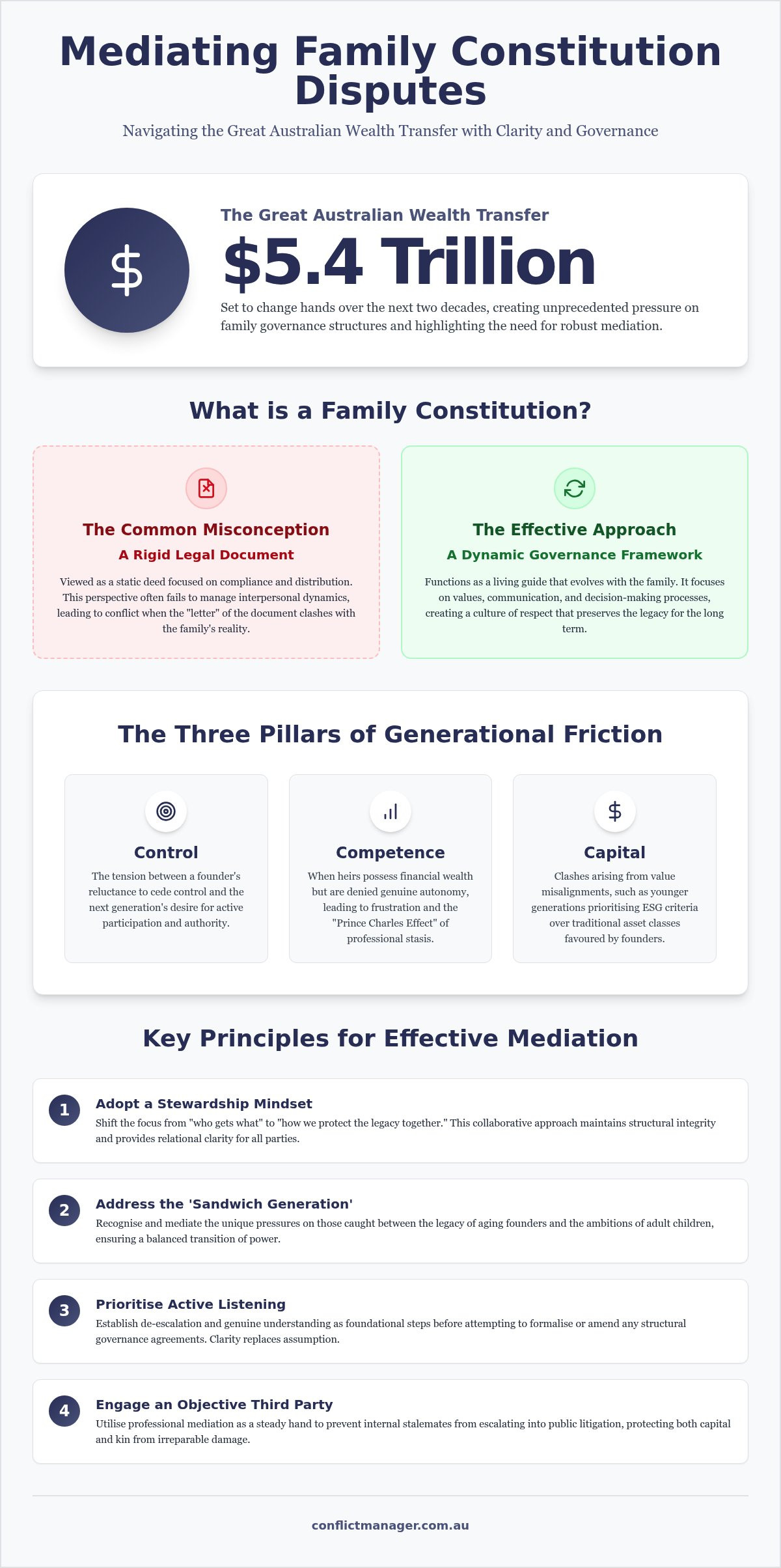
With an estimated $5.4 trillion set to change hands across Australia over the next two decades, the scale of the Great Wealth Transfer is unprecedented. It represents a period of profound transition. Legacy. Friction. Ownership. While these assets represent decades of industry, the absence of clear governance often leads to a fractured inheritance. Successfully mediating family constitution disputes has become essential as court-annexed mediations for succession cases have seen a significant surge in recent years. This rise highlights a growing discomfort with public litigation and the deep-seated desire to protect both capital and kin.
You likely recognise that a family constitution is meant to be a roadmap; yet, even the most robust documents can buckle under the weight of next-generation impatience or a founder's reluctance to cede control. Internal efforts to resolve these tensions often stall because the participants are too close to the friction to see the structural solution. You'll learn how to navigate this emotional and structural friction through expert mediation and the robust implementation of a family constitution. This article examines the logic of external intervention and how it protects asset integrity and family stability for the long term.
Key Takeaways
- View your family constitution as a dynamic governance framework rather than a rigid legal document to ensure the spirit of the legacy remains intact during transitions.
- Categorise friction into the three primary pillars of Control, Competence, and Capital to identify the specific structural or emotional roots of generational discord.
- Address the unique pressures of the 'Sandwich Generation' by balancing the legacy of aging founders with the evolving values and ambitions of adult children.
- Understand the critical role of an objective third party in mediating family constitution disputes to prevent internal stalemates from escalating into public litigation.
- Prioritise active listening and de-escalation as the foundational steps before attempting to formalise or amend any structural governance agreements.
Understanding the Anatomy of Family Constitution Disputes
A family constitution is frequently mischaracterised as a static legal deed. In reality, it functions as a living governance framework designed to evolve alongside the family it serves. Conflict typically emerges when the technical "letter" of the document fails to reflect the underlying "spirit" of the family's intent. This misalignment often occurs during the transition from wealth creation to wealth stewardship. While the founder prioritises growth and control, the next generation often seeks purpose and participation. If left unaddressed, these tensions compromise the stability of the family office and the integrity of the assets themselves.
Governance vs Legal Drafting: The Crucial Distinction
Even the most meticulously drafted legal structures can fail to manage interpersonal resentment. Legal deeds focus on distribution and compliance; governance focuses on values and communication. When mediating family constitution disputes, we often find that past family dynamics are the true drivers of current discord. A clause regarding voting rights might be the catalyst, but the root cause is usually a decades-old perception of unfairness or a lack of transparency. A successful framework must account for these human variables. It should define how the family makes decisions and resolves disagreements, rather than just outlining who receives which dividend. It's about establishing a culture of respect that outlives any single transaction.
The Stewardship Mindset in Conflict Resolution
Effective resolution requires a shift in perspective. The focus must move from "who gets what" to "how we protect the legacy together." This dual approach maintains structural integrity while providing relational clarity. One significant hurdle is the "Prince Charles Effect." This occurs when adult heirs are granted financial wealth but denied genuine autonomy or decision-making power. It's a common friction point in Australian family offices where the founder remains active well into their eighties. Professional mediation addresses this by creating clear pathways for competence and leadership. It ensures that stewardship is a shared responsibility rather than a source of frustration. By aligning the family's internal culture with its external governance, we preserve the stability required for a multi-generational legacy. Clarity replaces assumption. Order replaces chaos.
The Great Australian Wealth Transfer: Why Friction is Inevitable
Capital. Stewardship. Transition. These three forces converge as Australia navigates an intergenerational wealth transfer estimated at between $3.5 trillion and $5.4 trillion over the next two decades. This movement of assets creates a unique pressure on the "Sandwich Generation," those individuals caught between the needs of aging patriarchs and the ambitions of adult children. It's a period defined by high stakes and thin patience. While household wealth reached a record $19.21 trillion in early 2026, the structural integrity of the families holding these assets is often less secure than the balance sheets suggest. Friction isn't just a possibility; it's a mathematical certainty when traditional governance meets modern expectation.
The Delayed Succession Dilemma
Increased life expectancy has fundamentally altered the timeline of Australian succession. It's now common to see founders retaining absolute control of the family office well into their eighties, a reality that often leaves the next generation in a state of professional stasis. When leadership transitions are delayed, the family constitution can begin to feel like a cage rather than a guide. This stagnation often necessitates mediating family constitution disputes before they escalate into irreparable relational breaks. Managing the transition of decision-making authority requires a steady hand to ensure that the founder's need for security doesn't stifle the heir's need for autonomy. Without a clear pathway for the transfer of power, the document meant to preserve the legacy often becomes the primary source of its undoing.
Value Misalignment and Philanthropic Goals
Economic realities and core values have shifted significantly between Boomers, Gen X, and Millennials. Younger generations increasingly prioritise ESG (Environmental, Social, and Governance) criteria, often clashing with founders who favour traditional, proven asset classes. This misalignment extends to philanthropy. We frequently observe tension between "giving with warm hands"-the desire to see the impact of wealth during one's lifetime-and the more traditional approach of testamentary legacies. These disputes are rarely about the money itself; they're about the purpose of the wealth. When investment strategies or charitable goals diverge, the family constitution must be flexible enough to accommodate different visions while maintaining the core mission. Engaging in professional stakeholder facilitation can help bridge these generational divides by aligning diverse values into a single, cohesive governance strategy. Clarity in purpose is the only antidote to the friction of transition.
Identifying Core Flashpoints in Constitution Mediation
Control. Competence. Capital. These three pillars underpin almost every constitutional crisis. While the governance document provides the necessary structure, the human elements provide the volatility. We often see the 'Founder’s Mindset', rooted in the grit of wealth creation, collide with the 'Heir’s Expectation', which is frequently focused on modern stewardship and equitable participation. This friction is exacerbated by a lack of transparency. When financial data or decision-making processes remain opaque, suspicion thrives. Mediating family constitution disputes requires peeling back these layers of suspicion to reveal the core structural misalignment. Even the influence of "in-laws" can become a significant flashpoint, as their external perspectives are sometimes viewed as a threat to the family's established order.
Control and Decision-Making Authority
The transition from informal kitchen-table chats to formalised board meetings is a critical juncture. In many Australian family offices, the founder still holds an unofficial veto power that contradicts the written constitution. This creates a functional deadlock. Disputes often intensify when the family business, the source of the original wealth, is managed under different rules than the broader investment portfolio. Clarity on who holds the final say is essential. Without it, the governance framework remains a suggestion rather than a rule. Objective facilitation helps families define these boundaries; it ensures that decision-making authority is based on role and responsibility rather than just lineage.
The Burden of Expectation and Competence
A primary fear for many patriarchs is the "shirtsleeves to shirtsleeves in three generations" phenomenon. This anxiety often manifests as a deep doubt regarding the next generation’s ability to manage complex assets. It's a heavy burden. Heirs frequently struggle with "Imposter Syndrome" or are unfairly labelled with "Entitlement" before they've had a chance to lead. A 2025 report indicated that only 19% of Australian family businesses have a documented succession plan, leaving 81% in a state of governance ambiguity. Mediating family constitution disputes in this context involves creating objective benchmarks for competence. By shifting the conversation from personality to performance, families can reduce the emotional heat and focus on the long-term integrity of their assets. Order is restored through shared standards.
Strategies for Mediating High-Emotion Constitution Debates
De-escalation. Order. Neutrality. These are the precursors to any successful resolution. When mediating family constitution disputes, the process must begin with a stabilisation of the environment. We recommend a Governance Audit as the first step; this provides an objective assessment of where the current framework is misaligned with the family's operational reality. Moving these discussions to a neutral ground is equally vital. By removing the sessions from the family home or the corporate office, we neutralise the environmental triggers that often fuel historical resentment. It's about creating a space where the logic of the structure can finally be heard over the noise of the past. Professional mediation ensures that active listening precedes any attempt to amend the constitution.
Establishing a Formal Governance Framework
Precision in role definition is the only way to prevent relational overlap. Families must clearly separate their roles as parents or children from their professional duties as chairmen or directors. This involves creating a regular, structured forum for financial discussion that prevents 'ambush' conflicts during social gatherings. A robust framework also includes clear exit strategies for disgruntled members. If someone wishes to leave the family office, the path should be pre-defined and dignified, protecting both the individual and the asset integrity. This structural clarity is essential when mediating family constitution disputes that involve complex intergenerational dynamics. Without it, the lines between personal feeling and professional duty remain blurred.
The Power of Vulnerability and Transparency
In Australian culture, discussing death and money often remains a significant taboo. Yet, secrecy is the primary fuel for next-gen resentment. Transparency doesn't mean total disclosure of every cent; it means sharing the 'why' behind major financial decisions. When founders explain their rationale, it fosters a culture of shared stewardship rather than secretive, top-down ownership. This shift requires a level of vulnerability that can be difficult for patriarchs to embrace. If your family is struggling to bridge this gap, engaging in expert family conflict resolution provides the steady hand needed to facilitate these high-stakes conversations. Clarity builds trust. Trust preserves the legacy.
Professional Mediation: The Steady Hand in Family Legacy
Objectivity. Distance. Clarity. When internal efforts to resolve deep-seated conflict stall, it's often because the participants are too emotionally entangled to see the structural path forward. Internal discussions frequently devolve into a repetitive cycle of accusation and defence. This is where the value of a neutral third party becomes undeniable. A seasoned professional remains unruffled by high-stakes human dynamics. They act as a steady hand, viewing volatile situations with total objectivity. The process of professional facilitation begins with individual intake sessions. This allows every stakeholder to voice their concerns in a safe, confidential environment before joint sessions commence. The ultimate goal is a sustainable outcome that protects both the asset integrity and the family bond.
Why Long-Term Advisors Aren’t Always Neutral
Many families naturally turn to their long-term legal or financial advisors to resolve constitutional friction. While these professionals provide essential technical expertise, they often lack the specific training required for mediating family constitution disputes. There's also a significant risk of perceived bias. If an advisor has worked closely with the founder for thirty years, the next generation may view their suggestions with suspicion, regardless of the advisor's actual intent. A neutral mediator provides a safe space for difficult admissions without the fear of judgement or the weight of historical loyalty. They don't provide legal representation; they facilitate a resolution that every family member can respect and uphold.
Achieving Clarity and Stability through Facilitation
Moving from a state of disruption to a vision of structured, agreed-upon resolution requires a methodical approach. Expert-led facilitation provides the stability needed for future generations to thrive within the family office. It ensures that the governance framework is respected by everyone, not just those who originally drafted it. By addressing the human friction alongside the structural requirements, families can avoid the reputational damage of public litigation. This is particularly vital in the Australian context, where court-annexed mediations for succession cases increased sevenfold between 2021 and 2025. It's about building a legacy that is as resilient relationally as it is financially. If your governance structure is currently under pressure, you can enquire about Family Office Mediation with Conflict Manager to restore order to your family legacy. Clarity replaces chaos. Stability replaces friction.
Securing the Future of the Family Office
The transition of significant wealth requires more than just legal compliance; it demands relational resilience. A family constitution only succeeds when it's supported by a shared commitment to governance and transparency. By mediating family constitution disputes through an objective third party, you move away from the volatility of historical friction and toward a vision of structured resolution. This methodical approach ensures that the spirit of your legacy remains intact while the structural agreements evolve to meet the needs of every generation. It transforms a period of potential disruption into a foundation for long-term stability.
Conflict Manager provides composed, objective facilitation for high-stakes disputes. Our expertise in navigating complex human and structural dynamics ensures sustainable outcomes that preserve both capital and kinship. You can secure your family legacy through expert mediation to bring order to your family governance. Clarity is the ultimate safeguard for your assets and your people. Stability is achievable when you choose a path of total objectivity and mutual respect.
Frequently Asked Questions
What is the most common cause of family constitution disputes in Australia?
The most common catalyst is the friction between a founder’s desire for control and the next generation’s need for autonomy during wealth transfer. This often manifests as a disagreement over decision-making authority or investment philosophy. When the technical clauses of the document no longer reflect the family's underlying values, disputes over governance inevitably arise. Clarity is lost. Resentment builds. Addressing these tensions early prevents the document from becoming a source of ongoing discord.
How can a family office manage disputes between siblings with different values?
Managing sibling discord requires shifting the focus from individual differences to shared stewardship of the family legacy. Professional facilitation helps siblings categorise their friction into pillars of Control, Competence, or Capital. By establishing objective benchmarks for performance and clear roles within the family office, personal values can coexist with professional duties. This structural clarity prevents personal resentment from compromising asset integrity or the stability of the broader family governance framework.
When is the right time to bring in a neutral third-party mediator for a constitution?
The optimal time is before a disagreement escalates into litigation or permanent relational damage. If internal governance discussions have stalled or become circular, an external counsellor can provide the necessary objectivity. Bringing in a professional for mediating family constitution disputes is particularly effective during significant life events, such as a founder reaching their 80s or the introduction of "in-laws" into the family office board's decision-making processes.
Can mediation help if family members are already refusing to speak to each other?
Mediation is often most effective when communication has broken down entirely. The process begins with individual intake sessions, allowing each member to express their concerns in a safe, confidential environment. A mediator then uses these insights to build a bridge between parties without requiring immediate face-to-face contact. This methodical approach de-escalates high-emotion situations, moving the family from a state of total disruption toward a vision of structured, agreed-upon resolution.
What is the difference between family mediation and legal arbitration?
Mediation is a voluntary, collaborative process where a neutral facilitator helps parties reach their own agreement. In contrast, arbitration involves a third party making a binding decision after hearing evidence, much like a private court. While arbitration focuses on legal compliance and distribution, mediating family constitution disputes prioritises relational clarity and long-term stability. Mediation allows the family to retain control over the outcome rather than having a solution imposed upon them.
How does a family constitution help prevent future wealth disputes?
A robust constitution acts as a living governance framework that defines roles, responsibilities, and dispute resolution protocols. It establishes a culture of transparency, which is essential given that trillions of dollars are set to change hands in Australia by 2026. By pre-defining how the family handles transitions and investment shifts, the document reduces the ambiguity that often fuels resentment. It transforms wealth from a source of friction into a shared legacy.
How can we protect our family business from being destroyed by internal conflict?
Protection comes from the deliberate separation of family dynamics from commercial operations. Implementing a formal governance framework ensures that business decisions are made by qualified directors rather than based on lineage alone. This structural integrity is supported by regular, formalised board meetings and clear exit strategies for disgruntled members. By professionalising the business environment, you shield the operational assets from the emotional volatility of interpersonal disagreements and shifting intergenerational expectations.
Is mediation confidential for high-net-worth families in Australia?
Confidentiality is a fundamental principle of private mediation in Australia. Unlike public litigation, which can cause significant reputational damage, mediation sessions are conducted behind closed doors. All discussions and documents produced during the process are generally inadmissible in court, providing a safe space for families to address sensitive financial and emotional issues. This privacy is crucial for high-net-worth families who wish to resolve governance friction without attracting public or media scrutiny.


