

Friction. Stagnation. Risk. The most significant threat to your company's legacy isn't a shift in the market or a competitor's move; it's the quiet, corrosive tension between those at the helm. When the shared vision that built your enterprise begins to fracture, resolving business partnership disputes requires a level of objectivity that's often impossible to maintain from within the boardroom. You've likely spent months weighing the cost of a public fallout against the emotional exhaustion of daily conflict, fearing for your reputation and the long-term integrity of your assets.
It's an incredibly heavy burden to carry, but it's one that can be managed through a structured, neutral process. This guide offers a methodical, mediation-led framework to help you navigate these complex dynamics with composed authority and quiet confidence. You'll discover how external facilitation can decouple interpersonal friction from commercial requirements, allowing for a sustainable resolution that restores professional clarity. We'll examine the logic of neutral intervention and the creation of dignified exit strategies that protect the business's future while honouring the hard work that established it.
Key Takeaways
- Recognise that most friction stems from a breakdown in structural vision or trust rather than simple personality clashes. Understanding these core triggers is the first step toward reclaiming organisational stability.
- Discover why the adversarial nature of the Australian court system often destroys brand equity and how mediation offers a private, dignified alternative. This process ensures your internal friction remains off the public record.
- Learn a methodical, two-step framework for resolving business partnership disputes that prioritises objective assessment. This approach allows you to decouple personal interests from the business’s overarching objectives.
- Understand the critical role of a neutral third party in navigating high-stakes transitions like intergenerational succession. A steady hand provides the clarity needed to protect asset integrity and your long-term legacy.
Understanding the Anatomy of Business Partnership Disputes
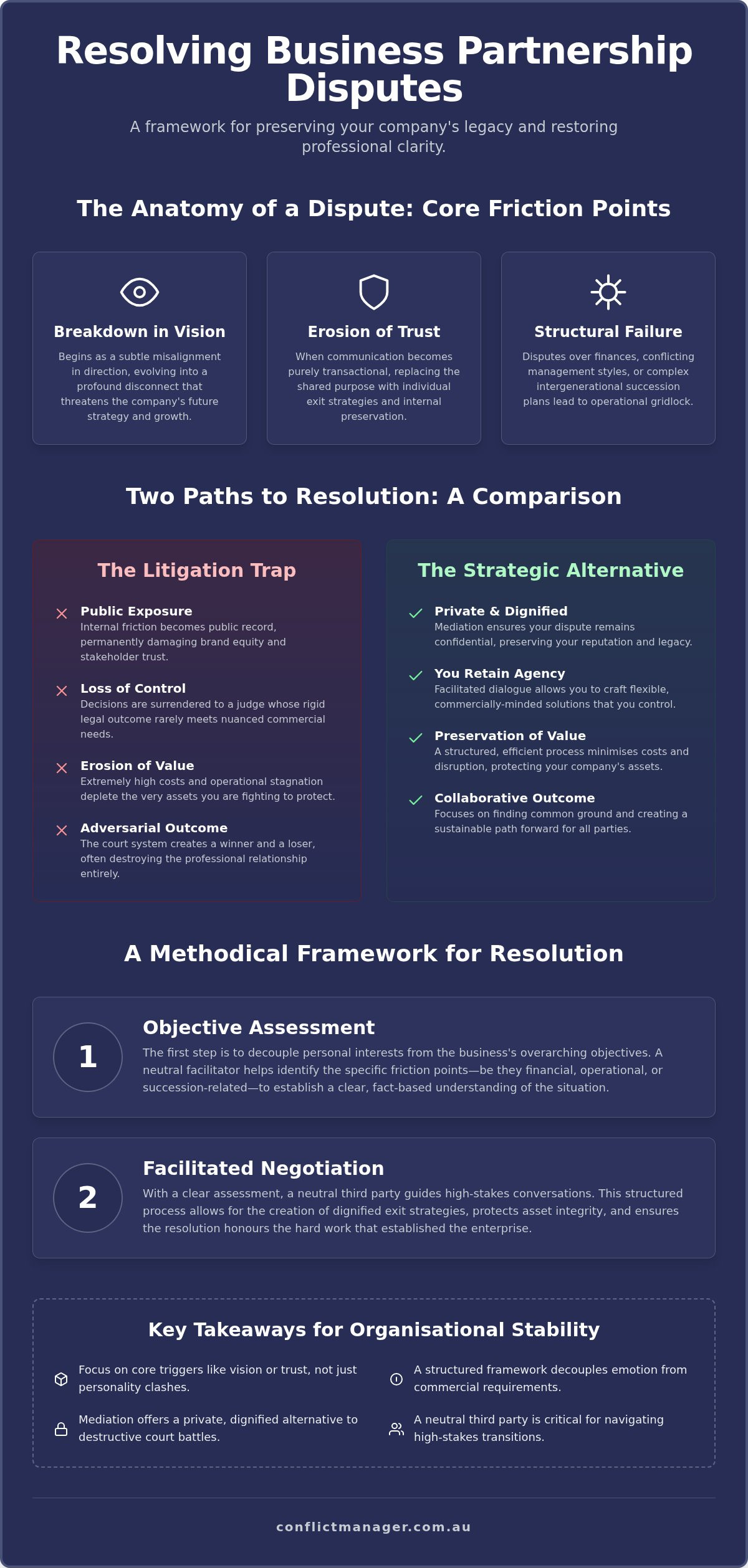
Alignment. Trust. Vision. These are the invisible pillars that support every successful commercial venture. When these pillars begin to buckle, the resulting instability isn't just a legal hurdle; it's a fundamental breakdown in the business's structural integrity. A partnership dispute is a multifaceted failure of both contract and communication. It often begins as a subtle misalignment in direction before evolving into a profound disconnect that threatens the very foundation of the enterprise.
Resolving business partnership disputes requires identifying the specific friction points that have stalled progress. These typically fall into three categories: financial disagreements over capital contributions or profit distribution; conflicting management styles that lead to operational gridlock; and the complex, often emotional, hurdles of intergenerational succession. While a well-drafted agreement provides the framework, it cannot account for the shifting psychological dynamics that occur as a business matures.
Many partnerships suffer from "silent" disputes; these are internal fractures that haven't yet reached the level of litigation but are already eroding value. Decision-making slows. Innovation halts. The focus shifts from external growth to internal preservation. Understanding various dispute resolution methods becomes essential at this stage to prevent a quiet decline from becoming a public collapse.
The Distinction Between Functional and Dysfunctional Friction
Healthy debate is the engine of growth. It's the process where differing perspectives refine a strategy. However, friction becomes dysfunctional when the objective is no longer the best outcome for the business, but rather the validation of one partner over another. This transition is often marked by "emotional contagion," where the stress of the founders permeates the entire organisation. You'll recognise a terminal breakdown when communication becomes purely transactional and the shared vision is replaced by individual exit strategies.
The High Cost of Unresolved Conflict
The price of prolonged friction is rarely confined to the balance sheet. It manifests as operational paralysis, where key projects remain in limbo because consensus is impossible. High-performing staff often sense the instability and seek more secure environments; this leads to a drain of intellectual property that's difficult to replace. In the Australian market, where reputation is a primary currency, a visible dispute can alienate stakeholders and damage your legacy. Protecting asset integrity requires a steady hand to intervene before the damage to your professional standing becomes irreversible.
Why Litigation Often Fails to Preserve Business Integrity
Conflict. Cost. Exposure. These are the inevitable byproducts of taking a commercial disagreement into the public arena. When tensions peak, the default instinct is often to seek a legal remedy through the courts. However, the Australian legal system is fundamentally adversarial. It's structured to produce a binary outcome: winners and losers. In the context of a functioning enterprise, this often means there are no survivors left to run the business. The process is designed to adjudicate rights, not to mend the complex operational and emotional threads that keep a business viable.
Entering the "Litigation Trap" involves surrendering control to a third party who lacks a deep understanding of your industry or family dynamics. High costs and significant delays are the baseline. By the time a judgment is handed down, the market may have moved, or the business's internal culture may have permanently soured. The pitfalls of this path include:
- Loss of Agency: A judge's role is to apply the law, which rarely addresses the nuanced commercial needs required for resolving business partnership disputes effectively.
- Erosion of Value: Legal fees and operational stagnation can quickly deplete the assets you're fighting to protect.
- Rigid Outcomes: You can often find better tips to resolve conflict through facilitated dialogue than through a rigid court order.
The Limitations of Legal Remedies
Legal wins can frequently result in commercial losses. A court order might grant you a specific right, but it can't force a partner to be collaborative or innovative. Statutory partnership dissolution is a blunt instrument. It often mandates the sale of assets or the winding up of a company, regardless of whether that's the most value-preserving path. In many cases, the law's lack of nuance fails to account for the operational reality of a going concern. Rights don't always translate to results.
The Case for Confidentiality
Public record risks are perhaps the most underestimated danger of litigation. Once a dispute enters the court system, it becomes public property. Competitors, clients, and staff can observe the internal friction in detail. This transparency can lead to a loss of stakeholder trust that's difficult to rebuild. For high-net-worth individuals and family offices, this exposure is often unacceptable. Maintaining a sense of quiet confidence during a transition is a strategic advantage. Resolving business partnership disputes behind closed doors ensures that your reputation remains intact while you work toward a sustainable resolution. If you're seeking a way to protect your legacy without the collateral damage of a courtroom, exploring organisational conflict management can provide the steady hand your business needs.
Common Triggers for Partnership Friction in Australian Enterprises
Growth. Evolution. Complexity. As an enterprise matures, the original frameworks that once provided clarity can become restrictive. This structural lag often acts as the primary catalyst for friction within Australian firms. Resolving business partnership disputes at this stage requires a deep understanding of how a company's needs change over time. When the business outgrows its original partnership agreement, the resulting vacuum is often filled by individual anxieties and conflicting ambitions.
Financial misalignment is a frequent trigger. One partner may prioritise aggressive reinvestment to capture market share; another may seek consistent dividend payouts to support a particular lifestyle. This "Lifestyle vs. Growth" divide isn't merely a tactical disagreement; it's a fundamental conflict of vision that can paralyse decision-making. Seeking Australian business dispute support can provide an initial sense of direction, but deep-seated misalignments often require a more bespoke, facilitated approach to ensure the business's survival.
Intergenerational succession remains one of the most volatile triggers for conflict. The tension between founding values and new-age strategies can create a profound rift between generations. While the founders may focus on the preservation of established methods, the incoming leadership often pushes for rapid modernisation. Without a clear, documented path for this transition, the resulting friction can threaten the very legacy the partners are trying to protect.
Family Office and High-Net-Worth Dynamics
In high-net-worth environments, the intersection of family history and commercial responsibility creates a unique set of pressures. The debate over entitlement versus contribution is particularly acute in family firms where legacy and asset integrity are at stake. It's common for personal grievances, some spanning decades, to masquerade as modern business disagreements. A steady, neutral hand is required to separate these emotional threads from the structural requirements of the firm, ensuring that family dynamics don't compromise the organisation's future.
Leadership and Boardroom Deadlock
The 50/50 equity split remains the ultimate structural stalemate. Without a clear tie-breaking mechanism, the boardroom can quickly descend into a state of total paralysis. This deadlock is often exacerbated by conflicts of interest, particularly when a partner's external ventures begin to compete for their time or resources. Such scenarios erode fiduciary duty and leave the core business vulnerable. Resolving business partnership disputes of this nature involves more than just legal interpretation; it requires a strategic realignment of interests to restore operational movement.
A Structured Framework for Resolving High-Stakes Disputes
Resolution. Order. Clarity. These are not merely aspirations; they are the tangible results of a deliberate, logical progression. Resolving business partnership disputes requires a methodical decoupling of interpersonal friction from commercial necessity. When trust has eroded, the path back to stability cannot be found through the same circular arguments that created the deadlock. Instead, it requires a structured framework designed to lower the emotional temperature and restore operational movement.
The process begins with an objective assessment. This involves engaging a neutral third party to map the dispute, identifying where personal grievances have begun to cloud structural requirements. Once the landscape is understood, the focus shifts to stakeholder alignment. Here, the goal is to separate individual interests from the overarching objectives of the business. This leads into facilitated dialogue, a stage where partners move away from entrenched positions to discuss their underlying needs. Finally, the framework concludes with structural re-alignment. This may involve redesigning the partnership agreement to reflect the business's current reality or, if necessary, organising a dignified exit that preserves the value of the assets involved.
- Objective Mapping: Identifying the root cause of friction without assigning blame.
- Interests over Positions: Uncovering what each partner truly needs to move forward.
- Structural Solutions: Updating governance to ensure the dispute does not recur.
The Role of the Neutral Facilitator
Internal efforts at resolution often fail because the participants are too emotionally entangled in the outcome. A neutral facilitator acts as the steady hand, providing a sense of order during periods of high stress. This external counselor views volatile situations with total objectivity, remaining unruffled by the high-stakes environment. By acting as a buffer, they allow for a level of honesty that is rarely possible in a direct confrontation. Their presence suggests a commitment to a professional outcome rather than a personal victory.
Achieving Sustainable Outcomes
A resolution is only successful if it sticks long after the facilitation ends. Sustainability is achieved by designing new governance structures that address the triggers identified during the process. This often involves creating clear tie-breaking mechanisms or updated financial protocols. In high-profile Australian enterprises, the importance of face-saving cannot be overstated. A dignified resolution allows all parties to maintain their professional reputation while achieving the clarity needed to move forward. To begin this process of restoration, you may consider engaging expert stakeholder facilitation to guide your organisation through the transition.
Restoring Stability: The Path Forward with Conflict Manager
Authority. Perspective. Neutrality. Conflict Manager approaches every engagement with the composed authority required to navigate high-stakes organisational friction. Our role is to act as a steady hand, viewing volatile situations with total objectivity to bring clarity to clouded environments. By focusing on resolving business partnership disputes through a lens of structural integrity and human dynamics, we ensure that the business's legacy remains protected. We specialise in high-emotion, high-net-worth scenarios where asset integrity is at risk, providing a neutral third-party perspective that internal stakeholders simply cannot maintain under pressure. This expertise is particularly vital for family offices where the lines between commercial responsibility and personal history are often blurred.
When to Engage External Support
Recognising the point of no return is critical for the survival of the enterprise. If internal negotiations have descended into circular arguments where trust is entirely absent, the risk of permanent structural damage increases daily. Early intervention in resolving business partnership disputes during periods of structural change or succession planning often prevents these fractures from widening into terminal breaks. Introducing a mediator to a skeptical partner requires a shift in narrative; it's not about admitting defeat, but about engaging a professional to secure the asset's value. A seasoned counselor provides the reassurance that the process will be objective, confidential, and focused on a sustainable commercial outcome. This external support allows partners to step back from the friction and view the business's needs with renewed objectivity.
Moving from Disruption to Resolution
The journey from disruption to resolution is methodical and logical. It begins by acknowledging the difficult reality of the current friction and transitions into an analytical explanation of the business's needs. We guide stakeholders through this process with quiet confidence, ensuring that both the emotional weight of the conflict and the technical requirements of the firm are addressed. This progression feels inevitable and calming, moving you from a state of complexity toward a vision of structured resolution. Our focus remains on achieving outcomes that stick long after the facilitation ends, prioritising the preservation of your professional reputation. You can achieve clarity and stability with our expert mediation services, allowing your organisation to move forward with restored professional clarity and a clear path for the future.
Securing Your Business Legacy Through Strategic Alignment
Restoring order to a fractured partnership is more than a legal task; it's a strategic necessity for the survival of your enterprise. The risks are profound. The triggers are predictable. By prioritising neutral facilitation, you can move away from the high-stakes friction that stalls progress and toward a vision of structural stability. It's a path that replaces emotional exhaustion with professional clarity and long-term security for all stakeholders involved.
Resolving business partnership disputes requires a steady hand and a proven framework for sustainable outcomes. At Conflict Manager, we specialise in high-net-worth family office dynamics and complex organisational conflict, providing the objective perspective needed to protect your asset integrity. Our methodical approach ensures that your professional reputation remains intact while you achieve the resolution required to move forward. If you're ready to transition from disruption to resolution, consult with a Conflict Manager expert to resolve your partnership dispute and reclaim the focus your business deserves. Your legacy is far too valuable to be left to the uncertainty of internal deadlock.
Frequently Asked Questions
How do I resolve a business partnership dispute without going to court?
You can use Alternative Dispute Resolution (ADR) methods such as mediation or facilitation to reach a private agreement. These processes allow partners to negotiate in a neutral environment away from the public record. Unlike litigation, ADR focuses on interest-based outcomes that preserve the business's operational integrity. It's often more cost-effective and significantly faster than the court system, providing a dignified path toward either a renewed partnership or a structured exit.
What are the most common causes of partnership disputes in Australia?
Friction typically arises from misaligned financial expectations, conflicting management styles, or structural lag as a business outgrows its original agreement. Disagreements over dividend payouts versus reinvestment are particularly frequent. Additionally, intergenerational succession often triggers conflict when founding values clash with modern growth strategies. Identifying these triggers early is essential for resolving business partnership disputes before they escalate into terminal organisational fractures that threaten the firm's survival.
Can a business partnership survive a major conflict between owners?
A partnership can certainly survive if there's a willingness to engage in a structured resolution process. Survival depends on decoupling personal grievances from the business's commercial requirements. Many enterprises emerge stronger after a dispute by implementing more robust governance structures and clearer communication protocols. However, if trust is fundamentally broken beyond repair, the focus should shift toward a dignified exit strategy that preserves the asset's value and the family legacy.
How long does the business mediation process typically take?
Most commercial mediations are resolved within one to three sessions, depending on the complexity of the dispute and the number of stakeholders involved. While the preparation phase might take several weeks to gather necessary data and map the conflict, the actual facilitation is designed for efficiency. This is significantly faster than the Australian court system, where litigation can often drag on for eighteen months or longer before reaching a hearing.
What happens if there is no partnership agreement in place during a dispute?
If a written agreement is absent, the relevant state or territory's Partnership Act will govern the dispute by default. These Acts provide a basic legal framework, but they're often blunt instruments that may not suit your specific commercial needs. They typically assume an equal share of profits and losses and can mandate a total dissolution of the partnership. This makes neutral facilitation even more critical to achieve a bespoke, value-preserving outcome.
Is business mediation legally binding in Australia?
Mediation itself is a voluntary and confidential process, but the settlement agreement reached at the end can be made legally binding. Once all parties sign a written deed of settlement, it becomes an enforceable commercial contract. This provides the certainty needed for resolving business partnership disputes without the unpredictability of a judge's ruling. It's a structured way to ensure that the agreed-upon stability and new governance protocols are maintained long-term.
How do we manage conflict in a multi-generational family office?
Managing family office friction requires separating family history from commercial responsibility. It's vital to establish clear boundaries between emotional dynamics and fiduciary duties. Using a neutral facilitator helps navigate the "entitlement versus contribution" debate that often plagues family firms during leadership transitions. This approach ensures that the family legacy and asset integrity are protected while providing a platform for different generations to align on a shared vision for the future.
What is the role of a neutral third-party mediator in a business dispute?
A neutral mediator acts as a steady hand who provides objectivity during periods of high stress or organisational friction. They don't take sides or offer legal advice; instead, they facilitate a logical dialogue to uncover the partners' underlying needs. By viewing volatile situations without emotional entanglement, they help stakeholders move past entrenched positions. Their presence brings order to chaos, ensuring the conversation remains focused on sustainable structural and commercial outcomes.


