

Legacy. Ownership. Identity. These powerful forces often collide when an Australian farming family faces the inevitable transition of the land to the next generation. You've likely felt the rising tension between the child who stayed to manage the paddocks and the siblings who built lives in the city, all while grappling with the fear that a fair split will eventually lead to a forced sale. It's a heavy burden to carry alone. You want to protect the business you've built without fracturing the relationships that matter most.
This article demonstrates how family farm succession mediation provides the objective framework necessary to navigate these high-stakes emotional and structural shifts. By introducing a composed, external perspective, you can transform a period of friction into a documented path forward. We'll examine the mechanics of professional facilitation, the critical role of financial disclosure under 2025 reforms, and the strategies used to ensure the farm remains a viable enterprise for decades to come.
Key Takeaways
- Recognise that farm succession is a profound transition of legacy rather than a mere business transaction, requiring a process that respects both heritage and commercial reality.
- Utilise family farm succession mediation to establish a neutral, structured environment that reduces emotional friction and fosters objective decision-making among all stakeholders.
- Resolve the tension between "fair" and "equal" by prioritising an equitable outcome that protects the commercial viability of the land for future generations.
- Approach the mediation process as a strategic muster, ensuring all family members are psychologically and practically prepared for a constructive and orderly dialogue.
- Understand the value of a steady, external hand in navigating complex interpersonal dynamics to secure a sustainable future for both the family unit and the asset.
Navigating the Friction of Australian Family Farm Succession
Transition. Heritage. Continuity. For an Australian family farm, these concepts aren't just business terms; they're the bedrock of a generational identity. Family farm succession mediation is a structured, facilitated process designed to help stakeholders reach a voluntary and binding agreement regarding the future of their land and assets. It isn't merely a legal box to tick. It's a method of protecting the commercial viability of the enterprise while preserving the fragile bonds of the family unit.
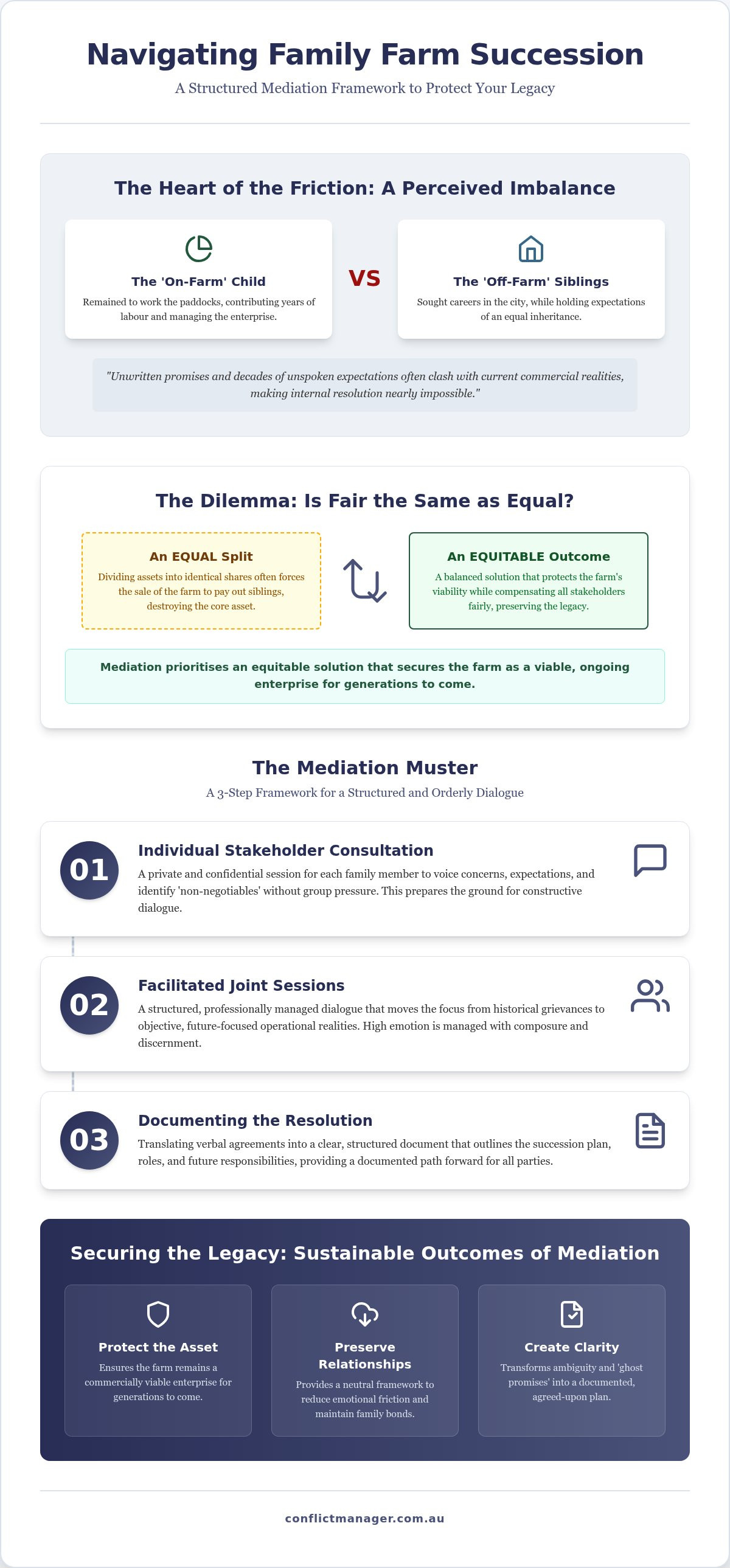
Conflict often arises from a clash between those who stayed to work the paddocks and those who sought careers in the city. This "on-farm" versus "off-farm" dynamic creates a perceived imbalance of contribution and reward. When you add the shift of operational control from a patriarch or matriarch to the next generation, the friction can become paralysing for the entire business. Internal efforts to resolve these issues frequently stall because they're weighted by decades of unspoken expectations and complex power dynamics that are difficult to untangle without help.
The Burden of Unwritten Promises
The phrase "one day this will all be yours" has been whispered across kitchen tables for generations. While intended as a reassurance, it's a precarious foundation for a modern business plan. These unwritten promises often clash with current commercial realities, such as rising land values or the need for capital reinvestment. Mediation brings these "ghost promises" into the light. It allows the family to examine them objectively, reconciling historical intent with the practical needs of a sustainable agricultural business that must survive in a global market.
Why Internal Resolution Often Fails
Achieving total objectivity is nearly impossible when you're emotionally entangled in the outcome. In high-pressure discussions, even the most successful adults can find themselves reverting to childhood roles; this only serves to deepen existing rifts. A neutral third party provides a sense of order. By acting as a steady hand, family farm succession mediation ensures the conversation remains focused on structural integrity rather than historical grievances. This external intervention creates the space required for a logical, methodical progression toward resolution.
The Mediation Framework: Moving from Emotion to Objective Reality
Structure. Logic. Order. Resolution. Family farm succession mediation operates through a methodical progression that moves stakeholders from a state of disruption toward a structured resolution. It's far more than a simple discussion; it's a commercial necessity. Without a steady, objective hand to lower the collective pulse of the family, the farm's commercial viability remains at risk. The goal is to produce sustainable outcomes that protect the integrity of the assets while ensuring the family unit remains intact.
Step 1: Individual Stakeholder Consultation
Hearing each family member in a private, safe environment is the first priority. This stage allows individuals to voice concerns without the pressure of a group setting. It's here that hidden "non-negotiables" are identified. These are the underlying issues that could derail the process if left unaddressed. By establishing a baseline of respect and professional boundaries early, the mediator prepares the ground for a constructive muster of the family's future. This approach mirrors global standards, such as those seen in the USDA Certified Mediation Program, which highlights the legitimacy of facilitated dialogue in resolving complex agricultural transitions.
Step 2: Facilitated Joint Sessions
Joint sessions move the group from historical grievances to a shared understanding of the farm's future. The process shifts the focus from "he-said-she-said" narratives to objective operational realities. The goal is not just agreement; it is clarity. A seasoned professional manages high-emotion outbursts with composure and discernment, ensuring the conversation doesn't spiral into unproductive conflict. This is where the transition from emotional friction to structural integrity occurs. If your family is struggling to maintain this level of objectivity, engaging in professional stakeholder facilitation can provide the stability needed to reach a resolution.
Step 3: Documenting the Resolution
The final stage involves translating verbal agreements into a clear, structural roadmap for the family. This isn't a vague promise; it's a documented path forward. This documentation ensures the outcome is sustainable for the farm's financial health, considering both current debt levels and future capital requirements. By providing this sense of order, the mediation process creates the foundation for legal professionals to later formalise the agreement. It's about securing the legacy of the land and the stability of the family for the decades ahead.
Resolving the Fair vs Equal Dilemma in Agricultural Assets
Equity. Viability. Fairness. Continuity. The central tension in any agricultural transition is the realisation that a farm often cannot be divided into equal portions and remain a productive primary production unit. If a property is split four ways to satisfy a literal interpretation of equality, the resulting parcels may be too small to sustain a commercial operation. This creates a profound sense of anxiety for the family. Family farm succession mediation provides the mechanism to distinguish between "equal distribution", which focuses on the raw numbers, and "equitable resolution", which focuses on the sustainable future.
Succession isn't a simple accounting exercise. It's a structural realignment of assets that must respect both historical contribution and future survival. When the family approaches the table with an understanding that "fair" does not always mean "mathematically equal", the path to resolution becomes clearer. It requires a shift in perspective from immediate liquidation to long-term stewardship. This shift is essential to prevent the fragmentation of the land.
The Case for the On-Farm Stakeholder
The child who stayed on the land has often contributed decades of "sweat equity" that isn't reflected on a standard balance sheet. They've maintained the station's productivity and managed the day-to-day risks, often accepting lower wages in exchange for the promise of future ownership. Recognising this contribution is essential for a stable transition. Professional facilitation helps the family navigate this without resentment poisoning the resolution. It allows for the acknowledgement of the on-farm stakeholder's dedication while ensuring the farm remains an intact, functional enterprise rather than a fragmented collection of titles.
Providing for Off-Farm Siblings
Ensuring off-farm children feel valued is equally critical to preserving the family unit. While they may have built lives in the city, their emotional connection to the land remains strong. Strategies for resolution often involve non-land assets; these might include investment portfolios, off-farm residential property, or specific insurance products designed to provide liquidity without jeopardising the farm's cash flow. Staged buyouts or life interests can also offer a structured way to provide for those who left the land. This ensures that every sibling feels they have a place in the family legacy, regardless of whether they choose to walk the paddocks or not.
Preparing for the Succession Muster: Steps for Stakeholders
Preparation. Discipline. Clarity. Intent. Entering family farm succession mediation requires more than just showing up at the table. It demands a strategic muster of the family's current position and future aspirations. Stakeholders must approach this phase as a deliberate effort to organise the chaos of unspoken assumptions into a coherent plan. Success depends on a collective willingness to find a sustainable path forward, even when the conversations feel uncomfortable or confronting. This is about moving from a state of reactive stress to one of proactive stewardship.
Transparency acts as the primary lubricant for these difficult transitions. When stakeholders withhold information or obscure the farm's true position, they inadvertently fuel the very mistrust they seek to avoid. A successful mediation relies on all parties entering the room with a shared commitment to honesty and a genuine desire to protect the farm's commercial viability for the next generation. If you're ready to secure your family’s future, engaging in professional family conflict resolution can provide the steady hand needed to guide you through these high-stakes decisions.
Gathering the Facts and Figures
Transparency is the foundation of trust. Before the first session, all parties need a clear, unvarnished understanding of the farm's financial health. This involves gathering several critical data points to remove ambiguity from the room:
- Current debt levels and mortgage obligations.
- Equity positions held within discretionary trusts or companies.
- Water rights and usage allocations.
- Recent professional valuations of land, machinery, and livestock.
Under the 2025 family law reforms, the standards for full and frank financial disclosure have been raised significantly. By removing the guesswork from the balance sheet, you allow the mediation process to focus on structural solutions rather than debating the value of a specific machinery shed or the back paddock. This objective foundation is essential for any binding agreement.
Mindset and Emotional Composure
Stability requires a profound shift in perspective. It's natural to feel defensive when discussing the future of your home and livelihood. However, a defence mindset often leads to gridlock. Transitioning to a legacy-building mindset allows you to view the process as a constructive evolution rather than a personal loss. Communicating your needs without triggering historical family friction is a skill that requires composure. Acknowledge that while the process is difficult, it is a necessary step to ensure the long-term integrity of the land. Focus on the outcome: a family that remains intact and a farm that remains profitable.
Securing the Legacy: Professional Facilitation for Sustainable Outcomes
Stability. Integrity. Foresight. Continuity. The final stage of any successful agricultural transition involves securing the legacy through professional facilitation. Family farm succession mediation serves as the bridge between current friction and future order. By introducing a neutral party, you protect the structural integrity of sizable assets while ensuring that interpersonal bonds remain intact. It's a strategic investment in the longevity of both your business and your family name. A farm that is stable, clear, and ready for the next generation is the ultimate objective.
A seasoned professional remains unruffled by high-stakes environments. This composure allows for the navigation of volatile situations with total objectivity. When the collective pulse of the family is lowered, logical decision-making can resume. This process ensures that the farm's commercial viability isn't sacrificed to resolve a personal grievance. Instead, the transition becomes a methodical progression toward a shared vision of success, moving the reader from a state of complexity toward a vision of structured resolution.
The Conflict Manager Approach
Conflict Manager acts as a steady hand during periods of organizational and family friction. Our focus is on guiding stakeholders through high-emotion situations with discernment and expertise. We help families achieve clarity where internal efforts have previously struggled, providing a sense of order that internal discussions often lack. By viewing the situation with total objectivity, we identify sustainable outcomes that protect the interests of all parties. This approach avoids the destruction of a court battle, preserving both the financial value of the estate and the dignity of the family members involved.
Next Steps for Your Family
Impasses are common, but they don't have to be permanent. The logic of external intervention becomes clear when internal efforts no longer yield progress. Early mediation is the most effective way to preserve the family estate before positions harden and relationships are irreparably damaged. It's about taking a composed path toward a documented resolution that provides certainty for every stakeholder. You don't have to navigate these complex structural changes alone. To begin the process of securing your land and your legacy, contact Conflict Manager to discuss a composed path forward for your farm succession.
Securing the Future of the Land and the Family
Stability. Continuity. Clarity. Legacy. Successfully transitioning an Australian agricultural enterprise requires a shift from emotional friction to structural order. We've explored how professional mediation provides the necessary framework to resolve the fair vs equal dilemma while protecting the farm's commercial viability. By prioritising transparency and thorough preparation, your family can move past historical grievances toward a documented, sustainable future.
Family farm succession mediation is the most effective path for families seeking to preserve both their assets and their relationships. Conflict Manager specialises in high-net-worth family office mediation, offering national service across Australia to navigate structural change and high-emotion disputes with total objectivity. If you're ready to move from a state of disruption to a vision of structured resolution, discuss your family succession with a composed professional at Conflict Manager. You can protect what you've built while ensuring the next generation is prepared for the responsibilities ahead. It's time to find a composed path forward.
Frequently Asked Questions
How long does a typical family farm succession mediation take?
A typical family farm succession mediation process generally unfolds over several months rather than a single day. The duration depends on the complexity of the farm's assets and the number of stakeholders involved. It begins with individual consultations to establish a baseline of trust. This is followed by a series of facilitated joint sessions. Taking a methodical approach ensures that the resulting agreement is both thorough and sustainable for the next generation.
Can mediation be successful if some family members are not on speaking terms?
Mediation is specifically designed to function even when family members are not on speaking terms. A professional facilitator uses structured communication techniques to manage the interaction. This might involve separate rooms or "shuttle mediation" where the parties don't meet face-to-face initially. The goal is to move beyond personal friction toward a logical discussion about the land's future. It provides a sense of order in highly volatile environments where internal efforts have failed.
Is a mediation agreement legally binding for the farm succession?
A mediation agreement is a voluntary contract that reflects the shared intentions of the family. While the document produced during the session outlines the resolution, it is usually formalised by legal professionals into binding deeds or court orders to ensure long-term security. This transition from a mediated agreement to a legal structure provides the necessary protection for the farm's assets. It ensures every stakeholder understands their documented path forward and their future responsibilities.
What happens if we cannot reach an agreement during the mediation process?
If an agreement isn't reached, stakeholders remain free to pursue other avenues such as legal advice or court intervention. However, the mediation process often brings clarity to the dispute by narrowing the issues at hand. Even without a final signature, the family typically gains a better understanding of each person's non-negotiables. This reduction in ambiguity can prevent future escalations and help maintain a level of structural integrity during a difficult transition period.
How does mediation differ from just hiring a lawyer for each family member?
Hiring individual lawyers often creates an adversarial environment where each side fights for a larger portion of the estate. In contrast, family farm succession mediation focuses on the health of the entire family system and the viability of the enterprise. A mediator is a neutral third party who does not advocate for any single individual. Their role is to facilitate a collective resolution that protects the family legacy rather than winning a legal battle.
Can mediation help with the "fair vs equal" split of the family estate?
Mediation is highly effective at resolving the "fair vs equal" dilemma by moving the conversation toward equitable outcomes. It allows the family to acknowledge non-financial contributions, such as "sweat equity" from the on-farm child, while providing for city-based siblings through off-farm assets. By exploring creative structural options, the process ensures that fairness is achieved without jeopardising the farm's cash flow. This objective approach helps everyone feel valued within the family legacy.
What is the role of the mediator in a high-emotion family dispute?
The mediator acts as a wise, external counselor who remains unruffled by high-stakes emotional dynamics. Their role is to provide a steady hand and an objective framework during periods of high stress. By viewing the situation with total objectivity, they help lower the collective pulse of the room. They ensure that the conversation remains focused on movement and structural resolution rather than becoming bogged down in historical grievances or reverting to childhood roles.
Should our accountant or financial advisor attend the mediation sessions?
Accountants and financial advisors are often essential participants in the mediation process. They provide the concrete data, such as debt levels and tax implications, that informs every decision. Their presence ensures that any proposed split is financially viable and doesn't trigger unexpected liabilities like Capital Gains Tax. Having these professionals in the room removes factual ambiguity. It allows the family to make decisions based on objective reality rather than assumptions or guesses.


