

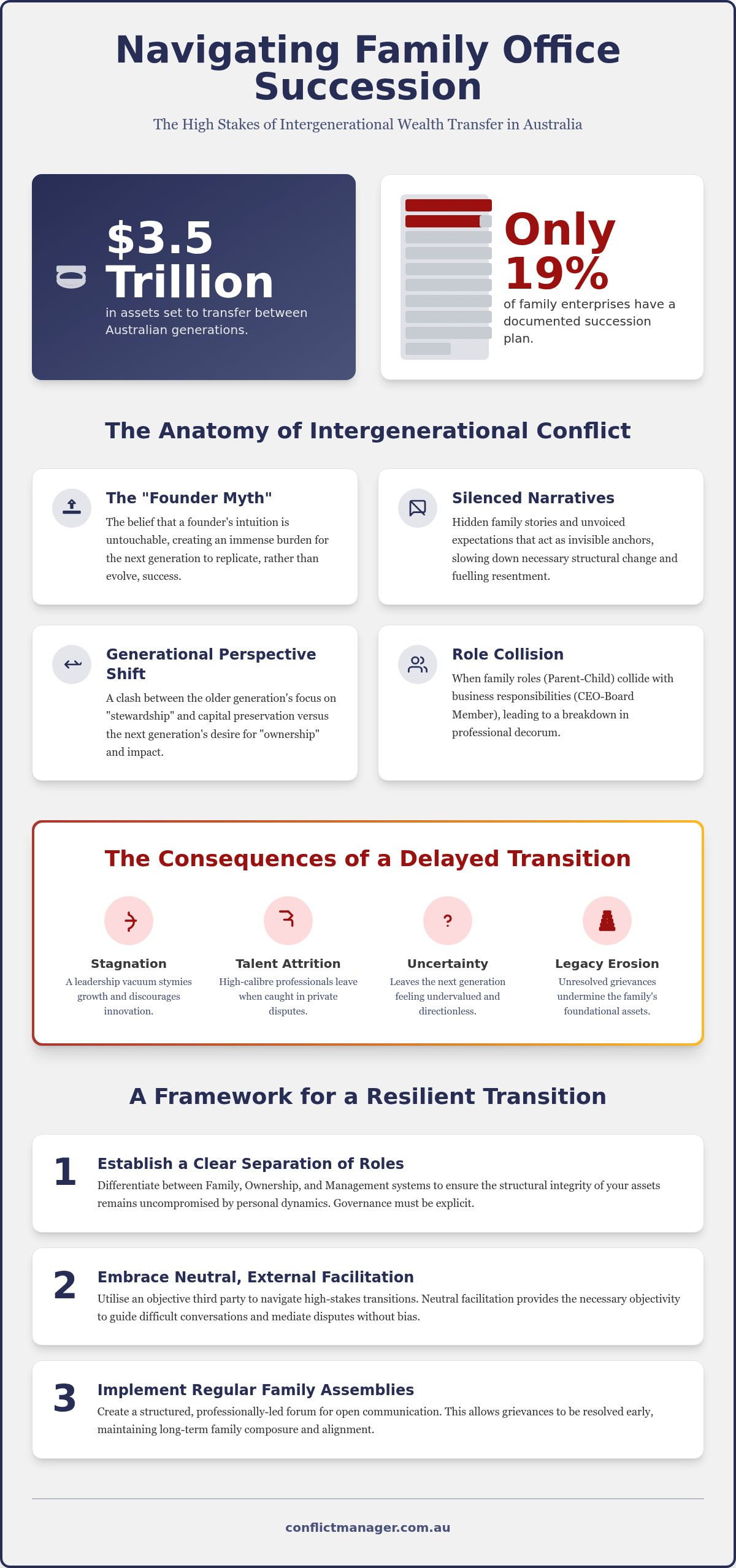
With $3.5 trillion in assets set to transfer between Australian generations over the next two decades, it's sobering to realise that only 19% of family enterprises have a documented plan for the transition. This gap rarely stems from a lack of technical expertise. Identity. Ownership. Legacy. These are the themes that spark friction when a founder's vision meets the aspirations of the next generation. Succession planning conflict in family office environments is often less about the ledger and more about the unspoken fears of those at the centre of the change. You likely understand the heavy atmosphere that develops when the future of your assets feels tethered to unresolved internal disputes.
Control. Continuity. Authority. These pillars require a steady hand to remain upright during periods of significant change. You'll discover how to navigate the complex emotional and structural friction of intergenerational wealth transfer through expert-led conflict resolution. This guide provides a clear path to transition power while preserving the integrity of your family relationships. We'll explore the logic of neutral facilitation and the structural governance needed to ensure your assets remain stable long after the current leadership steps away.
Key Takeaways
- Recognise that succession planning conflict in family office structures is frequently a byproduct of structural change and deep-seated emotional friction rather than simple financial disagreement.
- Identify the "founder myth" and unspoken family narratives that create invisible barriers to a successful intergenerational transfer of authority.
- Evaluate the limitations of internal governance and learn why neutral, external facilitation provides the necessary objectivity to navigate high-stakes transitions.
- Establish a clear separation between family, ownership, and management roles to ensure the structural integrity of your assets remains uncompromised.
- Implement regular family assemblies led by a steady hand to resolve grievances early and maintain the long-term composure of the family unit.
The High Stakes of Succession in the Australian Family Office
Succession planning conflict in family office environments is rarely a simple matter of legal documentation or tax efficiency. It's the friction that arises when the transfer of authority, assets, and legacy meets the complex reality of human emotion. While these structures are designed to provide stability, they often become the epicentre of intense disputes. This happens because the office represents more than capital; it's the physical manifestation of a family's identity and history. When transitions stall, the result is legacy erosion. This is a slow decay where unspoken narratives and unresolved grievances begin to undermine the very foundation the founder built.
The Australian context adds specific layers of complexity to these transitions. With an estimated $3.5 trillion in assets set to change hands over the next two decades, the pressure on private structures is immense. Many Australian families operate through intricate discretionary trusts and private enterprises that require sophisticated Succession planning to navigate. Without a clear strategy, these structural strengths can become points of failure during an intergenerational shift.
Why Wealth Does Not Insulate Families from Friction
Assets. Expectations. Security. It's a common misconception that significant wealth provides a buffer against internal discord. In reality, the opposite is often true. Sizable assets frequently lead to higher defensive walls between stakeholders as the perceived cost of losing increases. As a family office professionalises, it's easy for family members to feel marginalised by the very systems meant to protect them. Succession conflict is a structural misalignment between family roles and business responsibilities.
The Consequences of Delayed Transition
Stagnation. Uncertainty. Attrition. When a founder is reluctant to relinquish control, they fall into the "Founder Trap." This creates a leadership vacuum that stymies the growth of the next generation and leaves them feeling undervalued. This friction doesn't stay within the family; it radiates outward. It impacts the office's ability to attract and retain high-calibre, non-family professional staff who may feel caught in the crossfire of private disputes. Eventually, private disagreement reaches a tipping point where it becomes a direct threat to asset integrity and long-term governance. Succession planning conflict in family office settings must be managed with a steady hand to prevent this breakdown of order.
Deciphering the Anatomy of Intergenerational Conflict
Understanding succession planning conflict in family office environments requires looking beneath the surface of the balance sheet. It's often driven by the "Founder Myth", a belief that the creator of the wealth possesses a unique, almost untouchable intuition. This myth creates an immense emotional burden for the succeeding generation, who feel they must replicate the founder's success rather than evolve it. Silenced narratives, those hidden family stories of past disappointments or unvoiced expectations, often dictate current decision-making in ways the board doesn't realise. These narratives act as invisible anchors, slowing down the movement toward necessary structural change.
There is a fundamental shift occurring from stewardship to ownership. While the older generation views themselves as keepers of a legacy, the next generation often seeks to assert their own agency. This transition is a significant source of generational transition risks. These risks manifest most clearly in varying risk appetites. A traditional focus on capital preservation and blue-chip stability often clashes with a modern desire for impact investing, ESG compliance, or emerging technologies. This is not just a difference in investment philosophy; it's a clash of worldviews that can paralyse a family office if left unaddressed.
The Psychological Register of the Family Office
Family dynamics don't simply disappear at the office door. Parent and child roles often collide with CEO and board member responsibilities, leading to a breakdown in professional decorum. It is rarely about the money; it is about the recognition of contribution and the validation of one's professional identity. Narrator bias, where one dominant voice shapes the office culture, can leave other family members feeling invisible. This lack of visibility is a primary driver of succession planning conflict in family office settings, as it breeds resentment that eventually spills into commercial decisions.
Common Triggers for Succession Disputes
One of the most frequent triggers is the divide between active and passive family members. Those working daily in the office often feel their sweat equity entitles them to more influence, while passive members view equity as an equal birthright. This tension is exacerbated when the office lacks a clear policy on compensation versus dividends. The introduction of in-laws and external spouses further complicates the governance circle. These new participants often bring fresh perspectives that the original family unit isn't prepared to integrate, leading to defensive posturing and further friction. Fairness is a subjective concept that requires objective facilitation to define. Engaging in professional stakeholder facilitation can help align these differing perspectives before they fracture the family unit and threaten the integrity of the estate.
Internal Governance vs. External Mediation: A Strategic Comparison
Internal governance structures, while essential for day-to-day operations, often prove insufficient when the weight of intergenerational transition begins to press against the family unit. Many organisations rely on a robust framework, governance and succession planning to provide a roadmap; yet these documents are static. They cannot account for the volatility of human emotion. When succession planning conflict in family office settings reaches a boiling point, the internal board, composed of individuals with shared histories and ingrained biases, rarely possesses the objectivity required to facilitate a resolution.
Legal representation, while necessary for the finalisation of contracts, often serves to escalate friction during the negotiation phase. The adversarial nature of the legal system tends to pit family members against one another as competing interests rather than as stakeholders in a shared legacy. This approach focuses on technical compliance and rights. It frequently ignores the structural misalignment and emotional grievances that are the true drivers of the impasse. Professional mediation, by contrast, creates a safe harbour for these difficult conversations to occur without the threat of litigation hanging over the table.
The Limits of the Family Charter
A written document is a tool for order, not a cure for discord. It's possible to achieve compliance without securing commitment. Internal efforts often struggle because stakeholders find it impossible to separate their personal history from the current commercial problem. A family charter might dictate the rules of engagement, but it cannot force a genuine belief in the collective vision when trust has been eroded. Without that commitment, any resolution reached internally is likely to be temporary and fragile.
The Value of the Neutral Third Party
Clarity. Objectivity. Composure. These are the qualities a neutral third party brings to a volatile environment. Unlike an insider, an external mediator possesses the objective discernment to see the structural integrity of a dispute without becoming entangled in it. They act as a steady hand, lowering the pulse of the room and ensuring that every voice is heard without being overshadowed by the "founder myth" or dominant personalities. This professional facilitation leads to sustainable outcomes because the agreements are built on mutual understanding rather than forced concession. It moves the family from a state of reactive friction toward a vision of structured resolution that protects both the assets and the relationships involved.
Building a Conflict-Resilient Succession Framework
Structure. Clarity. Alignment. These are the foundations of a resilient family office. To mitigate succession planning conflict in family office environments, one must move beyond the informal handshake and into a formalised framework that survives the weight of transition. This begins with an absolute separation between family ties, ownership rights, and management responsibilities. When these roles are blurred, the emotional logic of the family often overrides the commercial logic of the office, leading to structural instability. Regular, facilitated "Family Assemblies" act as a vital pressure valve, allowing stakeholders to address grievances in a controlled environment before they calcify into destructive disputes.
Succession is not a takeover; it is an evolution. Removing the corrosive perception of favouritism requires the implementation of objective benchmarks for next-gen leadership. These metrics ensure that authority is earned through merit rather than birthright, which protects the long-term integrity of the assets. Equally vital is the formalisation of the founder's exit strategy. This plan must ensure the founder feels their life's work is honoured, providing them with a dignified path toward a new chapter without the fear that their legacy is being erased by those who follow.
Step 1: Auditing the Family Narrative
Every family office operates under a set of unspoken rules that govern how decisions are made and how friction is handled. Auditing this narrative involves identifying these hidden patterns and encouraging a cross-generational dialogue that aligns the founder's vision with future realities. Objective listening is the essential catalyst for a successful audit, as it allows for the discovery of truth without the distortion of personal bias. This process ensures that the "way we've always done things" doesn't become a barrier to necessary growth.
Step 2: Designing Bespoke Governance
Off-the-shelf templates rarely survive the friction of a high-stakes transition. Governance is not about control; it is about providing the clarity required for freedom of action. Bespoke structures should reflect the family's specific values and the unique nature of their Australian asset holdings, such as complex trust arrangements. Integrating conflict management protocols directly into the operating model ensures that disputes are viewed as natural byproducts of change rather than failures of leadership. This proactive approach prevents succession planning conflict in family office settings from escalating into public or legal battles.
Step 3: Ongoing Facilitation
Transition is a marathon, not a sprint. Succession planning is a slow, deliberate process that requires periodic "health checks" with an external mediator to maintain stability. These check-ins allow the family to adjust their course as new challenges arise, ensuring that the legacy remains intact and the relationships stay healthy. If you're ready to secure your family's future, you can learn how to manage conflict in a family office structure by engaging a neutral third party to guide your governance journey.
Restoring Composure: The Role of Neutral Third-Party Facilitation
Professional mediation represents the logical conclusion for families who recognise that their legacy is too valuable to be left to the volatility of internal disputes. Succession planning conflict in family office environments often reaches a point where internal stakeholders can no longer see the path forward through the fog of shared history. A neutral third party provides the objective perspective required to separate emotional grievances from structural requirements. This is not merely about reaching an agreement. It is about restoring the composure of the family unit so that the office can function with renewed purpose.
Conflict Manager approaches these delicate transitions with a steady, objective, and empathetic voice. We understand that the centre of the storm is a difficult place to be. By acting as a neutral anchor, we help families navigate the complexities of power and wealth without becoming emotionally entangled ourselves. One of the primary objections we encounter is the concern regarding privacy. For high-net-worth individuals, the bespoke nature of our facilitation ensures that all discussions remain strictly confidential. This is a private, professional intervention designed to protect the integrity of the estate and the family name from the risks of public exposure.
Achieving Clarity and Stability
External intervention provides the order needed during periods of high organisational stress. When a seasoned professional who remains unruffled by high-stakes environments enters the room, the collective pulse begins to lower. This sense of order is essential for moving from a state of friction toward a state of flow. Stability. Composure. Continuity. These are the outcomes of a structured resolution process. By focusing on the structural integrity of the transition, we ensure that the family office remains a vehicle for legacy rather than a source of persistent stress.
The Path Forward with Conflict Manager
Engaging a neutral third-party mediator does not need to cause alarm among staff or family members. It is a proactive step that signals a commitment to the long-term health of the organisation. It is far more effective to address succession planning conflict in family office settings before a dispute reaches the legal system, where control is often lost and costs escalate. Moving from a state of disruption toward a vision of structured resolution requires a willingness to invite an objective hand to guide the process. If you are ready to secure your family's future and preserve the legacy you have built, we invite you to enquire about our Family Office Mediation services today.
Securing the Future of the Family Legacy
The preservation of intergenerational wealth requires more than legal frameworks; it demands the structural clarity and emotional composure that only objective facilitation can provide. We've explored how the "founder myth" and unspoken family narratives often become the primary drivers of succession planning conflict in family office environments. By separating family roles from management responsibilities and engaging a neutral third party, you can move from a state of reactive friction toward a sustainable, structured resolution.
Order. Continuity. Stability. These are the markers of a successful transition. Professional mediation for high-net-worth families ensures that sizable assets remain protected while family relationships are preserved. You don't have to navigate these high-stakes transitions alone. Contact Conflict Manager for expert-led family office mediation to bring a steady hand to your organisation's most critical transition. With specialised dispute management and a commitment to asset integrity, we help you secure a legacy that outlasts the current generation.
Frequently Asked Questions
What are the most common causes of succession planning conflict in family offices?
Conflict typically arises from a structural misalignment between family roles and business responsibilities. Common triggers include the active versus passive divide where family members working in the office feel their sweat equity deserves more influence than those who are purely beneficiaries. Additionally, the founder myth often creates an emotional burden for successors. These deep-seated issues require professional management to prevent legacy erosion and ensure the structural integrity of the family assets.
How can we resolve a family dispute without going to court?
Resolving disputes outside the legal system is achieved through expert-led mediation and stakeholder facilitation. This process creates a safe harbour for difficult conversations that would otherwise escalate in a courtroom. By focusing on mutual commitment rather than adversarial compliance, families can reach sustainable agreements that protect both the ledger and the relationships. This approach maintains total confidentiality, which is essential for high-net-worth families who wish to keep private matters out of the public record.
Is it better to use a lawyer or a mediator for family office succession issues?
While lawyers are necessary for finalising contracts, a mediator is often better suited for resolving succession planning conflict in family office environments. Legal representation tends to focus on technical rights, which can inadvertently pit family members against each other. A mediator acts as a steady hand to address the emotional and structural friction that laws cannot reach. This ensures that the final legal documents reflect a genuine consensus rather than a forced settlement.
Can a family office survive a major intergenerational conflict?
Survival is possible if the family moves from a state of disruption toward structured resolution. Many offices have successfully navigated major friction by implementing conflict-resilient frameworks that separate ownership from management. The key is acting before the conflict results in the loss of non-family professional staff or the erosion of asset value. Professional intervention provides the objective discernment needed to restore order and establish sustainable governance that outlasts the current crisis.
What happens if the founder refuses to step down from the family office?
When a founder refuses to relinquish control, it creates a founder trap that stymies next-gen growth. This often leads to a leadership vacuum where the succeeding generation feels undervalued and ignored. Resolving this requires a formalised exit strategy that honours the founder's legacy without allowing their presence to paralyse the office's evolution. Neutral facilitation can help define new, meaningful roles for the founder that respect their history while allowing the office to modernise its operations.
How do we introduce an external mediator to a skeptical family member?
Introducing a mediator should be framed as a strategic move to protect the family's assets and legacy. Skepticism often arises from a fear of external judgment, so it's vital to emphasise that the mediator is a professional stakeholder facilitator. Positioning the intervention as a way to achieve structural stability and clarity helps reluctant members view the process as a high-level corporate necessity rather than a personal failing or an admission of weakness.
Why is neutral facilitation better than internal family council discussions?
Internal family councils often struggle because participants cannot separate their personal history from the current problem. Neutral facilitation brings total objectivity to a volatile situation, ensuring that dominant personalities don't overshadow quieter stakeholders. A mediator remains unruffled by high-stakes environments and can lower the pulse of the room. This allows for a logical progression of dialogue that internal efforts, clouded by years of narrator bias and emotional entanglement, simply cannot achieve.
How long does the mediation process typically take for complex family offices?
The timeline for resolving succession planning conflict in family office structures varies based on the complexity of the assets and the depth of the friction. It is rarely a single event. Typically, a thorough process involves an initial auditing phase followed by several months of structured facilitation and governance design. This slow, deliberate pace is necessary to ensure that the outcomes are sustainable and that all family members feel a genuine commitment to the new framework.


