

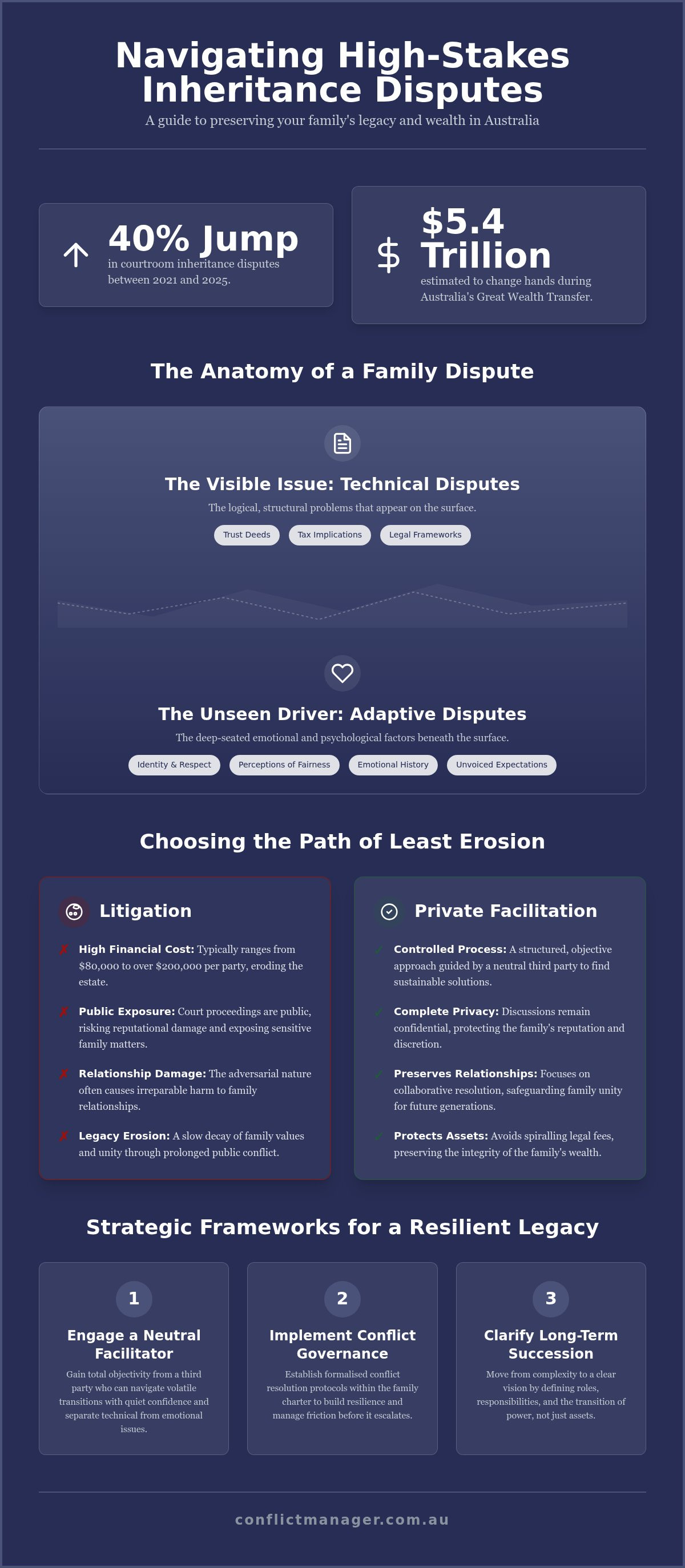
Courtroom disputes over inheritances across the country jumped by 40 per cent between 2021 and 2025. This surge highlights a difficult reality for many high-net-worth families facing a preserving family legacy dispute. You likely feel a profound weight of responsibility to protect what has been built over generations. It's natural to fear that public scandal or spiralling legal fees will erode the very foundation of your success. Order. Privacy. Continuity. These are the pillars of a lasting estate; they're often the first things to crumble when internal friction takes hold.
We understand that maintaining the structural integrity of a family business requires more than just legal documents. It demands a steady hand and total objectivity. This article explores how professional facilitation provides a path toward sustainable resolution without the destruction of litigation. You'll discover how to secure discretion, maintain asset integrity, and establish clear governance for future succession. By moving from a state of complexity toward a vision of structured resolution, you can ensure your family's story remains one of achievement rather than discord.
Key Takeaways
- Understand how the Great Wealth Transfer creates unique pressures that require a proactive approach to maintaining family unity and asset integrity.
- Learn to distinguish between technical disputes over trust deeds and the adaptive friction of identity and fairness that traditional advisers often struggle to address.
- Discover why private facilitation is the preferred method for preserving family legacy dispute outcomes while avoiding the public exposure of the Australian court system.
- Explore how to implement conflict governance frameworks that build resilience and clarity into your family's long-term succession planning.
- Gain insight into how a neutral third party provides the total objectivity needed to navigate volatile transitions with quiet confidence.
The Fragility of Legacy: Why Disputes Arise in Australian Family Offices
Vision. Control. Stability. These are the cornerstones of any enduring estate. A preserving family legacy dispute is rarely about the money alone; it's a fundamental misalignment of values, vision, or control within a multi-generational wealth structure. As Australia undergoes the "Great Wealth Transfer," where an estimated $5.4 trillion will change hands over the next 15 to 20 years, these misalignments are becoming more frequent. The sheer scale of this transition creates a unique set of pressures for families who have spent decades building their success.
Wealth creates a difficult paradox. It offers the security families crave while simultaneously introducing structural friction that can dismantle unity. Principals often experience "stewardship stress," a heavy emotional burden born from the responsibility of protecting the family's future. This pressure can cloud judgement and make objective decision-making nearly impossible when tensions rise. Without a neutral perspective, the weight of the past often stifles the potential of the future.
The Catalysts of Intergenerational Friction
Succession is a transition of power, not just a transfer of assets. Friction frequently arises when the founding generation's vision doesn't match the aspirations of "rising gen" stakeholders. Because the family firm is such a common model of economic organization, it's susceptible to the complexities of modern domestic life. Blended families, second marriages, and the interests of stepchildren create a web of competing priorities. If the family office lacks transparent governance, these issues simmer beneath the surface until they reach a breaking point.
The Cost of Unresolved Conflict
When disputes move into the legal arena, the financial erosion is immediate and severe. Research indicates that complex litigated matters involving business valuations in Australia can see costs range from $80,000 to over $200,000 per party. These fees eat into the multi-generational wealth that was meant to be protected for grandchildren and beyond. It's a high price to pay for a process that often leaves everyone dissatisfied.
There's also the significant danger of reputational damage. Unlike private facilitation, court proceedings are public, meaning sensitive family dynamics become part of the public record. Legacy erosion is the slow decay of family values through persistent, unaddressed friction. Without a steady hand to guide the family back to a state of order, the damage to relationships can be irreparable, leaving the business vulnerable and the family divided.
The Anatomy of a Dispute: Structural vs Emotional Friction
A family office is a sophisticated ecosystem. It's designed to protect capital, yet it often lacks the internal mechanisms to protect relationships. When a preserving family legacy dispute emerges, it usually presents as a technical disagreement over trust deeds, tax implications, or Australian legal frameworks. These are "Technical Disputes." They have clear rules and logical solutions. However, beneath these lies the "Adaptive Dispute," which involves identity, fairness, and deep-seated respect. Traditional professional advisers, such as accountants and lawyers, often struggle here. Their training focuses on the structural, not the psychological, leaving the emotional core of the conflict unaddressed.
This creates what we call the Iceberg Effect. The visible portion of the dispute is the financial figure or the asset in question. The submerged mass is decades of emotional history and unvoiced expectations. The dispute is rarely about the asset itself; it is about what the asset represents to each stakeholder. Understanding this distinction is vital for any family office seeking a return to stability. For those facing these complexities, engaging in professional stakeholder facilitation can provide the objectivity needed to separate the technical from the emotional.
Structural Weaknesses in Wealth Governance
Conflict thrives in ambiguity. In many Australian family offices, roles are poorly defined. A family member might simultaneously be an employee, a board member, and a beneficiary, leading to a confusion of interests. Often, the trust structures in place are outdated, failing to reflect the realities of a modern, blended family dynamic. Without a formalised conflict resolution protocol within the family charter, these structural gaps become fault lines during periods of transition.
The Emotional Register of HNW Conflict
High-net-worth conflict operates on a specific emotional register. A primary friction point is the tension between "fairness" and "equality" in asset distribution. This is often complicated by the Generational Shadow, Conflict, and Succession Planning, where the founder's influence makes it difficult for the next generation to establish authority. When sibling rivalries become institutionalised within the business structure, the friction is no longer just personal; it becomes a threat to the entire organisation's movement and integrity.
Mediation vs Litigation: Choosing the Path of Least Erosion
Discretion. Stability. Integrity. These are the values that usually define the creation of multi-generational wealth, yet they're the first to be compromised in a public courtroom. When a family office faces a preserving family legacy dispute, the choice of forum becomes the most critical decision for the estate's future. Litigation is, by its very nature, a public and adversarial process. In contrast, professional facilitation offers a private, controlled environment where the objective is resolution rather than victory. While courtrooms focus on narrow legal rights, mediation focuses on sustainable outcomes that protect both the balance sheet and the family bond.
The difference in efficiency is stark. Research shows that mediation has a high success rate in Australia, with 85 per cent of cases avoiding litigation. While a complex litigated matter can take years to reach a final hearing, a facilitated resolution is often achieved in a matter of days. This speed prevents the "attrition of spirit" that occurs when family members are locked in a cycle of legal correspondence and mounting costs. Choosing mediation is a strategic move to stop the erosion of both capital and character.
The Litigation Trap: Why Court is a Last Resort
Litigation forces family members into the rigid, hostile roles of "plaintiff" and "defendant." This structural friction often causes irreparable damage to intergenerational bonds that took decades to form. Handing the final decision to a judge means a total loss of control over the outcome. A judge must follow strict legal precedents and may ignore the nuanced family values or long-term business goals that built the legacy. This often leads to the "winner’s curse." You might win the legal battle and secure the assets, but you lose the family connection forever. In the high-stakes environment of a family office, a legal victory that destroys the family unit is, in reality, a profound failure.
The Mediation Advantage for Family Offices
Facilitation provides a shield of total confidentiality. Because the process happens behind closed doors, sensitive financial details, trust structures, and personal grievances never become part of the public record. This protects the family's reputation and prevents the "scandal premium" that often accompanies public legal battles. It also offers a level of flexibility that a court simply cannot provide. A judge can only order the division or payment of assets. A facilitator, however, can help a family craft bespoke solutions, such as reorganising board governance or drafting a new family charter. This empowerment allows the family to remain the architects of their own future, ensuring the resolution is as unique as the legacy it protects.
Strategic Frameworks for Preserving Family Legacy
Order. Governance. Resilience. These are not merely abstract concepts; they are the practical requirements for any family office seeking to endure across generations. To avoid a preserving family legacy dispute, one must move beyond reactive measures and adopt a framework of Conflict Governance. This involves proactively building resolution mechanisms into the very fabric of the family office operations. It shifts the focus from managing a crisis to maintaining a steady state of movement and growth.
A Family Charter serves as the constitutional foundation for this approach. It's a living document that defines the family’s shared values, their long-term vision, and, crucially, the protocols for resolving disagreements. When these rules are established during periods of calm, they provide a reliable map when tensions rise. Regular Family Assemblies further support this structure, providing a dedicated space for open communication before minor friction has the chance to crystallise into a formal dispute. A robust charter typically outlines:
- Defined family values and a shared mission statement.
- Clear criteria for family members entering the business.
- Formal protocols for resolving internal disagreements.
- Succession timelines and leadership transition plans.
Facilitating Difficult Conversations
Moving from debate to dialogue requires a specific set of skills that are often absent when emotions are high. Debate is about winning; dialogue is about understanding. Under the guidance of a neutral third party, stakeholders can explore divergent views without the conversation collapsing into hostility. This is particularly vital when Facilitating Difficult Conversations at the Leadership Level. Techniques for de-escalating high-emotion situations ensure that stakeholder meetings remain productive, focused on the future rather than litigating the past.
Building Structural Resilience
Structural integrity is maintained through the clear separation of decision-making forums. Family matters should be discussed in the family council, while business operations remain the province of the board. This prevents personal dynamics from clouding commercial judgement. Reviewing trust deeds through the lens of conflict management ensures that the legal structures actually support the family's desire for harmony. An external mediator is essential during these structural changes to provide the total objectivity required to balance competing interests fairly. Engaging specialised stakeholder facilitation provides the necessary distance to see the path forward clearly.
Restoring Stability: Professional Facilitation with Conflict Manager
Structure. Resolution. Continuity. These are the objectives that define our intervention. When a family office is entangled in a preserving family legacy dispute, the path forward often feels obscured by the friction of interpersonal history; Conflict Manager acts as a steady, objective hand, providing the distance necessary to view volatile situations with total clarity. As a neutral third party, we remain unruffled by high-stakes environments, allowing stakeholders to step back from the emotional fray and focus on the structural integrity of their estate.
Our focus is on sustainable outcomes. These aren't temporary truces but robust agreements designed to hold up under the pressure of time and future transitions. By introducing a sense of order during periods of organisational friction, we help families move from a state of disruption toward a vision of structured resolution. It's about ensuring that the movement of the family business is not stalled by internal conflict but rather strengthened by a shared understanding of governance and purpose.
Our Approach to Family Wealth Disputes
We bring a deep understanding of the complex human and structural dynamics unique to the Australian wealth landscape. Our process is methodical and logical, beginning with a clear acknowledgement of the current state of disruption. We then transition into an analytical explanation of why internal efforts might be struggling under pressure, before finally moving toward a tailored resolution strategy. This progression is designed to lower the pulse of the room and build trust through a logical sequence of steps. Our priority is always the long-term health of the family office and the absolute integrity of its assets.
Engagement and Next Steps
Every family dynamic is unique, and our engagement reflects this bespoke reality. The process begins with a confidential assessment where we listen to the concerns of all key stakeholders to understand the underlying friction. From this foundation, we develop a bespoke resolution roadmap that addresses both the technical and adaptive elements of the conflict. This roadmap provides the clarity on governance and succession that is often missing during times of stress. If you're ready to secure your family's future, contact Conflict Manager to discuss your family office resolution needs.
Moving From Friction to Functional Governance
Legacy isn't a static asset but a lived relationship that requires structural integrity to survive the friction of succession. Resolving a preserving family legacy dispute demands more than a legal ruling; it requires a deep understanding of the emotional history that often remains submerged beneath technical disagreements. By choosing professional facilitation, you secure total confidentiality and maintain the relationship integrity that courtrooms aren't designed to protect. This path allows for the creation of bespoke solutions that respect your family's unique history and future goals.
A sustainable future relies on moving from reactive crisis management toward proactive conflict governance. Conflict Manager provides expert-led facilitation for complex Australian family offices, focusing on sustainable outcomes that hold up under the pressure of time. Our objective, professional guidance helps you navigate volatile transitions with quiet confidence and total discretion. This methodical approach ensures that your assets remain intact while your family bonds are strengthened through clear communication and shared purpose.
Secure your family legacy with expert conflict resolution
Order can be restored even in the most high-stakes environments. With the right facilitation, your family's story will remain one of achievement and unity for generations to come.
Frequently Asked Questions
What is the primary difference between legal mediation and professional conflict facilitation?
Resolution. Movement. Integrity. The primary difference lies in the scope of the outcome. Legal mediation typically focuses on reaching a settlement of rights and obligations within a narrow legal framework. Professional conflict facilitation, however, addresses the adaptive friction and structural misalignments that cause the rift. It aims for a sustainable outcome that preserves the family's movement and integrity. This process looks beyond the immediate legal dispute to the broader health of the family office ecosystem.
How can a neutral third party help if our family has a long history of deep-seated conflict?
Objectivity. Distance. Clarity. A neutral third party provides the total objectivity required to view volatile situations without being entangled in family history. By acting as a steady hand, a facilitator can separate historical grievances from the practical requirements of current decision-making. This helps move the group from a state of disruption toward a structured resolution. The presence of an unruffled professional lowers the emotional pulse, allowing for a clearer focus on long-term objectives.
Is it possible to resolve a legacy dispute without going to court in Australia?
Yes, it's entirely possible to resolve a preserving family legacy dispute without involving the Australian court system. Private facilitation allows families to reach an agreement behind closed doors, ensuring that sensitive personal and financial details never become part of the public record. This method is often preferred by high-net-worth families because it offers greater flexibility and control. It avoids the adversarial nature of litigation, focusing instead on collaborative solutions that protect the estate.
How long does the family office mediation process typically take?
The duration of the process varies depending on the complexity of the family office structure. While litigation can consume several years, professional facilitation typically moves from assessment to resolution in a matter of weeks. The initial confidential assessment usually happens quickly, followed by a series of structured stakeholder meetings. This methodical pace is designed to build trust and ensure that the final roadmap is both comprehensive and sustainable for all generations involved.
Will our financial details remain confidential during the resolution process?
Confidentiality is a cornerstone of the professional facilitation process. Unlike court proceedings, which are public in Australia, private mediation ensures that your financial details and internal governance structures remain protected. This discretion is vital for high-net-worth families who wish to avoid reputational damage or public scandal. Every stakeholder involved in the facilitation process is typically bound by confidentiality agreements, providing a secure environment to discuss complex assets and sensitive family dynamics without external exposure.
Can professional mediation help with disputes involving family trusts and succession?
Professional mediation is highly effective for addressing disputes involving family trusts and succession planning. These technical structures often become the focus of a preserving family legacy dispute when they no longer reflect the family’s current reality. A facilitator helps stakeholders navigate the friction between legal deeds and emotional expectations. This process ensures that structural changes are made with the consent of all parties, leading to a more resilient framework that supports the long-term movement of the business.
What happens if one family member refuses to participate in the facilitation?
Facilitation is a voluntary process, but the refusal of one member doesn't necessarily halt progress. A professional facilitator can conduct individual stakeholder meetings to understand the source of the resistance. Often, a member refuses to participate because they feel unheard or fear a loss of control. By addressing these underlying concerns in a neutral environment, it's often possible to bring them back into the collective dialogue. The focus remains on finding a path that respects every stakeholder's perspective.
How do we know when it is time to engage an external conflict manager?
It's time to engage an external conflict manager when internal efforts to resolve friction have stalled or are causing further division. Common triggers include an upcoming intergenerational wealth transfer, a significant change in leadership, or the emergence of blended family complexities. If the weight of responsibility is causing stewardship stress for principals, an objective third party can provide the necessary distance. Engaging a steady hand early prevents minor friction from escalating into destructive and costly litigation.


