

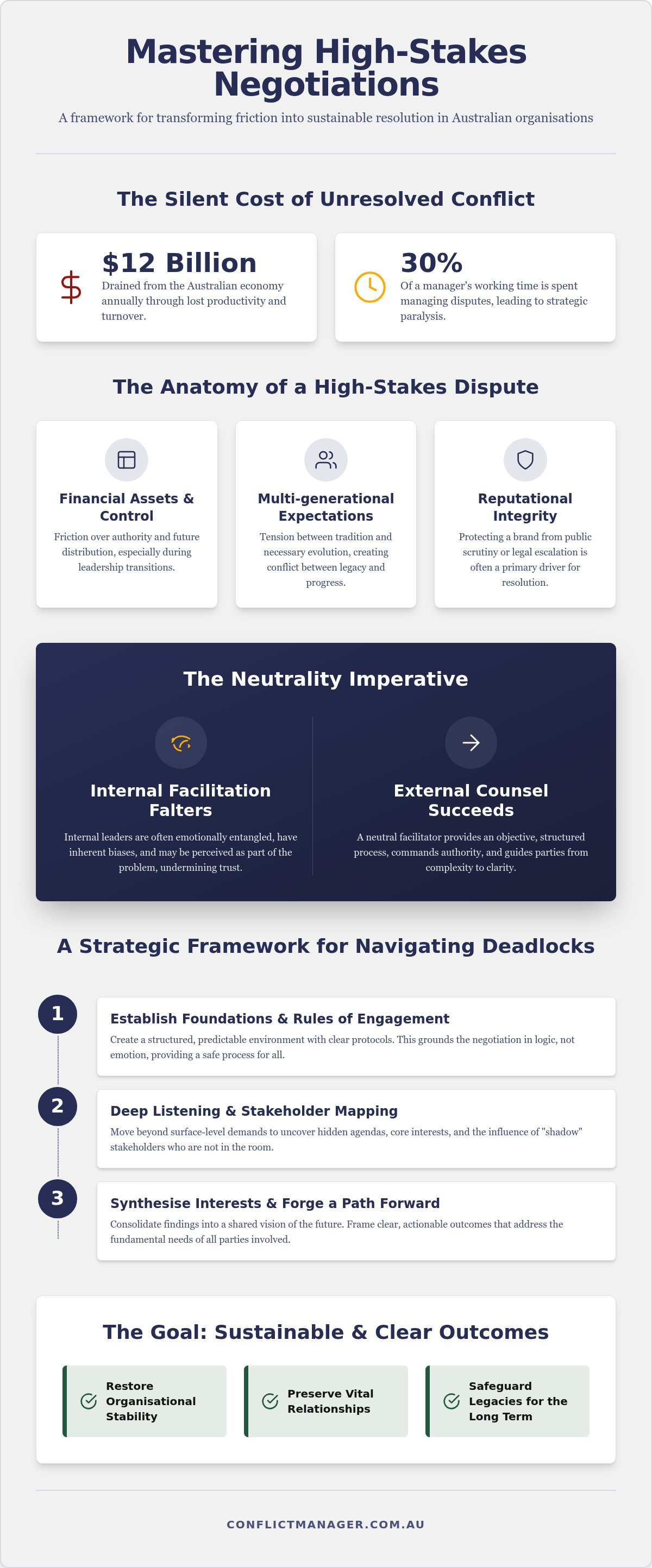
Deadlock. Friction. Fragility. In a high-stakes impasse, the loudest voice in the boardroom is rarely the one that secures a path forward. When interpersonal friction stalls strategic progress, the cost to the Australian economy can be staggering, with workplace conflict estimated to drain up to $12 billion annually through lost productivity and turnover. Successfully facilitating high-stakes stakeholder negotiations requires more than just a moderate touch; it demands a steady hand that remains unruffled when emotional stakes cloud objective decision-making. You likely understand how a single unresolved dispute can threaten an entire organisational legacy or lead to a public escalation that no one truly wants.
It's possible to transform this chaotic friction into a structured, sustainable resolution that preserves vital professional relationships. This guide provides a framework for mastering these complex dynamics through total neutrality, strategic mapping, and the exercise of composed authority. We'll explore how to restore organisational stability by moving stakeholders from a state of defensive complexity toward a vision of shared purpose and clear, actionable outcomes.
Key Takeaways
- Recognise the specific intersection of corporate governance and private wealth to protect reputational integrity during periods of structural change.
- Utilise stakeholder mapping to uncover hidden agendas and community expectations that often sit beneath surface-level demands.
- Learn why an external counsellor is often more effective at facilitating high-stakes stakeholder negotiations than internal leaders who may be emotionally entangled.
- Adopt a phased framework that establishes clear foundations and rules of engagement before moving to deep listening and the synthesis of core interests.
- Prioritise sustainable, clear outcomes that restore organisational stability and safeguard family legacies for the long term.
Defining the High-Stakes Landscape in Australian Organisations
Assets. Reputation. Legacy. These are the pillars of a high-stakes environment where traditional compromise often feels like a surrender. In the Australian context, these disputes frequently emerge at the intersection of corporate governance and private wealth management. When a family office or a large organisation undergoes structural change, the stakes aren't merely financial; they involve the preservation of decades of effort and the integrity of a brand name. Successfully facilitating high-stakes stakeholder negotiations requires a departure from standard tactical bargaining. It demands a shift toward strategic facilitation that prioritises long-term stability over temporary fixes.
Standard negotiation tactics often fail because they treat every dispute as a transaction. When emotions and legacy are at the centre of the table, a purely analytical approach can feel dismissive. It’s here that sophisticated business facilitation techniques become essential. They provide a framework that acknowledges the human element without becoming entangled in it. This method ensures that even when the emotional pulse of the room is high, the process remains grounded in logic and objective purpose.
The Anatomy of a High-Stakes Dispute
High-stakes disputes are rarely about a single issue. They are complex webs of divergent interests that require careful deconstruction to reveal the underlying structural friction.
- Financial Assets and Control: Sizable assets often lead to friction regarding authority and future distribution, especially during leadership transitions.
- Multi-generational Expectations: In family offices, the weight of the past can dictate the direction of the future, creating tension between tradition and necessary evolution.
- Reputational Integrity: Protecting a brand from external scrutiny or legal escalation is often a primary driver for seeking a composed, private resolution.
Managing these divergent interests across multiple stakeholder groups requires an authoritative presence that can command respect without being overbearing.
Friction vs. Conflict: Recognising the Turning Point
Not all disagreement is destructive. Healthy debate can drive innovation, but there is a clear turning point where friction becomes a liability. This often manifests as the "silent stall," a state where unresolved conflict quietly drains resources, momentum, and morale. While research indicates Australian managers spend approximately 30% of their working time managing disputes, the true cost is the strategic paralysis that occurs when stakeholders stop communicating in good faith. Facilitating high-stakes stakeholder negotiations is the essential bridge between this state of disruption and a return to structural order. This progression feels inevitable and calming, moving the parties from a state of defensive complexity toward a vision of structured resolution.
The Psychology of Engagement: Mapping Interests and Emotional Friction
Negotiation is rarely a linear exchange of facts. In high-stakes environments, it's a psychological landscape shaped by unstated fears, historical grievances, and the heavy weight of responsibility. Facilitating high-stakes stakeholder negotiations requires looking beyond the individuals at the table to the invisible forces driving their decisions. This involves a shift from viewing the dispute as a technical problem to understanding it as a complex human dynamic that demands both discernment and composure. When the emotional pulse of the room is high, the facilitator must act as the steady hand that brings order to the chaos.
Mapping the Web of Influence
Fear. Ambition. Duty. Every negotiation involves a hierarchy of influence that extends far beyond the boardroom. Primary stakeholders are those directly involved in the dialogue, yet their positions are often anchored by secondary or "shadow" stakeholders who never enter the room. These shadow figures might be family members, board mentors, or community leaders whose approval is non-negotiable. By visualising these power dynamics, you can identify the true leverage points for resolution. It's about tracing how external pressures, such as the need to protect a multi-generational legacy, shape a counterpart’s public stance. Understanding these layers allows for a more nuanced approach to Stakeholder Facilitation, ensuring that the final agreement satisfies those who hold the real veto power.
Navigating High-Emotion Business Disputes
Emotional friction is the primary cause of strategic paralysis. When the high-net-worth ego or the fear of public failure enters the room, logic often takes a back seat. Composed authority is the antidote to this volatility. By deliberately slowing the pace of conversation and maintaining a grounded, reassuring tone, a facilitator can lower the collective pulse of the group. This isn't about clinical psychotherapy; it's about professional de-escalation that validates concerns without compromising the objective path forward. Success often hinges on resolving multiple stakeholder interests by moving the dialogue from rigid positions to underlying core needs. While a position might be a demand for specific voting rights, the underlying interest is often a need for security or a fear of being sidelined. Once these core drivers are identified, the path toward a sustainable resolution becomes visible, allowing for a transition from disruption to order.
The Neutrality Imperative: Why Internal Facilitation Often Falters
Objectivity. Distance. Clarity. These are often the first casualties when a dispute becomes deeply personal. While an internal leader may possess profound institutional knowledge, that very knowledge often acts as a tether, preventing them from viewing the landscape with total impartiality. In the context of facilitating high-stakes stakeholder negotiations, neutrality isn't merely a state of mind; it's a structural requirement that ensures the process remains intact even when trust between parties has completely eroded. When an organisation or family office is in the midst of a volatile transition, the presence of a neutral third party provides a sense of order that internal efforts often lack.
The Limits of Internal Authority
Even the most well-intentioned CEO or family elder can fall into the "insider trap." This occurs when their previous decisions, alliances, or perceived biases make it impossible for them to be seen as a neutral arbiter. Stakeholders often view internal facilitation as a partisan exercise, suspecting that the outcome has been pre-determined to favour a specific faction. The burden of history also plays a significant role. Past grievances, whether they involve a failed project or a multi-generational family slight, cloud current efforts to reach a resolution. When the facilitator is part of the organisational chart, they're inherently entangled in the power dynamics they're trying to resolve. This entanglement makes it difficult to maintain the total objectivity required to navigate complex interpersonal friction.
The External Advantage: Composure and Discernment
An external counsellor brings a sense of grounded reassurance that internal members simply can't provide. They offer a fresh perspective capable of identifying the structural deadlocks that insiders might overlook, viewing the situation with a level of discernment unclouded by internal politics. This distance allows them to ask the difficult questions that others avoid to preserve a superficial sense of harmony. By addressing the core issues with composed authority, they create a safe and well-structured environment where stakeholders feel heard without feeling judged.
In both traditional and modern Australian business cultures, the "wise third party" acts as a stabilising force. This external presence provides the structural integrity needed to move from disruption to order. It lowers the pulse of the room, allowing for a methodical progression toward a sustainable resolution that preserves legacies and restores organisational stability. Ultimately, an external facilitator serves as the steady hand capable of viewing volatile situations with total objectivity, ensuring that the path forward is based on logic rather than legacy grievances.
A Strategic Framework for Navigating Complex Stakeholder Deadlocks
Resolution is not a matter of chance; it is the product of a methodical architecture. To move from a state of strategic paralysis to one of restored stability, a facilitator must deploy a disciplined progression. Successfully facilitating high-stakes stakeholder negotiations involves four distinct phases that guide parties through the friction of disagreement toward the logic of a shared future. This structure provides the necessary order when high-emotion disputes threaten to derail organisational progress.
- Phase 1: Clarity and Foundations. We begin by establishing the rules of engagement and shared objectives. This stage is about building the vessel that will hold the conversation and ensuring all parties understand the process.
- Phase 2: Deep Listening and Synthesis. We move beyond surface-level demands to uncover core needs. This requires a level of discernment that only a neutral third party can provide.
- Phase 3: Option Generation. During this phase, we develop sustainable outcomes that satisfy the primary interests of all parties. It is a transition from what is wrong to what is possible.
- Phase 4: Orchestration and Agreement. This is the methodical walk toward a vision of structured resolution. The final agreement is documented, verified, and ready for implementation.
Establishing the Foundational Mandate
Securing a mandate for the facilitation process itself is the first critical hurdle. Stakeholders must agree on the methodology before they can address the substance of the dispute. By defining what success looks like for the organisation or family office, we establish a common North Star. This ensures that everyone is working toward the same outcome, even if their starting positions are miles apart. A shared clarity of purpose acts as a potent sedative for high-stakes anxiety; it grounds the dialogue in objective goals rather than emotional reactivity. Without this foundation, the process risks collapsing under the weight of unstated expectations.
Moving from Complexity to Durable Decisions
The transition from a mass of conflicting information to a coherent path forward requires sharp synthesis. A facilitator must balance brevity with depth to maintain momentum. This is often referred to as the "em-dash approach," where short, punchy thematic foundations are followed by more complex, explanatory detail. This rhythmic variation in communication ensures that the process feels both efficient and thorough. Every decision must be structurally sound and well-supported to ensure it survives the test of time. When facilitating high-stakes stakeholder negotiations, the goal is to create a resolution that stakeholders can stand behind with total confidence. To ensure your organisation moves toward a vision of structured resolution, consider professional Organizational Conflict Management.
Securing Sustainable Outcomes with Conflict Manager
Integrity. Stability. Legacy. Conflict Manager operates as a specialised external counsellor for those navigating the most sensitive organisational transitions. We recognise that facilitating high-stakes stakeholder negotiations is not merely about reaching a compromise; it's about protecting the structural integrity of sizable assets and preserving the reputations of family offices and large scale enterprises. Our approach is defined by a sense of composed authority, providing a neutral centre when internal dynamics have become volatile or opaque. We understand the weight of responsibility that rests on your shoulders, and we provide the unruffled perspective necessary to move from friction toward a sustainable resolution.
Our focus extends beyond simple mediation to ensure long term stability for families and organisations across Australia. By prioritising asset integrity and legacy preservation, we help stakeholders move past immediate grievances to focus on the broader strategic horizon. This method ensures that the resolutions reached are not just temporary fixes, but are structurally sound agreements that can withstand future pressures and changes in leadership.
The Conflict Manager Philosophy
Grounded. Reassuring. Unruffled. Our methodology is built on a deep understanding of complex human and structural dynamics. We don't offer superficial agreements that fail at the first sign of renewed stress. Instead, we focus on organisational clarity and sustainable outcomes that allow for genuine stability. As a neutral third party, we view the landscape with total objectivity, acting as the steady hand capable of restoring order to disrupted systems. This commitment to neutrality ensures that every stakeholder feels heard, while the process remains firmly anchored in logic and professional discernment.
Next Steps: Restoring Stability
The journey toward resolution begins with a methodical assessment of the current landscape. We don't apply generic templates to unique disputes; we believe every high-stakes environment requires a bespoke strategy. Our process involves an initial consultation to understand the specific pressures, fears, and stakeholder interests at play. From there, we customise a facilitation approach that addresses the unique interpersonal and structural dynamics of your situation. This progression ensures that the path forward feels inevitable and calming, moving the reader from a state of complexity toward a vision of structured resolution.
If your organisation or family office is facing a complex deadlock that threatens strategic progress, Contact Conflict Manager to discuss your stakeholder facilitation needs. We provide the expertise required for facilitating high-stakes stakeholder negotiations with the discernment and quiet confidence your legacy deserves.
Restoring Order and Preserving Legacy
Order. Clarity. Legacy. The path from strategic paralysis to structural order requires more than just a moderate touch. It demands a framework of total neutrality and a disciplined, phased approach to resolution. By moving beyond surface demands to core interests, leaders can protect the integrity of sizable assets and ensure the long-term stability of their organisations. Successfully facilitating high-stakes stakeholder negotiations is an art of discernment; it requires a steady hand that remains unruffled when emotional friction threatens to cloud objective decision-making.
Conflict Manager provides national expertise in Australian family office mediation, focusing on sustainable and clear outcomes that transcend temporary fixes. Our seasoned professional approach to organisational friction ensures that your legacy remains intact even during periods of high stress or structural change. We bring clarity to clouded situations by acting as the neutral third party capable of viewing volatile landscapes with total objectivity. Secure a steady hand for your next high-stakes negotiation with Conflict Manager. Restoring stability is a methodical process. With the right guidance, a vision of structured resolution is always within reach.
Frequently Asked Questions
What defines a negotiation as "high-stakes" in an Australian corporate context?
A high-stakes negotiation is defined by its potential to impact significant assets, reputational integrity, or a multi-generational legacy. In the Australian corporate landscape, these disputes often involve complex interpersonal histories that threaten to derail strategic progress. With workplace conflict costing the national economy up to $12 billion annually, the stakes are both personal and structural. These situations require a level of discernment that transcends simple bargaining, focusing instead on the long-term stability of the organisation.
How does stakeholder facilitation differ from traditional legal mediation?
Stakeholder facilitation prioritises the preservation of professional relationships and structural order, whereas traditional legal mediation often focuses on a transactional settlement. Facilitation is a process-oriented approach that aims for a sustainable resolution rather than a one-off exit. It provides a grounded, reassuring framework for navigating complex transitions. This method allows parties to move beyond surface-level demands to address the underlying core needs that rigid legal frameworks might otherwise overlook during a dispute.
Can an external facilitator help if the stakeholders have a long history of conflict?
An external facilitator is specifically equipped to manage long-standing conflict by providing a sense of total objectivity. Internal leaders often find themselves caught in the insider trap, where past grievances make them appear partisan to other stakeholders. A neutral third party brings a fresh perspective and a composed authority that remains unruffled by historical friction. This distance allows for the deconstruction of complex webs of influence that have previously stalled progress for years.
What is the primary benefit of engaging a neutral third party for board disputes?
The primary benefit is the introduction of a steady hand that brings clarity to clouded board dynamics. A neutral party can ask the difficult questions that internal members avoid to preserve a superficial sense of harmony. When facilitating high-stakes stakeholder negotiations, this external presence ensures the process remains structurally sound. It allows the board to move from a state of defensive complexity toward a vision of shared purpose and clear organisational stability.
How long does a typical high-stakes stakeholder negotiation process take?
The duration of the process depends on the complexity of the interests involved and the number of stakeholder groups. While a single joint session might last a full day, the complete framework of assessment and orchestration usually takes several weeks. This methodical progression ensures that the final agreement is well-supported and durable. It avoids the pitfalls of artificial urgency, opting instead for a pace that builds trust through logical, sequential steps and thorough synthesis.
Is stakeholder facilitation confidential for private family offices?
Absolute confidentiality is a non-negotiable requirement for all stakeholder facilitation engagements, particularly within private family offices. The process is designed to protect multi-generational legacies and brand names from public or legal escalation. This safe environment allows stakeholders to express unstated fears and values without the risk of external scrutiny. By maintaining a private space, the facilitator can focus on resolving high-emotion disputes with total discretion and a deep sense of professional integrity.
What happens if stakeholders cannot reach a consensus during facilitation?
If consensus is not reached, the facilitator provides a clear synthesis of the remaining friction points and the underlying core interests. This objective assessment offers leadership a coherent path forward, even if a total agreement is not immediately possible. The focus remains on restoring order and identifying the structural requirements for future stability. It moves the organisation away from chaotic disruption and toward an analytical understanding of the strategic choices that must be made.
How do we prepare our leadership team for an external facilitation process?
Preparation involves securing a foundational mandate for the facilitation process among all participants. Leadership teams should focus on identifying their core interests and the unstated fears that may be driving their current positions. When facilitating high-stakes stakeholder negotiations, it is helpful to establish clear rules of engagement early. This preparation acts as a sedative for high-stakes anxiety, allowing the team to approach the dialogue with a sense of grounded reassurance and purpose.


