

What if the most significant risk to your organisation isn't a market shift, but the quiet, persistent friction within your own boardroom or family office? Friction. Erosion. Paralysis. These forces can dismantle a legacy faster than any external competitor, especially when public legal battles threaten to expose private vulnerabilities. You've likely recognised the weight of these tensions and the exhaustion that comes from trying to manage them internally. Understanding the long-term benefits of professional mediation is the first step toward reclaiming order. It's about more than just ending a fight; it's about building a framework for sustainable peace that protects your assets and your name for the next generation.
In this analysis, we'll discover how professional mediation acts as a strategic investment in your future governance. We'll look at the 2025 reforms to the Family Law Amendment Act and how higher standards for financial disclosure make early, private resolution more critical than ever. You'll learn how to move from reactive crisis management toward a model of proactive stability. This approach ensures that transitions of power and wealth don't become points of failure, but rather opportunities for renewed clarity and structural strength.
Key Takeaways
- Move beyond temporary truces toward sustainable peace by addressing the underlying human friction that threatens organisational stability.
- Discover the long-term benefits of professional mediation for high-net-worth families, focusing on the preservation of intergenerational wealth and relational clarity.
- Secure board-level integrity during significant structural changes, such as mergers or leadership restructures, through expert-led stakeholder facilitation.
- Recognise the value of a composed, objective third party in navigating high-emotion scenarios while avoiding the reputational risks of public legal battles.
- Establish robust governance frameworks that ensure future transitions are managed with order and quiet confidence rather than conflict.
The Enduring Value of Mediation Beyond Immediate Resolution
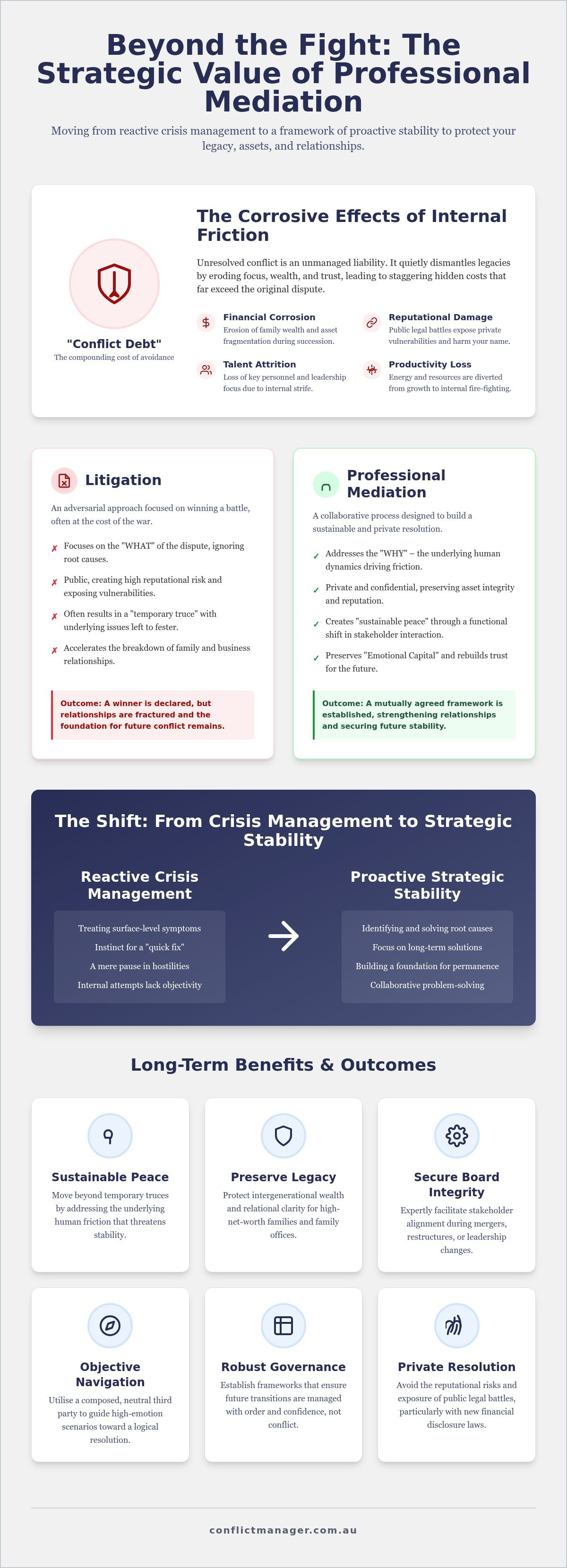
Professional mediation serves as a sophisticated mechanism for maintaining structural integrity within complex systems. While many view it as a final resort before court, its true power lies in its capacity to function as a strategic tool for long-term stability. To understand what is mediation in a professional context, one must move beyond the idea of a simple meeting. It's a structured intervention designed to dismantle "conflict debt." This debt is the accumulated interest on unresolved friction; it's the cost of avoidance that eventually bankrupts relationships and boardrooms alike.
Unlike litigation, which often results in a temporary truce where parties remain adversarial, the long-term benefits of professional mediation centre on creating sustainable peace. Litigation focuses on the "what" of a dispute, often leaving the "why" to fester. Mediation addresses the underlying human dynamics. This ensures that the resolution isn't just a signed document, but a functional shift in how stakeholders interact. External facilitation becomes necessary because internal attempts at resolution often lack the required objectivity. A steady, neutral hand can view volatile situations without becoming entangled in the history that created them.
Shifting from Crisis Management to Strategic Stability
Mediation identifies root causes. It doesn't just treat surface-level symptoms. When a leadership team or family office is in crisis, the instinct is often to find a quick fix. However, a quick settlement without structural change is merely a pause in hostilities. Professional mediation facilitates a psychological shift. It moves participants from adversarial thinking toward collaborative problem-solving. This transition is vital for preventing the recurrence of disputes. By teaching stakeholders how to navigate friction constructively, mediation builds a foundation for permanent stability.
The Cost of Unresolved Friction on Asset Integrity
Internal disputes are not just emotionally taxing. They are financially corrosive. When friction is left unaddressed, it erodes family wealth and organisational focus. The hidden costs are staggering. Lost productivity, talent attrition, and reputational damage can be far more expensive than the dispute itself. In high-stakes environments, the preservation of asset integrity depends on the ability to resolve conflict before it reaches a public forum. One must remember: "Unresolved conflict is an unmanaged liability that compounds over generations." Recognising the long-term benefits of professional mediation allows leaders to secure their legacy and ensure that future transitions are marked by order rather than upheaval.
Preserving the Family Legacy and Intergenerational Harmony
Legacy. Identity. Wealth. In the high-stakes environment of a family office, these elements are often inseparable. When personal grievances bleed into commercial decisions, the risk to the family's structural integrity is immense. The long-term benefits of professional mediation extend far beyond the immediate resolution of a specific disagreement. It's about the preservation of "Emotional Capital", which is the intangible trust and shared history that allow a family to function as a cohesive unit. Without this capital, even the most substantial financial portfolio begins to fragment under the weight of internal friction.
Conflict Manager acts as the steady hand during these high-emotion transitions. We provide a space where stakeholders can address the "why" behind the friction without the fear of permanent relational damage. This objective approach is essential because internal efforts often fail when years of subtext and unspoken expectations cloud the current reality. Moving from a state of disruption toward a vision of structured resolution requires a neutral perspective that family members simply cannot provide for themselves.
Protecting Sizable Assets through Relational Clarity
Asset fragmentation is a primary risk during succession. When siblings or cousins disagree on the future of a family enterprise, the instinct can be to seek legal redress. However, the adversarial nature of the legal system often accelerates the breakdown of the family unit. By choosing mediation in Australia, families can address complex inheritance disputes in total privacy. This avoids the reputational damage associated with public court battles, which is one of the key long-term benefits of professional mediation. A neutral third party facilitates clarity, ensuring that the distribution of assets is handled with logic rather than resentment. This clarity prevents the "splitting" of assets that often occurs when litigation forces a liquidating event to satisfy a court order.
Establishing Governance Frameworks for Future Successions
Succession planning is not a single event; it is a continuous process of transition. Professional mediation often results in the creation of robust family constitutions. These documents establish clear governance rules for how future disputes will be managed. By involving the next generation in these discussions, families provide them with a masterclass in conflict resolution. This is a legacy benefit that outlasts any financial inheritance. It provides the "quiet confidence" that comes from having a structured, agreed-upon path forward. When the rules of engagement are clear, the friction of transition is greatly reduced. For those looking to secure their family's future, engaging in family conflict resolution offers a methodical way to build these essential frameworks.
Structural Integrity in Organisations Undergoing Change
Change is a constant. Yet, its execution often falters at the human level. During a merger or a significant leadership restructure, the structural integrity of an organisation is tested. Friction at the executive level doesn't just stay in the boardroom; it cascades down, creating an anxious workforce. One of the long-term benefits of professional mediation is the "Stabilisation Effect" it provides. By introducing a neutral party, an organisation signals that it's committed to a methodical, objective resolution rather than a reactive power struggle. This presence alone can lower the collective pulse of the company, allowing teams to focus on operations while the leadership works through the friction.
Managing High-Emotion Business Disputes with Composure
Boardrooms are high-pressure environments where ego and strategy often collide. When leadership is paralysed by deadlock, the entire business risks losing its competitive edge. A mediator acts as a "steady hand," viewing volatile situations with total objectivity. This is essential for strategic mediation, where the goal isn't just to end a fight but to ensure business continuity. De-escalating these disputes privately prevents them from becoming public liabilities that could damage shareholder confidence or brand reputation. Stakeholder facilitation ensures that every voice is heard without the conversation devolving into a zero-sum game. It preserves the professional relationships necessary for the company to thrive once the transition is complete.
Sustainable Outcomes vs Temporary Truces
Many internal efforts result in a "temporary truce." This is a fragile agreement that collapses under the first sign of new pressure. In contrast, mediation seeks sustainable outcomes. These are flexible and creative solutions that the rigid nature of a court order cannot provide. In a corporate context, sustainability means the agreement holds even as the market or leadership changes. "A sustainable outcome is one where the logic of the agreement survives the heat of the initial dispute." This is why organisations increasingly recognise the long-term benefits of professional mediation as a form of proactive governance. It moves the organisation from a state of disruption toward a vision of structured, lasting resolution. By addressing the root causes of the friction, the business builds a framework that can withstand future challenges.
The Professional Mediator as a Neutral Stabilising Force
Authority. Neutrality. Clarity. These are the hallmarks of a seasoned practitioner. A professional mediator is more than a facilitator; they are a neutral stabilising force capable of viewing volatile situations with total objectivity. While internal HR teams or family members often try to resolve friction themselves, they frequently find themselves too entangled. They possess history, biases, or personal stakes that cloud their discernment. This lack of distance makes it nearly impossible to navigate the friction without becoming part of it. A high-level mediator brings "Composed Authority" to the table, providing a steady hand that remains unruffled by high-stakes environments.
Navigating Complex Power Dynamics without Entanglement
Power. Leverage. Subtext. In any dispute, these forces are constantly shifting. A mediator balances these dynamics, ensuring that a single dominant voice doesn't dictate the outcome. They create a "Safe Space" where difficult truths can be spoken without the risk of immediate retaliation. One of the long-term benefits of professional mediation is the absolute confidentiality it provides. In the Australian context, this privacy is a strategic shield. It protects high-net-worth families and organisations from the reputational damage inherent in public litigation. By keeping the resolution process private, stakeholders can explore creative solutions that would be impossible in a courtroom.
When to Engage External Facilitation for Maximum Impact
Recognising when internal efforts have reached their limit is a mark of leadership, not a failure. Engaging a mediator before a crisis reaches a breaking point ensures that the resolution process is proactive rather than reactive. It's about movement. It's about structural integrity. It's about the navigation of difficult transitions. Consider these early warning signs that your current approach may be failing:
- Decision-making has stalled due to persistent board-level disagreement.
- Productivity is declining as energy is diverted into internal politics.
- Key stakeholders are avoiding direct communication or relying on intermediaries.
- Past grievances are consistently overshadowing current strategic goals.
By addressing these signs early, you secure the long-term benefits of professional mediation before structural damage becomes permanent. It allows for a methodical transition from a state of disruption toward a vision of resolution. If your board or family office is experiencing these pressures, seeking expert organisational conflict management can provide the steady hand needed to restore order and protect your legacy.
Securing the Future with Conflict Manager
Conflict Manager provides the steady hand required to navigate the most intricate and high-stakes disputes. Our commitment to asset integrity and long-term relational health is the foundation of every intervention. We understand that for high-net-worth individuals and complex organisations, a dispute is never an isolated event. It's a weight on the legacy that threatens to erode years of effort. The long-term benefits of professional mediation are only fully realised when the resolution respects the history of the stakeholders while providing a clear, functional path forward. Our role is to act as the wise, external counsellor who remains unruffled by the heat of the boardroom or the family office.
Bespoke Resolution Strategies for Australian Stakeholders
We provide national coverage, bringing a sophisticated understanding of the Australian regulatory landscape to every case. Our approach is entirely bespoke. We integrate the complexities of family trusts and corporate structures directly into our resolution frameworks. This ensures that any agreement reached isn't just a temporary fix; it's a durable structure that protects the family’s wealth and the organisation’s focus. The service is premium, discreet, and highly professional. We recognise that for our clients, the preservation of reputation is as critical as the preservation of capital. By focusing on sustainable outcomes, we help you navigate difficult transitions with discernment and quiet confidence.
Moving from Complexity toward Structured Clarity
The process of engagement begins with a calming, methodical transition. We move stakeholders from a state of complexity toward a vision of structured resolution. Even the most volatile situations can find order when managed with total objectivity and a deep understanding of human and structural dynamics. Our rhythm is slow and deliberate. It's designed to lower the pulse of the situation and build trust through a logical, inevitable sequence of steps. By choosing to resolve friction through expert facilitation, you're securing the long-term benefits of professional mediation for future generations. It's a move toward permanent stability and the preservation of your organisational integrity.
Transition is a necessity. However, the friction that often accompanies it can be managed. Choosing an authoritative expert to guide you through these moments is a strategic investment in your future peace. We invite you to enquire about professional mediation with Conflict Manager to move your organisation or family toward a state of lasting, structured clarity.
A Strategic Path Toward Lasting Stability
Legacy. Stability. Order. These are the outcomes of a methodical approach to conflict resolution. By addressing the underlying human friction that erodes assets and boardrooms, you move beyond a state of disruption toward a vision of structured resolution. The long-term benefits of professional mediation are found in the sustainable peace that follows a well-facilitated transition, ensuring that your family office or organisation remains resilient against future pressures.
Conflict Manager brings seasoned expertise to high-emotion family wealth disputes, offering a composed, professional approach that provides national Australian coverage. Our focus remains on asset integrity, sustainable outcomes, and the structural strength of your governance frameworks. It's time to replace uncertainty with the quiet confidence of a clear path forward. Secure your legacy with professional mediation through Conflict Manager. You have the power to transform friction into a foundation for lasting, intergenerational success.
Frequently Asked Questions
What are the long-term benefits of professional mediation for family businesses?
One of the primary long-term benefits of professional mediation for family businesses is the establishment of clear governance structures that separate personal emotions from commercial decisions. This process prevents the "conflict debt" that often leads to the dissolution of multigenerational enterprises. By addressing root causes early, families can create constitutions that guide future leadership transitions with order and quiet confidence. This ensures the business remains resilient against internal friction as it passes between generations.
How does mediation protect family wealth and assets over several generations?
Mediation protects family wealth by avoiding the corrosive costs and public exposure of the Australian legal system. Litigation often forces the liquidation of assets to satisfy court orders or legal fees, whereas mediation allows for creative, flexible solutions that keep the portfolio intact. This strategic approach ensures that asset integrity is maintained. It allows wealth to compound over generations without being eroded by the friction and expense of unresolved inheritance disputes.
Can professional mediation help with organisational restructuring conflict?
Professional mediation is highly effective during organisational restructuring, such as mergers or leadership changes, as it provides a "Stabilisation Effect" for the entire workforce. By introducing a neutral third party to facilitate boardroom discussions, an organisation can resolve deadlock without damaging professional relationships. This ensures business continuity. It also prevents the loss of key talent that often occurs when leadership friction remains unaddressed during periods of significant structural change.
Is mediation as legally binding as a court order in Australia?
An agreement reached in mediation is not automatically as binding as a court order, but it provides the foundation for one. To become legally enforceable, the mediated agreement must be formalised by lawyers and approved by a court, typically as a "Consent Order." This process gives the agreement the same weight as a judicial decision while allowing the parties to retain control over the specific terms and outcomes of their resolution.
How long does the long-term impact of a mediated agreement typically last?
The long-term impact of a mediated agreement can last for decades because it focuses on sustainable outcomes rather than temporary truces. Because the parties themselves design the resolution, they have a higher psychological commitment to its success. When combined with a robust governance framework or family constitution, these agreements provide a permanent logic that survives market shifts and leadership transitions. They protect the structural integrity of the organisation indefinitely.
What happens if the mediation process doesn’t result in an immediate agreement?
If an immediate agreement isn't reached, the process still provides significant value by narrowing the issues and clarifying the underlying friction. It often serves as a necessary de-escalation phase that prepares stakeholders for a future resolution. Even without a signed document, the movement from high-emotion chaos toward a structured dialogue reduces the pulse of the conflict. This makes it much easier to manage the situation through continued stakeholder facilitation.
Why should a family office choose an external mediator over an internal advisor?
Internal advisors are often too entangled in the family's history and power dynamics to remain truly objective. An external mediator brings a steady hand and total neutrality, allowing them to view volatile situations without bias or personal stake. This distance is essential for identifying the root causes of friction that internal staff may be too close to see. It ensures that the resolution is based on logic rather than existing allegiances.
Is professional mediation confidential for high-profile business owners?
Professional mediation is a strictly private and confidential process, making it the preferred choice for high-profile business owners. Unlike the public court system, where sensitive financial and personal details can become a matter of record, mediation occurs behind closed doors. This privacy is one of the key long-term benefits of professional mediation, as it prevents reputational damage and ensures that internal disputes don't become a liability for the brand or the family name.


