

The most aggressive legal strategy often yields the most fragile results. While the instinct to protect your interests through litigation is understandable, the adversarial nature of the courtroom frequently dismantles the very legacy you are trying to defend. Friction. Uncertainty. Erosion. These are the inevitable byproducts of a system built on binary outcomes rather than human complexity. Choosing conflict resolution instead of lawyers offers a more sophisticated path toward long-term stability, especially when you've felt the mounting pressure of escalating legal fees and the quiet, corrosive anxiety that follows when a private matter enters the public record. It's exhausting to watch relationships fracture under the weight of a process designed to produce a winner and a loser rather than a genuine solution.
This article explains how professional mediation and facilitation can resolve even the most complex disputes while preserving your assets, your reputation, and your peace of mind. We will explore how shifting from a litigious mindset to a collaborative one creates sustainable agreements that all parties can actually live with. By prioritising discretion and structural integrity, you can ensure your business remains stable and your family bonds stay intact through a faster, more measured process. You'll discover that a steady, objective hand can bring clarity to clouded situations, allowing you to move from disruption toward a vision of structured resolution.
Key Takeaways
- Understand the true financial and emotional attrition caused by traditional litigation and how it can erode the very assets you aim to protect.
- Discover why choosing conflict resolution instead of lawyers often provides a more discreet and faster path to settlement for complex family or business matters.
- Learn how strategic facilitation preserves the structural integrity of your family legacy or business stability by prioritising relationship health.
- Gain insight into the role of a neutral third party in lowering the pulse of volatile situations and restoring order to organisational friction.
- Identify the specific criteria for assessing whether your dispute requires the steady hand of an expert mediator to achieve a sustainable, long-term agreement.
The Hidden Costs of Legal Adversarialism in Australia
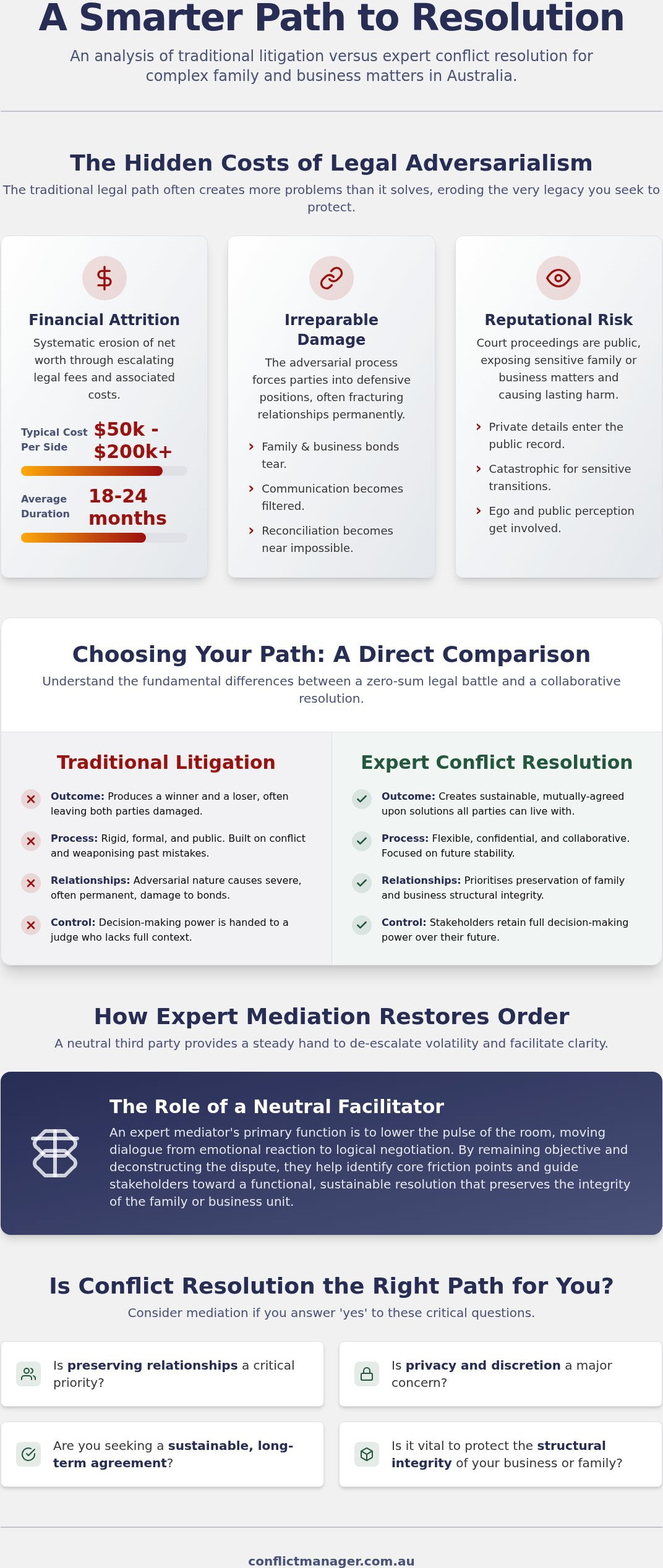
The Australian legal system is designed for finality, but finality is not the same as resolution. When disputes arise within family offices or corporate boards, the instinct is to seek legal counsel immediately. This path is well-trodden. It feels safe. However, the decision to pursue litigation often triggers a sequence of events that can be difficult to reverse. Choosing conflict resolution instead of lawyers allows stakeholders to step back from the brink of a zero-sum battle. In court, there is a winner and a loser. In reality, the costs associated with that victory often leave the winner in a position far worse than where they started. The friction of the process itself creates new problems that no court order can fix.
Financial Attrition and Asset Erosion
Billable hours are the heartbeat of the legal profession. This creates a fundamental misalignment of incentives where the complexity of a case directly benefits the representative rather than the client. Commercial litigation in Australia can cost between $50,000 and $200,000 per side, often taking 18 to 24 months to reach a conclusion. This timeframe is a luxury many organisations cannot afford. Asset erosion is the systematic reduction of a family or business's net worth through the payment of legal fees, expert witness costs, and the opportunity cost of stalled operations over years of litigation. Every dollar spent on a barrister is a dollar removed from the legacy you've built. The financial drain is compounding; it siphons away the liquidity needed for growth or succession.
The Irreparable Tear in Family and Business Bonds
Beyond the balance sheet, the emotional tax of adversarial proceedings is immense. The process is built on conflict. It forces people into rigid, defensive positions where every past mistake is weaponised. Once a statement of claim is filed, the tone of the relationship changes permanently. Communication becomes filtered through representatives, which strips away the nuance of long-standing human connections. Conflict resolution prioritises the preservation of these bonds by seeking functional clarity rather than legal truth.
Court proceedings are generally public. This exposure can be catastrophic for private family matters or sensitive business transitions. Reconciling after a public legal battle is nearly impossible because the ego and the public record are now involved. Choosing conflict resolution instead of lawyers protects your privacy and keeps the details of your wealth or internal friction behind closed doors. It allows for a measured, quiet resolution that maintains the structural integrity of the organisation or family unit.
Defining Conflict Resolution: A Sophisticated Alternative
Professional conflict resolution is often misunderstood as a simple compromise or a mandatory box to tick before a court date. It's actually a sophisticated, expert-led facilitation process designed for high-stakes environments where the preservation of structure is as vital as the settlement itself. Choosing conflict resolution instead of lawyers places the focus on navigating human and structural dynamics with total objectivity. This isn't about legal "winning"; it's about finding a sustainable path forward that respects the complexity of the situation. It provides a sense of order during periods of intense organizational friction, allowing stakeholders to breathe again.
A neutral third party acts as a steady hand, viewing volatile circumstances without becoming emotionally entangled. This objectivity allows for the identification of friction points that stakeholders, blinded by the heat of the moment, frequently overlook. While litigation is public and rigid, private mediation offers a "closed-door" advantage. It ensures that sensitive family office governance or corporate transitions remain strictly confidential. Crucially, the decision-making power stays with the stakeholders. You don't hand your future over to a judge who lacks the context of your history or your long-term goals.
The Mechanism of Expert Mediation
The process begins by lowering the pulse of the room. Facilitators move the dialogue from emotional volatility toward logical negotiation by using a methodical, step-by-step approach. This involves deconstructing the dispute to find its structural roots. It's about movement. Once the underlying friction points are identified, the focus shifts toward building a framework for future interaction. This transition is essential for maintaining the integrity of the organisation or family unit. The goal is to move the parties from a state of complexity toward a vision of structured resolution.
Facilitation vs. Litigation: A Comparison
The differences in efficiency are stark. While court battles can drag on for years, expert-led facilitation typically reaches a conclusion in weeks or months. The Benefits of ADR include increased control and the preservation of essential relationships that litigation often destroys.
- Speed: Resolution occurs in a fraction of the time required for a full trial process.
- Cost: Engagements are often project-based, avoiding the open-ended attrition of billable legal hours.
- Outcome: Agreements are bespoke and sustainable, unlike the rigid, one-size-fits-all rulings of a courtroom.
Navigating these difficult transitions requires a seasoned professional who understands the weight of responsibility. If you're seeking a way to bring order to organisational friction, exploring stakeholder facilitation can provide the clarity needed to move forward safely.
Preserving Assets and Legacies through Strategic Facilitation
Legacy. Stewardship. Continuity. True wealth is rarely just a number on a ledger; it's the culmination of decades of strategic effort and relational trust. When disputes arise within high-net-worth environments, the primary risk isn't just the legal fee. It's the total collapse of the structures that sustain that wealth. Choosing conflict resolution instead of lawyers ensures the focus remains on stewardship rather than destruction. By prioritising the health of the relationship, stakeholders can protect the underlying assets from the volatility that litigation inevitably introduces. This grounded approach provides a sense of order when internal friction threatens to dismantle a lifetime of work.
The Family Office Friction Point
Multi-generational wealth often brings together diverse interests that can easily clash during succession or investment shifts. Without a steady hand, these disagreements can escalate into legal battles that trigger a forced liquidation or a "fire sale" of assets to satisfy court orders or mounting legal debts. Sustainable outcomes depend on balancing individual needs with the collective integrity of the family estate. Facilitation allows for the creation of governance frameworks that address high-emotion situations with objectivity, ensuring the legacy remains intact for the next generation. It's about moving away from binary wins and toward a future that respects the complexity of family dynamics.
Structural Change and Organisational Stability
Organisations undergoing leadership transitions or significant restructuring are particularly vulnerable to internal friction. When internal efforts to resolve disputes fail, factions often form, paralysing the decision-making process and threatening the stability of the entire business. External mediation provides a path through this disruption by offering total objectivity. A neutral facilitator identifies the underlying structural friction points that internal stakeholders are often too emotionally entangled to see. The presence of composed authority during a corporate crisis acts as a stabilising force, moving the leadership team from a state of complexity toward a vision of structured resolution.
This methodical approach is essential for preventing future disputes. By building a bespoke framework for ongoing collaboration, organisations can avoid the "winner-takes-nothing" reality of the courtroom. Choosing conflict resolution instead of lawyers is a strategic choice to invest in the long-term viability of the business. It's a deliberate movement away from the friction of interpersonal dynamics and toward a future defined by order and clarity. Professional facilitation ensures that the transition is handled with the quiet confidence required for high-stakes environments.
Determining the Right Path for Your Dispute
Disruption. Friction. Choice. Every dispute eventually reaches a crossroads where the path splits between public escalation and private resolution. While matters involving criminal conduct or total asset concealment may require the blunt force of the law, most high-level disagreements are better served by a more nuanced approach. Choosing conflict resolution instead of lawyers is often a strategic decision to prioritise discretion and long-term stability. The "Quiet Approach" ensures that your internal dynamics aren't dissected in an open courtroom, protecting both your reputation and the structural integrity of your organisation. It's about movement. By viewing the situation with total objectivity, you can move from a state of complexity toward a vision of structured resolution.
A Checklist for Stakeholders
Determining the right path requires an honest assessment of the dispute's nature and the desired future state. If you're navigating a situation where the relationship must survive the resolution, the adversarial nature of litigation is likely to be counterproductive. Consider the following criteria:
- Is the dispute driven by structural issues or personal friction? If the root cause is a flaw in governance or a leadership transition, a judge's ruling might solve the symptom but leave the underlying friction to fester.
- Do you require a confidential outcome to protect your reputation? In the Australian landscape, private mediation is one of the few ways to ensure sensitive financial data and family matters remain behind closed doors.
- Are you seeking a solution that court-ordered rulings cannot provide? Litigation is binary. It produces a winner and a loser. Choosing conflict resolution instead of lawyers allows you to craft bespoke, sustainable agreements that honour the complexity of a family legacy or a multi-generational business.
Navigating the Transition to External Help
Introducing the idea of external intervention to reluctant stakeholders requires a sense of composed authority. It's about framing the process not as a sign of failure, but as a commitment to a sustainable outcome. Selecting a facilitator with the right corporate and psychological register is essential. You need a steady hand who remains unruffled by high-stakes environments and understands the weight of responsibility without becoming emotionally entangled. The first step is often a simple, objective assessment to determine the most logical path forward. If you are ready to explore a more measured way to resolve internal friction, you can begin the process of family conflict resolution to restore order to your situation.
Conflict Manager: Facilitating Clarity and Sustainable Outcomes
Order. Clarity. Stability. At Conflict Manager, we act as a wise, external counsellor for individuals and organisations facing the friction of high-stakes disruption. Our approach is built on a foundation of total objectivity, providing a steady hand when internal efforts struggle under the weight of emotional or structural pressure. We recognise that choosing conflict resolution instead of lawyers is a deliberate step toward protecting your legacy and your peace of mind. By engaging a neutral third party, you invite a measured perspective that prioritises movement over stalemate. We focus on the transition from a state of volatility toward a vision of structured resolution, ensuring that every stakeholder is heard within a safe, professional framework.
The experience we bring to high-net-worth families and complex organisations across Australia has refined a methodical process designed to lower the pulse of any room. We don't just seek a quick fix. We build sustainable agreements that address the root causes of friction. This logical progression moves the conversation away from defensive posturing and toward collaborative problem-solving. It's a slow, deliberate rhythm that builds trust through transparency and sequence. We understand the unique human and structural dynamics at play in multi-generational wealth and corporate leadership, allowing us to navigate these difficult transitions with quiet confidence.
The Steady Hand in High-Stakes Disputes
The professional register we maintain is carefully curated to align with the expectations of executive and family leadership. We avoid sensationalism, opting instead for precise, impactful terminology that conveys both expertise and discernment. The logic of our intervention is clear; we move from complexity to vision. By deconstructing the friction points within an organisation or family office, we help stakeholders see the path forward with complete neutrality. This commitment to an objective and empathetic voice ensures that we remain unruffled by even the most volatile situations, providing the stability needed to reach a lasting agreement.
Achieving Clarity Together
Every outcome we facilitate is as unique as the families and businesses we serve. Bespoke resolution is essential because a rigid, one-size-fits-all legal ruling cannot account for the nuances of your specific history or future goals. We help you achieve a sustainable agreement that everyone can live with, protecting the structural integrity of your business and the health of your family bonds. This faster, more discreet process allows you to return your focus to what truly matters. If you're ready to move toward a state of order and clarity, we invite you to enquire about our conflict resolution services today.
Securing Your Legacy Through Structured Resolution
The decision to step away from adversarial litigation is a strategic choice to prioritise the structural integrity of your future. You've seen how the hidden costs of court battles extend far beyond the financial; they reach into the heart of family bonds and organisational stability. By choosing conflict resolution instead of lawyers, you reclaim control over the narrative and the final outcome. This path offers a faster, more discreet resolution that preserves the assets and relationships you've worked decades to build. Clarity. Order. Continuity. These are the tangible results of a methodical, expert-led process.
Conflict Manager provides the steady hand required to navigate these volatile transitions. With deep expertise in high-net-worth family office mediation and a national Australian presence, we bring a composed, professional approach to every engagement. We understand the weight of your responsibility and remain unruffled by complex human dynamics. It's time to move from disruption toward a vision of structured resolution. Begin the path to a sustainable resolution with Conflict Manager. There is a way forward that restores order while honouring your legacy.
Frequently Asked Questions
Is conflict resolution as legally binding as a court order in Australia?
Agreements reached through mediation can be made legally binding by drafting them into a formal deed or filing for consent orders in court. While the process itself is consensual, the final documentation provides a secure and enforceable framework for all parties. This ensures that the sustainable outcomes achieved are recognised under Australian law, offering the same level of certainty as a litigated judgement without the accompanying adversarial friction and emotional toll.
How much does professional mediation cost compared to hiring a lawyer?
Professional mediation is significantly more cost-effective than prolonged litigation. Commercial litigation in Australia often costs between $50,000 and $200,000 per side, whereas facilitation involves a much smaller, project-based investment. By choosing conflict resolution instead of lawyers, parties avoid the compounding attrition of billable legal hours and court fees. This allows stakeholders to preserve the very assets that are the subject of the dispute rather than siphoning wealth into adversarial legal processes that have no clear end.
Can I still hire a lawyer if the conflict resolution process fails?
Yes, you retain the right to seek legal representation if a resolution isn't reached. Mediation is a "without prejudice" process, meaning anything discussed can't be used against you in court later. Most participants find that the clarity gained during facilitation often narrows the issues, making any subsequent legal action more focused. However, it's rare for complex disputes to fail within this framework because the process is designed to build trust and consensus from the outset.
What happens if one party refuses to participate in mediation?
Participation in private mediation is voluntary, but refusal often signals a preference for the high-cost, public nature of the courtroom. Under the Family Law (Family Dispute Resolution Practitioners) Regulations 2025, there's an increased emphasis on professional standards during this process. A steady, objective hand can often help a reluctant party understand that collaborative resolution is a strategic asset that protects their interests and reputation better than a volatile and public legal battle that offers no guarantees.
How long does the conflict resolution process typically take?
Most disputes reach a conclusion within weeks or months, which contrasts sharply with the 18 to 24 months common in Australian commercial litigation. The exact timeframe depends on the complexity of the structural friction and the readiness of stakeholders to engage. Because the process is methodical and logical, it bypasses the procedural delays and backlogs inherent in the court system. This efficiency allows organisations to move from disruption to structured resolution without the weight of prolonged uncertainty.
Is mediation suitable for complex financial disputes involving family trusts?
Yes, professional facilitation is specifically designed to handle the intricate dynamics of family trusts and sizable assets. These disputes often involve high emotions and multi-generational interests that a rigid court ruling might ignore. Choosing conflict resolution instead of lawyers allows for bespoke agreements that address tax implications, succession planning, and trust governance. It ensures the structural integrity of the trust is maintained while providing a sustainable outcome that honours the original intentions of the family legacy.
How do you ensure confidentiality during the resolution process?
Confidentiality is a core pillar of the mediation process, protected by strictly drafted non-disclosure agreements and statutory provisions. Unlike court proceedings, which are generally part of the public record, everything discussed behind closed doors remains private. This "Quiet Approach" is a strategic asset for high-net-worth families and corporate boards who wish to protect their reputations. It ensures that sensitive internal friction or financial data doesn't enter the public domain or impact your business stability.
What is the difference between a mediator and a solicitor?
A solicitor provides legal advice and advocates for one party's interests, often within an adversarial framework. A mediator is a neutral third party who facilitates dialogue between all stakeholders to find a mutually acceptable solution. While solicitors focus on legal "truth" and winning, mediators focus on functional clarity and sustainable outcomes. The mediator doesn't take sides; they act as a steady hand, helping parties navigate difficult transitions without becoming emotionally entangled in the dispute.


