

The most dangerous threat to an Australian organisation isn't a market downturn or a competitor's aggressive expansion; it's the quiet, corrosive friction within its own leadership. When a boardroom becomes a theatre for unresolved conflict, the resulting strategic paralysis can erode shareholder confidence faster than any external economic shift. Effective board of directors dispute resolution is not merely about ending an argument. It's a sophisticated process of restoring the structural integrity and objective focus of the entire organisation before the damage becomes irreversible.
You likely recognise the heavy weight of this responsibility. The emotional exhaustion of managing high-stakes personality clashes while attempting to protect a company's hard-earned legacy can feel overwhelming. It's often a lonely position to hold. This guide provides a professional, grounded framework for CEOs and Chairpersons to navigate these volatile dynamics with composure and authority. We'll explore how to establish clearer governance boundaries, move from friction back to functional collaboration, and implement structured facilitation that secures your assets, your culture, and your professional reputation.
Key Takeaways
- Identify the symptoms of destructive boardroom friction before they compromise your organisation's strategic stability and culture.
- Learn why internal resolution efforts often fail due to the neutrality trap and how cognitive bias entrenches personal positions.
- Implement a methodical framework for board of directors dispute resolution to move from personal rivalry back to functional collaboration.
- Discover how expert stakeholder facilitation preserves your organisation's legacy by establishing clearer governance boundaries.
- Protect the long-term value of your assets through objective, external management of volatile leadership dynamics.
The Strategic Stakes of Board of Directors Dispute Resolution
Friction within a leadership team is often dismissed as a byproduct of strong personalities. This is a dangerous oversight. In high-stakes environments, unresolved conflict is a core risk to organisational stability. It acts as a silent tax on every decision made. When the board of directors is divided, the organisation loses its primary anchor. This lack of alignment doesn't stay at the top. It filters down, creating a corrosive ripple effect that damages the very fabric of company culture. Strategic paralysis follows. When leaders are preoccupied with internal power dynamics, they aren't looking at the horizon. The result is a direct threat to the organisation’s long-term legacy and the integrity of its assets.
Effective board of directors dispute resolution is the only way to halt this decline. It's about more than just peace; it's about structural survival. The cost of inaction is measurable. It shows up in the exit of high-performing executives who refuse to work under a fractured mandate. It appears in the loss of shareholder confidence when the market senses a lack of clear direction. Conflict is not a temporary distraction. It is a structural flaw that requires a methodical, objective response to ensure the organisation's future remains secure.
Impact on Organisational Decision-Making
Governance relies on transparency and trust. When friction takes hold, these values are the first to disappear. We often see the rise of "backchanneling," where directors hold private discussions to bypass formal processes. This fractures governance. In a volatile Australian market, where agility is a competitive advantage, such delays are fatal. Many boards fall into the trap of "agreeing to disagree." This is rarely a solution. It's usually a mask for deeper instability that will inevitably resurface during the next crisis. Decisions become reactive rather than proactive, leading to a loss of market position that is difficult to reclaim.
Preserving the Integrity of High-Stakes Assets
The stakes are uniquely high within Australian family offices and private enterprises. Here, conflict isn't just professional; it's personal. Disputes can threaten the continuity of a family legacy that has taken decades to build. Protecting the organisation during periods of structural change, such as a leadership transition or a merger, requires absolute board alignment. Internal disputes must not be allowed to compromise the external market position. Professional dispute resolution provides a steady hand. It ensures that even in periods of intense friction, the focus remains on the sustainable growth and protection of the organisation’s most valuable assets.
Why Internal Resolution Efforts Often Falter at the Leadership Level
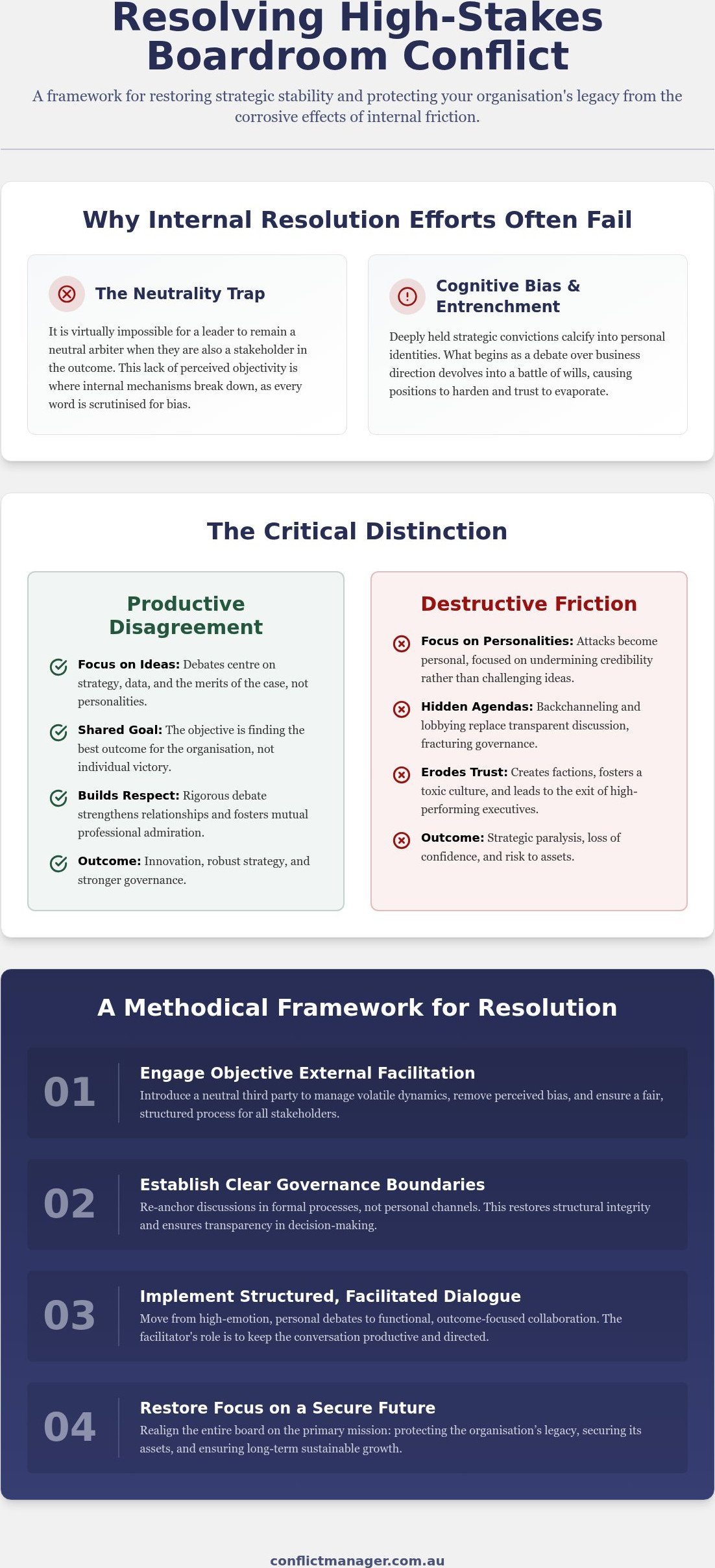
Internal attempts to resolve boardroom friction often begin with the best intentions. A Chairperson might suggest an informal coffee or a private discussion to "clear the air." However, these attempts frequently stumble into the neutrality trap. In high-stakes environments, it's virtually impossible for a leader to remain a neutral arbiter when they are also a stakeholder in the outcome. This lack of perceived objectivity is where internal mechanisms break down. When the parties involved are the very people who define the organisation's direction, the absence of an external perspective can lead to a dangerous entrenchment of positions. This is why a formal board of directors dispute resolution process is often the only viable path forward.
Cognitive bias plays a significant role here. Directors are often high achievers with deeply held convictions about the organisation's future. Over time, these strategic preferences can calcify into personal identities. What began as a debate over capital allocation or market entry becomes a battle of wills. Informal "chats" often inadvertently escalate these high-emotion business disputes because they lack the rigorous structure required for genuine resolution. Without a formal process, these conversations can feel like lobbying rather than collaboration. Positions harden; trust evaporates.
The Complexity of C-Suite Power Dynamics
Navigating strong personalities requires more than just good communication. It demands an understanding of competing strategic visions and the psychological register of executive ego. Internal mediation attempts are frequently dogged by the risk of perceived favouritism. If a CEO attempts to facilitate a dispute between two directors, their every word is scrutinised for bias. This environment makes it impossible to reach the level of nonprofit governance clarity or corporate transparency required for a sustainable outcome. The friction becomes a performance, and the underlying issues remain unaddressed.
The Requirement for Absolute Objectivity
Psychological safety is the foundation of any successful board of directors dispute resolution. Directors must feel they can speak candidly without fear of political retribution or long-term career damage. This safety can only be provided by a neutral third party who sits outside the hierarchy. Identifying the point where internal efforts become counter-productive is a critical leadership skill. If the same arguments are being rehearsed without progress, the limit has been reached. Engaging in professional stakeholder facilitation allows for a thematic foundation to be built, moving the conversation away from individual grievances and toward structural solutions that protect the organisation's legacy.
Productive Disagreement vs Destructive Boardroom Friction
Tension. Debate. Discernment. These are the hallmarks of a high-functioning leadership team. High-performance boards thrive on a certain level of tension; it is the fuel for innovation and rigorous risk assessment. However, a thin line separates robust strategic debate from corrosive personal rivalry. While healthy disagreement challenges assumptions to reach better outcomes, destructive friction serves only to protect egos or entrench power. Recognising this boundary is the first step toward effective board of directors dispute resolution. When the focus shifts from "what is right for the company" to "who is right in the room," the organisation's structural integrity is at risk.
Silence. Sarcasm. Subversion. These are the hallmark symptoms of a board in decline. When directors stop engaging openly in the boardroom and start lobbying in the hallways, the governance structure has failed. Destructive conflict often manifests as a refusal to share critical information or the subtle undermining of executive decisions. It shifts the energy of the leadership team from the organisation's mission to the survival of individual influence. Establishing clear rules of engagement for boardroom discourse is essential to contain these strategic disagreements before they mutate into personal vendettas.
Mapping the Sources of Organisational Conflict
Friction rarely appears in a vacuum. It often stems from structural flaws rather than simple personality clashes. During periods of organisational restructuring, unclear roles can lead to territorial disputes that look like interpersonal animosity but are actually symptoms of poor governance design. Misaligned incentives also play a significant role. If one director prioritises short-term dividends while another focuses on long-term asset growth, the resulting discord is a logical outcome of their differing mandates. Distinguishing between these structural triggers and genuine personality friction is a core component of professional stakeholder facilitation.
A Framework for Healthy Executive Discourse
Professional discourse requires a deliberate return to objective data. By grounding debates in verifiable facts and market realities, boards can depersonalise disputes and focus on the logic of the decision at hand. Structural conflict is the misalignment of organisational goals rather than personal animosity. Moving beyond defensive posturing requires a commitment to collaborative problem-solving and a willingness to view the situation with total objectivity. This shift is only possible when the board commits to a transparent process that values the organisation's legacy over individual victory. Effective board of directors dispute resolution restores this balance, allowing the leadership team to move back toward a state of functional collaboration and shared purpose.
A Methodical Framework for High-Stakes Boardroom Facilitation
Litigation is often viewed as the definitive resolution for corporate conflict. Courtrooms and letters of demand focus on identifying winners and losers; however, this binary approach is frequently fatal for business relationships and organisational culture. A professional board of directors dispute resolution framework offers a restorative alternative. It prioritises the preservation of structural integrity over legal victory. The process begins with a rigorous discovery phase. We unearth the underlying structural causes that often hide behind personal grievances. This stage isn't merely about who said what; it's about why the existing system allowed the friction to escalate in the first place.
Individual stakeholder engagement follows this discovery. This is a critical step in building a baseline of trust. Each director must feel heard in a neutral, confidential space. Without this individual foundation, the collective dialogue remains guarded and performative. We then transition into facilitated dialogue. This is a methodical move from complexity toward clarity. By the time the parties sit together, the objective isn't to litigate the past. It's to design a functional future. By focusing on shared goals, we help the board move beyond the inertia of disagreement.
Facilitating Difficult Conversations with Composure
High-emotion situations require a steady hand. Managing these dynamics isn't about suppressing feelings; it's about providing a grounded environment where those feelings don't derail the strategic objective. We use structured techniques to clarify nuanced stakeholder positions, ensuring every contribution is objective and measured. Precision in language is vital here. Using deliberate punctuation and clear sentence structures helps provide internal contrast to complex arguments. The goal is to lower the collective pulse. When the environment is calm and the communication is precise, logic can prevail over ego.
Building Sustainable Resolution Agreements
A resolution is only as strong as its implementation. Moving from a verbal agreement to structural change is where many internal efforts fail. We focus on developing agreed governance changes that address the root causes found in the discovery phase. This might involve refining board charters, clarifying roles, or establishing new reporting lines. Follow-up mechanisms are essential. They prevent recurring friction and ensure all stakeholders feel a sense of ordered resolution. If your board is currently experiencing strategic paralysis, engaging in expert stakeholder facilitation can provide the objective circuit-breaker needed to protect your organisation's legacy.
Restoring Structural Integrity through Expert Conflict Management
The decision to engage an external expert is often the most significant hurdle for a Chairperson. It requires a level of vulnerability and a recognition that the internal system, while robust in normal times, has reached its limit. While a standard board performance review can identify that friction exists, it rarely provides the active mediation required to resolve it. Expert-led board of directors dispute resolution moves beyond mere diagnosis. It provides the active, steady hand needed to navigate a leadership team through a volatile transition. This intervention is not a sign of failure; it is a strategic commitment to the organisation’s legacy and the protection of its long-term assets.
At Conflict Manager, we provide a steady hand for volatile leadership situations across Australia. Our approach is methodical and logical, beginning with an acknowledgment of the current disruption before moving toward a vision of structured resolution. We understand the weight of responsibility that rests on a CEO or Chairperson. By acting as a neutral third party, we bring clarity to clouded situations without becoming emotionally entangled in the friction. This objectivity is what allows for the restoration of structural integrity and the re-establishment of executive alignment. Achieving clarity and stability is possible when the process is led by those who understand the deep human and structural dynamics at play.
The Value of a Neutral Third Party
Order. Clarity. Stability. These are the outcomes of a structured approach to conflict management. When a board is trapped in a cycle of reactive posturing, the introduction of a neutral third party acts as a circuit breaker, allowing the leadership team to refocus on the strategic horizon. An external counsellor brings total objectivity to the boardroom, viewing the situation without the baggage of past decisions or personal alliances. This presence lowers the organisational pulse, creating a space where nuanced stakeholder positions can be clarified and addressed. We position our facilitators as wise, professional guides who understand the friction of leadership without being consumed by it.
Next Steps for the Leadership Team
Assessing your team's current level of structural friction is the first step toward recovery. It's important to recognise when internal efforts have become counter-productive and when the risk to your organisational culture has become too great to ignore. Re-establishing executive alignment requires a commitment to a transparent and objective process. If your board is currently experiencing strategic paralysis or an erosion of shareholder confidence, the path back to stability begins with professional intervention. You can enquire about professional facilitation for your leadership team to begin the process of restoring your board's functional collaboration and securing your organisation's future.
Securing Your Organisation’s Strategic Future
Boardroom friction is more than a distraction; it's a fundamental threat to the structural integrity of your organisation. We've explored how unresolved discord can lead to strategic paralysis and why internal attempts to mediate often falter because they lack the necessary objectivity. True board of directors dispute resolution requires a methodical shift from personal rivalry back to functional governance. By addressing the underlying structural causes through expert facilitation, you can protect your assets and your organisational culture from the corrosive effects of leadership friction.
Conflict Manager brings a composed, objective approach to high-emotion disputes within high-stakes Australian corporate environments. Our focus remains on achieving sustainable outcomes that restore order and clarity to your leadership team. If you're ready to move beyond the inertia of conflict and re-establish executive alignment, we invite you to restore alignment to your Board with professional facilitation. Returning to a state of collaborative stability is a deliberate choice that secures your legacy and ensures the long-term health of your business.
Frequently Asked Questions
How long does the board dispute resolution process typically take?
The duration of the process depends on the complexity of the structural friction and the number of stakeholders involved. Typically, a structured facilitation spans several weeks to a few months. This timeframe allows for a thorough discovery phase, individual stakeholder engagement, and collective facilitated dialogue. Rushing this progression often results in superficial agreements that fail to address the underlying causes. A methodical approach ensures the resolution is both sustainable and thorough.
Is board conflict management confidential for Australian organisations?
Confidentiality is the cornerstone of professional board of directors dispute resolution. All discussions, whether individual or collective, are conducted within a strictly private framework to ensure psychological safety for all directors. This allows for candid dialogue without the risk of external reputational damage or internal political fallout. Maintaining this boundary is essential for protecting the organisation's legacy and ensuring that sensitive strategic information remains secure throughout the entire facilitation process.
What is the difference between executive coaching and conflict facilitation?
Executive coaching focuses on the professional development of an individual leader, whereas conflict facilitation addresses the structural and interpersonal dynamics of a collective group. Facilitation is an external intervention designed to restore functional collaboration within a fractured team. While coaching might improve a single director's communication skills, facilitation provides the objective framework needed to resolve deep-seated disputes that threaten organisational stability. It's a systemic approach rather than an individual one.
Can conflict management help during a hostile merger or acquisition?
Conflict management is vital during high-stakes structural changes such as a hostile merger or acquisition. These periods often exacerbate existing boardroom friction and create new territorial disputes. Facilitation provides a steady hand to navigate these volatile transitions, ensuring the leadership team remains focused on protecting asset integrity and shareholder value. By establishing clear governance boundaries, an external mediator helps the board maintain a unified front during complex negotiations with external parties.
What happens if one board member refuses to participate in mediation?
Participation is most effective when it's voluntary, but a refusal by one member doesn't necessarily halt the process. In such cases, the focus shifts to individual engagement to understand the source of their resistance. Often, reluctance stems from a perceived lack of objectivity or fear of a predetermined outcome. By building a baseline of trust through neutral stakeholder facilitation, it's frequently possible to bring hesitant members back into the collaborative process over time.
How do we measure the success of a conflict resolution engagement?
Success is measured by the return to functional collaboration and the implementation of sustainable governance changes. Practical indicators include a reduction in backchanneling, clearer decision-making processes, and a renewed focus on long-term strategic goals. We also look for the re-establishment of executive alignment and a measurable improvement in the organisational pulse. Ultimately, the goal is to move the board from a state of strategic paralysis to one of ordered, objective resolution.
Is professional facilitation suitable for family-owned Australian businesses?
Professional facilitation is particularly beneficial for family-owned Australian businesses where professional and personal lives often intersect. These environments frequently face unique pressures related to succession planning and legacy preservation. Expert-led board of directors dispute resolution provides the total objectivity needed to navigate these high-emotion dynamics. It ensures that family relationships are preserved while the business continues to operate with structural integrity and a clear sense of strategic purpose.
Can mediation prevent the need for legal action under the Corporations Act?
Mediation often serves as a critical circuit breaker that prevents disputes from escalating into litigation under the Corporations Act. Legal action is frequently a binary process that results in winners and losers, often damaging the organisation's reputation and culture in the process. Facilitation offers a restorative alternative that focuses on resolving the underlying structural causes of the friction. By reaching a mediated agreement, boards can avoid the high costs and public scrutiny associated with court proceedings.


