

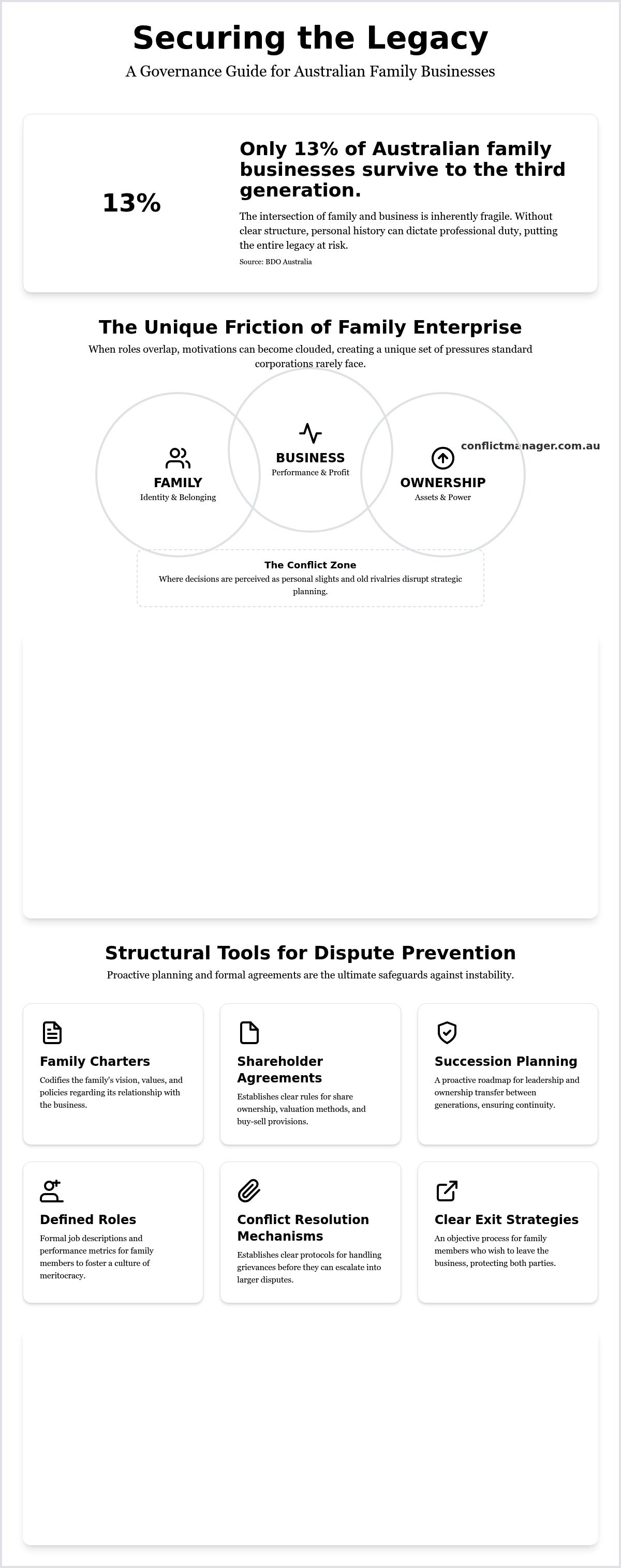
Only 13% of Australian family businesses make it to the third generation, according to 2026 data from BDO Australia. This statistic is a sobering reminder that the intersection of blood and business is inherently fragile. Order. Clarity. Resilience. Achieving these qualities is difficult when personal history and professional duty become entangled, often leading to a state where old sibling rivalries or unspoken expectations dictate the company's future. This guide explores the necessity of preventing disputes in a family business through a strategic governance approach, ensuring your commercial interests remain protected from interpersonal friction.
You likely understand that the health of the firm is inextricably linked to the health of the family, yet finding a neutral path forward amidst high-stakes emotions often requires a perspective that exists outside the family circle. We'll examine how structured communication and formalised boundaries can resolve friction before it escalates. By moving your organisation from a place of uncertainty toward a vision of lasting resolution, you can preserve the legacy you've worked so hard to build for the next generation.
Key Takeaways
- Transition away from informal "handshake" agreements by formalising the distinct roles of family, ownership, and business management.
- Utilise structural tools like Family Charters and Shareholder Agreements to establish clear exit strategies and objective valuation methods.
- Adopt the "Quiet Approach" to communication, prioritising de-escalation and structured protocols to manage sensitive business updates.
- Discover how a strategic governance framework acts as a proactive safeguard, preventing disputes in a family business by clarifying expectations.
- Recognise the value of neutral facilitation in providing an objective perspective when internal efforts to resolve friction reach an impasse.
The Unique Friction of Australian Family Enterprises
Identity. Power. Belonging. These three forces converge within the "Family-Business-Ownership" triangle, creating a unique set of pressures that standard corporate structures rarely encounter. When an individual is simultaneously a sibling, a director, and a shareholder, their motivations can become clouded. Decisions intended to benefit the firm might be perceived as personal slights by those excluded from the executive suite. Understanding these Family Business Dynamics is the first step in preventing disputes in a family business.
Many Australian enterprises began as humble, kitchen-table operations where a handshake was the only contract needed. While these informal arrangements foster agility in the early years, they often become significant liabilities as the business scales or transitions to the next generation. The lack of clear documentation creates a vacuum. In this space, assumptions thrive and grievances fester. Family business conflict is a clash between emotional systems and commercial logic.
The Blurring of Personal and Professional Boundaries
History. Memory. Perception. Old grievances from childhood often find a second life in the boardroom, where a disagreement over capital expenditure is actually a proxy for a thirty-year-old rivalry. This is the "dinner table" effect. It's when business talk invades family celebrations and family drama disrupts strategic planning. Early warning signs of structural friction include a total avoidance of certain topics, "sides" being taken by non-active family members, or a sudden lack of transparency regarding financial performance. If these patterns aren't addressed, the emotional weight of the family legacy can paradoxically trigger its destruction.
The High-Net-Worth Context: Asset Integrity
For high-net-worth families, the stakes are exceptionally high. Sizable assets don't just represent wealth; they represent the family's standing and future security. When disputes arise, the risk of asset fragmentation during multi-generational transfers becomes a reality. This division can weaken the firm's market position and dilute the family legacy. Conflict Manager acts as a steady hand in these volatile environments. By providing Stakeholder Facilitation and Family Conflict Resolution, we help maintain asset integrity. Our role is to view these complex human dynamics with total objectivity, acting as a neutral third party that brings order to periods of high stress.
Transitioning from Informal Roots to Formal Governance
Structure. Objectivity. Evolution. The psychological shift from "family first" to "governance first" represents a significant milestone in an organisation’s maturity. It's a move away from the intuitive, often unspoken rules of the home toward the explicit, documented requirements of the boardroom. In Australia, the "handshake deal" is often viewed with nostalgia, yet it remains a primary catalyst for future litigation. These informal arrangements fail to account for the complexity of growing assets or the diverse interests of subsequent generations. Transitioning to formal governance is the most effective method for preventing disputes in a family business, as it replaces ambiguity with a shared, objective reality.
Establishing clear decision-making authority ensures there is a visible line where the family’s emotional influence ends and the board’s fiduciary duty begins. This separation of powers is often achieved by centralising control through a Family Office. Such a structure allows for the professional management of the family's wealth, reducing the individual friction that occurs when family members have disparate views on investment or expenditure. It provides a buffer, protecting the firm’s commercial interests from the volatility of personal dynamics.
Defining Roles and Responsibilities
Ambiguity is the enemy of order. Formal job descriptions for family members are not a sign of distrust; they are a necessary tool for clarity. When family employees are subject to the same performance management and rigour as external hires, it reinforces a culture of meritocracy rather than entitlement. This structural discipline is vital for avoiding the "unfair prejudice" claims that frequently appear in Australian family disputes. Implementing clear Conflict Resolution Mechanisms ensures that grievances are handled through established protocol rather than personality.
Succession Planning as a Preventive Tool
Proactive planning is the ultimate safeguard against instability. With over $3.5 trillion in wealth expected to be transferred between generations in Australia over the next 20 years, the stakes of succession have never been higher. Yet, only 19% of Australian family businesses hold a documented succession plan, according to March 2026 data from Grant Thornton. Waiting for a health crisis or retirement to initiate these discussions is a strategic error. It's essential to distinguish between management succession, which focuses on leadership capability, and ownership succession, which addresses the transfer of equity. Navigating this high-emotion transition often requires a steady external hand to facilitate conversations that might otherwise become stalled by unspoken fears or historical grievances.
Structural Tools for Dispute Prevention
Order. Foresight. Integrity. Establishing a robust governance framework is the most effective method for preventing disputes in a family business. While emotional alignment is essential, it must be supported by structural tools that provide a clear roadmap for the future. These mechanisms act as the firm’s skeleton, providing the necessary rigidity to withstand internal pressures while allowing for the fluid movement of the family’s legacy across generations. In the Australian high-net-worth context, this often involves a combination of non-legal guiding principles and binding commercial agreements.
The Family Charter: A Living Document
Foundational values. Shared mission. Conflict protocols. A Family Charter, often referred to as a Constitution, is a non-legal document that establishes the "rules of engagement" for the family. It outlines how family members interact with the firm, including employment criteria and the process for resolving internal friction. The true value lies not just in the final document, but in the collaborative process of its creation. Conflict Manager specialises in facilitating these foundational discussions, acting as a neutral party to ensure every voice is heard without the conversation becoming derailed by historical grievances.
Shareholder Agreements in a Family Context
Exit strategies. Valuation methods. Dispute resolution. While the Family Charter manages the emotional and relational aspects, the Shareholder Agreement provides the legal framework for ownership. It's vital to include specific clauses for family buy-outs and share transfers to prevent the fragmentation of assets. Pre-determining the path for dispute resolution, such as requiring mediation before arbitration, ensures that conflicts are handled with discretion. This structure is particularly important when balancing the interests of active family employees with those of passive shareholders, who may have differing views on dividends and reinvestment.
Family Councils and Trust Deed Reviews
Separation. Clarity. Security. A Family Council creates a dedicated space for family matters, ensuring that personal discussions don't bleed into the operational boardroom. This separation allows the board to focus on commercial performance while the family addresses its own evolution. Similarly, regular Trust Deed reviews are essential for ensuring the structural integrity of family wealth vehicles. As Australian tax and workplace laws evolve, your wealth structures must remain compliant and fit for purpose, safeguarding the family's assets against external volatility and providing a stable foundation for Stakeholder Facilitation.
Cultivating a Culture of Composed Communication
Silence. Clarity. Equanimity. While the structural tools discussed previously provide the necessary framework for stability, the daily practice of preventing disputes in a family business depends on the quality of interpersonal interaction. The "Quiet Approach" favours de-escalation over aggressive confrontation, recognising that high-decibel arguments rarely lead to sustainable commercial outcomes. By implementing formal communication protocols for sensitive business updates, you ensure that critical information is shared in a professional setting rather than during a casual family gathering. Composed communication provides a sense of order during organisational friction.
Managing High-Emotion Business Disputes
Objectivity is often the first casualty of family friction. When tensions rise, it's vital to employ techniques that separate the person from the problem. This involves focusing on the commercial impact of a decision rather than the perceived intentions of the individual making it. Addressing the "elephants in the room" requires a delicate balance of honesty and tact to avoid triggering defensive reactions. Often, the presence of a neutral third party is the only way to facilitate these difficult conversations safely. For families facing entrenched friction, engaging expert Family Conflict Resolution provides the necessary distance to reset these communication patterns and focus on the firm's future.
The Psychology of Resolution
Safety. Trust. Collaboration. Moving away from a "zero-sum" mindset, where one family member’s gain is perceived as another’s loss, is essential for long-term health. This shift requires building "psychological safety" within the family board, creating an environment where members feel comfortable expressing dissenting views without fear of personal retribution. Active listening plays a critical role here, as it prevents the escalation of minor misunderstandings into full-blown grievances. Conflict Manager acts as a steady hand in these environments, using Stakeholder Facilitation to lower the collective pulse of the room and guide the family toward a collaborative vision of success.
The Value of Neutral Facilitation in Preserving Legacy
Stability. Perspective. Continuity. Even with the most robust governance frameworks in place, the human element remains the most volatile variable. Internal efforts to manage friction often fail under pressure because those involved are too deeply entangled in the family’s emotional history. When personal identities are inextricably linked to professional roles, objectivity becomes impossible. Engaging an external party is not an admission of failure. Rather, it is a strategic decision aimed at preventing disputes in a family business by introducing a steady hand capable of viewing complex dynamics with total discernment.
There is a fundamental distinction between legal representation and professional conflict facilitation. While legal advice identifies rights and obligations, it is often adversarial by nature, focusing on winning a position rather than resolving a problem. In contrast, facilitation seeks sustainable outcomes that maintain both business stability and family harmony. It prioritises the preservation of the relationship alongside the protection of the firm. Conflict Manager guides stakeholders through this resolution process with objective clarity, ensuring that the logic of the business isn't sacrificed to the emotions of the family.
When to Engage a Neutral Third Party
Deadlock. Stagnation. Resentment. These are the tell-tale signs that a family has reached an impasse in their decision-making. When board meetings become circular or when sensitive topics are avoided altogether to keep the peace, the risk of a major rupture increases. Early intervention is critical. Engaging a neutral third party before positions become entrenched allows for a more fluid and less painful transition. An external counsellor provides the total objectivity that internal members lack, acting as a neutral circuit breaker that brings order to periods of high organisational stress.
A Reassuring Path Forward
Resolution. Integrity. Legacy. The methodology employed by Conflict Manager is methodical and logical, designed to lower the collective pulse of the room. By moving the family from a state of complexity toward a vision of structured resolution, we ensure the long-term integrity of family assets. This process isn't about clinical psychotherapy or legal battles; it is about expert Stakeholder Facilitation that respects the weight of responsibility carried by every family member. It's a path that leads away from friction and toward a stable, prosperous future for the next generation. Achieve clarity and stability with Conflict Manager.
Securing the Future of Your Family Enterprise
Legacy. Resilience. Evolution. Transitioning from informal handshake deals to a robust governance framework is the most significant step toward long-term stability. By implementing structural tools like Family Charters and formalising communication protocols, you create a buffer against the emotional volatility that often disrupts high-stakes environments. This strategic approach is essential for preventing disputes in a family business; it ensures that the firm's commercial logic remains uncompromised by personal history.
Achieving sustainable outcomes requires a steady hand and total objectivity. Conflict Manager provides expert-led facilitation for high-net-worth families, focusing on asset integrity and the navigation of multi-generational friction. Our neutral guidance helps you move from complexity toward a vision of structured resolution. Preserve your family legacy with professional facilitation. With the right support, your business can thrive across generations while maintaining the harmony of the family it serves.
Frequently Asked Questions
What are the most common causes of disputes in an Australian family business?
Friction often arises from the overlapping roles of family, ownership, and management. According to PwC data from August 2026, 37% of Australian family firms identify resistance from the senior generation to leadership transition as a major challenge. Other triggers include old grievances resurfacing during meetings and a lack of clear succession plans. These factors create a volatile environment where personal history clashes with commercial logic, often destabilising the firm's market position.
Can a Family Charter actually prevent legal disputes?
A Family Charter acts as a proactive safeguard by formalising the "rules of engagement" before friction escalates. While it is a non-legal document, it establishes clear expectations regarding employment, dividends, and conflict protocols. This structural clarity is vital for preventing disputes in a family business. By aligning the family’s mission and values, the charter reduces the ambiguity that typically leads to expensive litigation or the fragmentation of family assets.
How do we resolve a deadlock between family members on the board?
Resolving a boardroom deadlock requires moving the conversation from a high-stress operational environment to a neutral space. Implementing a Family Council allows members to address interpersonal grievances away from the firm's commercial functions. If internal efforts fail, engaging a neutral third party for Stakeholder Facilitation can provide the total objectivity needed to break the impasse. This methodical approach helps stakeholders move from complexity toward a vision of structured, sustainable resolution.
What is the difference between mediation and arbitration for family businesses?
Mediation is a collaborative process where a neutral facilitator helps parties reach a mutually acceptable agreement. It focuses on preserving relationships and asset integrity. Conversely, arbitration is an adversarial process where a third party makes a binding decision, similar to a court ruling. For family enterprises, mediation is often preferred because it addresses the underlying emotional dynamics that arbitration ignores. It provides a more empathetic path toward lasting stability.
How much does it cost to implement a family governance structure?
The investment required to establish a governance structure varies based on the complexity of the family’s assets and the number of stakeholders involved. Rather than viewing this as a simple expense, many high-net-worth families see it as a necessary cost for protecting their legacy. Formalising structures like Family Charters or Shareholder Agreements helps avoid the severe financial penalties associated with litigation. It's a strategic investment in the long-term integrity of the family's wealth.
Can Conflict Manager help if the family is already in a high-emotion dispute?
Conflict Manager specialises in managing high-emotion situations and multi-generational friction. Our expert-led Family Conflict Resolution is designed to lower the collective pulse of the room, even when tensions are high. We act as a steady hand, viewing volatile situations with total objectivity to bring order to periods of organisational friction. Our role is to guide stakeholders through a logical process that prioritises sustainable outcomes and the preservation of the family legacy.
How do we protect the family legacy during a business restructure?
Protecting a legacy during restructuring involves separating the family’s emotional history from the business’s commercial future. You must ensure that wealth vehicles, such as trust deeds, remain structurally sound and compliant with current Australian laws. Clear job descriptions and performance management for family employees also help maintain asset integrity. This professional rigour ensures the firm remains competitive while the family navigates the complexities of multi-generational wealth transfer and structural change.
What happens if one family member refuses to participate in facilitation?
Participation in facilitation is ideally voluntary, as trust is the foundation of any sustainable resolution. If a family member is hesitant, a neutral facilitator can work individually with stakeholders to address their specific concerns and explain the benefits of a collaborative approach. The goal is to create a safe environment where every voice is heard. Highlighting the risks of non-participation, such as legal deadlock or asset dilution, often encourages reluctant members to engage.


