

Legacy. Stewardship. Alignment. While most people view estate planning as a series of legal filings, inheritance is actually the ultimate test of a family’s communication architecture. It is the point where structural integrity meets emotional history. You likely feel a sense of trepidation when considering how to talk to siblings about inheritance, fearing that the conversation might be mistaken for self-interest or that it will disturb a hard-won peace. It is natural to feel anxious about resurfacing old rivalries or becoming lost in the complexity of trust structures.
You don't have to navigate this transition alone or without a map. This guide provides a structured, empathetic framework designed to facilitate these sensitive discussions while preserving your family harmony. We will outline a clear plan for your first family meeting and share techniques to lower emotional tension effectively. By moving from a state of uncertainty toward a shared understanding of your parents’ wishes, you can ensure the transition is handled with the dignity and order it deserves.
Key Takeaways
- Identify the fairness versus equality trap to understand why inheritance discussions often stall when childhood roles and financial expectations collide.
- Establish internal clarity regarding your intentions and gather essential details on family trusts or superannuation before learning how to talk to siblings about inheritance.
- Master the soft start technique to initiate dialogue focused on shared legacy rather than asset division, using measured language to lower emotional tension.
- Navigate complex interpersonal dynamics such as caregiving imbalances and sweat equity to ensure all contributions are recognised without fostering long-term resentment.
- Recognise the threshold where professional stakeholder facilitation becomes necessary to preserve both asset integrity and vital family relationships.
The Emotional Landscape: Why Inheritance Conversations Stall
Grief. Money. Status. Identity. These elements form a volatile baseline for any family discussion regarding wealth. Understanding how to talk to siblings about inheritance requires more than just a review of a legal document; it's a process that demands a deep audit of the emotional architecture supporting the family unit. When these foundations are left unexamined, the conversation often stalls before it truly begins.
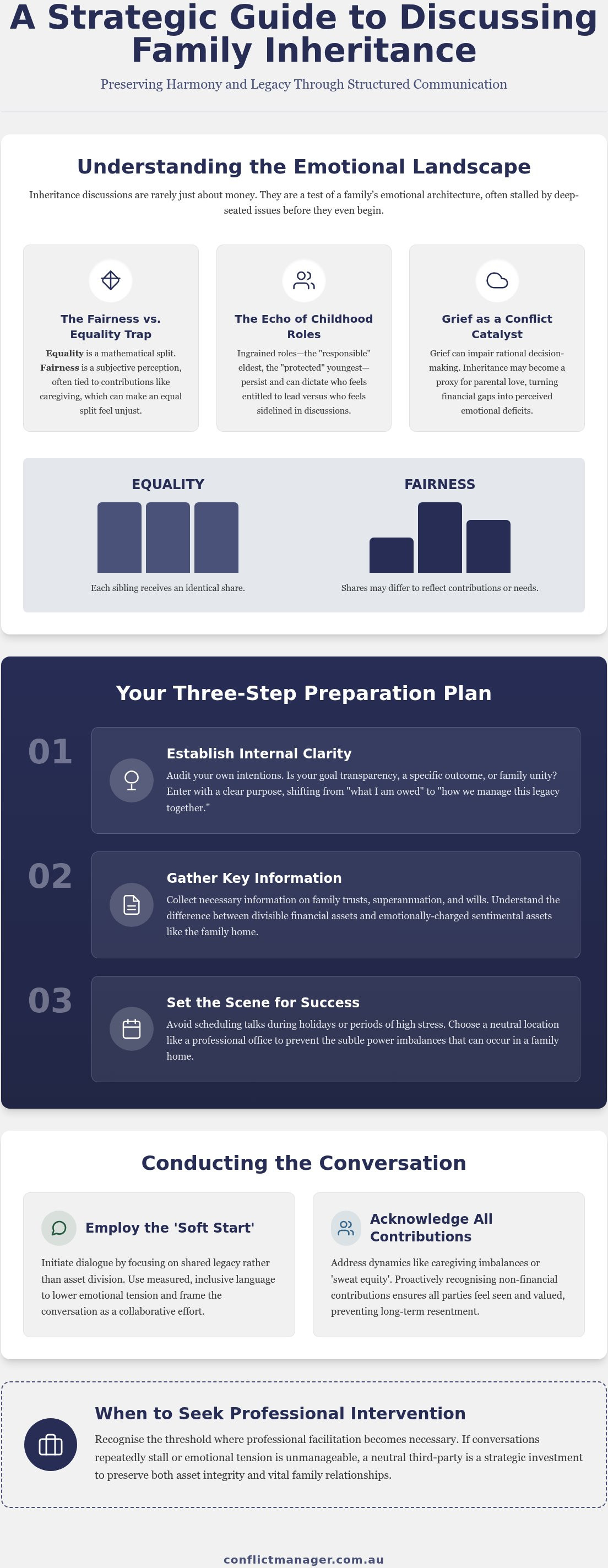
A primary friction point is the "fairness versus equality" trap. While equality is a mathematical certainty, fairness is a subjective perception. A sibling who has dedicated years to caregiving might view an equal distribution as fundamentally unfair, while another may interpret any deviation as a personal slight. This tension is rarely about the dollar value. It's about the perceived recognition of one's place within the family hierarchy.
Conflict is often viewed as a sign of failure, but a more objective perspective suggests it's a signal for structural adjustment. It shows that the existing communication patterns aren't sufficient to manage the complexity of the transition. Effective stewardship requires families to move beyond the immediate friction and focus on the long-term integrity of their legacy, treating the preservation of unity as a high-stakes objective.
The Role of Childhood Dynamics
Childhood roles tend to calcify over time. The "responsible" eldest or the "protected" youngest don't simply vanish when the topic turns to assets. These ingrained labels persist, often dictating who feels entitled to lead and who feels perpetually sidelined. When you're learning how to talk to siblings about inheritance, you've got to recognise that financial arguments are often a mask for deeper needs for validation. Past grievances, even those decades old, can resurface as roadblocks to a rational distribution of assets.
Grief as a Catalyst for Conflict
Grief is a complex, non-linear force that begins long before a loss is finalised. Anticipatory grief can significantly impair rational decision-making, leading to defensive postures or total avoidance of the topic. The danger is that inheritance often becomes a proxy for parental love. If a sibling feels they're receiving less, they'll often translate that financial gap into an emotional deficit. Maintaining a composed, professional dialogue is the only way to prevent these visceral reactions from causing permanent family estrangement.
Preparing the Ground: Internal Clarity Before the Dialogue
Clarity. Preparation. Composure. Before you address the collective, you must first secure your own internal alignment. When considering how to talk to siblings about inheritance, the most critical work happens before the first word is spoken. It involves a rigorous audit of your own intentions. Are you seeking total transparency, a specific outcome regarding an asset, or simply the preservation of family unity? Identifying these drivers allows you to enter the room with a sense of grounded authority rather than defensive reactivity.
Success in these high-stakes transitions depends on your commitment to objectivity. Developing a composed mindset means deciding, in advance, to prioritise the family’s structural integrity over individual grievances. It requires a shift in perspective from "what I am owed" to "how we manage this legacy together." Choosing a neutral, centre location for the discussion is equally vital. Meeting at a local cafe or a professional office prevents the subtle power imbalances that occur when one sibling hosts the meeting in their own home.
Information Gathering and Asset Literacy
A dialogue built on assumptions is destined for friction. You must gather the necessary structural information regarding family trusts, superannuation, and existing wills before initiating the conversation. Understanding the difference between financial assets and sentimental assets is crucial. While a share portfolio is easily divided, the family home or a specific heirloom often carries a heavy emotional weight that can trigger unexpected responses. Consulting with a professional solicitor or accountant ensures that the facts you present are accurate, providing a stable foundation for the discussion. For those managing complex family office dynamics, engaging in stakeholder facilitation can provide the external objectivity needed to navigate these technicalities without emotional entanglement.
Setting the Scene for Success
Timing functions as a silent participant in every negotiation. Avoid scheduling these talks during holidays, birthdays, or periods of high stress, as these occasions already carry significant emotional loads. Implementing a "No Surprises" rule is essential for building trust. Inform your siblings of the meeting's purpose well in advance, allowing them the space to prepare their own thoughts. By defining the scope of the meeting as a discussion on communication processes rather than final dollar amounts, you lower the stakes and encourage open, honest participation.
Navigating the Conversation: A Structured How-to
Structure. Protocol. Presence. Transitioning from internal preparation to active dialogue requires a disciplined approach to interpersonal dynamics. When you begin the process of how to talk to siblings about inheritance, the objective isn't to reach an immediate settlement; it's to establish a functional communication loop. Starting with a "soft start" ensures the conversation remains grounded in shared values. By explicitly stating that the primary goal is the preservation of family harmony, you lower the stakes and invite a more collaborative spirit from the outset.
Effective facilitation involves moving away from confrontational "you" language. Using "I" statements allows you to express concerns about future stability or asset integrity without inadvertently assigning blame. This shift in phrasing transforms a potential accusation into an observation. It invites your siblings to view the situation through your lens while leaving space for their own perspectives. Documentation is the final pillar of this structured approach. Creating a "family memorandum" ensures that every participant leaves with a shared understanding of what was discussed, preventing the "he said, she said" friction that often erodes trust over time.
The Five-Step Opening Framework
A successful meeting depends on a clear, predictable sequence when learning how to talk to siblings about inheritance. This framework provides the necessary guardrails to keep the discussion on track:
- Step 1: State the purpose. Reaffirm that the meeting is about protecting the family legacy and honouring your parents' hard work.
- Step 2: Invite input. Ask your siblings how they would like to approach the agenda to ensure they feel like active participants.
- Step 3: Share parental wishes. Relay the known facts of the estate with total objectivity, treating them as structural data rather than personal preferences.
- Step 4: Identify friction points. Note areas where expectations may differ without attempting to resolve them immediately.
- Step 5: Agree on next steps. Set a firm timeline for further professional consultation or subsequent family meetings.
Communication Techniques for High-Emotion Moments
Silence is a powerful tool in high-stakes environments. The power of the pause allows you to lower the collective pulse of the room, providing space for emotional reactions to settle before responding. If the dialogue becomes heated, use reframing to shift the focus. If a sibling expresses a desire for a larger share, reframe "you want more" into "you are concerned about long-term financial security." This technique validates the underlying fear without validating a potentially divisive demand. Maintaining a steady, reassuring tone is the hallmark of professional stakeholder facilitation; it signals that while the situation is complex, it remains under control.
Managing Friction and Divergent Expectations
Friction. Resistance. Divergence. When you initiate the process of how to talk to siblings about inheritance, you must anticipate resistance as a natural component of any complex transition. Common objections like "it is none of your business" or "Dad promised me this specific asset" are often defensive postures masking a deep-seated fear of loss or displacement. Addressing the caregiving imbalance, often referred to as "sweat equity," requires a high degree of discernment and objective recognition. Acknowledging the disproportionate labour provided by one sibling prevents resentment from calcifying into a permanent barrier to family resolution.
The "silent sibling" presents a different challenge to family unity. Withdrawal is frequently a sign of emotional overwhelm rather than indifference or agreement. Encouraging engagement from these members requires patience and a low-pressure environment that prioritises their perspective. Similarly, managing the influence of in-laws and external stakeholders is a matter of boundary integrity. The core sibling group must maintain a clear perimeter around their discussions to ensure that the primary relationships remain the focus of the stewardship, free from outside pressures that may not align with the family’s long-term interests.
When Expectations Clash
Needs. Wants. Interests. Effective conflict resolution depends on separating fundamental needs from surface-level wants. While a sibling might want a specific property, their underlying need might be financial security or a desire for parental recognition. By focusing on the "why" behind a demand, you can uncover interests that allow for more flexible solutions. Balancing liquid assets with property requires a sophisticated understanding of the family’s overall wealth structure; it involves making trade-offs that respect both the financial value and the emotional weight of the legacy. This is a vital step in learning how to talk to siblings about inheritance without triggering a defensive stalemate.
De-escalating Hostility
Hostility is a signal that the emotional capacity of the group has been exceeded. Recognising the signs of emotional flooding, such as increased heart rates or defensive rhetoric, is essential for maintaining order during a meeting. When these signs appear, a "cooling off" period is the most strategic move. Pausing the conversation preserves the relationship and prevents the kind of permanent estrangement that often follows a high-stakes row. When internal efforts reach a state of paralysis, the logic of pivoting to a neutral, third-party perspective becomes undeniable. If your family is struggling to move past entrenched positions, engaging in professional family conflict resolution can provide the objectivity needed to reach a sustainable outcome.
The Logic of Professional Intervention: When to Call a Mediator
Objectivity. Structure. Resolution. While the initial steps of how to talk to siblings about inheritance often begin within the family circle, there is a distinct threshold where internal efforts may reach their structural limit. When high-stakes assets are involved, or when long-standing interpersonal friction threatens to derail the process, the risk to the family legacy becomes significant. Recognising this limit isn't a sign of relational failure. Instead, it's a sophisticated acknowledgement that the complexity of the transition requires a neutral, professional hand to ensure asset integrity and emotional safety.
A professional mediator functions as a steadying force during periods of organisational friction. They bring a level of discernment that's impossible for those emotionally entangled in the outcome to maintain. By positioning stakeholder facilitation as an investment in the family’s health rather than a last resort, you preserve both the financial wealth and the vital relationships that define your legacy. This approach ensures that the transition moves from a state of volatility toward a vision of structured, sustainable resolution.
The Role of an External Counselor
An external counselor provides the total objectivity needed to view volatile situations without bias. They facilitate clarity when complex family dynamics or historical grievances have clouded the path forward. In a mediated environment, every stakeholder is given a dedicated space to be heard within a structured process that prioritises logical sequence over emotional reactivity. This disciplined framework prevents the conversation from spiralling into the kind of defensive rhetoric that often leads to permanent estrangement.
Achieving Sustainable Outcomes
Sustainable resolution requires more than an informal sibling handshake. While a verbal agreement might feel sufficient in the moment, it rarely survives the pressure of future financial or structural changes. Professional agreements, built through clear, mediated governance structures, provide a durable foundation for the family office and business stability. This level of formalisation protects family wealth from the erosion caused by ongoing dispute and uncertainty. To ensure your family legacy remains intact, you can discover how Conflict Manager facilitates clarity for high-net-worth families through expert family conflict resolution.
Securing Your Family Legacy Through Structured Dialogue
Legacy. Alignment. Preservation. Navigating the transition of wealth requires a commitment to both structural accuracy and emotional intelligence. By establishing asset literacy and mastering the protocols of how to talk to siblings about inheritance, you move from a state of reactive friction toward a sustainable family governance model. You've learned that clarity regarding family trusts and the use of a structured opening framework can lower the collective pulse and focus the group on the shared goal of harmony.
When high emotions or complex asset structures threaten to derail these efforts, the logic of external intervention becomes undeniable. You can seek the guidance of a professional mediator for your family dispute to ensure your legacy is managed with the objectivity it requires. Conflict Manager provides expert family office conflict resolution designed to reach sustainable and clear outcomes for wealthy families through a composed, objective approach to high-emotion disputes. Restoring order to your family dynamics is a profound act of stewardship that will benefit your family for generations to come.
Frequently Asked Questions
How do I bring up inheritance if my parents are still healthy?
Initiate the discussion as a matter of proactive stewardship rather than a response to illness. You might frame it as a desire to understand your parents’ long-term vision for their legacy while everyone's in a clear state of mind. This approach removes the urgency of crisis and allows for a methodical, calm dialogue. It's about ensuring the family’s structural integrity is maintained for the next generation.
What should I do if my siblings refuse to talk about the will?
Respect the resistance but maintain the objective of transparency. If a direct approach fails, try sharing your own concerns about future uncertainty using "I" statements. You don't want to trigger defensive reactions by being pushy. If the deadlock persists, suggest that a neutral facilitator could help manage the technical aspects of the discussion. It's a way to shift the focus from sibling friction to a professional, structured process.
Is it fair to ask for more inheritance if I am the primary caregiver?
Recognising "sweat equity" is a common step in learning how to talk to siblings about inheritance. While the contribution of a primary caregiver is significant, asking for more should be handled with total objectivity. It's helpful to document caregiving hours or costs incurred to provide a factual basis for the discussion. Framing this as a matter of fairness rather than a demand helps prevent siblings from feeling sidelined.
How can we avoid a legal battle over our parents’ estate?
Transparency is the most effective deterrent to litigation. By sharing information early and ensuring every stakeholder feels heard, you reduce the likelihood of the fairness versus equality trap mentioned earlier. If consensus seems impossible, engaging a professional for family conflict resolution is a strategic investment. It's a structured path toward a sustainable outcome, which is far more cost-effective and less destructive than a legal battle.
What is the difference between a family meeting and professional mediation?
A family meeting is an internal, self-guided discussion that relies on existing communication patterns. In contrast, professional mediation introduces a neutral third party who brings a disciplined framework and total objectivity to the room. Mediation is particularly effective when family dynamics have clouded the path forward. It ensures that the dialogue stays focused on resolution and asset integrity rather than historical grievances or emotional triggers.
How do we handle a sibling who is financially irresponsible?
Address these concerns by focusing on the parents’ intent to provide long-term security. Rather than attacking the sibling’s habits, discuss structural solutions such as family trusts or professional oversight of certain assets. This shifts the conversation from personal criticism to a shared goal of wealth preservation. It lets the family protect the legacy while ensuring all members are supported according to the established governance rules.
Should we include in-laws in our inheritance discussions?
Maintaining a clear perimeter around the core sibling group is usually the most effective strategy. While in-laws are vital family members, their presence in high-stakes inheritance talks can sometimes introduce external pressures that complicate the core dynamics. It's often better to reach a preliminary consensus among siblings before sharing the outcomes with the wider family. This ensures that the primary relationships remain the focus of the stewardship.
What happens if we cannot reach a consensus on the family home?
When consensus on a sentimental asset like the family home fails, it's a signal that the emotional weight has exceeded the group's capacity for resolution. You might explore trade-offs where one sibling retains the property while others receive liquid assets of equivalent value. If these internal negotiations stall, professional stakeholder facilitation can provide the necessary objectivity to navigate the deadlock. This helps move the family toward a sustainable resolution.


