

Legacy. Wealth. Friction. Most high-net-worth families believe their structures are ironclad until the moment personal interests collide with institutional protocols. You're currently navigating the immense weight of a A$3.5 trillion intergenerational wealth transfer, a process that demands absolute structural precision. When family office governance disputes arise, the primary risk isn't merely a balance sheet adjustment. It's the looming threat of public reputational damage and the deep paralysis that takes hold when unclear authority stalls every critical decision.
It's understandable that you feel emotionally drained by the constant tension between different generations, especially as new regulatory pressures like the 30% tax on discretionary trusts heighten the stakes. You deserve a path forward that doesn't sacrifice your family relationships for the sake of the firm. By reading on, you'll discover how to manage these high-stakes frictions with objectivity and structural clarity to preserve your legacy. We'll examine the logic of neutral facilitation, the necessity of clear decision-making frameworks, and the steps required to restore order to your most vital private structures.
Key Takeaways
- Understand why traditional corporate models often fail to address the unique intersection of trust and structure inherent in Australian family wealth.
- Identify the common triggers of family office governance disputes, ranging from the transition away from founder-centric models to diverging multi-generational investment philosophies.
- Avoid the "unblinking eye" of public litigation by comparing the true financial and reputational costs of court battles against the clarity of private facilitation.
- Learn a strategic two-step framework that begins with a necessary cooling-off period to establish a temporary truce; this allows for the identification of root causes rather than just symptoms.
- Discover how a neutral third party provides the composed authority needed to move from high-emotion friction toward a sustainable, objective resolution.
The Intersection of Structure and Sentiment in Family Offices
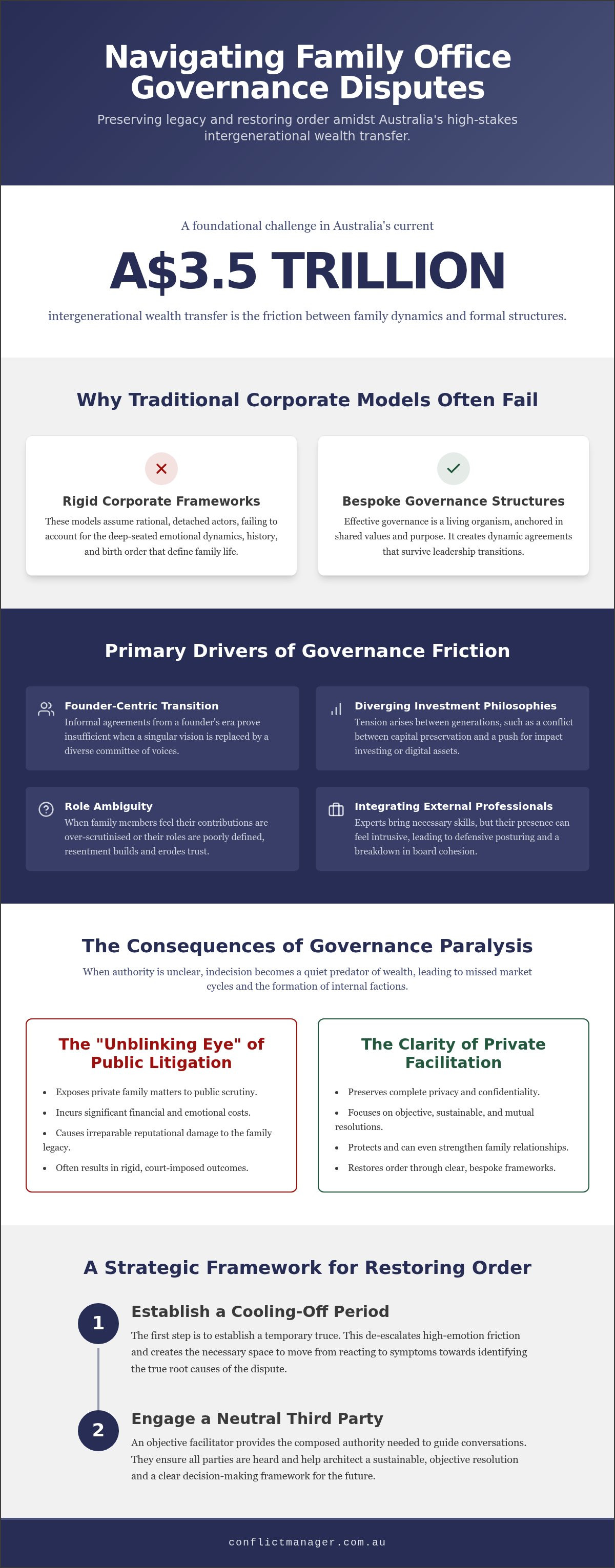
Stability. Order. Clarity. These are the pillars of a successful Family office, yet they are often the first casualties when interpersonal friction takes root. Many Australian families attempt to apply rigid, corporate-style frameworks to their private wealth. While these structures work for public companies, they often fail to account for the deep-seated emotional dynamics that define family life. Family office governance disputes are rarely just about a breach of a written policy; instead, they represent a simultaneous breakdown in both structural logic and foundational trust.
Traditional corporate governance often fails because it assumes rational, detached actors. In a family setting, every decision carries the weight of history and the nuance of birth order. This creates an "emotional tax" on the office, where unresolved friction begins to erode investment performance and asset integrity. When internal efforts to resolve these issues result in circular arguments or deepening resentment, the family has reached a tipping point where external, objective facilitation becomes a necessity rather than an option. Recognising this moment is vital to prevent the permanent fracturing of both the portfolio and the family unit.
Governance as a Living Organism
A robust framework should be viewed as a living organism rather than a static stack of legal documents. It needs to breathe. Effective governance moves beyond the "best practice" templates found in textbooks to create dynamic interpersonal agreements that reflect a family's unique history. By anchoring these structures in shared values, families can organise their affairs with a sense of purpose that survives the inevitable transitions of leadership. Bespoke governance recognises that the path forward must be paved with the specific cultural stones of the family's past, ensuring the structure remains resilient under pressure.
The Consequences of Governance Paralysis
Indecision is a quiet predator of wealth. When authority is unclear, the family office often enters a state of paralysis that leads to wealth dilution and missed market cycles. Internal factions begin to form as stakeholders retreat into silos to protect their individual interests. This fragmentation compromises the collective legacy and places the entire structure at risk. Ultimately, family office governance disputes are a failure of communication protocols rather than just legal drafting.
Primary Drivers of Governance Friction in Australian Family Offices
Friction doesn't appear in a vacuum. It's often the result of a structural evolution that hasn't kept pace with the family's growth. In Australia, many family offices are currently moving away from the traditional founder-centric model. This transition is a frequent catalyst for family office governance disputes, as the informal agreements of the past no longer suffice for a larger, more diverse group of stakeholders. When a founder's singular vision is replaced by a committee of voices, the lack of a clear mandate often leads to stalled decision-making. This paralysis is particularly damaging during periods of market volatility or regulatory change.
Disparate investment philosophies often create a wedge between generations. While the second generation may prioritise capital preservation and traditional property, the third generation frequently pushes for impact investing or digital assets. This tension is often exacerbated by role ambiguity. When family members feel their contributions are over-scrutinised or their roles are poorly defined, resentment builds. Integrating external professionals into a family-led board adds another layer of complexity. These experts bring necessary skills, yet their presence can feel like an intrusion into private dynamics, leading to defensive posturing and a breakdown in board cohesion.
The Intergenerational Wealth Gap
The "shirt sleeves to shirt sleeves" phenomenon is a persistent concern for families managing the current A$3.5 trillion intergenerational wealth transfer. Friction often arises between active managers who run the office and inactive beneficiaries who rely on its distributions. These groups have different appetites for risk and liquidity. To effectively manage conflicts within the family, the governance structure must balance traditional asset classes with the modern values held by younger generations. This requires a shift from viewing wealth as a static pool to seeing it as a dynamic tool for future legacy building.
Transparency and Information Flow
Gatekeeping is a significant driver of distrust. When financial data is closely guarded by a few individuals, other family members often feel alienated. This perceived lack of transparency can lead to secret decision-making, which undermines the psychological safety of the group. Establishing clear reporting lines that honour both professional standards and family needs is essential. If your family is experiencing these fractures, engaging in stakeholder facilitation can help rebuild the necessary trust. Providing everyone with a standardised view of the portfolio ensures that discussions are based on facts rather than assumptions or emotional projections.
The High Cost of Litigation vs. the Clarity of Facilitation
Exposure. Expense. Erosion. These are the inevitable results when private disagreements are dragged into the public sphere. In Australia, the court system acts as an "unblinking eye", a forum where the most intimate details of a family's financial and personal life are laid bare for the public record. While some believe that a legal ruling provides finality, the reality is that forced legal wins often lead to long-term family losses. Family office governance disputes that reach the courtroom rarely end with a restored relationship; they end with a judgment that satisfies neither the spirit of the legacy nor the integrity of the family unit.
Capital is also at risk. The financial burden is significant; a contested court matter in Australia typically costs between $30,000 and $150,000+ per side, though high-stakes cases involving complex trust structures often far exceed these figures. Beyond the direct legal fees, the reputational cost of public litigation can be impossible to quantify. For families who value discretion, the risk of having their internal mechanics scrutinised by the media or competitors is a high price to pay for a binary "win-lose" outcome. This exposure can lead to a loss of confidence from partners and a permanent stain on the family's standing.
The Adversarial Trap: Why Courts Often Fail Families
Adversarial by design, the legal system is built to determine a victor rather than heal a fracture. This environment encourages parties to adopt extreme positions, making future reconciliation almost impossible. During discovery, documents never intended for external eyes are scrutinised, causing permanent damage to family bonds. The Australian legal record is a permanent archive; once a dispute becomes public, privacy is surrendered to history. This loss of control is often the most painful part of the process.
Facilitated Mediation: Maintaining Privacy and Control
Choosing facilitation offers a composed alternative. It provides a "without prejudice" environment where stakeholders speak honestly without fear of future legal repercussions. This privacy allows for "win-win" structural adjustments that a judge simply cannot order. By engaging a neutral third party, families lower the emotional temperature and focus on objective clarity. Mediation preserves the family brand during family office governance disputes, ensuring the resolution remains a private matter that strengthens the organisational foundation.
Restructuring Governance After a Dispute: A Strategic Framework
After the heat of a disagreement, the path back to stability requires more than just a signature on a page. It requires a methodical transition from a state of conflict to a state of structural integrity. Most family office governance disputes are resolved not by winning an argument, but by redesigning the environment in which the argument occurred. This process begins with a cooling-off period; a temporary truce that allows all parties to step back from the emotional precipice. Once the temperature has lowered, facilitated discovery can begin, moving beyond the immediate symptoms of the fight to identify the root structural causes that allowed the friction to ignite.
The framework for sustainable resolution follows a logical progression:
- Establish a Truce: Halt all adversarial actions to prevent further reputational or financial damage.
- Facilitated Discovery: Use a neutral third party to map the underlying tensions that led to the breakdown.
- Redefine the Constitution: Align the family's core values with the modern requirements of the office.
- Implement Protocols: Roll out new decision-making frameworks that clarify authority and reporting.
- Ongoing Review: Schedule biannual assessments to ensure the structure remains resilient as the family evolves.
If your family is ready to move from friction to a structured path, our family conflict resolution services provide the objective guidance needed to navigate this transition.
Codifying Values into a Family Constitution
There is a vital distinction between a legal trust deed and a family constitution. While a trust deed provides the legal skeleton for asset holding, the constitution provides the heartbeat. It's a charter that outlines the family's "why" and sets the tone for how members interact with the office. Effective restructuring involves a values workshop where consensus is reached on legacy, philanthropy, and risk. To ensure this document doesn't become a dusty shelf-filler, it must be treated as a living guide that is revisited and updated as new generations come of age and the Australian regulatory landscape shifts.
Redefining Roles and Decision-making Authority
Clarity is the antidote to resentment. We recommend the "RACI" model to define who is Responsible, Accountable, Consulted, and Informed for every major office function. This model eliminates the ambiguity that often fuels family office governance disputes by clearly separating family participation from professional management. Establishing an independent advisory board can also break deadlocks by providing a steady, objective perspective that is untainted by internal family dynamics. This structural distance allows the board to focus on asset integrity while the family focuses on maintaining their personal bonds.
Restoring Stability Through Expert Mediation
Clarity. Order. Resolution. These outcomes are within reach when a family commits to a facilitated path. The Conflict Manager approach is defined by a sense of composed authority, providing a steady hand during periods of high organisational stress. We move stakeholders away from high-emotion friction and toward structured, objective clarity. By doing so, we ensure that family office governance disputes are handled with the discretion they require, allowing the family to honour their history while building a robust framework for the future.
Restoring stability requires more than just a change in policy; it requires a shift in the family's internal culture. When emotions run high, the ability to make logical, asset-focused decisions is often the first thing to suffer. Expert mediation provides the psychological safety needed for stakeholders to voice their concerns without fear of permanent fallout. This process isn't about clinical psychotherapy; it's about professional stakeholder facilitation that prioritises the health of the family office as a whole.
The Wisdom of the External Counsellor
Internal efforts often fail because the participants are too close to the friction. An external counsellor acts as a neutral third party, capable of viewing volatile situations with total objectivity. They see patterns in communication and power dynamics that are often invisible to those inside the family circle. This perspective is vital for maintaining asset integrity through periods of high stress. It isn't just about solving the current crisis. It's about building structural resilience that prevents future flare-ups and ensures the office remains fit for purpose across multiple generations. This steady hand provides the order required to navigate difficult transitions without becoming emotionally entangled in the outcome.
Next Steps: Initiating the Resolution Process
Introducing the idea of mediation to reluctant family members can be a delicate task. They might fear that external intervention suggests a failure of the family unit. Instead, frame the process as a sophisticated professional standard, one used by the most successful families globally to manage high-stakes dynamics. Focus the conversation on the shared goal of protecting the family legacy and reducing the "emotional tax" that everyone is currently paying.
Preparing for the first facilitation session involves a shift in mindset. Move away from the desire to "win" the argument and focus on the structural adjustments needed for a sustainable path forward. By entering the process with a focus on outcomes, you create the space for a resolution that protects your assets and restores your relationships. Achieve structural clarity and family stability with Conflict Manager.
Securing the Future of Your Family Legacy
Transitioning from a state of friction to one of structural integrity requires a commitment to objectivity. You've seen how the intersection of sentiment and structure can create complex hurdles, especially when intergenerational values diverge. By prioritising private facilitation over public litigation, you protect both your capital and your family's reputation. A robust, living constitution ensures that your office remains resilient through future transitions and regulatory shifts. It's about moving from a reactive state to a proactive, organised future.
Resolving family office governance disputes isn't about finding a winner; it's about establishing a framework where every stakeholder is heard and authority is clearly defined. This composed path preserves the legacy you've worked so hard to build. Our expert-led facilitation provides a neutral, steady hand to guide you through these high-emotion periods toward sustainable outcomes that protect both assets and relationships. Restore clarity and legacy to your family office with Conflict Manager. Your family's harmony is the foundation of its enduring success, and with the right guidance, a composed resolution is always possible.
Frequently Asked Questions
What is the difference between family office governance and corporate governance?
Family office governance differs from corporate models by integrating personal values and legacy with traditional structural oversight. While corporate systems assume detached, rational actors, family structures must account for the deep interpersonal dynamics that define multi-generational wealth. This includes managing the specific needs of inactive beneficiaries and the transition of authority. It's about balancing asset integrity with the preservation of family bonds; a nuance often absent in standard corporate protocols.
How do we resolve a dispute if the family constitution is outdated or non-existent?
Resolving a dispute without a current constitution requires a process of facilitated discovery to identify the root causes of friction. We begin by establishing a temporary truce to prevent further reputational damage. From there, we work with stakeholders to redefine shared values and align them with modern realities, such as recent regulatory shifts. This allows the family to build a bespoke governance framework that reflects their current needs rather than relying on obsolete documents.
Can mediation really work if family members are no longer speaking to each other?
Mediation is highly effective even when communication has completely broken down between family members. Through stakeholder facilitation, a neutral third party acts as a bridge, conducting separate sessions to identify common goals without requiring direct confrontation. This approach lowers the emotional temperature and allows the focus to remain on objective structural clarity. By removing the immediate friction of personal interaction, families can reach sustainable agreements that protect their collective assets and legacy.
How long does a typical family office mediation process take in Australia?
The duration of the resolution process depends on the complexity of the family office structure and the number of stakeholders involved. While some specific issues can be addressed in a series of intensive sessions over a few weeks, more deep-seated family office governance disputes often require several months of facilitated dialogue. This timeline ensures that the resulting framework is robust, thoroughly vetted by all parties, and capable of preventing future friction as the family evolves.
Is mediation legally binding, and can it be integrated into our trust structures?
The outcomes of mediation are documented in a settlement agreement that can be made legally binding once formalised by your legal counsel. These agreements are frequently integrated into trust deeds or family constitutions to provide a clear, enforceable path forward. While we don't provide legal representation, our facilitation ensures that the structural changes reflect the true consensus of the family. This creates a solid foundation that lawyers can then translate into the necessary legal architecture.
What happens if one family member refuses to participate in the facilitation?
If a family member refuses to participate, the facilitation process can still proceed with the willing stakeholders to establish a majority framework. Often, the progress made by the group creates a sense of stability that eventually encourages the reluctant individual to join the conversation. The refusal itself provides valuable data about the current state of trust within the office. We focus on building a resilient structure that protects the family's assets regardless of individual resistance.
How do we maintain privacy during a high-stakes governance dispute?
Maintaining privacy is a primary benefit of choosing private facilitation over public litigation. All discussions held during the mediation process are conducted in a "without prejudice" environment, meaning they cannot be used in future legal proceedings. This ensures that sensitive financial data and personal dynamics remain strictly confidential. By resolving family office governance disputes behind closed doors, families avoid the public Australian legal record and protect their reputation from external scrutiny or media exposure.
When is the right time to engage an external conflict manager?
The ideal time to engage an external conflict manager is when internal efforts to resolve friction begin to result in circular arguments or decision-making paralysis. Waiting until a formal legal threat is made often increases the emotional and financial cost of resolution. Early intervention, particularly during major transitions like succession or a shift in investment philosophy, provides a steady hand to navigate the human friction before it escalates into a full-scale organisational crisis.


