

The most expensive line item on a corporate balance sheet isn't interest or overhead. It's the silent, compounding erosion of value caused by unresolved internal friction. When evaluating business mediation services Sydney executives often find themselves at a crossroads where the momentum of the organisation has stalled. You've likely felt the weight of this stagnation. It's the emotional exhaustion of stakeholder conflict and the fear that a legacy, built over generations, could be dismantled by a single protracted legal battle.
Clarity. Stability. Integrity. There's a better way to handle these transitions. This article provides a strategic roadmap for navigating high-stakes commercial and family office disputes with a composed, professional approach that prioritises structural integrity and sustainable outcomes. We'll explore how a steady, objective hand moves your organisation from a state of complexity toward a vision of structured resolution. You'll discover the frameworks necessary to preserve your reputation, protect your assets, and ultimately return to a state of organisational stability.
Key Takeaways
- Understand why the adversarial nature of litigation often compromises asset integrity and how a structured mediation process prioritises sustainable, multi-generational outcomes.
- Distinguish between "rights-based" legal settlements and the "interest-based" resolutions provided by business mediation services Sydney to address the true psychological drivers of conflict.
- Identify the specific triggers for friction during organisational restructuring and learn how to manage the high-emotion dynamics inherent in family office environments.
- Master the preparation phase for stakeholder facilitation by establishing the neutral ground and professional boundaries necessary for clear, respectful dialogue.
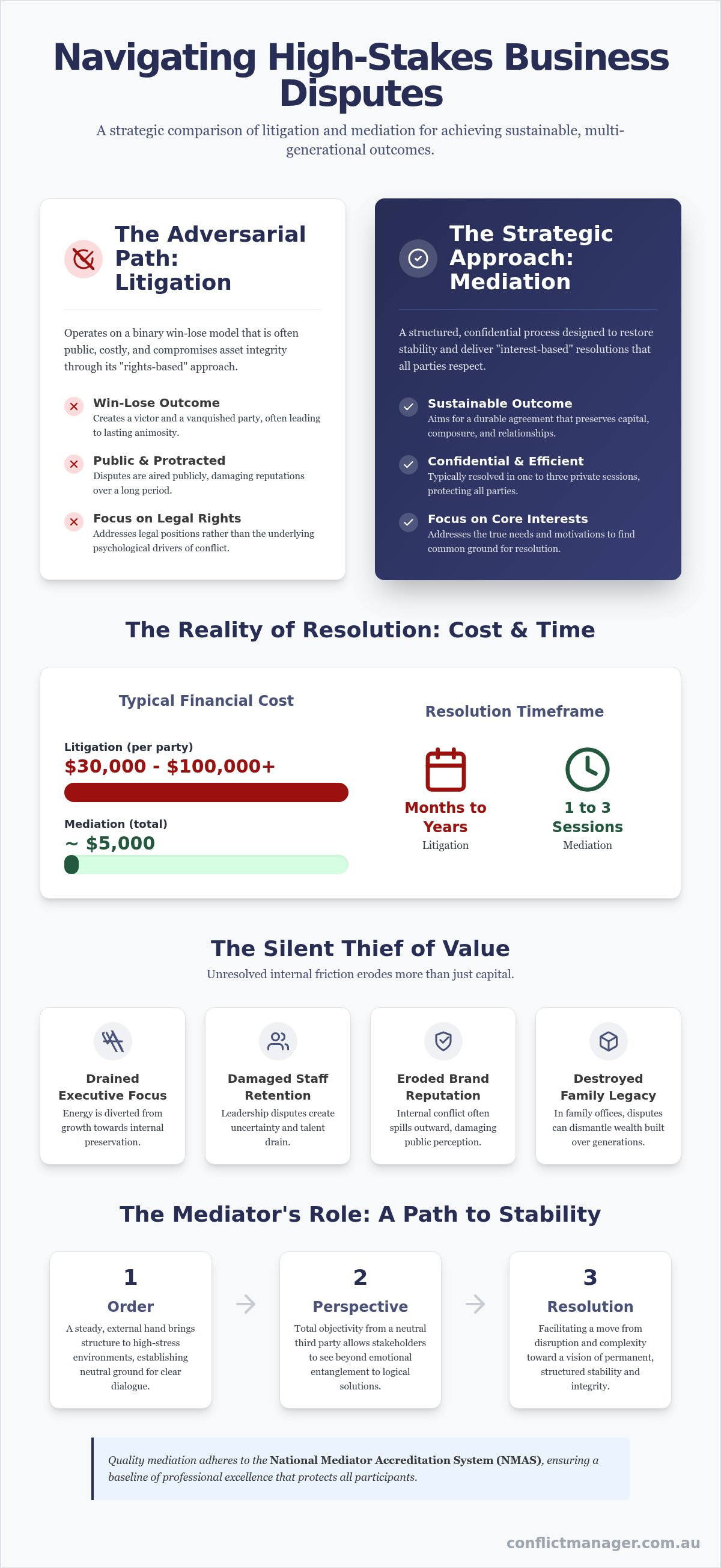
- Order. Perspective. Resolution. Recognise how a steady, external hand brings clarity to high-stress environments, allowing your organisation to move from disruption toward permanent stability.
Beyond Litigation: The Strategic Role of Business Mediation Services
Conflict is often viewed as an obstacle to be removed. In reality, it's a signal of structural misalignment. Business Mediation Services offer more than a simple alternative to the courtroom. They provide a structured facilitation process designed to restore clarity and stability to an organisation. While litigation operates on a binary win-lose model, mediation seeks a sustainable outcome where all parties respect the final agreement. High-stakes disputes, particularly those involving complex family offices or corporate restructuring, require a mediator who understands human and structural dynamics. This isn't just about legal points. It's about the invisible threads of relationship and responsibility that hold an organisation together.
Think of mediation as a tool for organisational hygiene. It shouldn't be a last resort. When used proactively, it identifies friction before it becomes a fracture. For those seeking business mediation services Sydney offers a competitive market, yet the focus must remain on the long-term health of the entity. It's about viewing the dispute not as a battle to be won, but as a transition to be managed. This composed approach allows leaders to address the underlying causes of friction without the scorched-earth consequences of a public legal battle.
The Financial and Emotional Cost of Unresolved Conflict
Internal friction is a silent thief. It erodes billable hours and drains executive focus, diverting energy away from growth and toward preservation. When leadership disputes are left to simmer, the ripple effect on staff retention and brand reputation is profound. In the context of high-net-worth family offices, the stakes are even higher. Intergenerational disputes that remain unmanaged don't just hurt feelings. They lead to the erosion of family assets and the potential destruction of a legacy built over decades. Research indicates that the average family court matter proceeding to a final hearing costs approximately $30,000 per party, with complex cases often exceeding $100,000. In comparison, mediation typically costs around $5,000 in total and is usually resolved within one to three sessions, preserving both capital and composure.
Mediation as a National Standard of Excellence
Quality mediation isn't defined by geography, but by adherence to the National Mediator Accreditation System (NMAS). For Sydney-based businesses, engaging a firm with a national perspective provides a broader lens on complex corporate disputes. These standards ensure a baseline of excellence that protects all participants. By moving from a state of disruption to a structured resolution, organisations can maintain their momentum. This transition requires a steady hand. It demands a neutral third party capable of viewing volatile situations with total objectivity, ensuring that the path forward is both logical and sustainable. This national excellence elevates the process from a local fix to a strategic asset for any Australian firm.
Navigating the Friction of Structural Change and Family Wealth
Change is a catalyst for friction. It's an inevitable byproduct of growth, succession, or restructuring. When an organisation shifts its shape, the established order is disrupted. This disruption often leads to a loss of momentum as stakeholders become preoccupied with internal politics rather than external objectives. In these moments, the intervention of professional business mediation services Sydney becomes a strategic necessity. A mediator acts as a wise, external counsellor who remains unruffled by the volatility of the situation. They provide a sense of order when internal efforts struggle under the weight of history and expectation.
The primary goal during these transitions is the preservation of structural integrity. Internal friction, if left to fester, creates an environment where emotional entanglement replaces logical decision-making. This is particularly true in environments where the stakes are high and the relationships are long-standing. External facilitation provides the objectivity required to view these volatile situations without becoming part of them. It allows for a methodical progression from complexity toward a vision of structured resolution, ensuring the business continues to move forward.
Conflict Resolution for High-Net-Worth Family Offices
The management of multi-generational wealth is an exercise in balancing tradition with evolution. High-emotion environments are common in family offices where the lines between personal identity and professional responsibility are blurred. Friction often manifests between family members and the non-family executives hired to manage the assets. These executives may prioritise modern governance, while the family prioritises historical legacy. External facilitation allows these parties to speak across that divide. It ensures that the transition of control doesn't lead to the erosion of the legacy itself. By focusing on sustainable outcomes, mediation preserves the family's structural integrity for the next generation.
Stabilising Organisations during Structural Change
Succession and mergers represent a high-stakes transition for any firm. Without clear communication, a power vacuum can quickly emerge. This leads to a state of complexity that can paralyse decision-making. Mediation acts as a neutral third party to bring clarity to these clouded situations. It facilitates dialogue between stakeholders who may have fundamentally different visions for the firm's future. By establishing a logical sequence for these conversations, mediation moves the parties from a state of disruption toward a vision of structured resolution. This process ensures all parties respect the final agreement because they were instrumental in its design.
Choosing the Right Mediator: Legal Settlement vs. Sustainable Resolution
The resolution of a complex dispute is rarely found in the fine print of a contract alone. While many organisations instinctively turn to a legalistic approach, this often fails to address the underlying psychological drivers that fuel the conflict. A purely "rights-based" model focuses on who is correct under the law; it seeks a winner and a loser. In contrast, the "interest-based" approach used by expert facilitators prioritises what each party actually needs to move forward. For those seeking business mediation services Sydney offers various options, yet the distinction lies in whether the mediator is seeking a quick settlement or a truly sustainable resolution.
Objectivity is the cornerstone of effective intervention. In volatile, high-stakes environments, emotions can cloud the judgment of even the most seasoned executives. A neutral third party brings a sense of order to this chaos. They don't just facilitate a conversation; they embody a composed authority that lowers the collective pulse of the room. This steady presence allows participants to step back from the friction of the moment and view the situation with total objectivity. It transitions the dialogue from a state of disruption toward a vision of structured resolution.
The Limitations of Lawyers in Strategic Mediation
Legal representation is essential for finalising deeds, yet allowing a legalistic mindset to drive the mediation process can escalate tension. Lawyers are trained for advocacy and adversarial combat. This can inadvertently deepen the divide between stakeholders when the goal should be reconciliation. There is a profound difference between a legally binding "deal" and a psychologically sustainable "resolution". A deal might end the litigation, but a resolution restores the organisational momentum. You should involve legal counsel to protect your interests, but they shouldn't be the primary architects of the interpersonal solution. The goal is to reach an agreement that all parties respect, not one they simply tolerate under duress.
Evaluating the Credentials of a Professional Mediator
Selecting a mediator requires looking beyond basic accreditation. While the National Mediator Accreditation System (NMAS) provides a baseline of professional standards, high-stakes disputes demand expertise in organisational change and family dynamics. You need a mediator who understands the weight of responsibility inherent in high-net-worth environments. They must be able to navigate the friction of interpersonal dynamics without becoming emotionally entangled themselves. Assess the "fit" between the mediator’s tone and your organisation’s culture. A wise, external counsellor should feel like a steady hand; someone capable of viewing the structural integrity of your business as the highest priority throughout the transition.
Preparing for Facilitation: Managing High-Emotion Stakeholder Dynamics
Preparation is the foundation of resolution. It requires more than a calendar invite and a meeting room. Before engaging with business mediation services Sydney, stakeholders must be mentally and structurally aligned for the process ahead. This begins with a clear acknowledgment of the friction. Internal efforts often fail because they lack a neutral ground. Attempting to resolve high-stakes disputes in the same boardroom where the conflict originated rarely yields results. The environment itself carries the weight of past arguments. A neutral space allows for a reset. It signals that this is not business as usual, but a dedicated effort toward organisational stability.
Managing expectations is equally critical. Resolution is a process, not a single event. While many hope for a quick fix, true structural integrity requires a methodical approach. You must be prepared for a timeline that respects the complexity of the human and financial dynamics involved. A common concern is whether the other side will engage in good faith. In reality, the structured nature of professional facilitation often compels engagement. When a steady, objective third party manages the room, the incentives shift from winning an argument to finding a sustainable path forward.
Facilitating Difficult Conversations at the Leadership Level
Succession. Equity. Performance. These topics are inherently volatile. Preparing for them requires a balance of brevity and depth. Leaders must be briefed on the importance of listening without immediately formulating a rebuttal. This sets the stage for a steady, objective, and empathetic dialogue. By removing the need for defensive posturing, stakeholders can focus on the logic of the transition. This shift in tone is often the first step toward restoring operational momentum. If you are ready to address these challenges with a composed, professional hand, contact Conflict Manager to begin the preparation process.
Governance and Mediation in Family Trusts
Family trusts often involve complex layers of responsibility and expectation. Preparing trustees and beneficiaries for mediated discussions involves clarifying their roles within the structure. Every party needs to feel heard. However, this must be achieved without compromising the structural integrity of the trust itself. Professional facilitation plays a vital role in estate planning and wealth transfer by ensuring that interpersonal dynamics don't derail the preservation of the family legacy. It provides a framework where difficult conversations about the future can happen in a controlled, respectful environment, moving the family from a state of complexity toward a vision of structured resolution.
Conflict Manager: Restoring Stability through Composed Professional Mediation
Conflict. Stagnation. Resolution. When internal efforts to manage friction reach their limit, the intervention of an independent expert becomes the only logical path forward. Conflict Manager provides the steady hand required to navigate these volatile transitions. Our approach to business mediation services Sydney is built on the principle of total objectivity. We don't just facilitate meetings; we restore the structural integrity of your organisation. By acting as a wise, external counsellor, we help stakeholders view their situation without the emotional entanglement that often stalls progress. This isn't merely about reaching a settlement. It's about ensuring the organisation emerges with its legacy intact and its momentum restored.
A Methodical Path to Resolution
The journey from disruption to stability is rarely linear. It requires a methodical progression that respects the weight of responsibility held by leaders and family offices. We move parties from a state of complexity toward a vision of structured resolution by using a deliberate, logical sequence of communication. This process is designed to lower the pulse of the room. It builds trust through transparency and objective analysis. We use rhythmic variation in our dialogue to manage the tempo of the discussion, ensuring that high-emotion topics are addressed with composure rather than reactivity. Our commitment is to the long-term health of both the organisation and the family unit. We prioritise sustainable outcomes over quick fixes, ensuring that the final agreements are ones that all parties respect and uphold for years to come.
Engaging a Neutral External Counsellor
Every dispute is unique. High-level stakeholder needs require a bespoke approach that acknowledges the specific human and structural dynamics at play. Initiating this process begins with a confidential consultation where we assess the current state of friction and the desired outcomes. This initial step provides the clarity needed to design a mediation framework that fits your organisational culture perfectly. By choosing a neutral external counsellor, you ensure that the process remains focused on the logic of resolution rather than the history of the conflict. This external perspective is often what's missing when internal teams try to self-regulate under pressure. If your organisation is ready to move past the erosion of assets and focus on a stable future, we invite you to enquire about our strategic mediation services today.
Securing the Future through Structured Resolution
Clarity. Order. Progression. The path from internal friction to organisational stability requires more than just a legal agreement. It demands a fundamental shift in perspective. By choosing interest-based facilitation over adversarial litigation, you ensure that the underlying drivers of conflict are addressed rather than ignored. This is especially vital for family offices where the preservation of a multi-generational legacy is the highest priority. When evaluating business mediation services Sydney executives deserve a partner who understands the weight of their responsibility.
Conflict Manager provides that steady hand. Our approach focuses on sustainable outcomes and the absolute integrity of your assets. We bring a composed, authoritative presence to even the most volatile situations. You don't have to navigate these complex transitions alone. A vision of structured resolution is within reach. Restore stability to your organisation with Conflict Manager and begin the process of returning to operational momentum. Your legacy is worth the investment in professional facilitation.
Frequently Asked Questions
What is the difference between business mediation and legal arbitration?
Mediation is a facilitative process where an independent third party helps stakeholders reach their own agreement. Arbitration is more adversarial; an arbitrator acts like a judge and makes a binding decision for the parties. While arbitration focuses on legal rights, business mediation services Sydney firms provide focus on underlying interests and sustainable outcomes. This allows for greater flexibility and the preservation of long-term professional relationships during high-stress periods.
How long does a typical business mediation process take in Australia?
Most business mediations in Australia are resolved within one to three sessions. A single full-day session is often sufficient for commercial disputes, while complex family office matters may require several sessions spread over weeks. The timeline depends on the parties' readiness to engage and the complexity of the structural issues. This efficiency contrasts sharply with the court system, where matters can take years to reach a final hearing.
Can mediation help if the relationship between business partners has completely broken down?
This process is specifically designed for situations where communication has collapsed. The mediator acts as a neutral buffer, managing the friction and ensuring dialogue remains objective. Even if partners can't stand to be in the same room, "shuttle mediation" allows the facilitator to move between separate spaces. This structured approach prevents emotional entanglement from stalling the resolution, helping parties reach a practical agreement despite their personal differences.
Is business mediation legally binding for all parties involved?
Agreements reached through this process become legally binding once they are documented in a written contract or a Deed of Settlement signed by all parties. Although the mediation sessions are flexible and confidential, the resulting document carries the same weight as any other valid contract. To ensure enforceability, many organisations choose to have these agreements converted into consent orders filed with a court, providing a clear and permanent resolution.
What happens if one stakeholder refuses to participate in the mediation process?
Participation is generally voluntary, meaning the process works best when all stakeholders are willing to engage. If one party refuses, the process cannot proceed in its traditional form. However, Australian courts increasingly compel reluctant parties to participate in mediation before allowing a case to go to trial. This often breaks the deadlock, as the presence of a steady, objective third party encourages even the most hesitant participants to consider a settlement.
How does mediation protect the privacy and reputation of a high-net-worth family?
Unlike court proceedings, which are typically a matter of public record, mediation is a strictly confidential process. Discussions, offers, and agreements made during facilitation cannot be disclosed to third parties or used in future litigation. This privacy is essential for high-net-worth families who wish to protect their reputation and legacy. It ensures that internal friction remains behind closed doors, allowing for a structured resolution without the risk of public exposure.
Should we have our lawyers present during the mediation sessions?
Parties are welcome to have legal counsel present, but their role should be one of support rather than advocacy. Lawyers can provide real-time advice on the legal implications of proposed agreements. The focus of the session remains on the stakeholders' interests and organisational stability. It's often helpful to have legal representatives who understand the interest-based model, ensuring they contribute to a sustainable resolution rather than escalating existing tension.
What is the success rate of professional mediation in resolving commercial disputes?
Professional mediation has a high success rate, with many industry reports indicating that over 70% of disputes are resolved during or shortly after the process. This effectiveness stems from the parties having direct control over the outcome. When engaging business mediation services Sydney organisations often find that the structured nature of the dialogue leads to agreements that all stakeholders respect, making it a highly efficient tool for restoring stability.


