

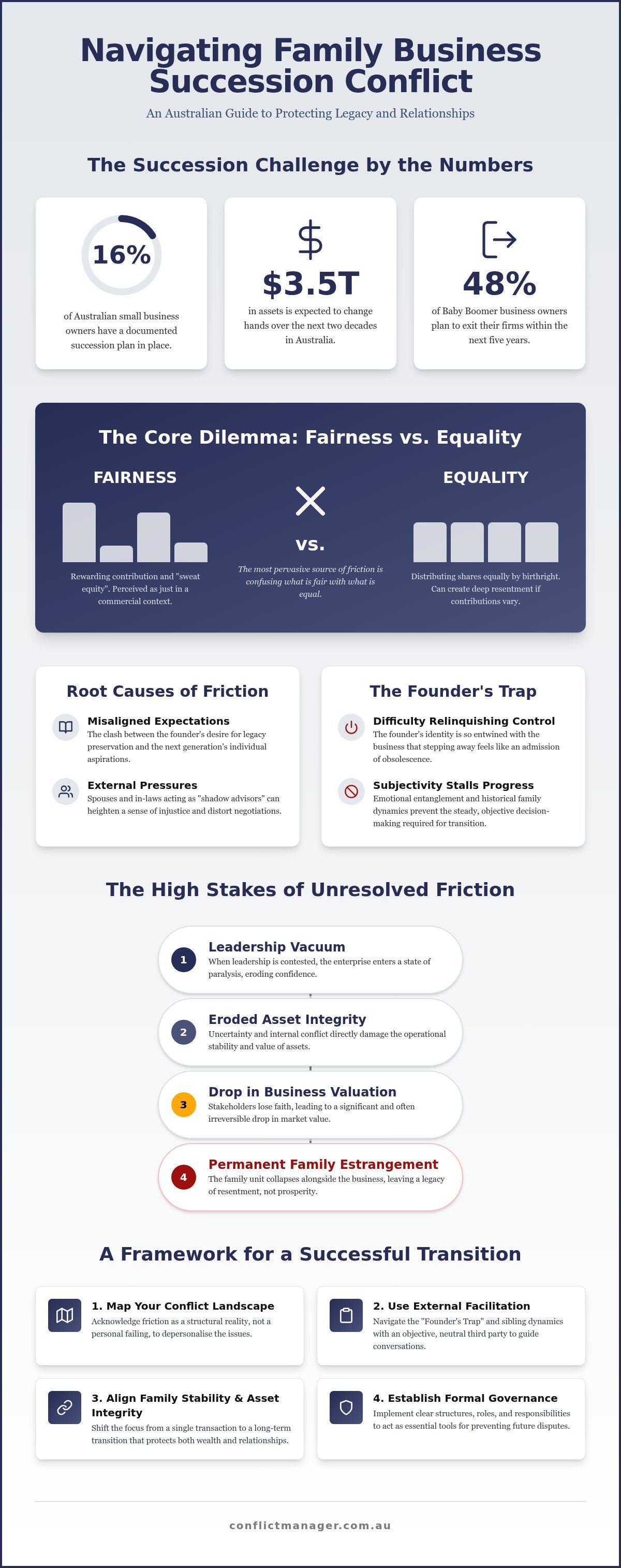
Only 16% of Australian small business owners have a documented succession plan in place. This statistic is startling when you consider that $3.5 trillion in assets is expected to change hands over the next two decades. For most families, the technical transfer of shares isn't the primary hurdle. The real challenge lies in the deep-seated family business succession planning conflict that surfaces when legacy meets new leadership.
Legacy. Identity. Friction. It's natural to feel a sense of dread when discussing the future of your enterprise. You've spent years building a business, yet the fear of family estrangement or founder's syndrome often keeps the most important conversations behind closed doors. This guide will show you how to manage the complex emotional and structural friction that arises during these transitions. We'll explore how to establish clear governance and define roles to ensure your family remains intact while the business moves forward with stability. By shifting the focus from a transaction to a transition, you can protect both your wealth and your relationships.
Key Takeaways
- Understand the structural triggers of family business succession planning conflict, focusing on the nuanced distinction between perceived fairness and literal equality.
- Learn why the "founder’s trap" often stalls internal progress and how external facilitation provides the objectivity needed to move forward.
- Explore a methodical framework for mapping your conflict landscape; this allows you to acknowledge friction as a structural reality rather than a personal failing.
- Discover how to align family stability with long-term asset integrity to ensure your enterprise remains resilient through intergenerational change.
- Gain clarity on how formal governance structures act as essential tools for preventing disputes before they jeopardise the family legacy.
The Complexity of Family Business Succession Planning Conflict
Identity. Ambition. Legacy. These forces often collide during the transition of power within an Australian enterprise. Succession conflict is the friction between legacy preservation and individual aspiration. While many view these disputes as purely financial or structural, they are deeply rooted in the intersection of family identity and commercial interests. It's a delicate balance where the weight of the past often presses against the requirements of the future.
The year 2026 represents a critical juncture for intergenerational wealth transfers in Australia. With 48% of Baby Boomer business owners planning to exit their firms within the next five years, the pressure on family systems is intensifying. This movement coincides with new, more granular ATO reporting obligations for family trusts that came into effect on 1 July 2026. Without a clear strategy, the pressure of these regulatory deadlines can transform healthy debate into destructive family business succession planning conflict. Healthy debate focuses on the Succession planning process as a tool for evolution; destructive friction, however, turns internal and targets the individuals involved rather than the organisational needs.
The High Stakes of Unresolved Friction
Stability. Continuity. Value. These are the first casualties of unmanaged disputes. When leadership remains contested, the enterprise enters a state of paralysis that often results in a leadership vacuum. This uncertainty erodes asset integrity and can lead to a significant drop in business valuation as stakeholders lose confidence. Beyond the balance sheet, the risk of permanent family estrangement looms large. Disputes over "who is in charge" can fracture relationships so deeply that the family unit collapses alongside the business structure, leaving a legacy of resentment rather than prosperity.
Why Internal Efforts Often Struggle
Objectivity. Clarity. Distance. These qualities are difficult to maintain when discussing the future of a family legacy at the kitchen table. Most internal efforts to resolve friction fail because they are weighed down by historical roles. Sibling dynamics established in childhood often resurface in the boardroom, making it difficult for the next generation to be seen as competent professionals. The "Founder’s Trap" also complicates matters. It's the psychological difficulty of relinquishing control, where the founder’s identity is so entwined with the business that stepping away feels like an admission of obsolescence. This emotional entanglement prevents the steady, objective decision-making required for a successful transition, as participants are often too close to the problem to see the solution.
Root Causes of Friction in Australian Family Enterprises
Equity. Entitlement. Expectation. These three elements form the volatile foundation upon which many disputes are built. While the technical aspects of a transition are often handled by accountants and lawyers, the underlying emotional drivers are what typically ignite a family business succession planning conflict. It's rarely just about the money; it's about what the money represents in terms of love, validation, and status within the family hierarchy.
The role of extended family, particularly in-laws, adds another layer of complexity to this dynamic. Spouses often act as "shadow" advisors, influencing the perceptions of the direct descendants and sometimes heightening a sense of injustice. This external pressure can distort internal negotiations, making it difficult for siblings to reach a consensus without feeling they're betraying their own immediate household's interests.
The "Fairness vs. Equality" Dilemma
The most pervasive source of friction is the confusion between what is fair and what is equal. Parents often feel a primal urge to leave an equal share of the estate to all children. However, in a commercial context, giving a 25% stake to a child who has spent twenty years building the firm and the same 25% to a child who has never stepped foot in the office is rarely perceived as "fair." This clash between "sweat equity" and birthright creates deep resentment. Managing these succession planning challenges requires a clear distinction between ownership rights and management responsibilities. If non-active family members are granted voting power over operational decisions, the resulting gridlock can be terminal for the enterprise.
Structural Misalignment: Trusts and Superannuation
Friction often arises when the legal architecture of the family wealth doesn't match the operational vision for the business. As of 1 July 2026, the ATO's increased reporting obligations for family trusts mean that distributions are under more scrutiny than ever. If a family trust deed was drafted decades ago, it might contradict the current succession strategy, leading to a "Control vs. Benefit" conflict. Similarly, the use of Self-Managed Super Funds (SMSFs) to hold business real estate can create liquidity traps. If the retiring generation needs to sell the premises to fund their pension while the next generation needs to retain the site for operations, the structural misalignment becomes a catalyst for dispute. Identifying these gaps early is essential, and engaging a professional to provide stakeholder facilitation can help align these disparate interests before they reach a breaking point.
Internal Resolution vs. Professional Mediation: Navigating the Founder’s Trap
Sunday lunch. Sunday afternoon. The kitchen table. For many Australian families, these are the traditional settings for discussing the future of the enterprise. While well-intentioned, these casual environments often lack the structure needed to address a deep-seated family business succession planning conflict. Without a formal process, discussions frequently devolve into historical grievances or circular arguments that leave the core issues untouched. The Founder’s Trap is the inability to separate personal identity from business leadership. When the business is the founder's life's work, any suggestion of a transition is often perceived as a challenge to their very existence.
Proactive conflict management is a deliberate investment in the structural integrity of the firm. It stands in stark contrast to the alternative: the high cost of litigation. Legal battles don't just drain financial reserves; they permanently erode the trust required to keep a family business viable. A neutral third party brings a level of composure that internal efforts simply cannot sustain under pressure. They act as a circuit breaker, preventing emotional volatility from short-circuiting the transition process.
The Limitations of Internal Facilitation
Power. Hierarchy. Silence. Internal discussions are often hamstrung by the weight of established family roles. Junior family members may feel silenced by a dominant founder or an older sibling, leading to a false sense of consensus that eventually fractures. Long-standing family offices frequently become echo chambers where old patterns of communication prevent new ideas from taking root. While trusted lawyers and accountants are vital for technical advice, they are often ill-equipped to mediate high-emotion disputes. Their focus is typically on the "hard" assets, whereas succession friction is usually driven by "soft" psychological factors that require a different set of professional tools.
The Value of a Neutral Third Party
Objectivity. Distance. Stability. A neutral third party provides a steady hand capable of viewing volatile situations without becoming emotionally entangled. They establish a safe space where difficult, transparent conversations can occur without the fear of immediate retribution or long-term estrangement. By ensuring all stakeholders feel heard without bias, the facilitator lowers the collective pulse of the room. This shift from a defensive posture to a collaborative one is essential for reaching a sustainable outcome. It allows the family to move past the fog of individual aspiration and focus on the shared goal of preserving the legacy for generations to come.
Strategic Frameworks for Resolving Intergenerational Disputes
Order. Structure. Resolution. Moving beyond a state of disruption requires a methodical approach that prioritises the health of the family system alongside the commercial viability of the firm. Resolving a family business succession planning conflict is not about eliminating disagreement entirely; it's about creating a framework where friction is managed constructively. This process begins with a fundamental shift in perspective, moving from blame toward an analytical understanding of the structural pressures at play.
A sustainable resolution typically follows five distinct stages:
- Step 1: Acknowledgment. Recognise that friction is a structural reality of intergenerational change, not a personal failing of the individuals involved.
- Step 2: Mapping. Engage external facilitation to map the conflict landscape, identifying the hidden triggers and misaligned incentives that fuel disputes.
- Step 3: Separation. Establish clear boundaries by separating family councils, where emotional and relational issues are discussed, from board meetings, which must remain focused on operational performance.
- Step 4: Formalisation. Document the agreed-upon path forward through family constitutions and charters that serve as the "north star" for future decision-making.
- Step 5: Implementation. Execute a staged transition plan that allows for a gradual transfer of authority, ensuring the incoming generation is prepared for the weight of leadership.
By following this progression, families can move from a state of clouded complexity toward a vision of structured resolution. If your family enterprise is currently stalled by internal friction, engaging professional family conflict resolution can provide the steady hand needed to navigate these stages with objectivity.
Establishing Clear Governance
Clarity. Boundaries. Accountability. Formal governance acts as a safeguard against the "Founder’s Trap" discussed earlier. A Family Constitution is essential for preventing future disputes because it defines the "Rules of Engagement" for communication and decision-making. This document should outline clear entry and exit criteria for family members, ensuring that roles are based on competence rather than birthright. When the rules are transparent and agreed upon in advance, the potential for perceived injustice is significantly reduced, allowing the focus to remain on asset integrity.
Managing the Psychological Transition
Identity. Purpose. Legacy. The structural side of succession is often easier to solve than the psychological one. For the founder, the transition often triggers a deep fear of loss, specifically a loss of power and identity. Helping the outgoing leader find a "Next Act" outside the day-to-day operations is vital for a smooth handover. Simultaneously, the incoming generation requires mentoring and coaching to build the confidence needed to step out from the founder's shadow. Addressing these emotional undercurrents ensures that the transition is not just a change in shareholding, but a successful evolution of the family's shared purpose.
Achieving Sustainable Outcomes with Conflict Manager
Stability. Integrity. Continuity. These are the essential pillars of any enduring family enterprise. Conflict Manager provides the expert-led facilitation required to protect these foundations during periods of high-emotion transition. We recognise that a family business succession planning conflict is rarely a simple legal or financial dispute; it's a complex human dynamic that requires a steady, objective hand to resolve. Our role is to act as a neutral third party that brings clarity to clouded situations, ensuring that the transition process remains methodical and logical.
Our approach treats asset integrity and family stability as twin goals. We act as a wise, external counsellor capable of viewing volatile situations with total objectivity. In high-stakes environments, composure is our primary tool. This allows us to lower the collective pulse of the room and move stakeholders from a state of defensive complexity toward a vision of structured resolution. By focusing on sustainable outcomes, we ensure that the transition strengthens the business rather than fracturing the family unit. We provide the order necessary to navigate structural change without becoming emotionally entangled in the friction.
Bespoke Solutions for High-Net-Worth Families
Complexity. Wealth. Heritage. High-net-worth families and family offices face unique structural pressures that standard business consulting often overlooks. We specialise in high-asset situations where complex trusts and intergenerational expectations create significant friction. Our facilitation provides a calm, professional perspective that helps families organise their governance and roles with precision. This level of discernment is vital for protecting the family legacy for future generations, ensuring that the wealth remains a source of opportunity rather than a catalyst for discord.
Next Steps: Reaching Clarity
Timing. Communication. Initiative. The most effective way to manage a dispute is to act before the friction reaches a permanent impasse. Introducing the idea of a mediator to the family doesn't have to be a confrontational act. Instead, it should be presented as a proactive step toward clarity and order. It's about acknowledging that the weight of the legacy is too significant to be left to chance or unmanaged emotion. If you are ready to secure the future of your enterprise, you can Enquire about our Family Office Mediation services to begin the process of structured resolution.
Securing the Future of Your Family Enterprise
Order. Stability. Continuity. The transition of leadership within an Australian enterprise is a profound shift that requires more than just legal documentation or tax advice. We've explored how a successful handover depends on distinguishing between fairness and equality, establishing clear governance, and acknowledging the psychological weight of the transition. When unmanaged, family business succession planning conflict can erode decades of hard-won asset integrity and fracture the very relationships the business was built to support.
Conflict Manager acts as a steady hand during these volatile periods. As specialists in high-net-worth family office friction, we provide composed, neutral, and professional facilitation across Australia. Our focus remains on achieving sustainable outcomes that preserve both your wealth and your family's heritage. By introducing a neutral third party, you move from a state of clouded complexity toward a vision of structured resolution.
Secure your family legacy with expert mediation. Your legacy is too valuable to be left to chance. With the right framework, your family can emerge from this transition more resilient and aligned than ever before.
Frequently Asked Questions
What is the most common cause of family business succession conflict?
The most pervasive trigger is the tension between perceived fairness and literal equality among siblings. Parents often default to equal distribution, but this frequently ignores the sweat equity of those active in the firm. This discrepancy creates deep-seated family business succession planning conflict. Resolving this requires a methodical approach that separates the emotional need for validation from the commercial requirements of the business, ensuring that all parties feel their contributions are recognised.
How can we resolve a dispute if the founder refuses to step down?
Resolving a situation where a founder resists retirement requires addressing the underlying fear of losing identity or purpose. This is the "Founder's Trap" in action. A neutral facilitator helps the leader identify a meaningful "Next Act" outside the daily operations while mentoring the next generation. By focusing on a staged transition rather than an abrupt exit, the process feels like an evolution of the founder's legacy rather than a rejection of their authority.
Is mediation better than legal action for family business disputes?
Mediation is almost always superior to legal action because it prioritises the preservation of family relationships and asset integrity. Litigation is inherently adversarial; it often results in permanent estrangement and the public dilution of business value. Professional facilitation provides a safe, private space to address the root causes of family business succession planning conflict. This approach focuses on sustainable, clear outcomes that a court of law cannot provide, as legal rulings rarely account for complex family dynamics.
What happens if the succession plan contradicts the family trust?
Structural misalignment between a succession vision and a family trust deed often leads to operational paralysis. This is particularly common given the new ATO reporting obligations for family trusts effective from 1 July 2026. Resolving this requires stakeholder facilitation to align the legal architecture with the business's future needs. By identifying these gaps early, families can restructure their holdings to ensure that the trust supports the transition rather than acting as a barrier to it.
How do we deal with family members who want the money but not the work?
Managing family members who desire financial benefits without operational responsibility requires a clear separation of ownership and management. Governance structures should define that dividends are a right of ownership, while salaries and decision-making power are rewards for active competence. When these boundaries are formalised, it reduces resentment among active members. This clarity ensures that the business remains a professional enterprise rather than a source of unearned entitlement, protecting long-term asset stability.
Can a neutral third party help if the family is already not speaking?
A neutral third party is often most effective when communication has completely broken down. They act as a steady hand and a circuit breaker, facilitating indirect communication before moving toward joint sessions. By establishing safe "Rules of Engagement," a mediator helps the family move past historical grievances. This objective perspective brings order to volatile situations, allowing the family to focus on shared commercial interests even when personal relationships are currently strained.
What is a Family Constitution and how does it prevent conflict?
A Family Constitution is a formal document that serves as the "north star" for the enterprise. It prevents conflict by defining clear entry and exit criteria for family members and establishing protocols for decision-making. By documenting these rules during a period of relative calm, the family creates a structural safeguard against future disputes. This governance framework ensures that everyone understands their roles and responsibilities, which lowers the collective pulse of the family system during high-pressure transitions.
How long does the family business mediation process typically take?
The duration of the mediation process varies depending on the complexity of the assets and the depth of the emotional friction. Most engagements follow a methodical, staged approach that typically spans several months. This allows for individual consultations followed by facilitated group sessions to map the conflict landscape. The goal isn't a quick fix, but a sustainable resolution that ensures the long-term integrity of the business and the stability of the family relationships.


