

Impasse. Friction. Erosion. When the collaborative spirit that built a company curdles into conflict, the damage isn't just financial. It's structural. You've likely felt the exhaustion of circular arguments and the creeping fear that your reputation might suffer while you're focused on resolving business partner disputes. It's a heavy burden to carry, especially when the only visible path forward seems to be a scorched-earth legal battle that threatens the very business you're trying to save.
Finding a sustainable resolution doesn't have to result in a binary win-loss outcome that leaves the organisation in tatters. This guide offers a methodical, expert-led framework for navigating these high-stakes transitions with composure. You'll discover how stakeholder facilitation and objective mediation can restore order, providing the clarity you need regarding equity, roles, or potential exit strategies. We'll examine the strategic logic of external intervention and how it serves to protect both your commercial assets and your personal wellbeing.
Key Takeaways
- Examine how misalignment in vision or fiduciary duty impacts the Australian corporate landscape and requires a structured, objective response.
- Learn why private mediation is a superior strategic choice for resolving business partner disputes compared to the public reputational risks of litigation.
- Identify the structural catalysts of friction, such as rapid growth or mergers, and how to address them before they compromise the business’s integrity.
- Develop a grounded approach to internal de-escalation that replaces emotional exhaustion with clear roles and sustainable governance.
- Understand the value of a neutral third party in navigating complex transitions while preserving long-term commercial relationships and family legacies.
Understanding Business Partner Disputes in the Australian Corporate Landscape
Alignment. Purpose. Duty. These pillars support every successful partnership, yet they are also the most common points of failure. A business partner dispute is often defined as a fundamental misalignment of vision, workload, or fiduciary responsibility. Within the Australian commercial landscape, the Partnership Act sets out basic obligations, but it rarely captures the nuanced friction that occurs in a high-stakes boardroom or a private family office. These legal frameworks provide a floor, not a ceiling, for how modern enterprises should function.
Distinguishing between transactional friction and deep-seated structural conflict is vital. Transactional issues are usually solved with a spreadsheet or a brief meeting. Structural conflicts, however, require a more sophisticated approach to resolving business partner disputes because they involve the very architecture of the organisation. For high-net-worth family offices, these pressures are magnified. Emotional history blends with commercial duty, making the path toward resolution feel particularly clouded and heavy.
The Spectrum of Disruption
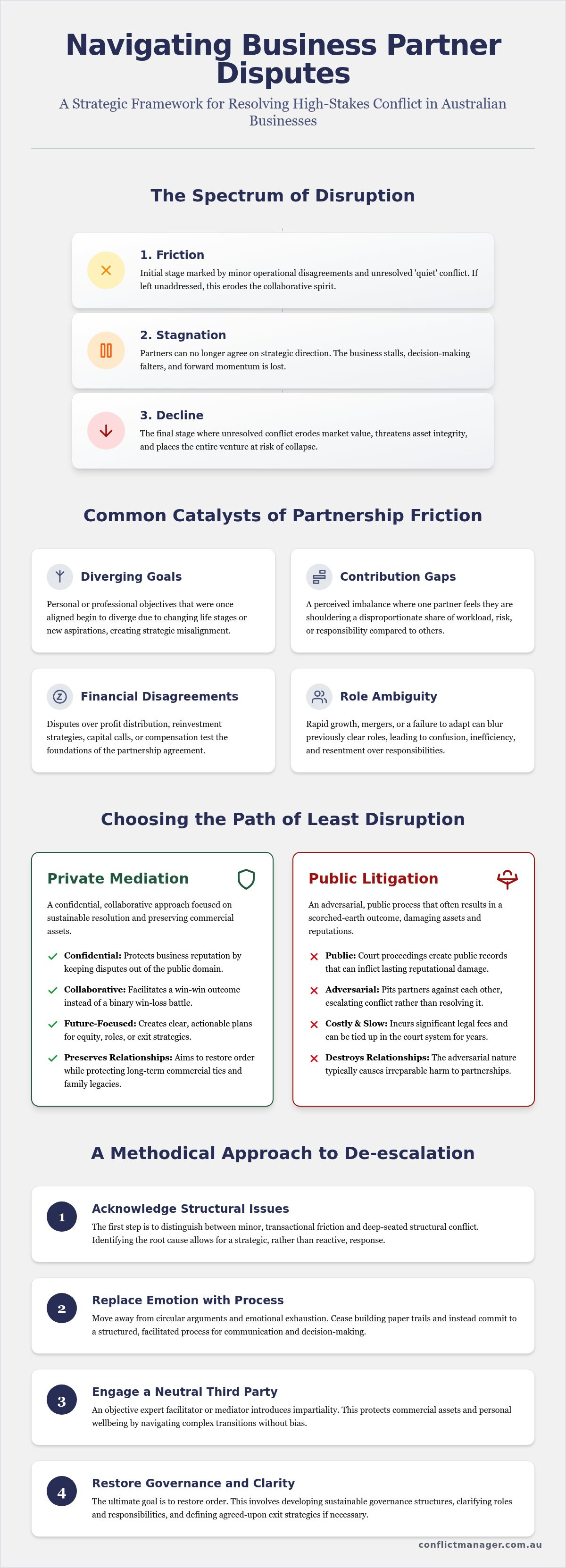
Friction. Stagnation. Decline. Disruption exists on a scale. It begins with minor operational disagreements that, if left unaddressed, evolve into fundamental strategic rifts. Unresolved "quiet" conflict is perhaps the most dangerous form of friction. It doesn't explode; it erodes. Over time, this erosion reduces the market value of the firm and eventually threatens asset integrity. When partners can no longer agree on the direction of travel, the business stalls, and the structural integrity of the entire venture is placed at risk.
Common Triggers for Partnership Disputes
Conflict often stems from a perceived contribution gap. When one partner feels they're shouldering a disproportionate workload while others reap the rewards, resentment builds quickly. Financial disagreements regarding profit distribution or capital calls are also frequent catalysts that test the strength of a partnership agreement. In family-run businesses, succession planning and intergenerational wealth transfer add layers of emotional complexity that traditional corporate structures don't encounter. Understanding these triggers allows stakeholders to explore various dispute resolution methods before the damage becomes irreversible. By identifying the root cause, you can move away from reactive stress and toward a vision of structured resolution, ensuring that the process of resolving business partner disputes remains objective and methodical.
The Structural and Interpersonal Catalysts of Partnership Friction
Ownership is deeply personal. In high-stakes environments, the human element isn't a variable to be managed; it's the foundation of the entire enterprise. When this foundation shifts, the business enters a period of heightened volatility. Structural changes, such as rapid scaling or complex mergers, often act as the primary catalyst for friction. Roles that were once clear become blurred, leading to role ambiguity that stifles productivity. The "founder's trap" frequently emerges when an individual's identity is so intertwined with the firm that they struggle to delegate or adapt as the organisation matures. This lack of flexibility creates a bottleneck that breeds resentment among other stakeholders.
The Anatomy of a Breakdown
Communication silos represent the first stage of a serious structural rift. Instead of open dialogue, partners begin to document every interaction. They stop talking and start building a paper trail. External stressors, like shifting market conditions or new regulatory burdens, often exacerbate these internal fractures by increasing the pressure on every decision. Personal goals that aligned perfectly a decade ago can diverge as life stages change. This divergence makes the task of resolving business partner disputes more about reconciling different visions for the future than simply fixing the present. When the focus shifts from growth to defence, the business's commercial integrity is already under threat.
Disputes in High-Net-Worth Family Offices
Legacy. Equity. Duty. High-net-worth family offices face a unique set of challenges that traditional corporate models aren't built to handle. Here, the intersection of multi-generational asset management and family history creates a complex web of "emotional inheritance." This isn't just about financial equity; it's about legacy, birthright, and perceived status within the family unit. Traditional corporate governance often fails in these contexts because it treats stakeholders as purely rational actors. It doesn't account for decades of domestic history or the weight of carrying a family name. Navigating the nuances of resolving business partner disputes in a family setting requires a steady, external hand. For those facing these layered complexities, seeking organisational conflict management can provide the objective distance needed to preserve both the assets and the relationships.
High-emotion situations naturally degrade objective decision-making. When the stakes are this high, the pulse rises and perspective narrows. It becomes difficult to see the business as an objective entity separate from the personal conflict. Recognising these catalysts early is the first step toward restoring order and ensuring the structural integrity of the business remains intact.
Mediation versus Litigation: Choosing the Path of Least Disruption
Privacy. Discretion. Control. These are the hallmarks of a strategic approach to conflict. When stakeholders face the prospect of resolving business partner disputes, the choice between mediation and litigation is rarely just a legal one; it's a commercial decision with long-term structural implications. Litigation is, by its nature, a public and adversarial process. It invites external scrutiny into the internal mechanics of a firm, often exposing vulnerabilities that are better left behind closed doors. This exposure can be particularly damaging for high-net-worth family offices where the line between private life and professional reputation is thin.
Expert-led facilitation, conversely, operates with a sense of composed authority. It prioritises the preservation of commercial integrity over the theatre of the courtroom. Choosing mediation isn't an act of compromise or a sign of weakness. It's a strategic move designed to keep decision-making power in the hands of those who actually understand the business's nuances. It allows for a level of nuance that a binary court ruling simply cannot accommodate.
The Limitations of the Adversarial Approach
Courtrooms are binary environments. There's a winner and a loser. In the context of a complex partnership, however, a "win" in court can still result in the total destruction of the business's operational focus. The adversarial approach often leads to a complete loss of control. You hand over the future of your assets and your equity to a judge or arbitrator who, while expert in law, may not grasp the delicate interpersonal dynamics or the specific market pressures your firm faces. This transfer of power often leads to outcomes that satisfy legal requirements but fail to address the underlying structural friction.
In the Australian business community, reputation is a fragile asset. Litigation is a matter of public record. The details of internal infighting, once aired in a public forum, can cause irreparable damage to your brand and your relationships with key stakeholders. The financial cost of a prolonged legal battle is significant, but the reputational cost is often higher. It's a heavy price to pay for a resolution that might not even solve the root cause of the disagreement.
The Advantages of Expert-Led Facilitation
Facilitation focuses on the "going concern" value of the business. While the resolution process unfolds, the organisation must continue to function. A neutral third party helps maintain stability, ensuring that operational friction doesn't lead to a total breakdown in service delivery or asset management. This methodical progression from disruption to resolution is designed to lower the pulse of the organisation, allowing partners to focus on the business rather than the battle.
Sustainable outcomes are the primary goal. Unlike a court order, which is often rigid and limited by statute, mediation allows for the creation of bespoke solutions. These might include innovative equity restructuring, redefined roles, or structured exit strategies that preserve the dignity of all parties. By opting for a methodical, expert-led path for resolving business partner disputes, you ensure that the conclusion of the conflict isn't just an end to the fighting, but a foundation for future stability or a clean, professional transition.
A Methodical Approach to Internal Conflict De-escalation
Order. Logic. De-escalation. Moving from a state of disruption to one of clarity requires a disciplined, step-by-step framework. It's not about winning an argument; it's about preserving the business's structural integrity. The process begins with a rigorous audit of your foundational documents, such as Shareholder or Partnership Agreements, to understand the formal boundaries already in place. You must look beyond the legal jargon to see how these agreements were intended to function during times of stress. Establishing clear communication protocols is equally vital. By restricting dialogue to specific times and professional formats, you prevent the further erosion of trust while the process of resolving business partner disputes continues.
Step 1: Establishing the Objective Reality
Facts over feelings. You must separate genuine grievances from the emotional fatigue that often clouds high-stakes friction. This requires a level of detachment that's difficult to achieve alone. Document the specific ways the dispute is impacting operational stability, whether through stalled decision-making, staff turnover, or decreased productivity. Identifying "non-negotiables" for all parties creates a map of the conflict. It shows where there's room for movement and where the impasse is absolute. This clarity is the only way to move toward a vision of structured resolution.
Step 2: Engaging a Neutral Third Party
Internal resolution often fails because the participants are too emotionally entangled in the outcome to see it clearly. A neutral third party acts as a steady hand, providing an objective lens that internal stakeholders simply can't maintain under pressure. They don't take sides; they facilitate progress. When introducing the idea of mediation to a partner, frame it as a strategic tool to protect the business's value rather than a personal concession. It's a professional choice designed to avoid the binary win-loss trap of the courtroom. For those ready to restore order, engaging in professional stakeholder facilitation offers a structured path away from volatility.
Step 3: Navigating to a Sustainable Outcome
The focus must shift. We move from the binary question of "who is right" to the strategic question of "what is the best path forward for the organisation." This transition allows for the drafting of actionable resolutions that aren't just temporary fixes but long-term governance improvements. Sustainable outcomes depend on follow-up reviews to ensure that new equity structures or redefined roles are actually functioning as intended. Governance isn't a one-time event; it's a continuous process of alignment. By following this methodical progression, resolving business partner disputes becomes a catalyst for a more resilient and professional partnership structure that can withstand future challenges.
Restoring Governance: The Role of Expert Facilitation
Stability. Clarity. Order. These are the markers of an organisation that has successfully navigated a period of intense transition. Conflict Manager acts as a wise, external counsellor, providing a steady hand for those navigating high-stakes environments. Our focus is always on the preservation of asset integrity and the restoration of structural order. By viewing volatile situations with total objectivity, we move beyond immediate friction to establish a foundation for long-term governance. This methodical approach ensures that the process of resolving business partner disputes doesn't just halt the conflict; it actually strengthens the business for the challenges that lie ahead.
Tailored Solutions for Complex Organisations
High-net-worth family offices and maturing corporations require a specialised level of discernment. In multi-generational disputes, the emotional weight of legacy can often paralyse decision-making. A neutral third party brings a perspective that internal stakeholders, no matter how skilled, simply cannot possess while they're in the centre of the storm. We provide order during structural changes like mergers or successions, ensuring that the human element doesn't compromise the commercial reality. Our facilitation is bespoke, designed to address the unique psychological and structural dynamics of your specific organisation.
Achieving Clarity and Stability
The psychological relief of reaching a structured resolution is profound. It allows leaders to return their full focus to operational excellence rather than the exhaustion of internal infighting. Through expert-led facilitation, we help you draft governance structures that are resilient, clear, and actionable. This isn't a temporary fix; it's a permanent shift toward a more professional and aligned partnership. If you're currently facing organisational friction, you can enquire about expert facilitation for your partnership to begin the journey toward stability.
The ultimate goal of resolving business partner disputes is the return to original purpose. Every business was founded with a vision of growth and collaboration. Conflict, while difficult, can be the catalyst that forces a necessary evolution in how that vision is pursued. When the heat is removed and the roles are clarified, the business is free to function as it was intended. Order is restored. The path forward is clear. The integrity of the legacy is preserved.
Restoring Order and Commercial Focus
Conflict. Stagnation. Resolution. The process of resolving business partner disputes requires more than a mere legal fix; it demands a fundamental restoration of governance and structural alignment. By prioritising private mediation over the public volatility of litigation, you protect the business's going concern value and your own professional reputation. This methodical progression allows you to move from a state of circular arguments toward a vision of sustainable, long-term commercial outcomes. You don't have to navigate these transitions alone.
Conflict Manager provides a composed, objective approach to high-stakes conflict, specialising in the unique dynamics of high-net-worth family office mediation. We understand that asset integrity and family legacy are non-negotiable. Our role as a steady hand ensures that transitions are handled with the discernment they deserve. If you're ready to move past the emotional exhaustion of partnership friction, contact Conflict Manager for a confidential discussion on resolving your partnership dispute. Order can be restored. Your organisation can return to its original purpose with renewed clarity and strength.
Frequently Asked Questions
What is the most common cause of business partner disputes in Australia?
Misalignment. Resentment. Friction. A lack of strategic alignment and perceived contribution gaps are the primary catalysts for conflict in Australian partnerships. Often, one partner feels they're shouldering a disproportionate workload while others benefit from the firm's profits. Financial disagreements regarding capital calls or dividend distributions also feature heavily. These structural issues erode the foundation of the venture. Identifying these triggers early is essential for resolving business partner disputes before they threaten the business's asset integrity.
How does mediation differ from arbitration in a business context?
Control. Discretion. Privacy. Mediation is a facilitative process where a neutral third party helps stakeholders reach their own sustainable agreement. It's a collaborative approach that preserves decision-making power and confidentiality. Arbitration, conversely, is an adjudicative process where an arbitrator hears evidence and makes a binding decision; it's much like a private court. While arbitration offers a final ruling, it lacks the flexibility and relationship preservation that expert-led mediation provides. Mediation focuses on mutual alignment and bespoke outcomes.
Can a partnership dispute be resolved if the relationship has completely broken down?
Impasse. Volatility. Transition. Resolution is still possible even when personal trust has completely evaporated. In these high-stakes scenarios, the goal shifts from restoring a friendship to protecting the business's structural integrity. Facilitation can help partners negotiate a clean exit strategy, a buy-out, or a redefined governance structure that limits direct interaction. By focusing on objective commercial outcomes rather than emotional reconciliation, stakeholders can reach a professional conclusion that preserves the value of their shared assets.
Is a mediator’s decision legally binding on the business partners?
Autonomy. Agreement. Structure. A mediator doesn't make a ruling or impose a decision on the parties involved. Instead, they facilitate a process where the partners reach their own consensus. This agreement only becomes legally binding once it's formalised in a written contract or settlement deed signed by all stakeholders. This ensures that the power remains with the business owners; it allows them to create bespoke solutions that a court or arbitrator couldn't legally mandate.
How long does the business mediation process typically take?
Efficiency. Stability. Order. The duration of the process depends on the complexity of the organisation and the willingness of stakeholders to engage. Many mediations reach a structured resolution within one to three sessions held over several weeks. This is significantly faster than the litigation process, which can often drag on for years in the Australian court system. By opting for a methodical, expert-led approach, partners can move from disruption to stability with minimal impact on operations.
What happens if we don’t have a formal partnership or shareholder agreement?
Governance. Risk. Default. Without a formal agreement, the relationship is governed by the default provisions of the relevant state Partnership Act. These laws are often rigid; they may not reflect the actual intentions of the partners. In these situations, mediation becomes even more critical. It provides a structured environment to negotiate a bespoke resolution that accounts for the unique contributions of each party. It's an opportunity to formalise governance and prevent future friction through clear protocols.
How can we protect the reputation of our business during a private dispute?
Discretion. Reputation. Integrity. Privacy is one of the primary benefits of resolving business partner disputes through external facilitation. Unlike court proceedings, which are matters of public record, mediation is strictly confidential. This prevents sensitive financial data or internal disagreements from reaching clients, competitors, or the media. By maintaining a composed and professional front, partners can resolve their differences behind closed doors; this ensures the firm's commercial reputation remains intact throughout the period of transition.
Is mediation suitable for resolving conflict in a family office?
Legacy. Equity. Duty. Mediation is particularly effective for high-net-worth family offices where emotional history and multi-generational assets intersect. Traditional corporate governance often fails to account for the emotional inheritance that influences family decision-making. A neutral third party brings total objectivity to these clouded situations, helping family members navigate high-emotion friction without destroying the family legacy. This focus on sustainable outcomes ensures that both the financial assets and the interpersonal relationships are protected for future generations.


