

Ambition. Disruption. Friction. The most sophisticated financial modelling cannot account for the visceral tension that occurs when two distinct corporate cultures collide. While the logic of a merger may be impeccable on paper, the human reality is often one of profound volatility. In a year defined by the 2026 mandatory merger control regime, managing conflict during mergers and acquisitions has become a core competency for the modern Australian executive. Friction is not a sign of strategic failure. It is a predictable response to structural change that requires a steady, objective hand to navigate.
You likely recognise that internal efforts to resolve these disputes often struggle under the weight of existing hierarchies and personal stakes. This guide provides a structured approach to resolving friction, ensuring you preserve key talent and the unique cultural integrity of your organisation. We will explore how external facilitation brings clarity to clouded leadership dynamics. This allows you to deliver the promised value of your transaction without the cost of productivity loss or staff turnover.
Key Takeaways
- View cultural friction as a predictable structural outcome rather than a strategic failure, allowing for a more objective response to organisational change.
- Pinpoint the psychological drivers of resistance, specifically how status anxiety and a perceived loss of control manifest in executive level behaviour.
- Recognise the limitations of internal HR teams who may be seen as biased, and learn when to engage a neutral third party to maintain stability.
- Develop a proactive framework for managing conflict during mergers and acquisitions by identifying potential flashpoints during the initial due diligence process.
- Focus on sustainable outcomes that protect family legacy and asset integrity through methodical, expert led dispute resolution protocols.
Understanding the Friction: Why Mergers and Acquisitions Breed Conflict
Ambition. Integration. Collision. While Mergers and acquisitions (M&A) are often framed as clinical financial manoeuvres, they are fundamentally human disruptions. Conflict in this context isn't a sign of a flawed strategy. It's a predictable reaction to the sudden destabilisation of established norms. When two entities merge, "the way we do things" becomes a contested territory. This cultural collision often manifests as petty bickering over processes, yet it's driven by a deeper anxiety regarding identity and security. Unresolved friction carries a heavy price. It erodes the very synergies the deal was designed to create, leading to talent attrition and a quiet decline in productivity. Managing conflict during mergers and acquisitions becomes a necessity when these internal tensions begin to stall strategic momentum.
The Structural Drivers of Organisational Friction
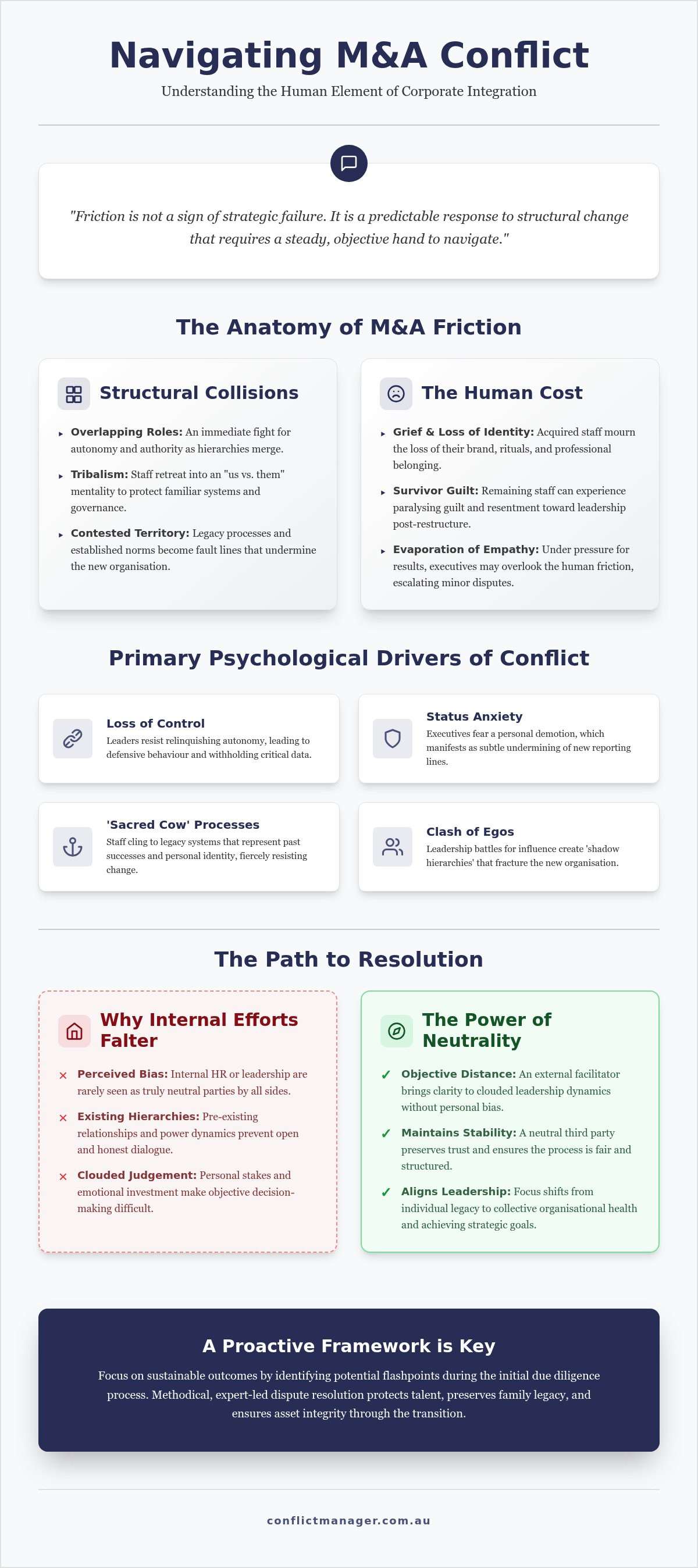
Conflict often stems from the practical mechanics of the new hierarchy. Overlapping roles create an immediate fight for autonomy. If two executives previously held sole authority over a department, the transition to a shared or subordinate role feels like a personal demotion. Tribalism takes hold quickly. Staff naturally retreat into an "us vs. them" mentality to protect their legacy systems and governance structures. Without clear protocols, these structural overlaps become permanent fault lines that undermine the integrity of the new organisation. Recognising these overlaps early allows for a more methodical approach to integration.
The Emotional Weight of M&A Transitions
Emotional volatility is an inherent part of the transition. Staff in the acquired organisation often experience a genuine sense of grief. They lose their brand identity, their established rituals, and their sense of professional belonging. For those who remain after a restructure, survivor guilt can paralyse decision-making and foster resentment toward leadership. In these high-stakes environments, empathy often evaporates. Executives, under pressure to deliver immediate results, may overlook the human friction that slows down integration. This lack of emotional awareness turns minor disagreements into major disputes. Managing conflict during mergers and acquisitions requires acknowledging this emotional weight to restore order and ensure a stable future for the collective enterprise.
The Psychology of Disruption: Identifying Primary Conflict Drivers
Fear. Uncertainty. Resistance. The psychological response to a merger is rarely a linear process; it is a complex web of emotional reactions that can derail even the most sound strategic plans. At the executive level, the fundamental driver of friction is often a perceived loss of control. When leaders who have spent decades steering an organisation are suddenly required to relinquish autonomy, the resulting defensive behaviour is a natural, if destructive, response. This status anxiety manifests in subtle ways, from the withholding of critical data to the active undermining of new reporting lines. Managing conflict during mergers and acquisitions requires an acute awareness of these internal shifts before they manifest as outward defiance.
Legacy processes, often referred to as "Sacred Cows," act as psychological anchors for staff. These are the systems and rituals that stakeholders refuse to abandon because they represent past successes and personal identity. When these processes are threatened within a communication vacuum, the organisational rumour mill fills the silence with worst-case scenarios. This lack of clarity fuels a cycle of resentment that can paralyse an entire department. Identifying these drivers early is the first step toward restoring a sense of order and structural integrity.
Executive Ego and the Battle for Influence
Power. Legacy. Influence. When two leadership teams merge, a "clash of the titans" is almost inevitable. This is particularly visible in Australian family offices, where the business is often inextricably linked to the family name and personal heritage. If these egos are not managed, shadow hierarchies begin to form. These are unofficial power structures where loyalists bypass new managers to seek direction from their former leaders. Prioritising organisational health over individual legacy is essential to prevent these fractures from becoming permanent. For those overseeing such volatile transitions, professional stakeholder facilitation provides the objective distance needed to align competing interests.
Cultural Misalignment and Value Collisions
Identity. Friction. Erasure. Every organisation is governed by unwritten rules that dictate how people interact and succeed. To the acquired party, the corporate promise of "synergy" often feels like an attempt at cultural erasure. Managing conflict during mergers and acquisitions involves mapping these value systems to find common ground rather than forcing a total assimilation. True integration occurs when both parties feel their core values are respected, moving the collective from mere tolerance to genuine collaboration. This methodical approach ensures that the unique strengths of both entities are preserved for the benefit of the new, unified organisation.
Strategic Facilitation: Why Internal Resolution Often Falters
Bias. Proximity. Perception. Internal teams often find themselves ensnared in a "neutrality trap" when managing conflict during mergers and acquisitions. Even the most capable internal leaders are viewed through the lens of their existing allegiances. This perceived bias creates an immediate barrier to honest dialogue. When staff believe a mediator has a vested interest in a specific outcome, they retreat into defensive postures. Boards increasingly recognise that superficial peace is not resolution; it's merely a delay. Sustainable outcomes require the total objectivity that only an external perspective can provide to ensure the long-term integrity of the asset.
The Limits of Internal Human Resources
Conflict. Interest. Friction. HR professionals navigate a dual role that's fundamentally incompatible during structural shifts. They must act as an advocate for the staff while simultaneously serving as an enforcer of the new corporate mandate. This creates a "messenger problem" where difficult news is met with hostility because of the source. Internal leaders cannot easily mediate for colleagues with whom they share years of history. In these instances, implementing structural change conflict management frameworks allows for a clean break from internal politics. This methodical approach ensures that resolution is based on logic rather than legacy relationships.
The Authority of the Neutral Third Party
Clarity. Order. Stability. An external counsellor acts as a steady hand during periods of high stress, viewing volatile situations with total objectivity. They establish a safe environment for high-stakes stakeholder facilitation where all parties feel heard without fear of retribution. This "wise outsider" psychology is essential for breaking deadlocks. Because the facilitator has no personal stake in the hierarchy, they can ask the difficult questions that internal teams often avoid. This process doesn't just resolve immediate disputes; it builds the structural integrity needed for the new organisation to thrive in a competitive market.
Practical Frameworks for Managing Conflict during Integration
Structure. Sequence. Clarity. Effectively managing conflict during mergers and acquisitions requires a transition from reactive firefighting to a proactive, designed framework. This methodology ensures that friction is addressed before it metastasises into systemic failure. By following a methodical sequence, executives can maintain organisational stability while navigating the inevitable turbulence of structural change. A structured approach provides the order necessary to preserve asset integrity during high-stress transitions.
- Step 1: Early detection. Map potential cultural and structural flashpoints during the due diligence phase. Identify where legacy processes are most likely to clash with new mandates.
- Step 2: Establishing protocols. Define clear dispute resolution processes before integration begins. This provides a predictable roadmap for resolving disagreements without stalling momentum.
- Step 3: Facilitating dialogue. Host structured sessions between leadership teams to align vision and resolve positional bargaining.
- Step 4: Empowering middle management. Train department heads to act as conflict first-responders. They are best positioned to spot the subtle signs of tribalism or productivity loss.
- Step 5: Monitoring pulse. Regularly assess the organisational atmosphere and adjust the pace of integration if resistance becomes counterproductive.
Facilitating Difficult Conversations at the Leadership Level
Negotiation. Empathy. Logic. Moving from positional bargaining to interest-based negotiation is essential for boardroom stability. When two leadership teams merge, disputes often centre on titles or reporting lines. By shifting the focus to underlying interests, such as strategic influence or operational autonomy, a neutral facilitator can help leaders find common ground. De-escalating these high-emotion disputes requires a steady hand that prioritises the collective outcome over individual ego. This ensures every stakeholder feels heard without compromising the core value of the transaction.
Maintaining Stability through Transparent Communication
Honesty. Consistency. Trust. The "over-communicate" rule is the most effective tool for filling the organisational void before rumours take hold. Organise town halls and feedback loops that allow for genuine interaction rather than just top-down directives. Building trust requires radical transparency, even when the news is difficult. When staff perceive that leadership is being honest about the integration challenges, their anxiety levels drop. If your leadership team is struggling to maintain this clarity, organisational conflict management services can provide the objective facilitation needed to restore order.
Restoring Stability: The Path to Sustainable M&A Outcomes
Stability. Clarity. Integrity. The final phase of integration is not marked by the absence of disagreement, but by the presence of a structured resolution process. Success occurs when the merged entity achieves a state of organisational clarity that allows it to focus entirely on its strategic objectives. Managing conflict during mergers and acquisitions is a journey that begins with friction and ends with a unified purpose. Conflict Manager assists organisations in navigating this final transition, ensuring that the structural and human elements of the deal are fully aligned for the long term. This methodical approach allows the new entity to move beyond the disruption and into a state of operational excellence.
Protecting the Family Office and Private Interests
Heritage. Continuity. Legacy. For many Australian family offices, a merger is more than a commercial transaction; it's a pivotal moment in the family's history. The intersection of family dynamics and corporate strategy is often where the most volatile friction occurs. Specialised mediation ensures that the "Family Brand" remains intact throughout the transition. By addressing private interests with the same rigour as corporate goals, executives can preserve both asset integrity and family harmony. This level of facilitation recognises that the preservation of legacy is just as vital as the preservation of capital.
Achieving Sustainable Conflict Resolution Outcomes
Resilience. Growth. Alignment. Sustainable resolution is achieved when the organisation shifts from managed friction to a culture of constructive dissent. This culture allows leaders to challenge ideas without threatening personal relationships or organisational stability. Measuring the return on investment for professional conflict management involves tracking specific indicators of stability:
- Retention rates of key talent from both the acquiring and acquired entities.
- The speed and consistency of decision-making within the new leadership team.
- The achievement of synergy targets without the drag of internal sabotage.
- The stability of long-term client and stakeholder relationships during the transition.
Closing the deal with a unified, high-performing leadership team is the ultimate mark of a successful merger. It transforms a collection of disparate parts into a singular, powerful market force. When the structural friction is resolved through objective facilitation, the organisation is free to deliver on the strategic promise that drove the transaction in the first place.
Securing the Future of the Unified Enterprise
Order. Stability. Continuity. The success of a transaction is measured not by the signing of the deal, but by the long-term integrity of the resulting organisation. You've seen how structural friction is an inevitable byproduct of change; however, it doesn't have to be a destructive one. By moving from reactive intervention to a proactive framework, you protect both the family legacy and the commercial synergies that drove the merger. Managing conflict during mergers and acquisitions requires the objective distance of a seasoned professional who remains unruffled by high-stakes dynamics.
Internal efforts often falter under the weight of existing hierarchies and personal stakes. True resolution requires a neutral perspective capable of seeing through the fog of transition. With national Australian coverage and a deep specialisation in high-emotion business disputes, we provide the steady hand necessary to restore order. Enquire about our Organisational Conflict Management services to ensure your leadership team emerges unified and focused. The path to a stable, high-performing future begins with a commitment to structural clarity.
Frequently Asked Questions
What is the most common cause of conflict during a merger or acquisition?
The primary driver of friction is usually the collision of disparate organisational cultures and the fundamental fear of losing autonomy. While financial metrics are often the focus, the human element creates the most volatility. Executives frequently resist new reporting lines because they perceive a drop in status. Managing conflict during mergers and acquisitions requires addressing these psychological drivers early. When the way we do things is challenged, stakeholders naturally retreat into defensive postures that stall integration.
How can we identify potential conflict before the M&A deal is signed?
Potential friction can be identified through rigorous cultural due diligence and stakeholder mapping during the preliminary stages. Executives should look beyond the balance sheet to examine governance structures and decision-making styles. Discrepancies in how teams handle dissent or authority often signal future flashpoints. By interviewing key leadership figures, you can spot the legacy processes that might trigger resistance. This proactive mapping allows for the creation of dispute resolution protocols before integration begins.
When should a board of directors engage an external conflict mediator?
A board should consider external facilitation when internal efforts are perceived as biased or when leadership deadlocks threaten the transaction's value. Internal HR teams often face a conflict of interest because they are part of the hierarchy they are trying to fix. Neutral third-party expertise is essential during high-emotion structural changes where objectivity is compromised. If a clash of the titans occurs at the executive level, an external counsellor provides the steady hand needed to restore order.
Can conflict during an acquisition actually be a positive sign?
Friction is often a sign of high engagement and a commitment to the organisation's legacy. When stakeholders argue over processes, it suggests they care about the integrity of the work rather than being indifferent to the transition. This constructive dissent can be harnessed to build a more resilient unified entity. Managing conflict during mergers and acquisitions involves shifting these disagreements from positional bargaining to interest-based collaboration. This process often reveals innovative ways to combine the strengths of both organisations.
How do we handle a culture clash between two very different organisations?
Handling a culture clash requires identifying the unwritten rules of both entities and finding common ground through interest-based negotiation. It's not about forcing total assimilation, which often feels like cultural erasure to the acquired party. Instead, focus on creating a new, shared identity that respects the core values of both sides. Methodical facilitation helps leaders move from tribalism to genuine collaboration. This approach ensures that the unique strengths of each organisation are preserved for the collective's benefit.
What role does communication play in managing M&A friction?
Transparent communication acts as the primary stabiliser by filling the information vacuum before rumours can take hold. Radical transparency regarding integration milestones and challenges builds trust among staff who feel vulnerable during the transition. Consistency is key; if leadership messages are contradictory, anxiety levels will spike. Town halls and feedback loops allow for a two-way dialogue that humanises the process. This flow of information reduces the psychological weight of disruption and keeps the organisational pulse steady.
How do we protect the interests of a family office during a merger?
Protecting a family office involves specialised mediation that navigates the intersection of family dynamics and corporate strategy. For high-net-worth families, the business is often a reflection of their heritage and personal brand. Facilitation focuses on maintaining asset integrity and ensuring the family legacy survives the structural change intact. This process requires a deep understanding of the emotional weight attached to family assets. It provides a structured environment where family members can resolve disputes without damaging their long-term relationships.
What happens if the leadership teams cannot reach a resolution?
Failure to reach a resolution often leads to talent attrition, lost synergies, and, in extreme cases, the total collapse of the deal. When leadership teams remain deadlocked, shadow hierarchies form, and productivity declines as staff focus on internal politics rather than performance. This state of perpetual friction erodes the asset's value. Engaging expert stakeholder facilitation is the most effective way to break such deadlocks. A neutral third party brings the clarity and objectivity needed to move the collective toward a sustainable outcome.


