

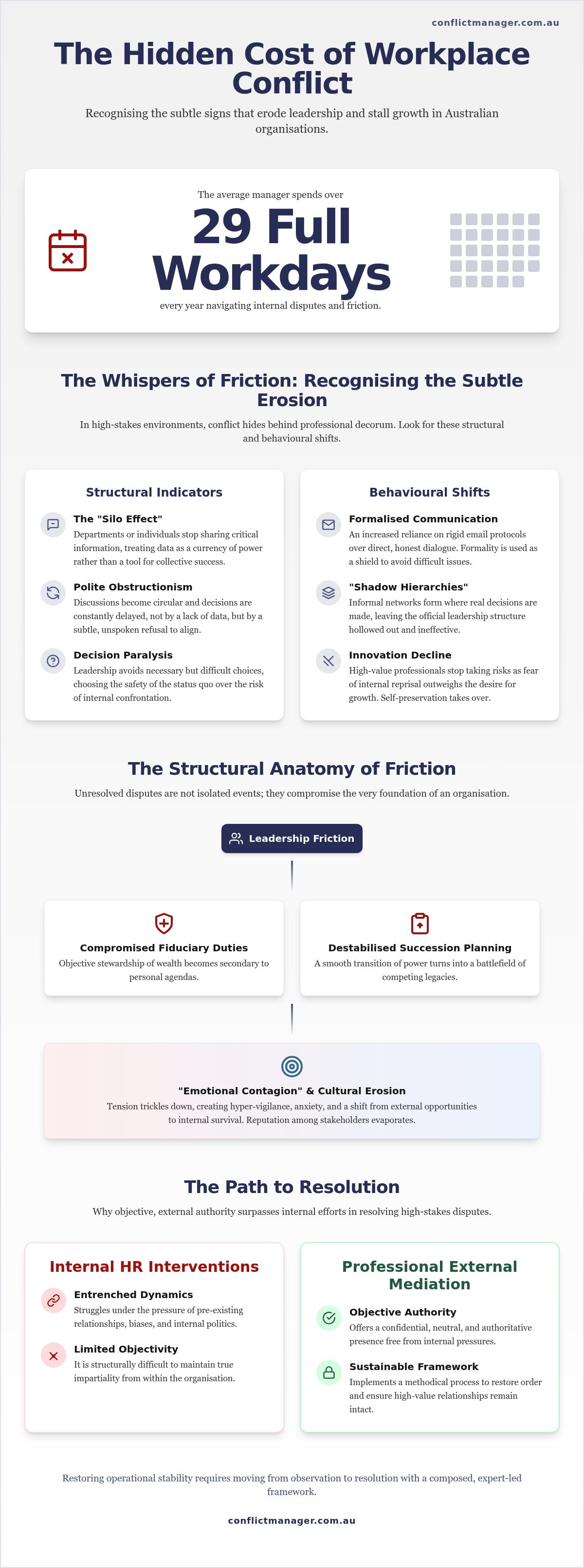
Did you know that the average manager spends over 29 full workdays every year simply navigating internal disputes? In high-stakes Australian organisations, this friction isn't always a loud argument in the boardroom. Often, it's a quiet, persistent erosion of trust that stalls strategic momentum and exhausts even the most seasoned executives. You likely feel the weight of these difficult personalities every day, sensing that your team's legacy is at risk while your operational focus slips away. Recognising the subtle signs of unresolved conflict in the workplace is the first step toward reclaiming your leadership bandwidth.
Friction. Stagnation. Attrition. It's exhausting to act as a constant buffer between competing interests when you should be focused on growth. We understand that internal efforts often struggle under the pressure of entrenched dynamics; objectivity is hard to maintain from the inside. This guide identifies the high-stakes indicators of organisational friction and explains how professional mediation restores structural integrity. We'll move from acknowledging the reality of disruption to a logical framework for sustainable resolution, ensuring your high-value professional relationships remain intact.
Key Takeaways
- Learn to recognise the subtle signs of unresolved conflict in the workplace that often hide behind professional decorum while quietly eroding leadership focus.
- Understand the structural risks that persistent friction poses to fiduciary duties, succession planning, and the long-term preservation of organisational legacy.
- Evaluate why external mediation offers a level of confidentiality and objective authority that internal HR departments are often structurally unable to provide.
- Identify the critical threshold for intervention to ensure that high-stakes disputes are resolved before they cause permanent damage to professional relationships.
- Discover a methodical framework for restoring operational order and navigating difficult transitions with a sense of composed, expert-led authority.
Signs of Unresolved Conflict in the Workplace: Recognising the Subtle Erosion of Leadership
Unresolved conflict is rarely a spectacle. In high-stakes Australian environments, it functions as a quiet tax on productivity; it siphons leadership focus away from strategic imperatives toward the exhausting management of interpersonal friction. Sophisticated settings, particularly family offices or executive boards, often mask this tension behind a veneer of professional decorum. It's a deceptive calm. While the surface remains polished, the underlying machinery of the organisation begins to grind. To understand what is workplace conflict at this level, one must look past obvious outbursts and identify the psychological shift from collaborative problem-solving to defensive positioning.
The Whispers of Friction: Subtle Indicators
The first signs of unresolved conflict in the workplace are often structural rather than personal. The "Silo Effect" emerges when departments or family members stop sharing critical information; they begin treating data as a currency of power rather than a tool for collective success. This leads to "Polite Obstructionism." Here, discussions become circular. Decisions are delayed not by a lack of data, but by a subtle, unspoken refusal to align. Eventually, decision paralysis takes hold. The board avoids necessary but difficult choices. They choose the safety of the status quo over the perceived risk of internal confrontation, leaving the organisation adrift during critical transitions.
Behavioural Shifts in High-Stakes Teams
As friction settles into the culture, communication patterns undergo a clinical change. You'll notice an increased reliance on formalised emails and rigid protocols over direct, honest dialogue. This formality acts as a shield, keeping colleagues at a distance to avoid the discomfort of unresolved issues. Simultaneously, "shadow hierarchies" begin to form. These are the informal networks where the real decisions are made outside the boardroom, leaving the official leadership structure hollowed out and ineffective. Innovation naturally declines. When fear of internal reprisal or the "wrong" word outweighs the desire for growth, high-value professionals stop taking risks. They retreat into self-preservation. Unresolved workplace conflict is a structural risk to organisational integrity.
The Structural Anatomy of Friction: How Unresolved Disputes Manifest
Conflict is rarely a static event. It's a dynamic misalignment of core interests that, when left unaddressed, begins to compromise the structural integrity of the organisation. In the context of Australian family offices and high-net-worth entities, this friction directly impacts fiduciary duties and asset management. When trustees or board members are at odds, the objective stewardship of wealth becomes secondary to personal preservation. This destabilises succession planning; it turns a transition of power into a battlefield of competing legacies. Identifying the signs of unresolved conflict in the workplace is essential for protecting the fiduciary interests of the entity.
Leadership friction doesn't remain contained within the executive suite. It spreads through emotional contagion. When the inner sanctum is fractured, the tension trickles down to every level of the organisation, creating an environment of hyper-vigilance and anxiety. Staff begin to mirror the defensive postures of their superiors; they prioritise safety over innovation. The Damaging Impact of Unresolved Conflict is often felt most acutely in this cultural erosion, where the collective focus shifts from external market opportunities to internal survival. This is one of the most persistent signs of unresolved conflict in the workplace.
Legacy and Reputation at Risk
Internal disputes have a way of leaking into the public domain. For high-profile Australian organisations, a fractured leadership team is a significant reputational risk. Stakeholders, investors, and clients value stability. When they sense indecision or internal bickering, trust evaporates. In a family office, the stakes are even higher. Friction here is never just business; it's a direct threat to the family legacy. Preserving this legacy requires a steady hand to navigate these difficult transitions before the private friction becomes a public liability.
The Economic Cost of the Status Quo
The "friction tax" is a real economic burden. Consider the hundreds of hours executive teams spend managing interpersonal disputes rather than driving growth. This is time that cannot be recovered. When leadership is looking inward, they miss the external signals of market shifts or emerging crises. The organisation’s ability to handle external pressure is weakened by its internal instability. If you recognise these patterns in your own leadership team, seeking professional Stakeholder Facilitation can help restore operational order before the cost of the status quo becomes too high to bear.
Strategic Alternatives: Why External Mediation Surpasses Internal HR Interventions
Neutrality. Objectivity. Distance. These are the essential components of a successful intervention when the structural integrity of an organisation is at stake. While internal HR departments are often the first to note the signs of unresolved conflict in the workplace, they frequently reach a functional ceiling when disputes involve senior leadership or family office principals. This isn't a failure of competence; it's a reality of the corporate hierarchy. An internal employee, regardless of their skill, cannot be perceived as entirely neutral when their own reporting lines or professional future are entangled with the parties involved in the dispute.
External mediation provides a "sealed room" that internal processes cannot replicate. In this environment, confidentiality is absolute. For high-net-worth families and executive boards, this privacy is a strategic asset. It allows for the honest exploration of grievances without the fear that sensitive admissions will end up in an HR file or a public courtroom. This quiet approach preserves the brand's inner sanctum; it ensures that the navigation of difficult transitions remains a private matter of governance rather than a public spectacle of dysfunction.
The Internal Bias Trap
HR professionals often find themselves in a precarious dual role. They must act as both an advocate for the employee and an agent for management. This creates an inherent conflict of interest that stakeholders quickly sense. When the perception of fairness is compromised, engagement drops. A neutral third party, however, brings no historical baggage or internal agenda to the table. By engaging a specialist before the "lawyer-first" reflex takes over, organisations can save high-value professional relationships that would otherwise be destroyed in an adversarial legal process.
A Comparison of Resolution Pathways
Selecting the right path depends on the nature of the friction and the seniority of the stakeholders involved. Each method serves a different purpose:
- Internal HR: Best suited for operational grievances and standard policy breaches. It's often ineffective for resolving deep-seated structural friction at the leadership level.
- Litigation: A public, zero-sum game. It's designed to determine a winner and a loser, which often results in the permanent destruction of the very assets or legacies the parties seek to protect.
- Professional Mediation: A composed and strategic path. It focuses on sustainable outcomes and the preservation of long-term interests through expert-led facilitation.
For those managing sizable assets, a mediator with specific industry discernment is vital. They understand the weight of responsibility and the nuances of intergenerational wealth. They provide a steady hand that internal staff simply cannot offer when the signs of unresolved conflict in the workplace begin to surface at the highest levels of the organisation.
The Threshold of Intervention: Moving from Observation to Resolution
Clarity. Order. Resolution. Recognising the signs of unresolved conflict in the workplace is a diagnostic achievement, yet it's only the precursor to restoration. There exists a critical threshold where observation must transition into purposeful intervention. This "Point of No Return" is often reached when internal grievance procedures have been exhausted or when senior leadership finds itself locked in a cycle of defensive positioning that threatens the organisation's strategic goals. At this stage, the mediator enters as a steady hand, providing a neutral centre of gravity that remains unruffled by the high-stakes environment. The best time to intervene is before a friction becomes a fracture.
Assessing Suitability for Mediation
Effective mediation relies on three foundational pillars: voluntariness, capacity, and timing. All parties must be ready to move from entrenched, ego-driven positions toward a discussion of shared interests. This shift requires professional maturity and a recognition that the status quo is no longer sustainable. Capacity is equally vital; the stakeholders involved must possess the actual authority to reach and execute a binding agreement. In the Australian corporate context, timing often dictates success. Mediating during a structural change, merger, or succession transition isn't just a remedial act; it's a strategic necessity to ensure the organisation’s legacy remains intact.
The Intake and Assessment Process
The process begins with a methodical assessment of the hidden drivers behind the friction. These drivers are rarely what they appear on the surface. They often involve deep-seated concerns regarding structural integrity or perceived threats to professional identity. The mediator establishes rigid ground rules to ensure a safe, objective container for these difficult conversations. When briefing the board, the focus remains on organisational clarity. Mediation is framed not as a sign of failure, but as a sophisticated tool for restoring operational order. If your leadership team is experiencing these challenges, engaging in professional Organizational Conflict Management can provide the composed authority needed to navigate these transitions successfully.
Restoring Stability: The Conflict Manager Approach to Sustainable Outcomes
Integrity. Order. Legacy. These are the foundational pillars of our approach to resolution. When the signs of unresolved conflict in the workplace become undeniable, the path forward requires a composed authority capable of viewing volatile situations with total objectivity. Our philosophy is rooted in a quiet confidence that reassures stakeholders even during periods of intense organisational friction. We act as a steady hand, guiding complex entities through the navigation of difficult transitions without becoming emotionally entangled in the interpersonal dynamics. This methodical progression moves the reader from a state of disruption toward a vision of structured resolution.
A Reassuring Path for Complex Organisations
We provide a sense of order that internal efforts often struggle to maintain under pressure. Our voice is objective yet empathetic; it suggests a deep understanding of both human and structural dynamics. This is particularly vital for high-stakes environments where the weight of responsibility can feel overwhelming. With national Australian coverage, we ensure a consistent, premium standard of resolution for organisations regardless of their location. A seasoned professional who remains unruffled by high-ego or high-emotion dynamics brings a level of discernment that is essential for executive trust. We provide the stability needed to bring clarity to clouded situations.
Securing the Future Legacy
Sustainable resolution is about more than just a signed agreement. It's about implementing lasting structural change that prevents the recurrence of friction. We specialise in facilitation for family offices, managing sizable assets and high emotions with equal care. By identifying the underlying signs of unresolved conflict in the workplace early, we can address the root causes before they threaten the organisation's structural integrity. We prioritise the preservation of high-value professional relationships and the protection of the family's legacy. This ensures that the resolution is not merely a temporary pause in hostilities, but a return to long-term operational order.
Achieving clarity is the ultimate goal of expert-led stakeholder facilitation. We help move stakeholders from a state of clouded complexity toward a vision of structured resolution that stands the test of time. If you are ready to restore order to your organisation, Enquire about our professional mediation and conflict resolution services today.
Restoring Operational Order and Leadership Focus
The quiet erosion of leadership focus is a high price to pay for delayed intervention. Recognising the subtle signs of unresolved conflict in the workplace allows you to act before structural friction leads to an irreparable fracture. We've explored how external mediation provides the neutrality required to navigate high-stakes dynamics; it offers a private, objective space where internal efforts often struggle. By prioritising sustainable outcomes over zero-sum litigation, you protect both your fiduciary duties and your professional legacy.
As a neutral third party specialised in family office and organisational disputes, we provide a composed, steady hand for Australian leaders facing complex transitions. Our national expertise ensures that even the most volatile human dynamics are managed with discernment and quiet confidence. You don't have to navigate these clouded situations alone. Secure your organisational stability with expert workplace mediation.
Clarity is within reach, and we're here to help you restore the structural integrity your organisation deserves.
Frequently Asked Questions
What are the most common signs of unresolved conflict in a leadership team?
The most common indicators include a shift toward siloed information sharing and the emergence of polite obstructionism during critical decision making. You'll notice that the board avoids necessary but difficult choices, choosing the safety of the status quo instead. These signs of unresolved conflict in the workplace often manifest as a decline in innovation because stakeholders fear internal reprisal. When communication becomes overly formalised, it usually signals that trust has eroded.
Can workplace mediation work if one party is extremely resistant to the process?
Mediation is a voluntary process that requires a baseline willingness to engage, yet resistance is often a symptom of underlying fear or a perceived threat to status. Our intake and assessment phase identifies these hidden drivers to help stakeholders move from entrenched positions toward shared interests. While we don't force participation, a neutral third party can often frame the resolution as a strategic tool for organisational clarity. This perspective helps lower defences.
How does family office mediation differ from standard workplace mediation?
Family office mediation involves the complex intersection of sizable assets and high emotion. It requires a specific understanding of intergenerational wealth transfers and the preservation of a long term family legacy. Unlike standard corporate disputes, the relationships involved are both professional and personal. This dual nature means that friction is never just business. We focus on maintaining asset integrity while navigating the unique human dynamics of high net worth families.
Is the outcome of a professional mediation engagement legally binding in Australia?
The mediation process itself is confidential and non binding until a formal settlement agreement is reached and signed by all parties. Once executed, these agreements function as legally binding contracts under Australian law. Many organisations choose to have their legal counsel review the final document to ensure it aligns with their broader fiduciary duties. This provides a structured, enforceable path toward operational order without the public exposure of a courtroom.
How long does it typically take to resolve a high-stakes leadership dispute?
The duration of an engagement varies based on the complexity of the structural friction and the number of stakeholders involved. A typical process involves an initial intake assessment followed by one or more joint facilitation sessions. Most disputes reach a sustainable resolution within a few weeks rather than months. This efficiency is a primary advantage over litigation, which can stall organisational momentum for years while costs and tensions continue to escalate.
Why should we choose an external mediator over our internal HR department?
Internal HR staff often face a neutrality deficit when mediating disputes between senior executives or family principals. Their dual role as management agents and employee advocates creates a perceived conflict of interest. An external mediator provides a "sealed room" where confidentiality is absolute and reporting lines don't exist. This objective distance is essential for building executive trust and ensuring that the resolution process remains entirely focused on the organisational integrity.
What happens if we cannot reach an agreement during the mediation sessions?
If a final agreement isn't reached, the parties still benefit from the clarity gained during the facilitation process. The discussions remain confidential and cannot be used in future legal proceedings, which protects the organisation's reputation. Stakeholders often leave with a better understanding of the underlying friction, even if a full consensus is pending. This clarity allows leadership to make more informed decisions about their next strategic steps or alternative resolution pathways.
How do you ensure confidentiality when mediating disputes between high-profile stakeholders?
Confidentiality is the cornerstone of professional mediation in Australia. We establish strict ground rules at the outset that govern all verbal and written communication within the mediation container. These protections ensure that sensitive admissions or financial details remain private and are never leaked into the public domain. For high profile stakeholders, this "sealed room" approach is a vital asset for preserving the brand's inner sanctum while resolving signs of unresolved conflict in the workplace.


