

The most expensive decision a family office or board will ever make isn't a failed investment; it's the choice to let an internal dispute fester until the structural integrity of the organisation begins to crumble. When emotional entanglement blocks commercial progress, the risk to a multi-generational legacy becomes a tangible threat. You've likely felt the internal fatigue of unresolved arguments that loop without end, draining both capital and spirit. Understanding how to choose a mediator is the first step in reclaiming order. It requires finding a professional who can view a volatile situation with total objectivity while maintaining the quiet confidence needed to guide high-level stakeholders toward a resolution.
This guide provides the framework to identify a neutral third party with the composed authority required to resolve complex organisational friction. We'll explore the qualities of a seasoned expert who provides a steady hand during periods of high stress. You'll learn how to select a facilitator who prioritises sustainable outcomes over temporary fixes, ensuring your business avoids the costs and public exposure of litigation. By the end, you'll have a methodical approach to restoring stability through expert intervention.
Key Takeaways
- Recognise that internal efforts often fail because of deep-seated emotional biases. A neutral third party acts as a strategic anchor to move beyond these psychological blind spots.
- Shift the focus from rigid rights-based arguments toward interest-based mediation. This approach creates the structural integrity needed for long-term organisational health.
- Learn how to choose a mediator who possesses the steady hand required to manage high-emotion disputes within family offices and corporate boards.
- Distinguish between mediation and arbitration to ensure your dispute resolution process aligns with the goal of preserving multi-generational legacies and avoiding public litigation.
- Restore order to volatile situations by applying a methodical framework designed to achieve sustainable, clear outcomes for all stakeholders involved.
Beyond Internal Efforts: When Neutrality Becomes Essential
High-stakes friction often begins with a quiet breakdown in communication. In family offices and corporate boards, this friction is rarely just about financial figures; it's about legacy, identity, and the weight of future generations. A neutral third party acts as a professional anchor, providing a foundation for Mediation that is entirely free from historical bias or internal power plays. When considering how to choose a mediator, the primary focus should be on their ability to remain detached from the internal power dynamics that typically paralyse a room. This composed authority allows an expert to facilitate a resolution without becoming a part of the conflict themselves.
Internal facilitators, regardless of their skill level, often lack the perceived objectivity required to break long-standing deadlocks. Their presence can unintentionally signal a continuation of the status quo, making it difficult for stakeholders to voice genuine concerns or explore radical structural changes. A truly neutral presence brings a sense of order that internal efforts simply cannot replicate, especially when the 2026 National Mediator Accreditation System (NMAS) standards are applied to ensure a high level of professional rigour.
The Limits of Internal Dispute Management
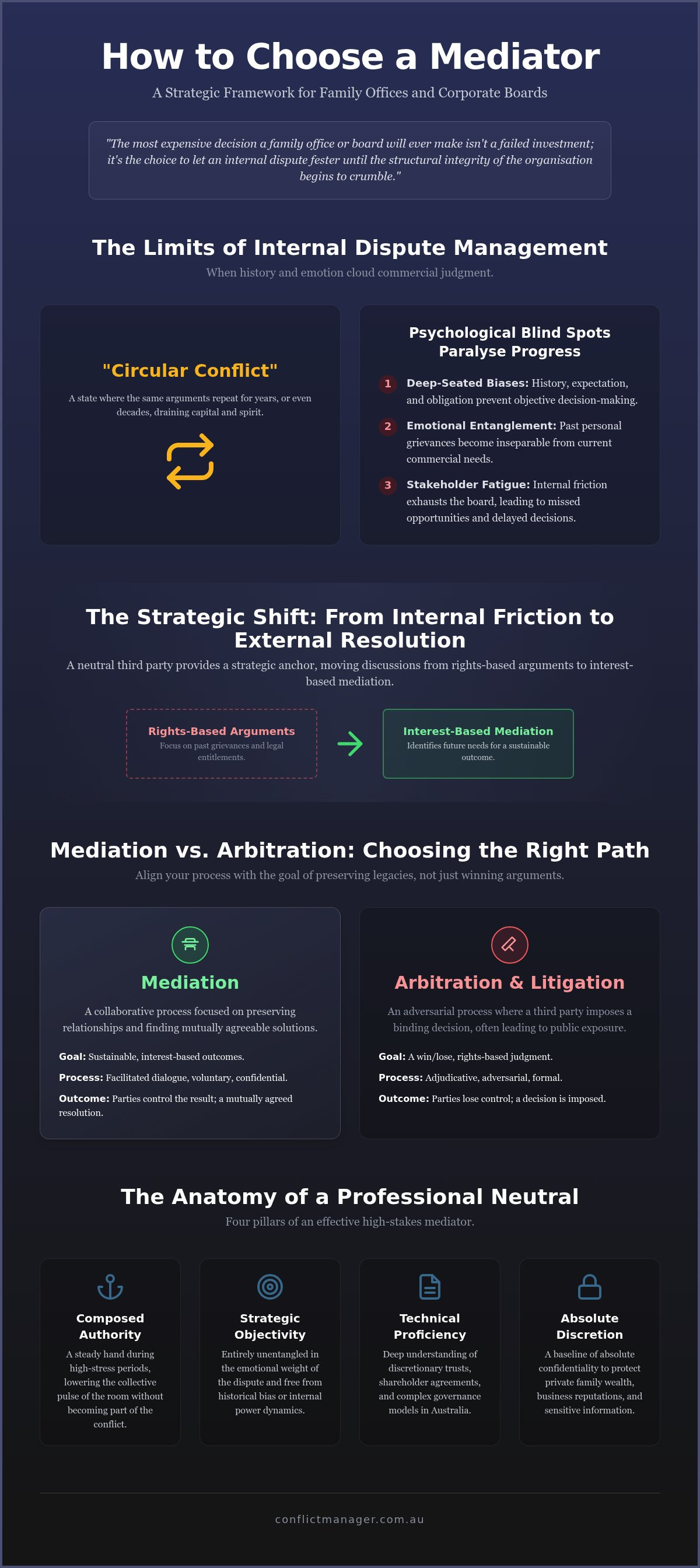
History. Expectation. Obligation. These are the abstract nouns that define the psychological blind spots inherent in multi-generational families. Emotional entanglement clouds objective decision-making, leading to what we call "circular conflict." This is a state where the same arguments repeat over years, or even decades, because the participants cannot separate current commercial requirements from past personal grievances. Internal efforts to resolve these issues often lead to stakeholder fatigue. When a board or family office becomes exhausted by its own internal friction, the risk to the organisation’s stability grows. Decisions are delayed. Opportunities are missed. The legacy that was meant to be protected becomes the very thing that is under threat.
The Strategic Value of External Objectivity
Objectivity. Clarity. Restraint. An external professional brings a steady hand to volatile situations, remaining unruffled by high-stakes environments that might overwhelm those inside the bubble. This external perspective is vital during intense organisational restructuring, as it lowers the collective pulse of the room. By removing the threat of personal bias, a mediator creates a safe, structured space for rational dialogue. Learning how to choose a mediator who understands these complex human and structural dynamics is the first step toward a clear resolution. This approach moves the focus away from winning an argument and toward restoring the structural integrity of the entire organisation.
The Anatomy of a Professional Neutral Third Party
Precision. Discretion. Objectivity. These three pillars form the thematic foundation of any successful high-stakes resolution. A professional mediator doesn't merely facilitate a conversation; they act as a structural anchor who synthesises complex technical data with nuanced human dynamics. In the context of Australian family offices and corporate boards, this requires a deep understanding of discretionary trusts, shareholder agreements, and the intricate governance models that define private wealth. When you are assessing a framework for selecting a mediator, look for a professional who remains entirely unentangled in the emotional weight of the dispute while possessing the intellectual rigour to navigate its commercial complexities.
Learning how to choose a mediator who can perform this synthesis is vital for any organisation facing structural change. The mediator’s role is to create a safe, disciplined environment where the shift from "rights-based" arguments to "interest-based" mediation can occur. While rights-based discussions focus on past grievances and legal entitlements, interest-based mediation looks forward, identifying the underlying needs and goals that will support a sustainable outcome for future generations.
Technical Proficiency and Discretion
Navigating the unique governance structures of Australian family offices demands more than just interpersonal skill. It requires the ability to translate abstract emotional grievances into concrete, actionable resolution pathways. Absolute confidentiality is the baseline. Protecting private family wealth and business reputations isn't just a legal requirement; it's a strategic necessity. A mediator with composed authority ensures that sensitive information remains within the room, allowing for a level of transparency that would be impossible in a public court or a less disciplined setting. This level of expert stakeholder facilitation is essential when the stakes involve multi-generational assets and public-facing reputations.
Facilitating Movement through Deadlock
Stagnation. Friction. Deadlock. These states are often the result of circular arguments where history prevents the adoption of new solutions. A seasoned professional uses rhythmic variation in dialogue to de-escalate high-emotion business disputes, slowing the pace when tension rises and accelerating toward consensus when opportunities for movement appear. Identifying the underlying needs that drive stakeholder resistance is the only way to break these cycles. Every party must feel their perspective has been integrated into the discussion, yet the structural integrity of the process remains the mediator’s priority. This methodical approach ensures that the final agreement isn't just a temporary fix, but a robust foundation for organisational stability. Understanding these nuances is the core of how to choose a mediator who can actually deliver a clear, lasting result.
Mediation vs. Arbitration: Choosing the Right Path
Control. Autonomy. Consensus. These elements distinguish mediation from the more rigid, adversarial structures of arbitration. While both methods fall under the umbrella of Alternative Dispute Resolution (ADR), their impact on a multi-generational legacy differs significantly. In mediation, the parties retain total control over the outcome, working with a facilitator to build a sustainable agreement. Arbitration, by contrast, mirrors the court process; an arbitrator acts as a private judge, delivering a binding decision that parties must follow, regardless of whether it heals or deepens the divide.
When evaluating how to choose the right mediator, you must first determine if the goal is to repair a relationship or simply to end a deadlock. For many complex Australian commercial disputes, a hybrid pathway known as "Med-Arb" is becoming a standard strategy. This allows stakeholders to attempt mediation first, with the understanding that if a resolution isn't reached, the process transitions into a binding arbitration. This ensures finality while still prioritising the collaborative benefits of mediation. Understanding how to choose a mediator who understands these procedural nuances is vital for navigating high-stakes friction.
Mediation: The Path of Consensus
Sustainability. Relationship. Integration. For family offices where stakeholders must continue to interact in the boardroom or at private gatherings, mediation is often the only viable path. It focuses on interest-based outcomes rather than rigid legal rights, allowing for the preservation of the multi-generational legacy. Voluntary agreements carry a psychological weight that imposed decisions lack; when people build their own solutions, they're far more likely to comply with them long-term. This avoids the stakeholder fatigue and circular conflict that often lead to total organisational breakdown.
Arbitration and Litigation: The Cost of External Decisions
Privacy. Finality. Risk. Litigation is almost always the least desirable path for high-net-worth families due to the public nature of Australian court records. Sensitive organisational data and private friction can become a matter of public record, risking both reputation and commercial leverage. While arbitration is an external decision-making process, it offers a layer of privacy that the courts don't. However, the adversarial nature of both can be destructive to long-term stability. Knowing how to choose a mediator who can prevent the escalation to these stages is a critical skill for any executive or family head who values discretion over public victory.
Selecting a Mediator: A Framework for High-Stakes Resolution
Precision. Discernment. Authority. Selecting a professional to resolve a dispute within a family office or a corporate board is a decision that impacts the very foundation of the organisation. When determining how to choose a mediator, the focus must shift from a simple list of credentials to an assessment of temperament and executive presence. A high-stakes environment requires a steady hand that remains unruffled by the intense friction that often accompanies multi-generational wealth and complex structural transitions.
During an initial consultation, observe the mediator’s communication flow. It should be methodical and logical. If they're unable to establish a sense of order during a preliminary meeting, they're unlikely to maintain it when the pressure of the actual mediation begins. Understanding how to choose a mediator involves looking for a professional who demonstrates an intuitive grasp of the dynamics specific to high-net-worth (HNW) assets. These disputes require a different psychological register than standard commercial litigation, as the stakes often involve the survival of a legacy rather than just a financial settlement.
Criteria for Family Office and HNW Mediation
Responsibility. Discretion. Legacy. You must ask if the mediator recognises the weight of responsibility inherent in managing sizable Australian assets. They need to navigate the psychological register of family dynamics without becoming an emotional participant themselves. A track record of achieving quiet, sustainable resolutions in private matters is more valuable than a high-profile public reputation. The goal is a clear outcome that protects the family’s privacy and commercial interests while ensuring the multi-generational structure remains intact. The mediator acts as a neutral anchor, viewing the volatile situation with total objectivity.
Evaluating Organisational Expertise
Stability. Transition. Clarity. The right mediator should have extensive experience guiding stakeholders through structural changes and leadership transitions. When leadership team conflict threatens business stability, the facilitator must provide the structural integrity needed to move forward. They must remain objective and detached from internal corporate politics, acting as a neutral anchor for all parties involved. This steady hand is essential for lowering the collective pulse of the room and creating space for rational dialogue. If you require this level of professional intervention, consider engaging an expert in organisational conflict management to restore order to your operations.
Restoring Stability with Conflict Manager’s Composed Approach
Order. Clarity. Resolution. Conflict Manager operates as a seasoned professional services firm for families and organisations across Australia. We recognise that in high-stakes environments, the loudest voice rarely provides the most effective solution. Instead, our team provides a sense of composed authority. This quiet confidence allows us to establish order in volatile situations where emotional entanglement has previously blocked commercial progress. As you determine how to choose a mediator, consider the value of an external counsellor who remains entirely unruffled by internal friction. We act as a steady hand, viewing complex human and structural dynamics with total objectivity.
Our communication flow is methodical. It begins with a clear-eyed assessment of the disruption, followed by an analytical explanation of why internal efforts are struggling. Finally, we move toward the logic of external intervention. This progression feels inevitable and calming. It moves stakeholders from a state of complexity toward a vision of structured resolution. By maintaining a national reach, we ensure that private family matters and corporate disputes are handled with the premium, bespoke attention they require.
A Reassuring Path to Resolution
Stability. Integrity. Growth. Managing high-net-worth family friction requires a deep understanding of both human psychology and structural governance. We assist families in navigating asset-related disputes by acting as a neutral anchor. Our methodical approach ensures that outcomes are not just temporary fixes; they are sustainable foundations for future growth. By preserving both asset integrity and relationship health, we help organisations restore stability during periods of intense restructuring. This focus on long-term stability is essential for protecting a multi-generational legacy from the risks of public litigation or internal collapse. Professional conflict resolution provides the order necessary for commercial success to resume.
Engaging Our Services
The process begins with an acknowledgement of reality. Whether it's a board deadlock or a transition in a family office, the first step is recognising that internal efforts have reached their limit. We then plan a structured intervention tailored to the specific dynamics of your organisation. We guide stakeholders through the resolution process with discernment and authority. Every party is heard. The process remains disciplined. Understanding how to choose a mediator means finding a partner who can lower the collective pulse of the room while maintaining a firm grip on the logic of the resolution. We provide the movement required to transition from deadlock to a clear, actionable future.
Contact Conflict Manager to discuss your resolution requirements.
Restoring Order and Preserving Legacy
The path from volatile friction to structured resolution begins with the recognition that internal efforts have reached their limit. We've explored how neutrality acts as a strategic anchor, allowing stakeholders to move beyond circular arguments and toward interest-based solutions. Understanding how to choose a mediator with the right temperament is the final, most critical step in this journey. It requires finding a professional who possesses the composed authority to navigate complex family wealth friction and organisational restructuring with total objectivity.
Conflict Manager provides a national Australian service for private and corporate stakeholders who require a steady hand. Our specialised expertise in high-net-worth family office dynamics ensures that asset integrity and multi-generational relationships remain protected. By prioritising sustainable, clear outcomes over temporary fixes, we help you restore the structural integrity of your business or family office. You don't have to navigate these difficult transitions alone. Secure a steady hand for your resolution process with Conflict Manager. Stability is within reach when you choose a guide who understands the weight of your responsibility.
Frequently Asked Questions
What is the primary role of a neutral third party mediator?
A neutral third party mediator acts as a strategic anchor who facilitates communication without personal or professional bias. Their primary role is to provide a structured environment where stakeholders can move from emotional complexity toward a rational resolution. They don't impose decisions. Instead, they guide parties to identify underlying interests and build their own sustainable outcomes. This process is essential for maintaining the structural integrity of an organisation during periods of intense friction.
How does mediation differ from arbitration in the Australian context?
Mediation is a voluntary, consensus-driven process where the parties retain total control over the final agreement. In the Australian context, it focuses on interest-based outcomes that preserve relationships. Arbitration is an adversarial process where an independent arbitrator acts as a private judge to deliver a binding decision. While arbitration provides finality, it lacks the collaborative benefits of mediation, making it less ideal for multi-generational families who must continue working together.
Can a mediator help with multi-generational family office disputes?
Yes, specialised mediation is highly effective for managing the unique friction found in family offices. These disputes often involve sizable assets and deep emotional history that can block commercial progress. A professional mediator helps navigate high-emotion situations with a steady hand, ensuring that asset integrity is maintained. By focusing on the preservation of the family legacy, they help stakeholders reach clear outcomes that internal efforts simply cannot achieve.
What happens if we cannot reach an agreement during the mediation process?
If an agreement isn't reached, the mediation process remains confidential and non-binding. Parties are free to explore other pathways, such as arbitration or litigation, to resolve the deadlock. Many Australian commercial disputes use a hybrid model where the process transitions into a binding arbitration if mediation fails. However, the goal of a neutral third party is always to facilitate a voluntary consensus that avoids the costs and public exposure of court proceedings.
How long does a typical mediation take for complex organisational disputes?
The duration of a mediation depends on the complexity of the organisational friction and the number of stakeholders involved. Typical sessions are structured as either half-day or full-day engagements. For complex organisational restructuring, it's common for a series of sessions to be scheduled over several weeks. This methodical pace allows for thorough data analysis and gives parties the space required to lower their collective pulse before making final, high-stakes decisions.
Is the mediation process confidential for high-net-worth families?
Confidentiality is a fundamental pillar of the mediation process, particularly for high-net-worth families. Agreements to mediate typically include strict confidentiality clauses that protect private family wealth and sensitive organisational data. Statements made during these sessions are generally not admissible in future court proceedings. This level of discretion is a primary reason why families prefer mediation over public litigation, as it protects their reputation and multi-generational legacy from public exposure.
Why should a business choose a mediator during a period of structural change?
Structural change often triggers leadership friction and internal fatigue that can paralyse decision-making. Choosing a mediator during these periods provides a sense of order and objectivity that internal facilitators often lack. A neutral third party remains unruffled by corporate politics, acting as a steady hand to view volatile situations with total clarity. This intervention ensures that the organisation’s movement remains focused on commercial goals rather than becoming trapped in circular, emotional arguments.
What qualifications should I look for in a professional mediator in 2026?
When considering how to choose a mediator in 2026, you should prioritise professionals who meet the National Mediator Accreditation System (NMAS) standards. Beyond accreditation, look for extensive experience in organisational restructuring and high-net-worth asset friction. A qualified mediator must demonstrate composed authority and a logical communication flow. They should be able to synthesise complex technical data while remaining detached from the emotional weight of the dispute to ensure a premium, bespoke resolution.


