

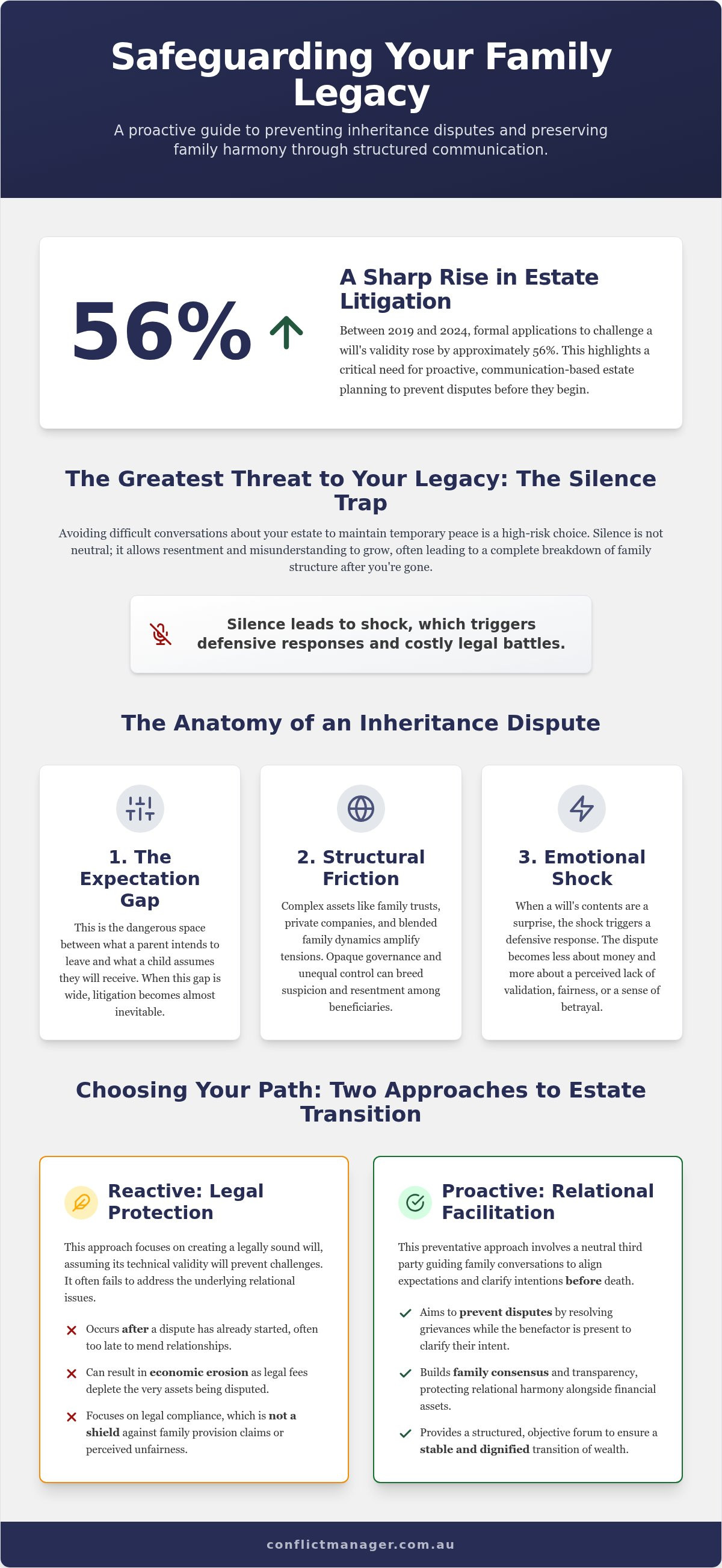
Between 2019 and 2024, the number of formal applications to challenge the validity of a will rose by approximately 56 per cent. This sharp increase in estate litigation highlights a sobering reality: even the most meticulous legal documents can fail when they're not supported by relational clarity. If you're focused on preventing inheritance disputes before death, you understand that wealth alone cannot guarantee peace. You've spent a lifetime building a legacy, yet the prospect of your children being torn apart by asset distribution remains a source of anxiety. It's a heavy weight, especially when multi-generational structures add complexity to your decisions.
Stewardship, succession, and stability. We believe that the true value of your estate lies in the harmony of those who inherit it. This guide reveals how to safeguard your family legacy and bypass the financial drain of the courtroom through proactive communication and structured conflict management. We will walk through the logic of external facilitation and the frameworks needed to ensure a stable, dignified transition of wealth that leaves your family's bond intact.
Key Takeaways
- Understand why silence is the most significant threat to your legacy and how to navigate the "silence trap" that often leads to future courtroom battles.
- Master a proactive framework for preventing inheritance disputes before death by conducting a thorough relational audit of your family's unique dynamics.
- Compare the reactive nature of legal representation with the proactive benefits of stakeholder facilitation to choose the right path for your family.
- Learn to manage the friction inherent in complex asset structures, such as family trusts and private companies, without compromising your relationships.
- Integrity, order, and resolution. See how a neutral third party can provide the steady hand needed to guide your family through high-stakes transitions.
The Hidden Cost of Silence in Estate Planning
Fragmentation, resentment, and erosion. These are the silent architects of family discord when estate intentions remain unsaid. Many individuals mistakenly view an inheritance dispute as a purely legal event, yet the reality is far more personal. It represents a fundamental breakdown of the family structure, where the transfer of wealth becomes a proxy for unresolved emotional grievances. One essential pillar of preventing inheritance disputes before death is acknowledging that silence is rarely neutral; it is an active choice that carries significant risk.
The "Silence Trap" occurs when a benefactor avoids difficult conversations to maintain a temporary, fragile peace. While comprehensive estate planning addresses the technical transfer of assets, it often fails to account for the psychological impact of unexpected decisions on beneficiaries. When a Will is read and a child feels marginalised or surprised, the shock triggers a defensive response. This isn't just about the money. It's about a perceived lack of validation or fairness that can never be addressed once the parent has passed away.
Beyond the emotional toll, silence invites economic erosion. When a family enters litigation, the estate's value begins to bleed out through legal fees, court costs, and administrative delays. In many cases, the very assets intended to provide for future generations are depleted to fund a battle over their distribution. Proactive engagement is the only reliable method for preventing inheritance disputes before death, as it allows for the resolution of grievances while the principal is still present to clarify their intent.
Why Legal Validity Is Not a Shield Against Friction
A Will can be technically perfect and legally sound, yet still be vulnerable to a challenge. In the Australian context, Family Provision claims allow certain beneficiaries to contest an estate if they feel they haven't been adequately provided for, regardless of what the document says. Legal compliance does not equal family consensus. When perceived unfairness takes root, grieving beneficiaries often prioritise their sense of justice over legal logic, leading to protracted battles that a simple conversation could have diverted.
The Role of Composed Authority in Planning
Navigating these waters requires a sense of composed authority. It's about identifying friction points, such as blended family dynamics or unequal asset distributions, before they evolve into full-scale disputes. Treating estate planning as a strategic transition rather than a final, isolated act allows for a more methodical approach. By maintaining a steady and objective perspective, you can facilitate a level of transparency that provides clarity for all stakeholders, ensuring the structural integrity of the family remains intact long after the assets have moved.
The Anatomy of Intergenerational Inheritance Disputes
Expectation, friction, and shock. These are the catalysts that turn a private family transition into a public legal battle. While many focus solely on the technical validity of a Will, the true anatomy of a dispute is found in the lived experience of the beneficiaries. Preventing inheritance disputes before death requires a deep understanding of the "expectation gap." This is the space between what a parent intends to leave behind and what a child assumes they will receive. When this gap is wide, litigation becomes almost inevitable.
The unique pressures on the "rising generation" shouldn't be understated. These individuals are often tasked with stewarding a legacy they didn't build while navigating their own financial aspirations. In blended families, these tensions are amplified. A "surprise" legacy to a new spouse or a step-sibling can feel like a structural betrayal of the original family unit. Without a clear strategy for managing these perceptions, the estate becomes a battlefield for unresolved emotional history.
Complexity in Family Office and Trust Structures
High-net-worth families often rely on sophisticated vehicles like family offices and discretionary trusts. While these structures are excellent for asset protection, their opaque governance can breed suspicion among stakeholders who feel excluded from the decision-making process. Friction is particularly common when dealing with illiquid assets, such as shares in a private company. If one sibling runs the business while others merely hold equity, the disparity in control often leads to resentment. Navigating these technical and relational overlaps requires a level of expert facilitation that prioritises transparency and structural integrity.
The Emotional Register of Estate Conflict
Grief is rarely a quiet passenger; it often drives aggressive posturing and a desire for control. In the context of intergenerational wealth, the debate usually centres on the difference between fairness and equality. Providing more to a child with special needs might be "fair," but it isn't "equal." If the logic behind such a decision isn't socialised before the benefactor passes, the marginalised siblings may use legal means to seek their own version of balance. Recognising the early signs of discontent, such as a sudden lack of communication or increased scrutiny of trust accounts, is a critical step in preventing inheritance disputes before death.
Legal Protection vs. Relational Facilitation
Compliance, documentation, and litigation. These are the hallmarks of a traditional legal approach. While essential for the transfer of assets, they are often reactive by nature. Law firms focus on the "what" and the "how" of distribution, ensuring documents meet statutory requirements. However, this focus on legal protection often overlooks the relational dynamics that actually drive conflict. True success in preventing inheritance disputes before death requires more than just a signature on a page. It demands a deliberate effort to align family expectations with the structural reality of the estate.
Some families rely on professional executors to manage the transition. But an executor's role begins only after the benefactor has passed. By then, the seeds of resentment have often already sprouted into full-scale litigation. A neutral third-party facilitator acts while the principal is still present, providing a steady hand to guide stakeholders through complex transitions. This approach builds structural integrity through transparent family governance, ensuring that the legacy is understood by all beneficiaries before it is ever contested.
The Legal Approach: Wills, Codicils, and Trusts
Every robust Australian estate plan requires foundational documents to establish authority and direction. Wills, codicils, and discretionary trusts provide the framework for asset protection and tax efficiency. Many benefactors also include a "Letter of Wishes." This document provides the personal context behind certain decisions, yet it lacks the binding power of a Will. When legal documents alone fail to provide clarity, they leave a vacuum that is quickly filled by beneficiary assumptions and perceived slights. Legal robustness is necessary, but it is rarely sufficient to maintain family harmony.
The Facilitation Approach: Open Dialogue and Consensus
Facilitation shifts the focus to the centre of the family dynamic. It involves holding difficult conversations in a controlled, professional environment where all stakeholders can voice their perspectives. This methodical process is the cornerstone of preventing inheritance disputes before death, moving the family from a state of disruption toward a vision of resolution. By involving beneficiaries in the legacy discussion early, you provide them with a sense of agency. The psychological benefits of being heard are immense. It reduces the urge to litigate later, as the surprise element that often triggers legal action is removed through consensus. This level of stakeholder facilitation ensures the transition is not just legally valid, but relationally sustainable.
A 5-Step Framework for Preventing Estate Disputes
Methodology, structure, and execution. These are the pillars of a successful wealth transition. While previous discussions explored the psychological and structural triggers of conflict, this framework provides the practical steps for preventing inheritance disputes before death. It's a shift from passive planning to active stewardship. By following a methodical sequence, you can move your family from a state of complexity toward a vision of structured resolution.
- Step 1: Conduct a relational audit. Map out all stakeholders and identify potential friction points, such as the differing needs of active and passive participants in a family business.
- Step 2: Establish a cadence of transparent communication. Transparency isn't a single event. It's a regular rhythm of updates that prevents the build-up of suspicion or resentment.
- Step 3: Document the "Why". Context provides the necessary bridge between your decisions and the beneficiaries' understanding of them.
- Step 4: Formalise family governance. Establish clear protocols for how decisions are made and how future disagreements will be handled within the family structure.
- Step 5: Engage an external counsellor. A neutral third party brings objectivity to volatile situations, acting as a steady hand to facilitate the transition.
Executing the Family Meeting
The environment dictates the tone of the conversation. Choosing a neutral centre, away from the emotional weight of the family home, helps maintain professional composure for everyone involved. It's vital to structure the agenda so that every beneficiary feels their voice is heard, even if the final decision remains with the principal. High-emotion responses are expected during these sessions. A seasoned facilitator remains unruffled by these outbursts, keeping the focus on the long-term integrity of the family bond.
Documenting Intent Beyond the Will
A Will is a cold, legalistic document. To add warmth and clarity, consider using video statements or personal letters to explain your legacy choices in your own words. These don't replace legal advice, but they provide a narrative that can soften the blow of unequal distributions or complex trust arrangements. Regularly reviewing the plan every three to five years ensures it reflects changing family dynamics, such as new marriages or the birth of grandchildren. Aligning your family office charter with these personal estate goals creates a seamless structure that protects both assets and relationships. To begin this process with a sense of order, consider engaging in professional stakeholder facilitation to guide your next steps.
Preserving the Legacy through Expert Facilitation
Objectivity, neutrality, and discernment. These are the qualities required to bridge the gap between a benefactor's intent and the beneficiaries' expectations. While a structured framework provides a necessary map, navigating the actual terrain of family dynamics requires a guide who remains unruffled by high-stakes environments. Preventing inheritance disputes before death is a complex undertaking that often exceeds the capacity of internal family efforts. The weight of responsibility, coupled with the friction of interpersonal history, makes it difficult for stakeholders to view the situation with total objectivity. Without an external perspective, even the most well-intentioned families can find themselves trapped in cycles of misunderstanding and defensive posturing.
External intervention is the most effective path to sustainable outcomes because it introduces a steady hand into a volatile system. It allows for a methodical analysis of the structural integrity of the estate and the emotional register of the family. By treating the transition as a strategic evolution rather than an isolated event, you ensure that the move from one generation to the next is grounded in order rather than chaos. This proactive approach bypasses the reactive, adversarial nature of the legal system, focusing instead on the preservation of both assets and relationships. It is a process of deliberate movement, designed to align the family's shared future with the benefactor's original vision.
The Conflict Manager Approach
Clarity, stability, and continuity. Conflict Manager provides expert-led facilitation designed for high-net-worth families and family offices navigating internal friction. We act as a wise, external counsellor, capable of viewing complex human and structural dynamics without becoming emotionally entangled in them. Our expertise lies in managing high-emotion situations where the stakes involve both sizable assets and deep-seated family bonds. We offer bespoke strategies that respect the unique history of your family while providing the professional register needed to manage a multi-generational transition. This neutral third-party objectivity is essential for identifying blind spots and resolving grievances before they crystallise into litigation.
Taking the First Step Toward Resolution
The path toward a stable future begins with a deliberate choice to lower the pulse of family friction. Our communication flow is logical and methodical, moving stakeholders from a state of complexity toward a clear, documented path forward. This progression feels inevitable and calming, as it replaces anxiety with a vision of structured resolution. Successfully preventing inheritance disputes before death requires a commitment to transparency and a willingness to engage in difficult conversations while the principal is still present to lead them. By engaging in stakeholder facilitation now, you provide the rising generation with the clarity they need to steward your legacy with confidence. To protect your family's future, contact Conflict Manager to discuss your family’s legacy transition.
Securing the Future of Your Family Legacy
Stability, transparency, and foresight. These are the markers of an estate plan that transcends the merely legal to become truly relational. We have explored how the "Silence Trap" can erode even the most substantial wealth, and why a strategy focused on preventing inheritance disputes before death is the only way to ensure the structural integrity of your family remains intact. Legal documents are the foundation, but they cannot speak for you once you are gone. Proactive facilitation ensures your intent is understood, your beneficiaries are heard, and the potential for future litigation is dismantled through consensus.
Navigating these high-stakes environments requires a steady, objective hand. Conflict Manager offers specialised mediation for high-net-worth families, providing national expertise in complex asset management and a neutral perspective that internal efforts often lack. By choosing professional stakeholder facilitation, you move from a place of anxiety toward a vision of structured resolution. It's about protecting more than just capital; it's about preserving the bonds that define your legacy. Secure your family’s legacy with professional conflict facilitation. You have the power to create a transition that is as harmonious as it is successful.
Frequently Asked Questions
Is a valid Will enough to prevent my children from contesting my estate?
Legality, intent, and perception. A valid Will is a necessary baseline, but it doesn't address the emotional drivers that lead to litigation. In Australia, family members can contest an estate based on a perceived lack of fairness or inadequate provision. Preventing inheritance disputes before death requires aligning family expectations with your legal intent. Without this relational work, even a perfect document remains vulnerable to challenges from those who feel surprised or marginalised.
What is a Family Provision claim, and how can I minimise the risk of one?
A Family Provision claim is a legal application for a larger share of an estate, often based on a claimant's financial need or your moral obligation. Minimising this risk involves transparency and documented reasoning. Engaging in stakeholder facilitation allows you to address potential grievances while you are still present. This proactive approach reduces the shock that often triggers these costly legal actions after a benefactor has passed away.
How do I talk to my children about an unequal inheritance without causing a fight?
Strategy, empathy, and clarity. Approach the conversation by explaining the logic behind your decisions rather than just stating the final outcome. If one child has received significant financial support during your life, or another has special needs, socialising these reasons early prevents resentment. Using a neutral facilitator helps maintain order and ensures the conversation remains focused on the family's long-term stability rather than immediate emotional reactions.
Can professional mediation help if my family isn’t currently in a dispute?
Facilitation is most effective when it is proactive. You don't need an active conflict to benefit from structured dialogue. Professional facilitation establishes governance and communication protocols that act as a buffer against future friction. It is about building structural integrity within the family unit today to ensure that the eventual transition of wealth is seamless, dignified, and entirely expected by all your beneficiaries.
What is the role of a family office in preventing inheritance disputes?
A family office provides the governance framework necessary for managing complex assets and multi-generational expectations. It acts as a central point for education and transparency, ensuring that the rising generation understands their future roles. By formalising decision-making processes and conflict resolution protocols, the family office plays a vital part in preventing inheritance disputes before death. It transforms a private collection of assets into a professionalised, enduring legacy.
How can I protect my family business from being broken up by a dispute?
Continuity, planning, and facilitation. Business assets are often illiquid, making them a primary friction point if one child wants to sell while another wants to lead. Protecting the business requires a clear succession plan that has been socialised with all heirs. Facilitating these discussions allows you to explore buy-out options or equity structures that satisfy all parties without compromising the operational integrity or the future of the enterprise.
When is the best time to start facilitating these conversations?
The ideal time is while you possess full capacity and the family is in a state of relative calm. Waiting for a health crisis or a major life event introduces unnecessary urgency and emotional stress. Early intervention allows for a slow, deliberate pace where complex asset structures can be explained and emotional grievances can be aired. Starting now ensures you remain the steady hand guiding the family's trajectory toward resolution.
Does professional conflict resolution replace the need for a lawyer?
No, the two roles are complementary. Lawyers provide the technical expertise to draft Wills and trusts that comply with Australian law. Conflict resolution professionals focus on the human and structural dynamics that legal documents cannot reach. While a lawyer ensures your plan is legally valid, a facilitator ensures it is relationally sustainable. Both are essential for a comprehensive and successful approach to estate and legacy planning.


