

Privacy. Capital. Integrity. These are the pillars of a lasting legacy, yet they're often the first assets to crumble when estate disputes reach the public gallery of an Australian court. The most significant threat to your wealth isn't a shifting market; it's the transparency of litigation. Family asset protection mediation provides a strategic discipline that shields your family office from this exposure. It's a methodical approach to resolving friction while keeping your structural foundations firm and your private affairs away from the public record.
You've likely seen how internal discussions can quickly become clouded by historical dynamics and the stress of high-stakes responsibility. This article demonstrates how an objective, external perspective can move a family from a state of disruption toward a vision of structured resolution. You'll discover how to navigate complex asset distributions and secure a sustainable agreement that protects your wealth from the financial erosion of legal fees. We'll also look at how this process ensures your legacy remains intact despite the evolving landscape of Australian property reforms.
Key Takeaways
- Recognise why public litigation often costs more in reputation and privacy than the financial value of the dispute itself.
- Discover how family asset protection mediation provides a private, strategic framework for resolving complex multi-generational estate and trust disagreements while maintaining capital.
- Compare the sustainable logic of a mediated settlement against the compounding legal fees and emotional toll of the Australian court system.
- Learn the practical requirements for a successful resolution, from gathering structural documentation to adopting an objective problem-solving mindset.
- Understand the role of neutral facilitation in restoring order to volatile situations and securing the long-term integrity of the family office.
Understanding the Stakes of Family Asset Protection in Australia
Legacy. Identity. Continuity. In Australia, estate disputes are rarely confined to the balance sheet. They're often the culmination of decades of historical friction, manifesting at the exact moment a family is most vulnerable. When a family office manages significant assets, the intersection of complex interpersonal dynamics and structural wealth creates a unique set of pressures. Without a steady hand to guide these transitions, internal efforts to resolve disagreements can inadvertently deepen the divide.
This is where family asset protection mediation serves as a vital strategic discipline. It's a structured, private process designed to bring objective clarity to clouded situations. Unlike internal negotiations that often circle back to old grievances, professional mediation provides a neutral space to address the mechanics of asset distribution while preserving the human connections that underpin the estate. It's about moving from a state of disruption toward a vision of functional order.
The Friction of Multi-Generational Wealth
Transitioning wealth from one generation to the next is a delicate movement. It requires balancing a founder's original intent with the evolving needs of contemporary beneficiaries. In the Australian context, structural changes to family trusts or the introduction of new stakeholders can trigger latent conflicts. These aren't just financial hurdles; they're threats to the very identity of the family unit. If left unaddressed, this friction can turn a hard-won legacy into a source of permanent heartache, eroding the structural stability of the entire family office.
Common triggers for these transitions include:
- The appointment of new trustees or directors within a family trust structure.
- Disagreements over the liquidation of long-held family assets or property.
- Varying levels of involvement in the family business among siblings or cousins.
Why Court is the Least Desirable Path for Wealth Preservation
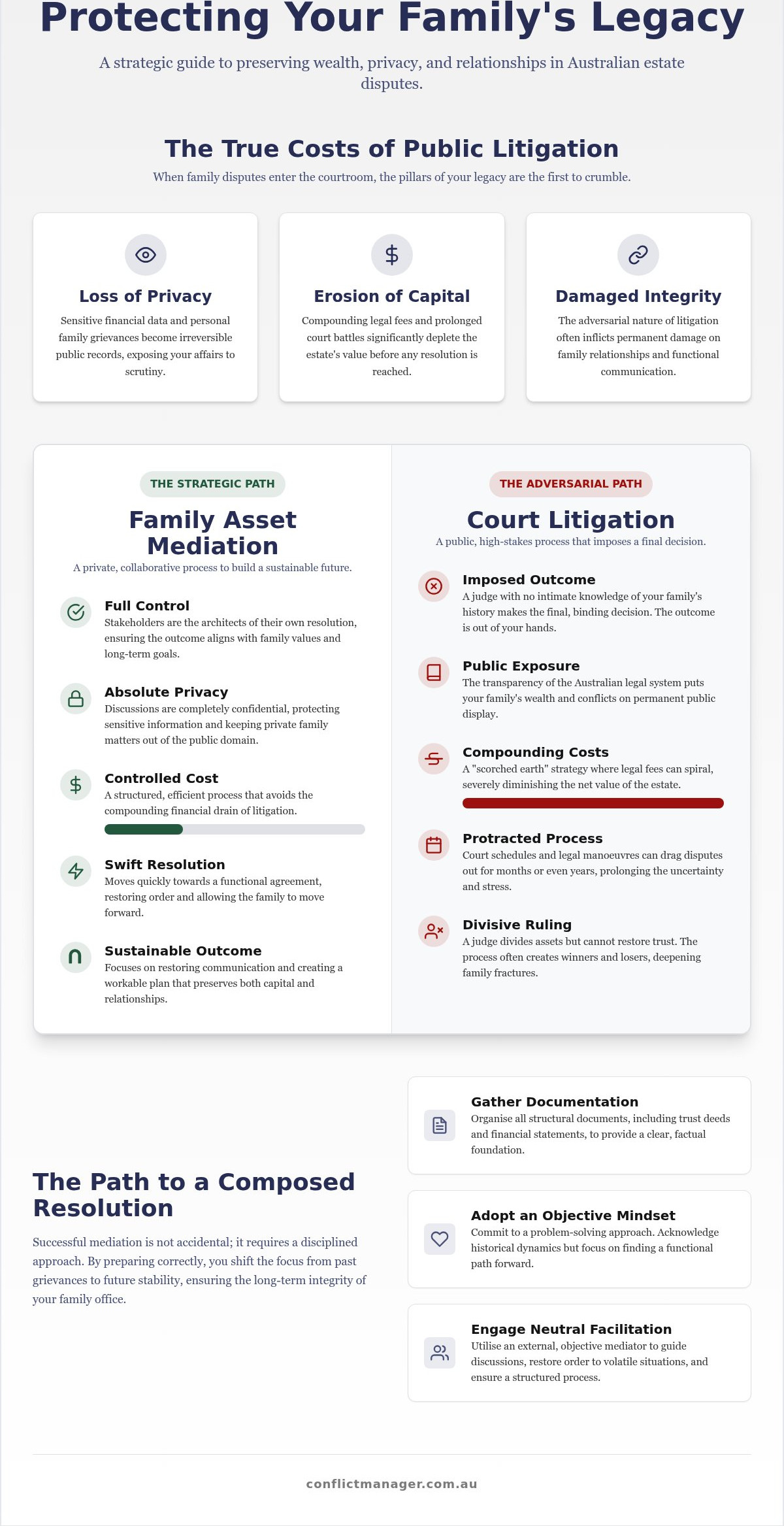
The Australian legal system is built on transparency, which is a virtue in civic life but a liability for private family wealth. Entering a public courtroom means sensitive financial data and personal grievances become part of the public record. This loss of privacy is often irreversible. Beyond the exposure, litigation is a "scorched earth" strategy. It's expensive; it's adversarial; and the financial erosion caused by compounding legal fees can significantly deplete the estate's value before a single cent is distributed.
Perhaps most importantly, a judicial decision is an imposed outcome. A judge can divide assets, but they can't restore the trust or functional communication required to manage a multi-generational legacy. Litigation focuses on the "what" of a dispute, whereas family asset protection mediation addresses the "how" of a sustainable future. Choosing the collaborative path ensures that stakeholders remain the architects of their own resolution, protecting both the capital and the reputation of the family name.
The Strategic Logic of Mediation for Asset Preservation
Control. Privacy. Resolution. These are the fundamental requirements for maintaining a stable family office during periods of transition. By utilising family asset protection mediation, stakeholders move away from the high-stakes theatre of the courtroom into a disciplined, controlled environment. This shift isn't merely about avoiding conflict; it's about reclaiming the power of self-determination. In an adversarial setting, a judicial officer who lacks intimate knowledge of your family's history makes the final call. Mediation ensures that those with the most at stake remain the primary architects of the structural resolution.
Confidentiality acts as a cornerstone of this process. In Australia, the transparency of the court system means that sensitive trust documents and financial strategies can become public record. Mediation provides a secure perimeter. It keeps private affairs private. Organisations such as Better Place Australia emphasise that property and financial mediation offers a lower-cost, more discreet alternative to the long-term drain of litigation. Speed is also a strategic advantage. A swift resolution stops the financial erosion of the estate, allowing the family to return to a state of order before the conflict becomes a permanent feature of their legacy.
Maintaining Control Over Governance
Trust structures are often delicate and highly specific. A court's jurisdiction is broad, but it lacks the flexibility to order the bespoke, nuanced solutions that complex wealth management requires. Mediation allows for the creation of unique governance agreements that preserve the integrity of the family trust. It reduces the emotional pulse of the dispute. By focusing on interests rather than rigid legal positions, stakeholders can craft outcomes that respect both the letter of the law and the spirit of the family's original intent.
The Logic of External Intervention
Internal attempts at resolution often fail because the participants are too close to the friction. Historical grievances and power imbalances can cloud objective judgment. An external mediator acts as a catalyst for clarity, viewing the situation with total objectivity. This distance is essential for de-escalating multi-generational friction and uncovering the root causes of a disagreement. If you find your internal discussions have reached a standstill, engaging in Family Conflict Resolution can provide the steady hand needed to navigate these difficult transitions with confidence.
Mediation vs Litigation: A Framework for Asset Integrity
Depletion. Exposure. Friction. These are the inevitable byproducts of the Australian court system when applied to private family wealth. While litigation is often framed as a quest for justice, it functions as an exercise in erosion. It's a zero-sum game where the victory of one stakeholder often necessitates the structural damage of the entire family office. In contrast, family asset protection mediation operates as a collaborative framework. It prioritises the integrity of the estate over the binary outcomes of a courtroom, ensuring that the resolution serves the collective future rather than a singular grievance.
The temporal advantage of mediation is undeniable. A typical court battle in the Federal Circuit and Family Court of Australia can span years, during which time the assets in question remain in a state of paralysis. Mediation compresses this timeline into days or weeks. This speed isn't just about convenience; it's about stability. By achieving closure sooner, families can return to the active management of their portfolios, preventing the stagnation that often occurs when trusts are under the shadow of a legal freeze.
Adversarial vs Collaborative Outcomes
Litigation is designed to find a winner. In the context of a multi-generational family, this approach is often catastrophic. A judicial officer can divide a bank account, but they can't repair a relationship or preserve a nuanced governance structure. Mediation allows for bespoke outcomes that the law simply isn't equipped to provide. It's a path toward sustainable agreements where every party's interests are considered. This ensures that the final resolution is functional, respected, and capable of weathering the complexities of future transitions without recurring to conflict.
Financial and Temporal Efficiency
The financial drain of litigation extends far beyond the final settlement. As of July 1, 2026, the Federal Circuit and Family Court of Australia has implemented updated fee structures that reflect the rising cost of public resolution. An initiating application for both parenting and financial matters now costs A$895, while daily hearing fees in Division 1 reach A$1,115. These figures don't account for the compounding costs of solicitors, barristers, and expert witnesses, which can quickly reach six figures.
Mediation offers a more logical allocation of resources. By investing in a neutral third party early in the process, families avoid the "scorched earth" financial policy of discovery and trial. A clear, mediated outcome protects the capital of the estate from the compounding drain of legal fees, ensuring that the wealth remains where it belongs: within the family legacy. This efficiency allows for a cleaner transition, moving stakeholders from a state of disruption into a period of renewed order and clarity.
Preparing for a Composed Resolution Process
Preparation. Intention. Composure. These are the precursors to any successful structural resolution. While the previous sections established the strategic logic of choosing mediation over litigation, the effectiveness of the process itself depends heavily on the work done before entering the room. Engaging in family asset protection mediation requires more than a willingness to talk; it demands a shift in mindset from adversarial confrontation to collaborative, strategic problem-solving. It's about viewing the dispute not as a battle to be won, but as a structural misalignment to be corrected.
Before the formal session begins, it's often prudent to engage in conflict resolution consulting. This preliminary step allows stakeholders to clarify their own objectives in a private, neutral setting, ensuring that the actual mediation can focus on interests rather than grievances. By identifying what each party truly requires for long-term stability, you move away from rigid, defensive positions toward a vision of functional order. This methodical approach lowers the emotional pulse of the room before the first joint meeting even occurs.
The Mindset of Composure
Entering the mediation space with a sense of order is vital for de-escalating multi-generational friction. It's natural for emotions to run high when legacy and wealth are at stake, yet articulating needs without triggering further resentment is a skill that must be cultivated. Listening becomes a strategic tool in this environment. By truly hearing the concerns of other stakeholders, you build the trust necessary to reach a sustainable agreement. This composed approach ensures that the dialogue remains productive, allowing for clear-headed decision-making even under pressure.
Technical and Practical Preparation
A successful outcome is built on a foundation of precise data. You'll need to gather comprehensive documentation regarding your estate and trust structures, including trust deeds, company constitutions, and recent valuations of assets. Consulting with your existing financial and legal advisors is essential; they provide the boundaries within which a resolution must function. In the Australian HNW landscape, understanding the specific tax and regulatory implications of any proposed asset shift is non-negotiable.
When preparing your summary of contentions, focus on desired sustainable outcomes rather than past failures. Selecting a mediator who understands the nuances of the Australian family office landscape is equally critical. You need a steady hand who remains unruffled by high-stakes environments. If you are ready to move toward a structured resolution, professional Stakeholder Facilitation can provide the objective clarity required to secure your family's future and restore organizational integrity.
Restoring Order: The Conflict Manager Path to Stability
Order. Stability. Continuity. These are the markers of a successful intervention. While the immediate objective of family asset protection mediation is to resolve a specific dispute, the broader goal is to establish a foundation for future family stability. An agreement that only addresses the division of assets without considering the mechanics of future communication is often a temporary fix. True resolution requires a transformation of the family's internal culture, moving from a state of reactive disruption toward a vision of proactive governance. It is about ensuring the legacy remains a source of strength rather than a catalyst for friction.
The legacy of a successful resolution is found in the family's ability to manage future transitions without external crisis. By navigating the current impasse through a disciplined process, stakeholders learn the value of objective dialogue. This shift in dynamic is essential for protecting the integrity of the family office over multiple generations. It moves the unit from a state of volatility into a period of sustainable order, where the wealth is shielded not just from legal erosion, but from the internal friction that often precedes it.
Sustainable Conflict Resolution Outcomes
A robust agreement must be clear, enforceable, and respectful of the structural integrity of family assets. It's about ensuring that the trust deeds and corporate structures mentioned in our earlier analysis are not just legal documents, but functional frameworks for interaction. The transition from dispute to governance involves implementing new frameworks for communication that prevent historical grievances from resurfacing. Maintaining a steady hand during this implementation phase ensures that the resolution is not merely a signature on a page, but a living standard for the family's future conduct.
The Conflict Manager Approach
Conflict Manager provides bespoke mediation services designed for the unique complexities of high-stakes family dynamics across Australia. We understand that multi-generational wealth requires a sense of composed authority and total objectivity to navigate successfully. Our role as a neutral, external counsellor is to view volatile situations with clarity, helping families move through difficult transitions with discernment and poise. We act as the steady hand that brings order to clouded situations, ensuring that every stakeholder is heard without becoming emotionally entangled in the friction.
If your family office is currently navigating a period of organizational or interpersonal disruption, a structured path to resolution is available. We invite you to Enquire about our Family Office Mediation services to discover how a methodical, private approach to family asset protection mediation can secure your legacy and restore the structural integrity of your estate.
Securing the Future of Your Legacy
Protecting a multi-generational estate requires more than financial acumen; it demands the foresight to manage interpersonal friction before it erodes the family's structural foundation. By choosing a private, collaborative path, you ensure that sensitive trust details remain confidential and that the estate's capital is shielded from the compounding costs of the Australian court system. This shift from adversarial confrontation to strategic problem-solving allows your family to remain the architects of its own governance, preserving both wealth and reputation for the years ahead.
Conflict Manager provides a steady hand during these difficult transitions. With specialised expertise in high-net-worth family office dynamics and a composed, neutral approach, we offer national service to families seeking to restore order to volatile situations. Family asset protection mediation is the methodical choice for those who recognise that a sustainable resolution is the only way to safeguard a lasting legacy. It's time to move toward clarity and functional stability.
Restore clarity to your family estate-engage a Conflict Manager mediator today. You have the power to transform disruption into a vision of structured continuity, ensuring your family's future remains as robust as the foundations you've built.
Frequently Asked Questions
What is the primary difference between family asset protection mediation and going to court?
The primary difference lies in the locus of control and the level of public exposure. In a courtroom, a judicial officer imposes a decision that becomes part of the public record. In family asset protection mediation, stakeholders retain the power to craft their own bespoke resolution in a strictly private setting. This ensures that sensitive trust data and historical family dynamics remain confidential while avoiding the binary win-loss outcomes of litigation.
Is family estate dispute mediation legally binding in Australia?
A mediated agreement is not automatically enforceable by law in Australia. To become a legally binding instrument, the reached settlement must be formalized as either a consent order filed with the court or a binding financial agreement. This secondary step provides the structural certainty required to ensure all parties adhere to the new governance framework while maintaining the privacy established during the mediation itself.
What happens if one party refuses to participate in the mediation process?
Mediation is fundamentally a voluntary process that requires the participation of all key stakeholders. If a party refuses to engage, the process cannot proceed to a collaborative resolution. However, the Australian legal system strongly encourages pre-court resolution. Under the Family Law Amendment Act 2025, courts often require evidence of a genuine attempt at dispute resolution before a matter can progress through the litigation stream.
How long does a typical estate mediation session take to reach a resolution?
A typical estate mediation can reach a resolution in a matter of days rather than the years often required for a trial. While the preparation phase involves gathering documentation, the actual sessions frequently conclude within three to six hours. This speed is a strategic advantage. It prevents the stagnation of assets and allows the family office to return to a state of functional order with minimal delay.
Do we need to involve solicitors in the mediation process?
You don't strictly need solicitors present during the mediation session, though their involvement is highly recommended for independent legal advice. The mediator acts as a neutral facilitator, not a legal representative. Engaging your own counsel ensures you understand the legal implications of any agreement before it's finalized. This collaborative approach between legal advisors and the mediator ensures the final outcome is both fair and robust.
Can mediation help with disputes involving family trusts and business assets?
Mediation is exceptionally effective for disputes involving family trusts and business assets. These structures are often too complex for the broad strokes of a court order. A professional mediator provides the objective clarity needed to navigate trust deeds and company constitutions. This allows stakeholders to develop nuanced governance frameworks that protect the long-term integrity of the family's commercial interests and capital.
How is the privacy of our family office protected during the mediation process?
Privacy is protected through strict confidentiality agreements signed by all participants before the process begins. Unlike the Australian court system, where proceedings are generally open to the public, mediation occurs behind closed doors. Nothing discussed during the session can be used as evidence in future litigation. This perimeter of silence is vital for families who wish to resolve friction without damaging their public reputation or exposing financial strategies.
What is the cost of professional mediation compared to litigating an estate dispute?
The cost of professional family asset protection mediation is significantly lower than the compounding expenses of a full trial. Court fees in Australia increased on July 1, 2026, with daily hearing fees in Division 1 now reaching A$1,115. When you add the cost of barristers and discovery, the financial erosion of the estate can be immense. Mediation avoids these adversarial costs, allowing more of the estate's value to remain with the intended beneficiaries.


