

The documents are in order. The structures are sound. And yet, something in your family office is quietly breaking down. Family office governance conflict rarely announces itself with a single dramatic event; it accumulates in the silences between meetings, in the ambiguity of who holds authority, and in the growing distance between generations who each believe they're acting in the family's best interest.
If that tension feels familiar, you're not alone, and you're not wrong to take it seriously. Governance frameworks, no matter how carefully drafted, cannot resolve the human friction that builds when roles blur, decisions stall, and trust erodes. The risk isn't just operational disruption; it's the very legacy the family office was built to protect.
This article is for families and their advisers who are asking a direct question: how do we fix persistent disagreements without ending up in court, and without fracturing the relationships that matter most? What follows is a composed, practical look at why internal resolution so often falls short under pressure, what structured facilitation actually achieves, and how a clearer path forward is more attainable than it might currently appear.
Key Takeaways
- Family office governance conflict rarely stems from structural failure alone — understanding the human dynamics beneath the surface is essential to achieving lasting resolution.
- Even the most carefully drafted family constitution has limits; learn why deeply entrenched roles and cognitive biases can quietly undermine even institutional-grade governance frameworks.
- Australian family offices face specific governance pitfalls — from unclear decision-making authority to information asymmetry — and recognising these early can prevent disputes from escalating beyond repair.
- Shifting from an enforcement mindset to a facilitation approach is one of the most powerful — and often overlooked — strategies for restoring equilibrium within a divided family office.
- Discover why engaging an objective external facilitator often achieves what internal efforts cannot, preserving both the family's legacy and its relationships without the exposure of court proceedings.
The Complexity of Family Office Governance: Where Legacy Meets Friction
Wealth. Structure. Continuity. These three words capture the ambition of every family office, yet they rarely capture the lived reality. Understanding family office governance structures requires more than an appreciation of legal frameworks and investment mandates; it demands an honest reckoning with the human architecture beneath them. Governance, at its core, is the system by which decisions are made, authority is distributed, and accountability is maintained across a complex, often emotionally charged organisation. In the family office context, that system must simultaneously serve as a commercial institution and a custodian of generational identity.
That dual purpose is precisely where friction begins.
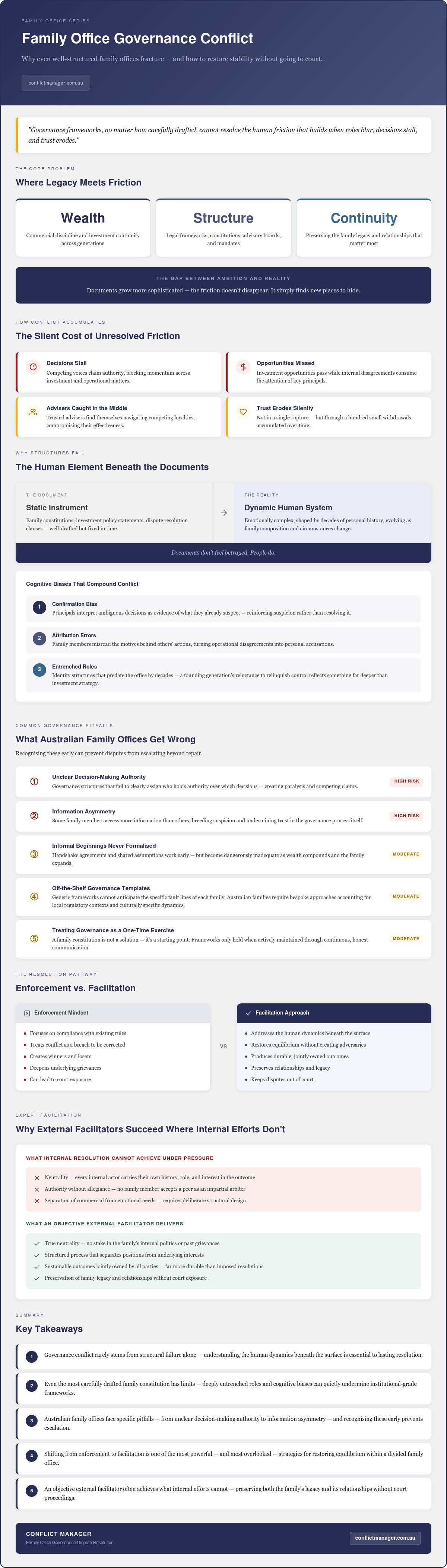
For many Australian families, governance arrangements begin informally, built on handshakes, shared assumptions, and the trusted authority of a founding patriarch or matriarch. As wealth compounds and the family expands, those informal agreements become inadequate. Institutional-grade frameworks emerge: family constitutions, investment policy statements, advisory boards, and formal dispute resolution clauses. The documents grow more sophisticated. The friction, however, doesn't disappear. It simply finds new places to hide.
The silent cost of unresolved friction is rarely visible on a balance sheet, but it accumulates with precision. Decisions stall as competing voices claim authority. Investment opportunities pass while internal disagreements consume the attention of key principals. Trusted advisers find themselves navigating competing loyalties. And beneath all of it, the trust that holds the structure together quietly erodes, not in a single rupture, but through a hundred small withdrawals.
The Intersection of Family and Business
Every family office principal carries a dual identity: the executive who must act with commercial discipline, and the family member whose decisions are shaped by decades of personal history. These two identities don't operate in separate compartments. A sibling's perceived dismissal in a board meeting carries the weight of childhood dynamics. A parent's reluctance to relinquish control reflects something far deeper than a preference for a particular investment strategy. Separating emotional needs from commercial objectives isn't a matter of willpower; it requires deliberate structural design and, often, skilled external facilitation.
Governance as a Living Organism
A family constitution is not a solution. It's a starting point. Governance frameworks only hold when they're actively maintained through continuous, honest communication, and adapted as the family's composition and circumstances evolve. Australian families, in particular, require bespoke approaches that account for local regulatory environments, culturally specific family dynamics, and the distinctive pressures of managing concentrated, often illiquid wealth across generations. Off-the-shelf governance templates may provide structure, but they cannot anticipate the specific fault lines that make family office governance conflict so difficult to resolve from within.
The Human Element: Why Structural Governance Often Falters Under Pressure
Documents don't feel betrayed. People do. This is the fundamental limitation that even the most rigorously drafted family constitution cannot overcome: it is a static instrument applied to a dynamic, emotionally complex system. When resentment has accumulated over years, when a sibling feels perpetually overlooked, or when a founding generation refuses to acknowledge that the world has changed, no clause or covenant will dissolve that tension. It will simply reroute it.
Family office governance conflict is rarely born in the boardroom. It gestates in the accumulated weight of unspoken grievances, unexamined assumptions, and identity structures that predate the office itself by decades. Cognitive biases compound the problem significantly. Confirmation bias leads principals to interpret ambiguous decisions as evidence of what they already suspect. Attribution errors cause family members to assign malicious intent to what is, in many cases, simply poor communication. And the family archetypes, the cautious patriarch, the ambitious second child, the diplomatically exhausted spouse, don't dissolve when someone takes a seat at the governance table. They simply put on a suit.
Succession introduces its own particular pressure. The transition from wealth creator to wealth steward is not merely a transfer of assets; it's a transfer of identity, authority, and meaning. Founders frequently conflate the family office with their own legacy, making any proposed change feel like a personal diminishment rather than a structural evolution. The next generation, meanwhile, arrives with legitimate ambitions and a different relationship to risk, technology, and purpose. Neither position is wrong. But without a structured process to hold both perspectives with equal dignity, the gap between them widens until it becomes a fault line.
Intergenerational Friction and Succession
Crafting a shared vision across generations requires more than a strategic planning session. It demands a process that genuinely surfaces the expectations of non-active beneficiaries, acknowledges the emotional weight carried by the founding generation, and creates space for honest disagreement before it calcifies into opposition. The families who navigate this well don't do so by accident; they invest in structured facilitation that holds competing visions in productive tension rather than forcing an artificial consensus.
Role Ambiguity in the Family Office
The friction between professional executives and family stakeholders is one of the most persistent sources of breakdown in high-net-worth governance environments. The distinction between decision rights and influence rights is rarely defined with sufficient clarity, which means both sides operate with different maps of the same territory. A professional CEO assumes operational authority; a family principal assumes the right to override it. Without explicit boundaries, both assumptions are simultaneously reasonable and corrosive.
Recognising these dynamics early, before they harden into entrenched positions, is where the real work of governance begins. For families navigating this terrain, engaging a specialist in family conflict resolution can provide the structured clarity that internal conversations, however well-intentioned, often cannot.
Identifying the Catalysts: Common Governance Pitfalls in Australian Family Offices
Knowing that governance is fragile is one thing. Knowing precisely where it breaks is another. Family office governance conflict rarely emerges from a single catastrophic failure; it accumulates through a series of structural blind spots, each one manageable in isolation, collectively corrosive. For Australian families managing concentrated, often multigenerational wealth, these pitfalls tend to cluster around the same recurring fault lines.
The absence of a formal decision-making framework is perhaps the most consequential. When no one has clearly defined who holds final authority, every significant decision becomes a negotiation, and not always a civil one. Competing principals each operate with a different understanding of their mandate. The result isn't deadlock so much as drift: decisions get made, but without legitimacy, and legitimacy is the currency governance runs on.
Information asymmetry compounds this considerably. In many family offices, a single principal or a small inner circle controls the flow of financial reporting, investment data, and operational intelligence. This gatekeeping, whether intentional or habitual, creates a two-tier system in which some family members are genuinely informed and others are merely notified. Mistrust follows almost automatically. When people don't have access to the same information, they fill the gaps with assumptions, and assumptions in high-stakes environments tend toward the unflattering.
The "Founder's Shadow" is a related but distinct problem. Over-centralisation of authority around a founding figure doesn't just create succession risk; it actively suppresses the professional development of the next generation and the operational independence of non-family executives. Talented professionals leave. Capable successors disengage. The office retains its structure but loses its vitality.
What's often overlooked entirely is the soft side of governance: the relational health of the family system itself. Most governance frameworks contain dispute resolution clauses, but very few contain protocols for maintaining the conditions that prevent disputes from arising. Conflict resolution is treated as a remedial measure rather than an ongoing discipline.
Ineffective Communication Protocols
Informal decisions made at the kitchen table have a way of overriding what was formally agreed in the boardroom, and the damage this causes to professional staff is rarely appreciated. When executives discover that a direction has shifted through a family conversation they weren't party to, trust erodes quickly and quietly. A disciplined rhythm of structured family reporting and board communication isn't bureaucratic overhead; it's the connective tissue that holds the governance architecture together.
Stagnant Governance Models
A structure designed for a single founder and two adult children doesn't scale gracefully to three branches of a family dispersed across Sydney, Singapore, and London. Governance models that aren't periodically stress-tested against the family's actual composition and complexity become misaligned with the very relationships they're meant to serve. Regular, honest review, ideally with objective external input, is what separates governance that endures from governance that simply exists on paper.
Restoring Equilibrium: Strategies for Resolving Deep-Seated Governance Disputes
Resolution doesn't begin with a clause. It begins with a decision, made collectively, to prioritise the health of the system over the vindication of any single position. For families carrying the accumulated weight of unresolved family office governance conflict, that shift in orientation is often the most difficult step, and the most consequential one.
The instinct, particularly in high-stakes environments, is to reach for enforcement mechanisms. Invoke the constitution. Escalate to the advisory board. Appoint an independent director. These responses aren't wrong, but they address the symptom rather than the source. What enforcement cannot do is restore the relational trust that makes governance function in the first place. That requires a different discipline entirely: facilitation.
Refining the family charter to incorporate specific dispute management protocols is a practical starting point. Rather than generic arbitration clauses, well-constructed charters specify the conditions under which facilitation is triggered, who holds the authority to call it, and what process governs the dialogue. This removes the decision to seek help from the arena of conflict itself, where it's most vulnerable to being weaponised.
The Family Council, when properly constituted, plays a distinct and valuable role here. It's not a decision-making body in the commercial sense; it's a deliberative space where family stakeholders, including non-executive beneficiaries, can surface concerns before they harden into formal disputes. Councils work best when they operate on a regular rhythm, not reactively, and when their proceedings are held to the same standard of structured communication as any board meeting.
The Facilitated Dialogue Approach
Creating a genuinely neutral space for difficult conversations is harder than it sounds. The goal isn't comfort; it's safety, the kind that allows people to speak honestly without fear of retribution or dismissal. Skilled facilitation moves participants away from positional statements ("I want control of the investment mandate") toward the interests beneath them ("I need to know my contribution to this family is recognised"). That shift, from position to interest, is where durable agreements become possible. Lowering the emotional temperature in high-stakes meetings requires pace, structure, and an experienced hand that holds the process without taking sides.
Clarifying Decision-Making Rights
Mapping authority clearly across the CIO, CEO, and Family Board is not a bureaucratic exercise; it's an act of respect toward everyone in the system. When each principal understands precisely where their decision rights begin and end, the ambient anxiety that fuels conflict diminishes considerably. Equally important are escalation pathways for deadlocked decisions: a pre-agreed sequence that removes the resolution process from the heat of the moment and places it within a structured, time-bound framework.
Families who invest in this architecture before disputes arise are in a fundamentally stronger position than those who design it under pressure. If your office is navigating this terrain now, speak with a specialist in family conflict resolution to explore what a structured facilitation process could achieve for your specific circumstances.
The Path to Stability: Engaging Expert Facilitation for Sustainable Outcomes
There's a particular kind of exhaustion that settles over a family office when internal resolution efforts have run their course without resolution. The meetings have been held. The advisers have weighed in. The documents have been reviewed again. And yet the same tensions resurface, wearing slightly different clothes. At that point, the question isn't whether external help is needed. It's why it wasn't sought sooner.
An external facilitator brings something no internal process can replicate: genuine objectivity. Family members, however well-intentioned, carry the accumulated weight of shared history into every conversation. Trusted advisers, however capable, are rarely truly neutral; they have relationships to protect and mandates to honour. A skilled facilitator enters without that history, without those loyalties, and without a stake in any particular outcome. That freedom to see clearly is precisely what makes the difference when family office governance conflict has reached an impasse that goodwill alone can't break.
The alternative, litigation, deserves serious consideration for what it actually costs. Court proceedings don't just consume time and capital; they generate a public record, harden positions into legal arguments, and transform what might have been a managed disagreement into an adversarial contest with winners and losers. For families whose wealth, reputation, and relationships are intertwined, that exposure can cause damage that outlasts the dispute itself by years.
When to Engage a Neutral Third Party
Several signals suggest that internal resolution has reached its limit: when the same conversation cycles without progress, when key principals have stopped engaging in good faith, when professional executives are caught between competing family directives, or when a generational transition is approaching and no succession framework commands genuine consensus. Early intervention, before positions calcify, consistently produces more durable outcomes than engagement sought in the heat of a full breakdown. The facilitator you choose should understand both the structural mechanics of a family office and the human dynamics that governance documents can't contain; that combination is rare, and it matters.
Sustainable Resolution and Asset Integrity
Lasting stability isn't achieved by suppressing disagreement. It's built by creating the conditions in which disagreement can be held, examined, and resolved without threatening the foundations of the enterprise. Structural clarity, relational trust, and a shared orientation toward the family's long-term purpose are what protect asset integrity across generations. That foundation, once established through a professional facilitation process, gives every principal something more valuable than a favourable outcome: confidence that the system itself is sound.
Conflict Manager specialises in mediation and facilitation for high-net-worth families navigating exactly these circumstances. If your family office is carrying unresolved tension that internal efforts haven't been able to shift, the most composed next step is a confidential conversation. Organise a confidential consultation with Conflict Manager to explore what structured, expert facilitation could achieve for your family's specific situation.
A Steadier Path Forward Starts Here
Family office governance conflict doesn't resolve itself. Left unaddressed, the structural ambiguities and relational fractures explored throughout this article compound quietly until they become genuinely costly, to the enterprise, to the family, and to the legacy that both were built to protect.
The clearest takeaways are these: governance documents set the foundation, but human dynamics determine whether that foundation holds; early, structured intervention consistently outperforms reactive crisis management; and objectivity, the kind that only a neutral external facilitator can bring, is what transforms entrenched positions into durable agreements.
Conflict Manager brings professional mediation for high-net-worth families, a composed and neutral approach to high-emotion disputes, and a genuine focus on sustainable outcomes for complex organisations. That combination is rare, and in the right circumstances, it's exactly what's needed.
The most composed next step is also the most practical one. Secure your family legacy with expert conflict resolution services and begin a confidential conversation about what structured facilitation could achieve for your family office.
Frequently Asked Questions
What is the most common cause of family office governance conflict?
The primary driver is the intersection of family emotional dynamics and commercial decision-making. Roles aren't clearly defined. This leads to "kitchen table" decisions that bypass formal structures. Such ambiguity creates a vacuum where personal history dictates professional outcomes. Without clear boundaries, the family office becomes an arena for historical grievances rather than a vehicle for wealth management.
How can we resolve a deadlock between the founder and the next generation?
Resolving a deadlock requires shifting the conversation from entrenched positions to underlying interests. Founders often seek to protect a legacy. The next generation seeks to build one. These objectives aren't mutually exclusive. A structured facilitation process can surface these motivations, allowing both parties to find a path that respects the creator's vision while giving the next generation meaningful authority.
Is a family constitution legally binding in Australia?
In Australia, a family constitution is generally a statement of intent rather than a legally binding contract. It carries significant moral weight. However, it isn't enforceable in court unless specific provisions are mirrored in shareholder agreements or trust deeds. Its primary value is providing a clear roadmap. This helps prevent family office governance conflict by establishing agreed-upon behaviours before disputes arise.
How does family office mediation differ from traditional legal arbitration?
Family office mediation is a voluntary, collaborative process aimed at reaching a bespoke agreement. Traditional legal arbitration is different. It's an adversarial process where a third party imposes a decision. Mediation focuses on preserving relationships and finding creative solutions. Arbitration often results in a "winner" and a "loser," which can cause irreparable damage to family harmony and public reputation.
Can we implement governance structures if our family is currently in active dispute?
Governance structures can be implemented during a dispute, but the process must begin with stabilising the immediate friction. Attempting to draft a long-term constitution while emotions are high is rarely successful. It's better to wait. Once a neutral facilitator helps restore a level of equilibrium, the family can then build the structures required to ensure long-term stability and prevent the same family office governance conflict from recurring.
What is the role of a neutral facilitator in family office meetings?
A neutral facilitator manages the process of the meeting rather than the content of the decisions. They ensure all voices are heard. They keep the emotional temperature manageable. By remaining objective, they can point out structural blind spots that family members or long-term advisers might be too close to see. This brings a sense of order to even the most volatile situations.
How do we manage conflict between family members and professional non-family staff?
Managing this friction requires explicit mapping of decision-making authority and clear reporting lines. Conflict often occurs when family members bypass professional CEOs to give direct orders to staff. This is a common pitfall. Establishing a formal "no-interference" protocol for operational matters creates the boundaries necessary for professional staff to succeed without feeling caught between competing family interests.
How long does the family office conflict resolution process typically take?
The duration of the process depends on the complexity of the family structure and the intensity of the dispute. A targeted facilitation might resolve a specific deadlock in several weeks. A full governance restructure often takes several months of deliberate work. The focus remains on achieving a sustainable outcome. This requires a pace that allows all stakeholders to genuinely align with the new protocols.


