

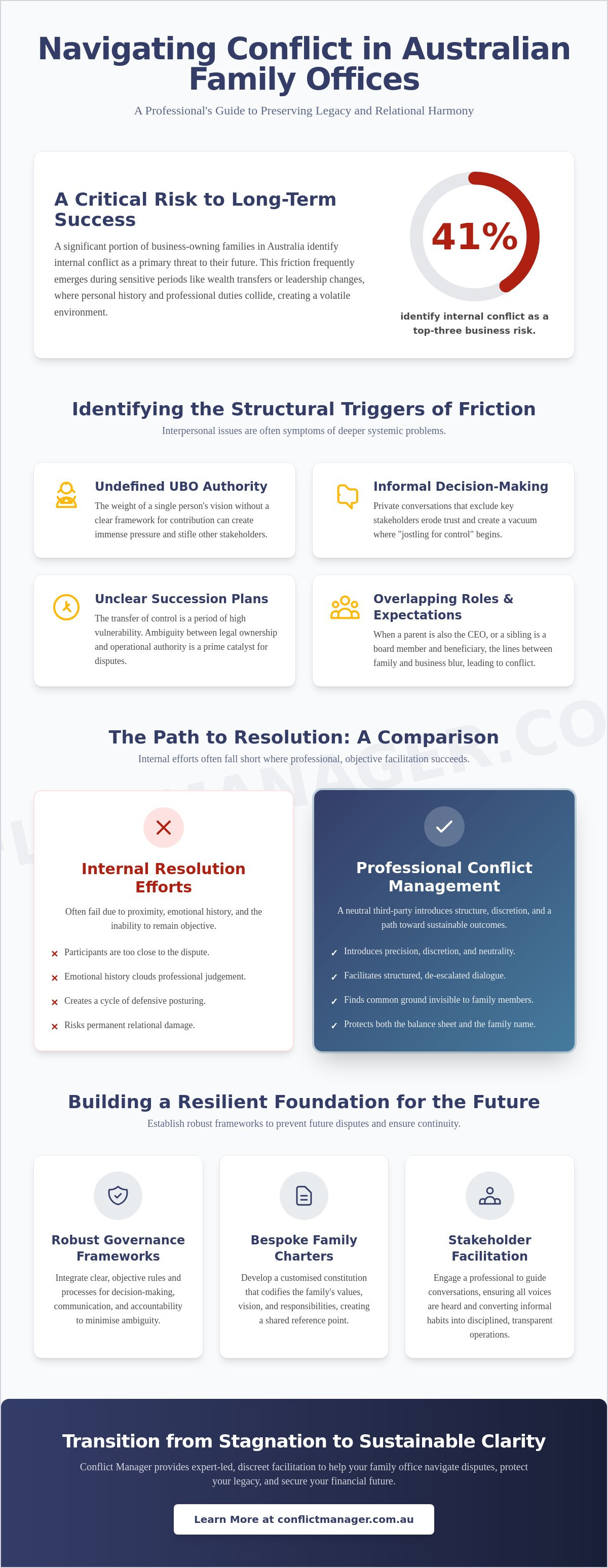
41 per cent of business-owning families identify internal conflict as a top-three risk to their long-term success. This reality often surfaces during wealth transfers or shifts in leadership, where the friction between personal history and professional duty creates a volatile environment. Stewardship. Equilibrium. Continuity. When these pillars falter, family office conflict resolution becomes an essential mechanism for restoring order without compromising the family's public reputation or private bonds.
It's common to feel that internal efforts to resolve deep-seated disputes struggle under the weight of emotional history and misaligned roles. This article provides a structured, professional path to resolving these disputes while preserving both your legacy and relational harmony. We'll examine how stakeholder facilitation and objective governance can transition your organisation from a state of deadlock toward a vision of composed authority and lasting stability.
Key Takeaways
- Recognise the distinct nature of family office conflict resolution as an expert-led process designed to navigate the high-emotion landscape of private wealth structures.
- Uncover the structural triggers of friction, from the weight of the Ultimate Beneficial Owner's decisions to the complexities of undefined leadership transitions.
- Evaluate the limitations of internal mediation and the value of an objective Conflict Manager in breaking the cycle of psychological triangulation.
- Establish a resilient foundation for the future by integrating robust governance frameworks and bespoke Family Charters into your office’s operations.
- Transition from operational stagnation to a state of sustainable clarity through professional stakeholder facilitation that prioritises both legacy and relational harmony.
What is Family Office Conflict Resolution?
Precision. Discretion. Neutrality. At its core, family office conflict resolution is the expert-led process of navigating disputes within private wealth structures. Unlike standard corporate HR, which operates within the clear boundaries of employment law and performance metrics, the family office exists in a high-emotion landscape where personal history and commercial strategy are inextricably linked. It's an environment where a disagreement over an investment isn't just about capital allocation; it's often a proxy for deeper issues of recognition, authority, or perceived favouritism. The primary goal is to achieve sustainable outcomes that honour the family legacy while ensuring the business continues to function without interruption.
Internal attempts to resolve these frictions often fail because the participants are too close to the fire. This is where the concept of a neutral third party becomes a stabilising force. By introducing an objective professional, the family can move away from defensive posturing and toward a structured dialogue. This process draws upon the established principles of Conflict Resolution to de-escalate tension and find common ground that might be invisible to those within the family circle. It's about creating a safe harbour where difficult truths can be spoken without the fear of permanent relational damage.
The Intersection of Family Dynamics and Commercial Interests
Friction. Overlap. Expectation. Family offices are uniquely susceptible to tension because roles are rarely as distinct as they appear on an organisational chart. A sibling may be both a board member and a beneficiary; a parent may be both the CEO and the primary source of emotional validation. This "legacy burden" creates immense pressure to maintain wealth across generations, often leading to clashes during succession planning or shifts in investment strategy. When intergenerational values diverge, the resulting deadlock can paralyse decision-making, leaving the office unable to respond to market shifts or internal needs.
The Cost of Unresolved Friction
The price of silence is high. Beyond the immediate stagnation of business operations, unresolved friction erodes asset integrity. When family members are at odds, the strategic focus required to manage billions in assets is often diverted toward internal politicking. There's a hidden emotional cost for both family members and employees who must navigate the fallout of these disputes daily. Perhaps most critically, in an Australian context where reputation is a form of currency, the risk of a dispute becoming public or litigious can cause irreparable damage to the family's standing in the community. Professional intervention ensures these matters remain private, protecting both the balance sheet and the family name.
Identifying the Structural Triggers of Family Office Friction
Authority. Ambiguity. Friction. These elements often converge when the structural foundations of a family office are left undefined. While interpersonal grievances might appear to be the cause of a dispute, they're frequently just symptoms of deeper systemic issues. The role of the Ultimate Beneficial Owner (UBO) is a primary example. The weight of their decisions, while historically successful, can become a source of immense pressure as the office scales. When a singular vision dominates without a clear framework for dissent or contribution, the resulting environment becomes ripe for misunderstanding.
Informal decision-making processes often exacerbate these tensions. Conversations held over dinner or in private corridors might feel natural to founding members, but they frequently lead to a perceived sense of exclusion among other stakeholders. This lack of transparency creates a vacuum where trust erodes and "jostling for control" begins. When the rising generation feels their voices are sidelined by opaque processes, the resulting deadlock can stall even the most sophisticated investment strategies. Transitioning toward a model of professional stakeholder facilitation can help convert these informal habits into disciplined, transparent operations.
Succession and the Transfer of Control
Succession remains the primary catalyst for family office disputes in Australia. There's a critical distinction between "legal ownership" and "operational authority" that many families fail to address until a crisis occurs. Intergenerational wealth transfer is a period of high structural vulnerability where the friction between past success and future vision is most acute. Without a clear map for how power moves from one generation to the next, the office risks becoming a battleground for legitimacy rather than a vehicle for growth.
Governance vs. Personality
The danger of a family office operating purely on the "force of personality" cannot be overstated. When the office's culture is tied to a single individual, the absence or decline of that person creates a leadership void that invites chaos. To mitigate this, families must establish clear roles and responsibilities that exist independently of personal relationships. According to Morgan Stanley on Family Governance, robust systems are essential for managing the complexities of multi-generational wealth. By implementing formal trust structures and governance protocols, the family can ensure that family office conflict resolution is built into the system's design rather than being an afterthought. This shift from personality-led to process-led management provides the structural integrity needed to navigate difficult transitions with quiet confidence.
Internal Resolution vs. Professional Mediation
History. Loyalty. Deadlock. When friction arises within a wealth structure, the natural instinct is often to keep the matter "in the family." This "muddling through" approach relies on existing relationships to fix what those very relationships may have broken. It's a process that frequently leads to a psychological phenomenon known as triangulation. In these instances, two parties in conflict pull in a third family member to vent or seek validation, which only serves to spread the tension across the entire organisation rather than resolving the core issue. Internal efforts often lack the necessary distance to see the structural roots of the problem, leading to a cycle of temporary fixes that eventually fail.
By contrast, professional family office conflict resolution is a premium, bespoke service designed to protect the family's privacy while delivering a structured path forward. It's not about assigning blame or litigating past grievances. Instead, it's about introducing a stabilising force that can view the situation with total objectivity. According to Global Law Experts on Dispute Resolution, structured mediation is increasingly favoured over traditional legal battles because it preserves relational harmony while addressing the complex commercial realities of the office. This external intervention provides a sense of order that internal stakeholders, no matter how well-intentioned, simply cannot offer.
The Myth of Internal Neutrality
True objectivity is impossible for those inside the circle. Whether it's a sibling, a cousin, or even a long-term family lawyer, every internal stakeholder carries a decade of history and subconscious bias. The risk of "taking sides" is constant, and even the perception of favouritism can exacerbate existing friction. A family lawyer may have drafted the trusts, but they're often too entangled in the family's emotional history to act as a neutral facilitator. A fresh pair of eyes brings a level of discernment that isn't clouded by past holidays, childhood rivalries, or long-standing professional allegiances. It's this detachment that allows for a sustainable outcome.
Benefits of a Composed External Facilitator
A professional facilitator acts as a steady hand during periods of high stress. Their presence alone often lowers the "emotional pulse" of the room, creating a space where logic can finally prevail over reactive impulses. This approach is highly efficient; it bypasses the years of circular arguments that often characterise internal disputes. By focusing on stakeholder facilitation, the mediator helps the family move toward a resolution that sticks. The result isn't just the end of a dispute, but the establishment of a professional standard that protects the family's legacy for the next generation. It's a methodical progression from complexity toward clarity.
Building Resilient Governance Frameworks
Logic. Order. Resilience. Effective governance is the structural antidote to the emotional volatility that often disrupts private wealth management. By integrating family office conflict resolution protocols directly into the foundation of the office, families can address friction before it escalates into a crisis. This proactive approach serves as a vital insurance policy for relational harmony; it ensures that when disagreements arise, they're handled through a pre-agreed process rather than reactive impulse. Regular, facilitated family meetings held outside the formal board setting provide a neutral ground for these discussions to occur safely and constructively.
Establishing these frameworks requires a steady hand and a deep understanding of human dynamics. To begin building a more resilient structure for your family office, consider the benefits of professional stakeholder facilitation to guide these complex transitions and ensure every voice is heard with total objectivity.
The Family Charter: A Living Document
A Family Charter acts as a guiding light, documenting the collective vision, values, and decision-making processes of the family. A charter prevents misunderstandings by setting clear parameters in advance regarding how wealth is managed and how disputes are resolved. The process of drafting this document is just as important as the final product itself. It's a collaborative, trust-building exercise that requires every stakeholder to voice their expectations and concerns in a structured environment. When facilitated by an expert, this process transforms potential friction into a shared commitment to the family's future legacy, ensuring the document remains relevant as the family grows.
Communication Protocols and Accountability
Formalised communication channels are essential to prevent the "informal corridor conversations" that often lead to exclusion and resentment. These protocols ensure that every family member, regardless of their operational role, knows how and when critical information is shared. Accountability is further strengthened by implementing merit-based employment and promotion criteria for family members, which removes the sting of perceived favouritism. Independent directors also play a crucial role in this ecosystem. By bringing a level of objectivity to the family board that is often missing in purely internal structures, they act as a buffer against personal grievances and keep the focus on long-term strategic goals.
Achieving Sustainable Outcomes with Conflict Manager
Clarity. Stability. Resolution. Moving from a state of internal deadlock to one of structured order requires more than just good intentions. It demands a methodology that respects the weight of the family's history while prioritising the long-term integrity of the wealth structure. Expert family office conflict resolution serves as the vital bridge between these two worlds. By introducing a grounded and objective presence, the process de-escalates the immediate friction and refocuses every stakeholder on the shared objective: the preservation of the family legacy. This isn't merely about stopping a fight; it's about restoring the structural integrity of the entire organisation.
The brand approach is one of quiet confidence. It avoids the artificial urgency that often characterises crisis management, opting instead for a steady and empathetic voice that understands the weight of your responsibility. By acting as a neutral third party, we bring clarity to clouded situations, allowing for a communication flow that is both methodical and logical. This progression feels inevitable and calming, moving the family from a state of complexity toward a vision of structured resolution.
The Process of Resolution
The journey begins with an unvarnished acknowledgement of the current disruption. There is no judgment in this initial phase. Instead, there is an empathetic recognition of the human and structural dynamics that have led to the current impasse. We then transition into analytical facilitation. This is the stage where the logic of external intervention becomes most apparent. By stripping away the emotional layers that often cloud internal discussions, we reveal the structural misalignments that are actually driving the dispute. This methodical progression moves the family from a state of complexity toward a vision of structured resolution. The ultimate goal is a sustainable outcome that every stakeholder can support, ensuring the resolution isn't just a temporary truce but a permanent shift toward organisational stability.
Taking the First Step
Introducing an external facilitator can feel like a significant admission of internal struggle. This is particularly true for founding members who have spent decades building a legacy on the foundation of self-reliance. However, the most resilient Australian family offices view professional stakeholder facilitation not as a failure, but as a sophisticated tool for risk management. The Conflict Manager process is defined by absolute discretion and quiet confidence. We understand that your reputation is your most valuable asset. By taking this step, you're securing the future of your family's assets and relational harmony for generations to come. It's a choice to move away from the pulse of high-stress friction and toward a future of composed authority.
To begin this transition from complexity toward a vision of structured resolution, you can organise a confidential consultation with Conflict Manager.
Restoring Order and Legacy
Order. Continuity. Equilibrium. The journey from internal friction to structural stability requires a shift in perspective, moving away from reactive impulses toward a model of composed authority. You've seen how identifying structural triggers and establishing robust governance frameworks can prevent the stagnation that often follows leadership transitions or wealth transfers. It's a process that moves beyond merely stopping a dispute; it's about building a foundation where future disagreements are resolved through logic rather than history.
Expert-led family office conflict resolution provides the essential distance needed to view these complex human dynamics with total objectivity. Our national Australian coverage ensures that high-net-worth families can access experienced facilitators who remain unruffled by high-stakes environments and are committed to sustainable outcomes. This professional intervention protects your public reputation while strengthening private bonds.
Secure the future of your family legacy with expert facilitation at Conflict Manager. By taking this step, you're not just resolving a current impasse; you're ensuring your family's vision remains clear and resilient for generations to come.
Frequently Asked Questions
How do you resolve conflict in a family office without going to court?
Professional stakeholder facilitation and expert-led mediation provide a structured path to resolution that avoids the adversarial nature of the legal system. By engaging a neutral third party, families can address the structural and emotional roots of a dispute in a private setting. This approach prioritises relational harmony and asset integrity over the public and costly process of litigation, ensuring that sensitive family matters remain entirely confidential.
What are the most common causes of multi-generational family office disputes?
Ambiguity. Succession. Vision. Most disputes arise when leadership transitions remain undefined or when the rising generation's values diverge from the founder's original strategy. Opaque decision-making processes often lead to a perceived sense of exclusion, creating friction that stalls business operations. Establishing clear governance early is the most effective way to mitigate these systemic triggers before they escalate into a full-scale crisis.
When is the right time to engage a professional conflict mediator?
The ideal time for professional family office conflict resolution is when internal discussions begin to circle without reaching a conclusion. Waiting until a crisis occurs often complicates the path to resolution and increases the risk of relational damage. Engaging a facilitator early ensures that the emotional pulse of the office remains low, allowing for a logical and methodical approach to solving complex problems.
Can a family charter really prevent future disputes from occurring?
A family charter acts as a proactive insurance policy by documenting vision, values, and decision-making protocols well in advance. While it cannot eliminate human emotion, it provides a pre-agreed framework for handling disagreements when they inevitably arise. This clarity reduces the likelihood of misunderstandings and ensures that every stakeholder understands their specific role and responsibility within the broader family legacy.
How does family office mediation differ from standard commercial mediation?
History. Identity. Wealth. Unlike standard commercial mediation, which focuses primarily on contractual obligations, family office mediation must account for deep-seated emotional dynamics and multi-generational history. It requires a facilitator who understands the psychological phenomenon of triangulation and the unique pressure of preserving a legacy. The process is bespoke, addressing both the commercial balance sheet and the complexities of the dining table.
What happens if one family member refuses to participate in the resolution process?
Resolution can still progress by focusing on the stakeholders who are willing to engage in the mediation process. A professional facilitator works to create a framework that remains stable even if participation is incomplete at the outset. Often, the transparency and order established by the participating members eventually encourage the reluctant party to join the dialogue once they observe the benefits of the new structure.
How can we protect our family's reputation during a high-stakes dispute?
Discretion is the cornerstone of professional conflict management. By keeping the dispute within a private, mediated environment, the family avoids the risk of public exposure that comes with court proceedings. Expert facilitators ensure that all discussions remain strictly confidential, protecting the family's standing in the Australian business community while the underlying issues are resolved with composed authority and quiet confidence.
Is it possible to maintain business stability while a major family conflict is being resolved?
Stability. Focus. Continuity. It's possible to maintain operational integrity by establishing clear boundaries between the ongoing conflict and day-to-day management. Professional facilitation helps stakeholders focus on their fiduciary duties while the personal elements of the dispute are handled in a separate, structured environment. This decoupling ensures that the family's assets remain protected and business operations continue even during periods of high internal stress.


