

A family office is often more fragile than the wealth it manages. Silence. Ambiguity. Resentment. While Australian family offices now account for 40% of all private capital investors in the country, the true risk to a legacy isn't market volatility; it's the quiet erosion of trust between generations. Implementing robust family office dispute prevention strategies is no longer a luxury for those seeking to avoid the public glare of a courtroom or the heavy costs of a serious privacy breach under the 2025 reforms. These internal pressures, if left unaddressed, can dismantle even the most sophisticated financial structures.
It's natural to feel that your internal dynamics are too personal for external frameworks. You've worked hard to build a private world where your values should be enough to guide you. However, as the Australian regulatory landscape becomes more assertive, relying on goodwill alone can leave your assets vulnerable to intergenerational friction and decision-making deadlocks. This article outlines how to implement structural and relational safeguards that prevent internal tension from becoming a threat to your family office legacy. We'll explore a clear framework for decision-making that reduces emotional friction and ensures asset protection through long-term stability.
Key Takeaways
- Learn why separating emotional dynamics from commercial strategy through a Family Council creates a necessary buffer for wealth preservation.
- Discover how bespoke family office dispute prevention strategies, such as a tailored Family Charter, align intergenerational values with long-term investment goals.
- Establish clear protocols for family participation to ensure that professional roles are based on merit rather than birthright.
- Understand the importance of neutral stakeholder facilitation and formal Family Forums in maintaining transparency outside the boardroom.
- Transition your family office from a reactive crisis state to a resilient framework built on structural integrity and psychological discernment.
The Unique Landscape of Australian Family Office Friction
Legacy. Discretion. Stewardship. For the Australian high-net-worth individual, these are not mere concepts but the pillars of a life's work. In a market where family offices now control 40% of private capital, the intersection of private wealth and public reputation creates a high-stakes environment. While a standard corporation might survive a board dispute with its brand intact, a family office rarely enjoys that luxury. Here, internal friction doesn't just threaten the balance sheet; it threatens the family name. Understanding What is a Family Office? in the Australian context means acknowledging that these entities are as much about managing human dynamics as they are about managing assets.
Traditional corporate governance often fails because it treats the family as a rational, monolithic entity. It assumes that legal contracts and shareholder agreements are sufficient to contain interpersonal history. They aren't. Effective family office dispute prevention strategies must account for the "emotional tax" that unaddressed tension imposes on multi-generational assets. When silence becomes the default response to disagreement, the resulting instability devalues the portfolio through stagnant decision-making and missed opportunities. Moving toward a governance-first strategy, rather than a reactive lawyer-first approach, allows families to address the root causes of friction before they escalate into public scandal.
The Three-Circle Model of Family Business
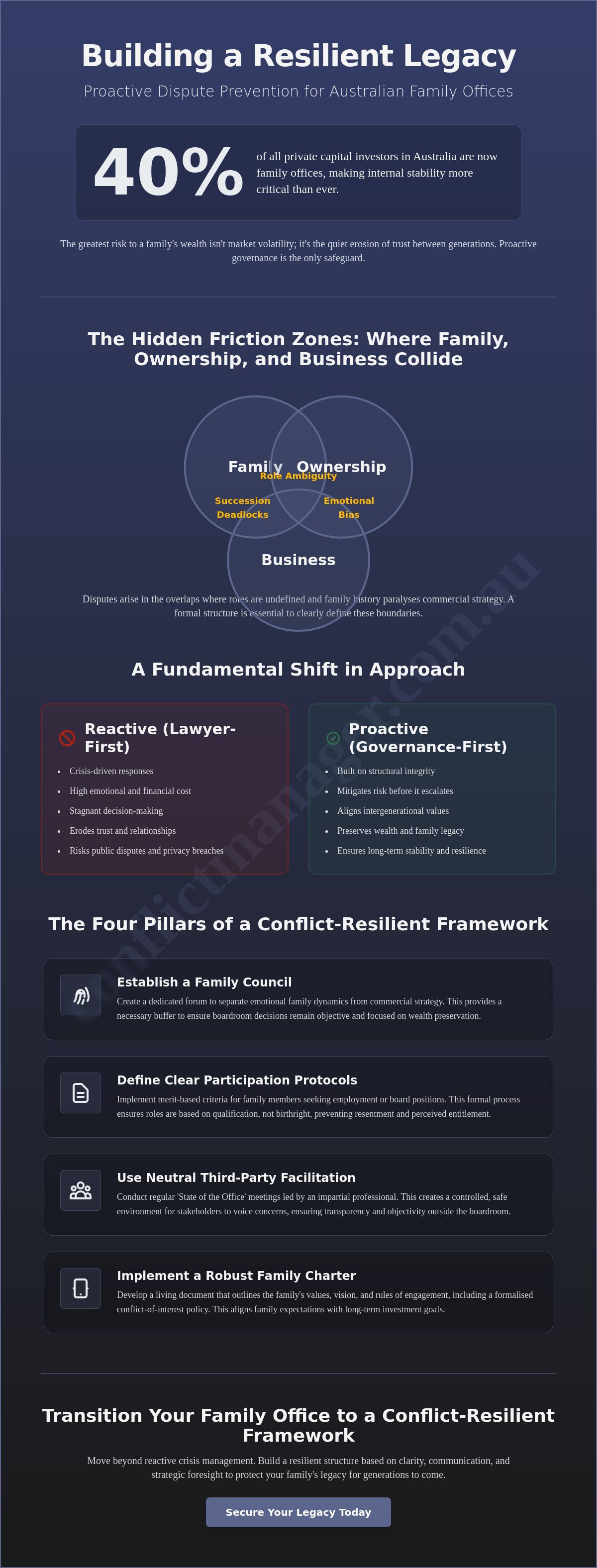
Friction often arises at the overlap of three distinct circles: the family, the owners, and the business managers. These "friction zones" are where roles become blurred. A sibling might be a co-owner but not an employee; a parent might be the founder but no longer the primary decision-maker. Australian families often struggle with succession because these boundaries aren't clearly defined. Without neutral facilitation, the emotional weight of family history can paralyse commercial strategy. Identifying these overlaps early is a core component of sustainable family office dispute prevention strategies.
Regulatory Stability and the Corporations Act 2001
While family offices prize privacy, they don't operate in a vacuum. Australian governance standards, particularly those outlined in the Corporations Act 2001, provide a necessary framework for structural integrity. Fiduciary duties aren't just legal obligations; they are tools for preventing "oppressive conduct" claims that often arise when minority stakeholders feel sidelined. Balancing these statutory requirements with private family values requires a sophisticated touch. It's about ensuring that the family's "fair go" culture is backed by the same rigour found in a public board, providing a grounded sense of order even during periods of high stress.
Core Strategies for Proactive Dispute Prevention
Prevention is a discipline. It requires a fundamental shift from viewing conflict as a failure to seeing it as a predictable outcome of complex human systems. Effective family office dispute prevention strategies are built on the premise that clarity is the ultimate antidote to friction. One of the most potent tools in this regard is the Family Council. This body functions as a dedicated forum for family-specific concerns, effectively separating emotional narratives from commercial imperatives. By Mitigating Risk and Safeguarding Wealth through this structural separation, you ensure that board meetings remain focused on performance rather than past grievances.
Proactive offices don't wait for a crisis to define their boundaries. They establish clear protocols that govern how family members interact with the office and its assets. Consider the following foundational elements:
- Defined Entry and Exit Criteria: Establishing merit-based requirements for family members seeking employment or board positions prevents the resentment that stems from perceived entitlement.
- Facilitated "State of the Office" Meetings: Regular sessions led by a neutral third party allow stakeholders to voice concerns in a controlled, objective environment.
- Robust Conflict-of-Interest Policies: A formalised policy ensures that personal ventures or external investments don't cloud the primary objectives of the family office.
Engaging in professional stakeholder facilitation can help bridge the gap between intent and implementation, ensuring these policies are respected by all generations.
Structural Integrity: Roles and Responsibilities
Ambiguity is the primary driver of internal friction. When roles are undefined, family members often default to historical patterns of behaviour that may no longer serve the organisation. Drafting formal job descriptions for every family member involved in the office is a simple yet transformative step. It establishes accountability and provides a framework for performance reviews. Additionally, the presence of independent directors provides an objective centre of gravity. These external professionals offer a steady hand, ensuring that the office's structural integrity remains unruffled by the inevitable fluctuations of family life.
Financial Transparency as a Preventive Shield
Wealth is a frequent source of tension, particularly when expectations regarding liquidity and distributions differ across generations. Standardising dividend policies manages these expectations by providing a predictable roadmap for all shareholders. This transparency is further reinforced by regular external audits. These audits aren't just about compliance; they are about building a culture of trust. When minority shareholders have access to clear, audited financial reporting, the potential for suspicion or claims of "oppressive conduct" is significantly reduced. Managing the power dynamic of the Ultimate Beneficial Owner requires grace, and transparency is the most effective way to achieve it.
The Family Charter: A Living Document for Legacy Stewardship
Identity. Purpose. Continuity. While many advisors offer off-the-shelf templates, a truly effective family charter must be a bespoke reflection of the family’s unique narrative. In the context of family office dispute prevention strategies, the charter serves as the foundational architecture upon which all other governance sits. It isn't merely a static file in a drawer; it's a living document that aligns the "Family Creed" with commercial investment objectives. When the family’s core values are explicitly linked to how capital is deployed, the potential for friction over investment direction is significantly reduced.
The charter also functions as a pre-negotiated mediation framework. When disagreements occur, the document provides an objective set of rules to return to, ensuring that the resolution is based on agreed principles rather than the loudest voice in the room. To remain effective, these documents require regular review cycles. An Australian family office that thrived in the 1990s may find its original charter ill-equipped for the digital and ESG-focused landscape of 2026. Ensuring the charter evolves with each new generation prevents it from becoming an archaic relic that the next generation feels compelled to ignore.
Defining the Family Mission and Values
Facilitating a collective vision requires more than a simple meeting. It involves deep stakeholder facilitation to uncover the shared "why" that transcends individual interests. When family members understand the purpose behind the wealth, they're more likely to honour the structures that protect it. A family charter is a relational contract that defines the psychological and ethical boundaries of the family, moving beyond the mere legalities of ownership. This intergenerational buy-in is the most effective shield against future litigation.
Succession Planning and Leadership Transition
The "founder’s shadow" can be a source of immense stability or a catalyst for profound resentment. A well-structured charter addresses this by outlining transition phases that allow the next generation to earn authority through merit. It also provides essential provisions for unforeseen events, such as death, divorce, or incapacity, which could otherwise destabilise the office. By formalising these pathways, the charter prevents the undignified jostling for control that often occurs during leadership changes. It ensures that the transition is a measured movement rather than a chaotic disruption, maintaining the integrity of the family’s legacy throughout the process.
Implementing Communication Protocols and Neutral Facilitation
Structure provides the skeleton, but communication is the breath of a family office. Even the most robust governance can collapse if the way information flows is fragmented or opaque. To move from theory to practice, family office dispute prevention strategies must include a methodical approach to how stakeholders interact. This isn't about "getting along"; it's about establishing a professional cadence that survives emotional volatility. A logical progression involves five distinct steps.
- Audit current channels: Evaluate whether sensitive decisions are being discussed in informal settings like family dinners or WhatsApp groups. Transparency requires a shift to centralised, secure communication.
- Formalise Family Forums: These gatherings are distinct from Board meetings. They provide a space to discuss the emotional aspects of the legacy without derailing commercial strategy.
- Train in "Difficult Conversation" frameworks: Equipping family members with tools to express disagreement without personal attack is a long-term investment in stability.
- Engage neutral facilitation: For agenda items known to be divisive, bringing in an external hand ensures the process remains fair and objective.
- Document the rationale: Decisions should be recorded alongside the reasoning behind them. This prevents "memory drift," where different generations recall the same agreement in contradictory ways.
For those ready to move beyond informal arrangements, engaging in professional stakeholder facilitation provides the necessary distance to view complex dynamics with total objectivity.
Managing High-Emotion Dynamics with Composure
Intergenerational wealth transfer is rarely a purely financial transaction. It's a period of profound psychological transition. Recognising the triggers of this shift is essential for maintaining order. When discussions turn to inheritance or leadership, the "pulse" of the room often rises. Professional conflict management uses empathy not as a soft skill, but as a diagnostic tool. It allows the facilitator to identify the underlying fear or resentment driving a dispute. By acknowledging these emotions without becoming entangled in them, it's possible to lower the collective heart rate and return the focus to structural resolution.
The Value of the Neutral Third Party
Internal attempts at mediation often lead to further entrenchment. This happens because family members cannot shed their historical roles; a sibling remains a sibling, regardless of their professional title. A neutral third party brings a level of objectivity that is impossible to achieve from within. The Conflict Manager approach focuses on providing a steady hand during periods of high stress. This external presence preserves the reassurance of order, acting as a buffer that prevents personal friction from damaging the office's commercial integrity. It ensures that every voice is heard while keeping the organisation moving toward its strategic goals.
The Conflict Manager Approach: Building Conflict-Resilient Offices
Stability. Clarity. Resolution. Many family offices operate in a state of reactive crisis management, addressing fires only once the smoke is visible to the public or the regulators. This approach is inherently exhausting, and it places an unnecessary emotional tax on every stakeholder involved. Transitioning to a structured resolution framework requires a fundamental shift in perspective. By implementing proactive family office dispute prevention strategies, you move from a posture of defence to one of deliberate stewardship. Our methodology is built on the intersection of composed authority and psychological discernment, providing a steady hand when internal efforts struggle under the weight of interpersonal history.
Consider a transition within a prominent Australian family office where the founder sought to step back from daily operations. The friction wasn't about the assets themselves, but about the perceived loss of influence and the ambiguity of new roles. By navigating this structural change with quiet confidence, we facilitated a series of forums that allowed for a measured transfer of power. This wasn't a legal battle; it was a guided transition that preserved the family’s bond while securing the office's commercial future. The result was a sustainable outcome that protected the portfolio from the volatility of unaddressed resentment.
Expert Mediation and Facilitation Services
We provide specialised support for Australian family offices and high-net-worth families who recognise that traditional corporate governance is insufficient for their unique needs. Our services in Family Conflict Resolution and Organizational Conflict Management are designed to guide stakeholders through structural change without becoming emotionally entangled in the dynamics. This is stakeholder facilitation at its most refined. We act as a neutral third party, viewing volatile situations with total objectivity and bringing a sense of order to the most complex interpersonal environments. This ensures that the pulse of the organisation remains steady even during the most difficult transitions.
Securing Your Legacy
The progression from disruption to clarity is a logical one. It begins with acknowledging the reality of friction and ends with a resilient framework that protects both your assets and your relationships. A neutral external hand isn't a sign of weakness; it's the most efficient path to long-term stability. It ensures that the legacy you've built isn't devalued by the very people meant to inherit it. You can Contact Conflict Manager to discuss your family office governance strategy and begin the process of formalising your resolution framework today. Proactive family office dispute prevention strategies are the only way to ensure that your wealth serves your family, rather than the other way around.
Securing the Future of Your Family Legacy
Integrity. Clarity. Continuity. You've seen how structural safeguards and bespoke charters provide the essential framework needed to navigate the complexities of Australian wealth. By separating emotional narratives from commercial strategy, you ensure that your office remains a source of stability rather than friction. Moving away from reactive measures toward formalised communication protocols allows each generation to find its place within the legacy without the shadow of entitlement or ambiguity.
Implementing effective family office dispute prevention strategies is the most reliable way to protect your assets from the erosion of internal conflict. Conflict Manager offers composed, objective guidance for high-emotion situations, delivering expert-led mediation with a focus on sustainable outcomes. With national service coverage across Australia, we provide the steady hand required to maintain professional order. Enquire about our Family Office Mediation and Facilitation services to begin fortifying your governance structure today. It's a journey from complexity toward a vision of structured resolution, ensuring your legacy remains intact for generations to come.
Frequently Asked Questions
What are the most common causes of family office disputes in Australia?
Disputes often stem from the "founder’s shadow," where the transition of authority lacks a clear roadmap. Ambiguous decision-making roles and differing views on risk appetite between generations also create significant friction. When family members feel sidelined from the wealth they inherit, or when commercial objectives conflict with personal values, the resulting tension can destabilise the entire office structure.
How does a family charter differ from a shareholder agreement?
A shareholder agreement is a legally binding contract focused on the commercial rights and obligations of owners. In contrast, a family charter is a relational document that outlines the family’s mission, values, and ethical boundaries. While the shareholder agreement provides the legal skeleton, the charter provides the moral and psychological heart, guiding how the family interacts with the wealth over multiple generations.
Can a family office dispute be resolved without going to court?
Yes, the Australian system strongly encourages resolving disputes through negotiation, mediation, and stakeholder facilitation. These out-of-court methods are often preferred because they preserve privacy and are generally more cost-effective than litigation. Effective family office dispute prevention strategies focus on creating these resolution pathways before a disagreement escalates into a public legal battle.
When is the right time to engage a neutral third-party mediator?
The ideal time is during periods of high-stakes transition, such as succession planning or a major shift in investment strategy. Engaging a mediator early prevents minor frictions from hardening into entrenched positions. If you notice that board meetings are becoming emotionally charged or that certain topics are being avoided altogether, it's a clear signal that external facilitation is required to maintain order.
How do we manage conflict between different generations in a family office?
Managing intergenerational conflict requires formalising "Family Forums" that are separate from commercial board meetings. These forums allow different generations to discuss their values and expectations in a structured environment. Using neutral facilitation helps bridge the gap between the founder’s vision and the aspirations of the next generation, ensuring that the legacy evolves without losing its core identity.
What is the role of independent directors in preventing family disputes?
Independent directors act as an objective centre of gravity, ensuring that the office adheres to the fiduciary duties outlined in the Corporations Act 2001. They provide an external perspective that isn't clouded by family history or personal dynamics. By focusing on merit-based decision-making and structural integrity, they help prevent claims of "oppressive conduct" from minority stakeholders.
Is mediation confidential for high-profile Australian families?
Mediation is a strictly private process, offering a level of discretion that the courtroom cannot match. Under the 2025 privacy reforms, protecting the family name has become even more critical. Mediation allows families to resolve complex disagreements behind closed doors, ensuring that sensitive financial and personal information remains shielded from public scrutiny and the media.
How do we implement dispute prevention strategies without upsetting family members?
Implementation should be framed as a collective commitment to legacy stewardship rather than a response to individual failings. Presenting these frameworks as a professional standard for high-net-worth families helps depersonalise the process. When everyone understands that the goal is asset protection and intergenerational stability, the introduction of new family office dispute prevention strategies is viewed as a reassuring step toward a more secure future.


