

Privacy. Logic. Continuity. These are often the first casualties when a dispute transitions from a manageable friction into a high-stakes crisis. Neutrality is far more than the simple absence of bias; it is a rigorous, professional framework that allows stakeholders to detach their personal identities from the friction of a dispute. When internal efforts struggle under the weight of history, engaging a neutral third party mediator becomes a logical necessity. You've likely reached a point where emotional entanglement has stalled logic, leaving family assets or business operations in a state of costly stagnation; it's a difficult reality to face when the fear of a permanent relationship breakdown looms over every discussion.
This external perspective provides the structural integrity and objective distance required to navigate these complexities with composure. Since the Family Law (Family Dispute Resolution Practitioners) Regulations 2025 commenced on April 1, the framework for resolving such tensions has become even more robust. This article explores how a seasoned expert brings clarity to clouded situations, ensuring your privacy remains intact while moving you from a state of disruption toward a vision of structured, lasting resolution.
Key Takeaways
- Structure. Distance. Resolution. Discover how a neutral third party mediator provides the framework necessary to separate personal identities from complex disputes, allowing for movement in otherwise stagnant environments.
- Recognise the subtle markers of organisational stalemate, including declining productivity and communication breakdowns, that indicate it's time to seek external facilitation to protect your interests.
- Understand the critical distinction between a neutral expert and a sympathetic ally, ensuring the process remains grounded in logic rather than emotional entanglement.
- Evaluate potential mediators within the Australian context by looking past baseline accreditation to find the specific temperament and industry experience required for high-stakes resolution.
- Prioritise the integrity of your assets and the health of your professional relationships through a methodical journey toward clarity and composure.
The Architecture of Neutrality: Defining the Third-Party Mediator
Stagnation. Friction. Silence. These are the markers of a conflict that has outgrown internal resolution. Neutrality is often misunderstood as a passive state, yet in high-stakes environments, it's a strategic tool. A neutral third party mediator doesn't simply sit between two parties; they act as a catalyst for movement. By removing the need for defensive posturing, they create a space where stakeholders can finally separate their core interests from their emotional narratives. It's about restoring order when the internal structure of a family or organisation has begun to buckle under pressure.
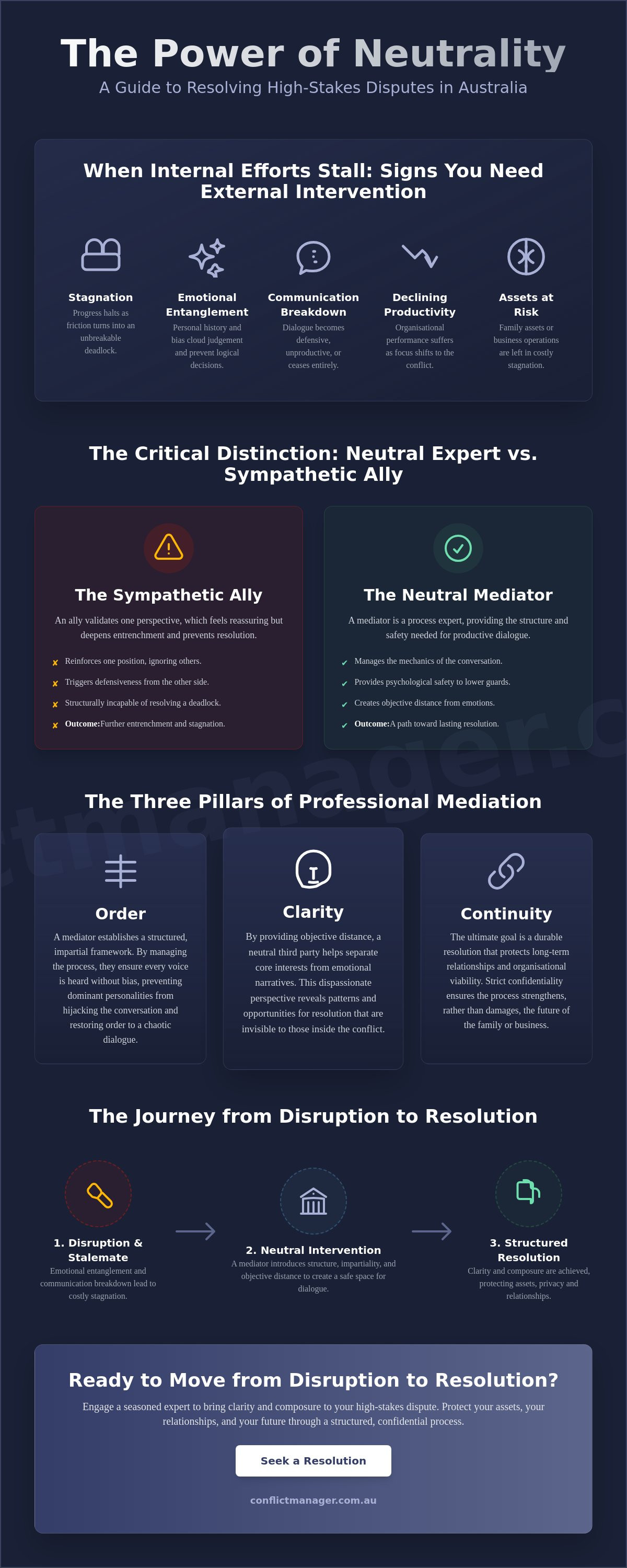
It's common for individuals to seek an ally during a dispute, someone who validates their perspective and reinforces their position. While this feels reassuring in the short term, an ally is structurally incapable of resolving a deadlock. Their presence usually triggers further resistance from the opposing side, deepening the entrenchment. A mediator, however, is a process expert. They don't act as a judge or a legal advocate. They're there to manage the mechanics of the conversation, ensuring that the dialogue remains productive even when the subject matter is volatile. This objective presence provides a unique form of psychological safety; it allows everyone in the room to lower their guard without fearing they'll be exploited.
Mediation vs Arbitration: Choosing the Right Path
Choosing the correct framework is the first step toward resolution. The definition of mediation centres on a voluntary, confidential process where a facilitator assists parties in reaching their own agreement. It's a collaborative search for interests where the parties retain total control over the outcome. It's about finding a path forward that everyone can live with, rather than having a decision imposed from above. Arbitration, by contrast, involves a third party making a binding decision. It's often chosen when finality is more important than the nuances of the relationship. Some Australian organisations now opt for a hybrid Med-Arb approach. This begins with flexible mediation but transitions into binding arbitration if a consensus isn't reached, providing a guaranteed conclusion to the friction.
The Value of Objective Distance
Internal stakeholders are frequently too close to the heat of the conflict to see the exit. When you're embedded in the day-to-day operations of a family office or a corporate board, history and habit cloud your judgment. A neutral third party mediator brings a steady hand and a fresh set of eyes. They view the situation dispassionately, identifying patterns and opportunities that those in the thick of it might overlook. This distance is protected by strict confidentiality protocols. In the Australian market, where reputation is a primary asset, the privacy of the mediation room ensures that difficult transitions don't become public spectacles. It's about maintaining the integrity of the process while protecting the long-term viability of the organisation.
Beyond Bias: The Three Pillars of Professional Mediation
Order. Clarity. Continuity. These three pillars form the structural foundation of professional mediation. While the previous section explored the identity of the mediator, it's the application of these specific principles that allows a resolution to withstand the pressure of high-stakes environments. A neutral third party mediator acts as the architect of this shift, ensuring the focus remains on the health of the organisation rather than the grievances of individuals. By establishing a framework built on impartiality, bespoke design, and interest realignment, they move the parties from a state of disruption toward a vision of structured, logical resolution.
Impartiality isn't a passive stance; it's an active refusal to align with any single narrative. In the context of Australian family offices or corporate boards, where power imbalances are often deeply entrenched, this refusal is vital. Dominant personalities can easily hijack internal discussions, leaving quieter stakeholders sidelined and resentful. The mediator’s role is to ensure every voice is heard without allowing the process to be derailed by those who hold traditional authority. By preventing emotional entanglement from clouding strategic choices, they help the group return to a state of logic. This is particularly crucial when dealing with organisational conflict management, where the objective is to protect the asset's integrity while navigating complex human dynamics.
Impartiality in High-Stakes Environments
In volatile situations, the "loudest voice" often dictates the terms of engagement. This creates a dangerous precedent where decisions are made based on influence rather than merit. A professional mediator levels the field. They provide a steady hand, ensuring that the process isn't overwhelmed by the weight of historical grievances or current status. By maintaining total objectivity, the mediator allows for a more equitable distribution of input, which is essential for reaching a sustainable agreement that all parties can respect. This objective distance is what prevents the stagnation of family assets or the breakdown of business operations during periods of transition.
Designing the Resolution Framework
Every conflict has its own unique rhythm and friction. A standard, one-size-fits-all approach rarely succeeds in complex environments. Instead, a neutral third party mediator creates a bespoke facilitation plan tailored to the specific needs of the group. This involves a deliberate use of rhythmic variation in communication, where precise terminology and measured pacing are used to clarify nuances without losing momentum. The goal is to move the conversation away from "who is right" and toward "what is required." This interest realignment ensures that the final outcome preserves the long-term integrity of the family or business, fostering a sense of order that persists long after the mediation has concluded.
Identifying the Need: When to Engage External Intervention
Erosion. Stagnation. Decay. These are the silent consequences of unmanaged friction. While conflict is a natural byproduct of ambition and diverse perspectives, left unaddressed, it begins to erode the very assets it was meant to build. A specific point exists where internal attempts to "work through it" actually entrench the problem. This is when the intervention of a neutral third party mediator becomes essential. It's not an admission of failure, but a strategic decision to preserve the integrity of the structure. By identifying the tipping point early, you prevent the permanent breakdown of relationships and the decline of organisational value.
Stalemate often presents as a repetitive cycle. If the same grievances are aired in every meeting without resolution, logic has been replaced by a loop. You'll notice declining productivity in the leadership team or a freeze on critical decision-making within the family office. When internal stakeholders try to fix these issues, they often bring their own baggage to the table, inadvertently making them part of the friction rather than the cure. A neutral third party mediator breaks this cycle by providing a fresh set of eyes and a steady hand. They offer the objective distance necessary to see the exit path that those in the thick of the heat simply cannot find.
Family Office and Multi-Generational Friction
Wealth and emotion are a volatile mix. In Australian family trusts, the overlap of legacy and personal identity can lead to significant blockages. Intergenerational wealth transfer is a particularly sensitive period; legacy is frequently threatened by sibling or cousin rivalry that has simmered for years. Learning how to manage conflict in family office settings requires an external perspective that respects the family history without being bound by it. A mediator ensures that the transfer of assets doesn't become a catalyst for the dissolution of the family unit.
Organisational Change and Structural Tension
Rapid growth or restructuring creates natural stress points within any business. Leadership teams often find themselves at odds over strategic direction, and boardroom disputes can quickly turn personal when the stakes are high. During these corporate transitions, the presence of an external facilitator provides a sense of composed authority. They help stakeholders find strategic alignment by stripping away the personal friction, allowing the business to maintain its momentum. This is about protecting the culture and the bottom line from the high cost of internal discord.
Vetting for Excellence: Selecting a Mediator in Australia
Discernment. Temperament. Experience. These are the qualities that separate a standard practitioner from a specialist capable of managing high-stakes friction. While many individuals claim the title, selecting a neutral third party mediator for a family office or a corporate board requires a rigorous vetting process. It isn't enough for a facilitator to be impartial; they must possess the structural understanding to navigate complex asset distributions and the psychological depth to manage entrenched interpersonal dynamics. In the Australian market, where professional reputations are closely guarded, the choice of mediator can determine whether a transition leads to renewal or further decay.
Accreditation serves as the baseline for any professional engagement. In Australia, the National Mediator Accreditation System (NMAS) provides the primary framework for practice standards. For those involved in family matters, the Family Law (Family Dispute Resolution Practitioners) Regulations 2025, which commenced on April 1, have introduced updated duties regarding family violence screening and record-keeping. However, these certifications only represent the floor. A truly effective mediator is a fast learner who can quickly grasp the nuances of technical asset disputes or multi-generational trust structures without requiring an extensive briefing on the basics of business operations.
The Importance of Accreditation and Experience
There's a significant distinction between a mediator who focuses solely on legal compromise and a conflict manager who addresses the underlying structural tension. A legalistic approach often settles the immediate dispute but leaves the relationship in tatters. By contrast, a specialist in organisational conflict management looks toward the long-term health of the entity. They understand that finality is worthless if it doesn't also provide a foundation for future cooperation. When vetting a professional, ask about their experience with similar corporate or family structures; you're looking for someone who understands the weight of legacy as clearly as they understand the law.
Assessing the Professional Register
The "Steady Hand" test is perhaps the most critical component of selection. You need a seasoned professional who remains unruffled by high-stakes environments or volatile personalities. During the intake process, observe their composure. Do they project a sense of quiet confidence? Are they able to articulate a methodical journey from complexity toward resolution? A mediator who understands sustainable outcomes will prioritise the integrity of the process above all else. They act as a stabilizing force, ensuring that even the most heated boardroom disputes are handled with the level of professional decorum required to protect the brand and the family name.
Achieving Clarity: The Conflict Manager Approach
Resolution. Stability. Legacy. These three states represent the culmination of a methodical journey from complexity toward order. When a neutral third party mediator is engaged, the process moves beyond the immediate friction to address the structural integrity of the organisation. It's a transition from a state of emotional disruption to one of decisive, logical action. By focusing on asset integrity and the preservation of long-term relationships, the Conflict Manager approach ensures that the resolution isn't just a temporary ceasefire but a foundation for future growth.
This signature style is defined by composed authority. It provides grounded, reassuring guidance that remains unruffled even when the stakes are at their highest. Internal efforts often fail because they lack the objective distance required to see the exit. An external facilitator brings that distance, acting as a steady hand that guides stakeholders through the most volatile transitions. This approach moves the focus away from historical grievances and toward a structured vision of what's required to move forward together.
Bespoke Facilitation for Families and Organisations
Every Australian family office or corporate board has its own unique dynamics. A standard approach to mediation is often insufficient for these high-stakes environments. Instead, the process must be tailored to the specific friction of the group, ensuring the intervention respects the family legacy while addressing the current blockages. Achieving clarity during leadership team conflict requires more than just a conversation; it requires a professional framework that prioritises sustainable conflict resolution outcomes. This bespoke design ensures every stakeholder feels heard and the final agreement is robust enough to withstand future pressure.
Next Steps: Restoring Order
Acknowledging the reality of disruption is the first step toward resolving it. If your family office or leadership team is experiencing stagnation, it's a sign that internal efforts have reached their limit. Transitioning toward the logic of external intervention is a strategic choice to protect your culture and your assets. A confidential consultation with a neutral third party mediator allows you to explore the path forward in a safe, objective environment. It's time to move away from the cycle of repetitive arguments and toward a vision of structured resolution. You can Consult with a Conflict Manager expert today to begin the process of restoring order and clarity to your organisation.
Restoring Structural Integrity and Long-Term Stability
Conflict doesn't have to result in the permanent breakdown of a family office or a corporate board. By engaging a professional framework, you move from a state of disruption toward a vision of structured resolution. We've explored how neutrality acts as a catalyst for movement in stagnant environments and why selecting a practitioner with specific industry experience is the baseline for success. It's about protecting the integrity of your assets while ensuring that the human dynamics remain functional.
Finding the right neutral third party mediator is a decisive step toward regaining control. Our team provides national Australian coverage for complex organisational disputes, bringing deep expertise in high-net-worth family office dynamics to every facilitation. We focus on sustainable, long-term resolution outcomes that respect your legacy. You can engage a neutral third-party mediator to restore clarity and stability to your organisation. Order is achievable. The right intervention ensures that your most valuable relationships and assets are preserved for the future.
Frequently Asked Questions
What exactly is the role of a neutral third party in a dispute?
A neutral third party acts as a process expert who facilitates dialogue between conflicting parties without taking sides. Their role is to manage the mechanics of the conversation, ensuring that every stakeholder is heard and that the discussion remains focused on interests rather than grievances. They don't impose a decision but provide the structural integrity required for the parties to reach their own agreement.
How does a mediator remain truly neutral if one party pays the fee?
Ethical standards and professional accreditation ensure a neutral third party mediator remains impartial regardless of who settles the invoice. In Australia, mediators accredited under the National Mediator Accreditation System (NMAS) must adhere to strict practice standards that mandate transparency and impartiality. The mediator’s primary duty is to the integrity of the process itself, not to the party who pays the fee.
Can a neutral third party help with family inheritance disputes?
Mediation is highly effective for family inheritance disputes where wealth and emotion frequently overlap. A mediator provides the objective distance necessary to navigate complex trust structures and multi-generational friction without the process being derailed by historical personal grievances. This approach focuses on preserving family relationships while ensuring a logical and equitable distribution of assets.
What is the difference between a mediator and a lawyer?
The primary difference lies in the role of advocacy versus facilitation. A lawyer acts as an advocate for their client's specific interests and legal rights, whereas a mediator remains neutral to facilitate a resolution between all parties. While a lawyer focuses on legal outcomes, a mediator focuses on the process of communication and the search for a mutually acceptable interest-based agreement.
How long does the mediation process typically take for complex disputes?
The duration of the process depends on the complexity of the friction and the number of stakeholders involved. For family parenting disputes, mediation often requires three to four hours. More complex organisational or property matters typically involve a full-day session of approximately eight hours. Some disputes involving multi-generational family offices may require multiple sessions over several weeks to reach a sustainable outcome.
Is the outcome of a neutral third-party mediation legally binding?
Mediated agreements are not automatically legally binding, but they can be formalised into enforceable documents. In Australia, parties often choose to convert their mediated agreement into Consent Orders or Binding Financial Agreements. This step requires legal assistance and court approval to ensure the outcome carries the weight of law. The neutral third party mediator facilitates the agreement, but the parties must take formal steps to make it legally binding.
What happens if the parties cannot reach an agreement through mediation?
If an agreement isn't reached, the mediator may issue a Section 60I certificate in family law matters, which is required before filing certain applications with the court. In organisational contexts, parties might choose to move toward arbitration or litigation. However, even an unsuccessful mediation often clarifies the core issues, making future negotiations more focused and less volatile. It's a structured way to test whether a voluntary resolution is possible.
How do I know if my business needs a mediator or a consultant?
You need a mediator when the primary blockage is interpersonal friction or a breakdown in communication between stakeholders. A consultant typically provides expert advice or strategic solutions for a specific business problem. If the logic of the solution is clear but the parties cannot agree on the implementation due to emotional entanglement, a mediator is the correct choice to restore order and movement.


