

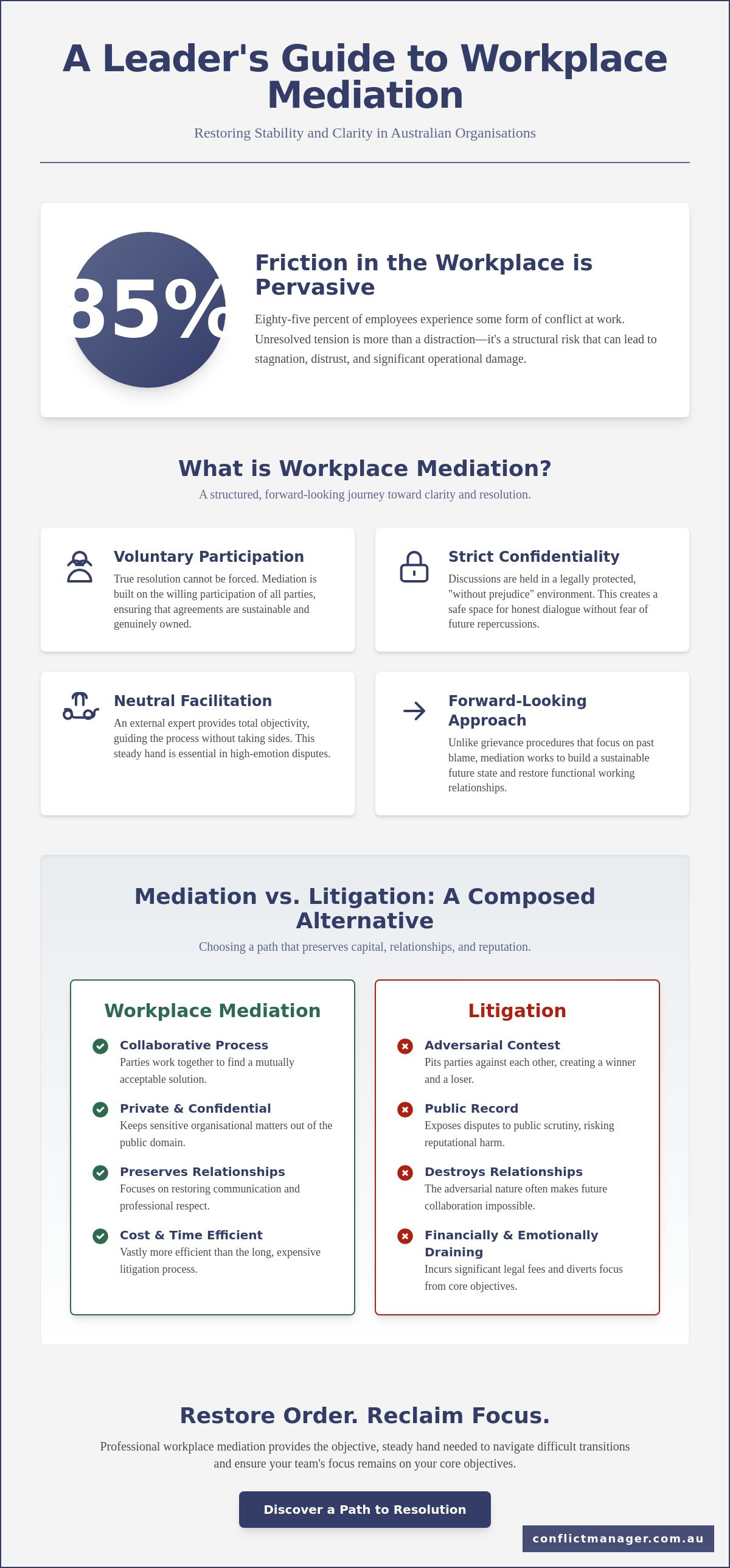
Eighty-five percent of employees experience some form of conflict at work. Friction. Stagnation. Distrust. You've likely felt the quiet, exhausting drain that unresolved interpersonal tension places on your leadership team. It's more than just a distraction; it's a structural risk that threatens your core business objectives and carries the heavy shadow of potential legal or reputational damage. When internal efforts reach a stalemate, professional workplace mediation provides the objective, steady hand needed to navigate these difficult transitions without becoming emotionally entangled.
You understand that preserving professional relationships is just as vital as resolving the immediate dispute. This guide explores how professional workplace mediation restores structural stability and interpersonal clarity to Australian organisations facing high-stakes friction. We'll examine the methodical frameworks that establish sustainable communication and the logic behind moving from a state of complexity toward a vision of structured resolution. By reclaiming operational order, you can ensure your team's focus remains exactly where it belongs.
Key Takeaways
- Understand how workplace mediation operates as a voluntary, structured journey toward clarity rather than a punitive grievance procedure.
- Learn why addressing organisational friction early prevents the "compound interest" of unresolved tension from eroding your structural stability.
- Identify the specific high-stakes scenarios, such as leadership transitions or structural shifts, where external intervention is most effective.
- Discover the methodical phases of the mediation process, beginning with preparatory intake sessions designed to build a foundational understanding of the dispute.
- Recognise the essential value of a neutral third party who brings total objectivity to volatile situations that internal teams may struggle to resolve.
What is Workplace Mediation? Defining the Path to Resolution
Friction. Stagnation. Disruption. These are the markers of organisational conflict that demand a specialised, expert response. Workplace mediation is a structured, voluntary process facilitated by a neutral expert who brings a sense of order to volatile environments. It serves as a deliberate departure from traditional grievance procedures. While internal protocols often look backward to assign blame or seek retribution, mediation looks forward to restore structural stability and interpersonal clarity. It's a strategic tool designed to resolve friction before it compromises the integrity of the entire team.
Within the Australian professional landscape, this approach is a cornerstone of Alternative Dispute Resolution (ADR). To understand the broader context of What is Mediation?, one must view it as a sophisticated alternative to the rigid, often adversarial nature of formal industrial relations. It's about finding a sustainable future state rather than litigating the past. This focus on resolution rather than punishment is what allows organisations to move from a state of complexity toward a vision of operational order.
The Core Principles: Confidentiality and Voluntariness
Privacy. Autonomy. Safety. These are the bedrock of successful organisational resolution. In a professional workplace mediation, all discussions are conducted under the protection of confidentiality. This environment allows stakeholders to speak with total honesty without the fear of their words being used against them in future proceedings. In Australia, these sessions are typically conducted "without prejudice," which provides a legal safety net that encourages genuine transparency. Furthermore, the process is entirely voluntary. True resolution cannot be forced; it must be reached through the willing participation of all parties. This autonomy ensures that the resulting agreements are not just temporary fixes, but sustainable, long-term frameworks for communication.
Mediation vs. Litigation: A Composed Alternative
Conflict in the workplace often feels like a public theatre, especially when it escalates toward litigation. Courtrooms are inherently adversarial, designed to produce a winner and a loser, a dynamic that often destroys the very professional relationships required for a business to function. Mediation offers a quiet, private alternative. It's a space where the "wise counsellor" can view a situation with total objectivity, guiding parties away from the heat of the moment and toward a logical settlement.
For family offices and high-stakes stakeholder groups, this distinction is vital. Litigation is loud, expensive, and emotionally draining. Mediation is efficient. It saves significant time and financial resources, but more importantly, it preserves the human capital of the organisation. By choosing a composed path to resolution, leaders can protect their reputational standing and ensure that the business continues to focus on its core objectives. It's a methodical way to lower the pulse of a dispute and build trust through a logical, sequenced progression.
The Strategic Value of Early Intervention
Friction. Stagnation. Distrust. These aren't just inconveniences; they are the inevitable byproducts of complex human systems operating under pressure. When left unaddressed, minor interpersonal tension begins to accrue a form of "compound interest," where small disagreements evolve into deep-seated structural instability. Professional workplace mediation serves as a proactive governance tool, allowing leaders to dismantle these barriers before they calcify into permanent organisational silos. By addressing friction at its inception, you protect the integrity of your leadership team and maintain the steady confidence of your stakeholders.
Leadership friction is rarely contained within the executive suite. It trickles down, manifesting as a lack of direction that erodes the wider organisational culture. This is why the U.S. Department of the Interior on Workplace Mediation highlights the importance of early resolution in preventing administrative grievances and systemic disengagement. In the Australian corporate landscape, where reputational standing is paramount, waiting for a crisis to intervene is a high-risk strategy. A composed, neutral intervention provides the objectivity required to see through the fog of high-emotion disputes.
Recognising the Signs of Structural Friction
Silos. Paralysis. Turnover. These are the subtle indicators that your organisation's structural integrity is under threat. You might notice a sudden slowing of decision-making processes or an uncharacteristic increase in executive departures. In high-emotion environments, objective judgement is often the first casualty, making it difficult for internal stakeholders to find a way forward without assistance. This is particularly acute in family businesses. When personal histories and professional responsibilities blur, the friction can feel insurmountable. Engaging a specialist in organisational conflict management ensures that these dynamics are navigated with total objectivity and professional discernment.
The Cost of Inaction: Beyond the Balance Sheet
The financial burden of unresolved conflict is substantial. Research indicates that employees spend an average of 2.8 hours per week dealing with friction, a figure that translates to significant lost productivity for Australian businesses. Beyond the direct payroll impact, the "hidden costs" are even more damaging. Lost innovation, damaged brand reputation, and the rising tide of mental health claims create a significant drain on corporate assets. Early workplace mediation protects the value of these assets by restoring operational order. It's a strategic investment in clarity that ensures your resources are focused on growth rather than the exhausting management of internal discord.
When is Workplace Mediation the Appropriate Choice?
Timing. Readiness. Intent. Leaders often question if a dispute has progressed too far for a composed resolution to be effective. In truth, workplace mediation remains a viable path for as long as the parties involved retain a shared interest in operational stability. It's rarely too late to seek clarity, provided there's a willingness to move from a state of conflict toward a vision of structured resolution. However, mediation is not a universal solution. It's unsuitable for cases involving serious misconduct, criminal activity, or systemic harassment, where formal disciplinary or legal investigations must take precedence to ensure accountability.
Ideal scenarios for this intervention typically involve high-stakes friction where the cost of a stalemate is too high to ignore. These include leadership transitions, board-level disputes, or complex stakeholder negotiations where high emotions have begun to cloud objective judgement. By introducing a neutral third party, organisations can de-escalate volatile situations before they reach the point of total structural failure.
Navigating Structural Change and Leadership Friction
Transitions. Mergers. Restructures. These periods of movement often act as catalysts for latent tension to surface within an executive team. When an organisation undergoes a significant shift, the resulting change in power dynamics can lead to decision-making paralysis. A professional mediator acts as a steady hand, facilitating communication during these high-pressure transitions. They help leaders navigate the complexities of a restructure without the emotional entanglement that often derails internal efforts. This focus on future-state clarity is essential for maintaining stakeholder confidence. As described in the EEOC Mediation Process, the efficiency of this approach provides a faster, more private alternative to the exhaustive nature of formal investigations.
The Family Office Context: Preserving Legacy
Legacy. Succession. Stewardship. Family offices manage more than just capital; they manage the weight of multi-generational responsibility. When discussions turn to inheritance or the transition of leadership between generations, the lines between personal history and professional assets often blur. Workplace mediation provides a bespoke framework for these sensitive conversations. It offers a neutral ground where stakeholders can discuss the future of sizable assets without compromising family stability. A neutral facilitator understands these unique dynamics, guiding the family toward a resolution that respects the past while securing the future integrity of the business. This methodical approach ensures that the legacy built over decades isn't compromised by a period of temporary disruption.
The Mediation Process: A Journey Toward Clarity
Resolution is rarely a matter of chance. It's the result of a sequenced, deliberate methodology that transforms disruption into order. The process of workplace mediation moves parties through a series of logical stages, each designed to strip away complexity and reveal the path toward a sustainable future. It's a journey from entrenched friction toward operational clarity. Each step is carefully managed to lower the pulse of the dispute and build a foundation of trust that internal efforts often fail to establish.
The Intake: Establishing the Thematic Foundation
Before any joint dialogue begins, the mediator conducts private, one-on-one intake sessions. These meetings serve a critical purpose. They allow the mediator to identify the core issues and the underlying emotional drivers that often remain hidden in group settings. A seasoned professional remains unruffled during these volatile disclosures, viewing the situation with total objectivity and discernment. This preparatory phase is where trust is established. It's about creating a safe space where stakeholders can speak with total honesty. By building this foundational understanding, the mediator can design a bespoke strategy that addresses the specific structural dynamics of the dispute. This phase ensures that when parties eventually meet, they don't do so in a state of blind reactivity.
The Facilitated Discussion: Navigating the Transition
The joint session is a controlled environment. Here, the mediator manages the pace and tone of the interaction, ensuring the conversation remains focused on resolution rather than retribution. The dialogue is structured to allow for internal contrast. Nuanced points are clarified through methodical questioning that brings order to clouded situations. The primary objective is movement. We guide participants away from entrenched positions, which are often rigid and backward-looking, and toward shared interests. This shift is vital. It allows for the discovery of practical solutions that preserve professional relationships and restore structural stability. It's a transition from "what happened" to "how we move forward."
The final stage of this journey is the creation of an "Outcome Agreement". This document acts as a sustainable roadmap for the future. It doesn't just resolve the immediate friction; it establishes clear, sustainable communication frameworks that the parties can rely on long after the mediation has concluded. It provides a sense of order and a vision of structured resolution that allows the organisation to return to its core objectives. If you're facing high-stakes friction, you can book a stakeholder facilitation session to begin restoring clarity to your team.
Restoring Order: Why External Facilitation is Essential
Internal efforts at resolution frequently buckle under the weight of existing organisational dynamics. It's a fundamental challenge. When a leader or HR professional attempts to mediate, they do so from within the very system that created the friction. Their history, their reporting lines, and their future career paths are all intertwined with the parties involved. Research indicates that 72% of organisations lack a formal conflict resolution policy, leaving managers to improvise solutions in high-stakes environments. When you consider that 60% of managers have received no formal conflict training, the risk of worsening the situation becomes clear.
Professional workplace mediation requires a level of detachment that internal staff simply cannot provide. This is where the persona of the wise counsellor becomes essential. A neutral third party brings total objectivity to the table. They have no skin in the game. In the Australian sector, this expertise is underpinned by the National Mediator Accreditation System (NMAS). Choosing an NMAS accredited professional ensures that the facilitator adheres to a rigorous ethical and procedural framework. It's about more than just ending a dispute; it's about providing a premium, bespoke resolution that restores structural integrity.
The Value of Total Objectivity
Objectivity. Clarity. Discernment. An external facilitator identifies the structural blind spots that stakeholders, clouded by proximity and emotion, often miss. They remain unruffled when tensions peak, providing a grounded presence that lowers the collective pulse of the room. This steady hand is vital during periods of intense organisational friction. By viewing the situation through a neutral lens, the mediator facilitates a transition from chaotic complexity toward a vision of structured, sustainable resolution. It's a methodical progression that builds trust through logic rather than emotional appeal. Managers spend up to 40% of their time dealing with conflict. External intervention allows them to reclaim that focus for core business objectives.
Achieving Sustainable Outcomes
A quick fix is often nothing more than a temporary patch on a deeper structural wound. True resolution requires a move toward long-term stability. While improvised internal efforts might quiet a dispute for a week, they rarely address the underlying communication frameworks that allowed the friction to occur. Conflict Manager focuses on these foundational elements. We guide stakeholders toward a state of clarity where professional relationships are preserved and operational focus is restored. This approach ensures that the resolution is not just immediate, but sustainable. If your organisation is facing high-stakes friction, it's time to move toward a state of operational order. You can engage a steady hand for your organisational resolution today.
Reclaiming Operational Order and Structural Stability
Conflict doesn't have to be the final word for your organisation. It's often the catalyst for a necessary transition toward greater clarity and structural integrity. By choosing a methodical path through workplace mediation, you move away from the exhausting cycle of interpersonal friction and toward a sustainable communication framework. We've explored how early intervention protects your core objectives and why the objectivity of a neutral third party is essential for navigating high-stakes disputes.
A seasoned professional with a deep understanding of human dynamics can see the blind spots that internal teams cannot. This wise counsellor provides a steady hand, ensuring that even the most volatile situations are resolved with total objectivity. Whether you're managing a complex family office transition or a board-level stalemate, the right facilitation restores a sense of order. You can restore clarity to your organisation with expert mediation and protect the legacy you've built. Reclaiming operational stability is not just a possibility; it's the logical next step for your leadership team.
Frequently Asked Questions
How long does the workplace mediation process typically take?
The workplace mediation process typically spans one to two full days for the joint sessions, though this is preceded by individual intake meetings. These preliminary sessions allow the mediator to build a foundational understanding of the friction. While the timeline depends on the complexity of the organisational dynamics, most disputes reach a structured resolution within a fortnight of the initial engagement.
Is workplace mediation legally binding in Australia?
Mediation itself is a facilitative process rather than a judicial judgment, but the resulting "Outcome Agreement" can be drafted as a legally binding contract between the parties. In the Australian context, once all stakeholders sign the written resolution, it functions as a private agreement that outlines future conduct and obligations. This provides the structural stability needed for the organisation to move forward with confidence.
Can a lawyer be present during the mediation sessions?
Legal practitioners may attend mediation sessions as advisors or support persons, provided their presence is agreed upon by all parties and the mediator. Their role is typically to provide private counsel rather than to engage in adversarial advocacy. This ensures the environment remains focused on resolution rather than retribution, preserving the quiet, private nature of the discussion and the integrity of professional relationships.
What happens if one party refuses to participate in mediation?
Participation in workplace mediation is entirely voluntary, meaning the process cannot proceed without the genuine consent of all stakeholders. If one party refuses, the mediator may conduct individual sessions to explore the reasons for the hesitation or suggest alternative facilitation frameworks. However, forced participation often undermines the sustainability of the outcome, so the focus remains on building willingness through clarity and trust.
How is confidentiality maintained throughout the organisational mediation process?
Confidentiality is maintained through a formal agreement signed by all participants before the process begins. In Australia, discussions are generally conducted on a "without prejudice" basis, which means they can't be used as evidence in future legal proceedings or tribunal hearings. This protection allows for total honesty, ensuring that sensitive organisational or family dynamics remain private and secure throughout the journey toward resolution.
What is the difference between workplace mediation and workplace investigation?
A workplace investigation is a backward-looking fact-finding mission designed to determine if misconduct occurred and who is at fault. In contrast, mediation is a forward-looking process focused on resolving friction and restoring operational order. While investigations seek a verdict, mediation seeks a sustainable roadmap for future cooperation, making it better suited for leadership or personality-driven disputes where ongoing collaboration is required.
How do we choose the right mediator for a high-stakes leadership dispute?
Selecting the right mediator involves looking for National Mediator Accreditation System (NMAS) certification and a deep understanding of your specific organisational sector. For high-stakes leadership or family office friction, you need a wise counsellor who remains unruffled by complex human dynamics. The ideal choice is a neutral third party who can view volatile situations with total objectivity and professional discernment.
What should I do to prepare for my first mediation session?
Preparation begins with identifying your core interests and the specific outcomes you require for operational stability. You should reflect on the emotional drivers of the friction and consider what a sustainable future state looks like for the team. Approaching the first session with an open mind and a focus on resolution rather than past grievances ensures the process moves methodically toward clarity and order.


