

Silence. Friction. Erosion. For many family offices, the cost of internal discord isn't just measured in lost productivity, but in the slow decay of a legacy you've spent a lifetime building. A 2026 report from J.P. Morgan indicates that ultra-high-net-worth families pay an average of A$10 million annually to run a family office for assets over A$1.5 billion, yet the most significant risks often remain hidden in interpersonal tension. You likely feel that circular arguments have become the status quo, and the looming threat of public litigation feels like an inevitable, devastating conclusion.
Engaging a professional conflict mediation service isn't merely a defensive move; it's a strategic investment in your organisation's structural integrity. This guide provides the clarity you need to select the right expertise for your specific challenges. We'll explore how to identify a mediator who understands the nuances of Australian family wealth, the necessity of total confidentiality, and the path toward a documented resolution that restores order and preserves your most vital relationships.
Key Takeaways
- Identify the critical moment when internal friction transforms into structural risk to prevent the erosion of your family legacy.
- Select a conflict mediation service that holds National Mediator Accreditation System status and demonstrates a sophisticated understanding of complex Australian family office dynamics.
- Opt for private mediation over traditional litigation to maintain absolute discretion and ensure that sensitive business details remain off the public record.
- Establish clear, objective goals before the process begins to navigate the emotional complexities of the dispute with a focus on sustainable resolution.
- Transform your organisational culture by viewing bespoke facilitation as a catalyst for improved governance and long-term conflict competence.
Beyond Disagreement: When to Engage a Professional Conflict Mediation Service
Friction. Stagnation. Risk. In the high-stakes environment of a family office or a large organisation, the line between healthy debate and operational paralysis is often thin. While robust discussion drives innovation, unresolved tension creates a silent tax on every decision made. Recognising when to engage a conflict mediation service is not a sign of failure; it is a sophisticated act of governance. It's the moment you decide that the health of the structure is more important than the ego of the individual.
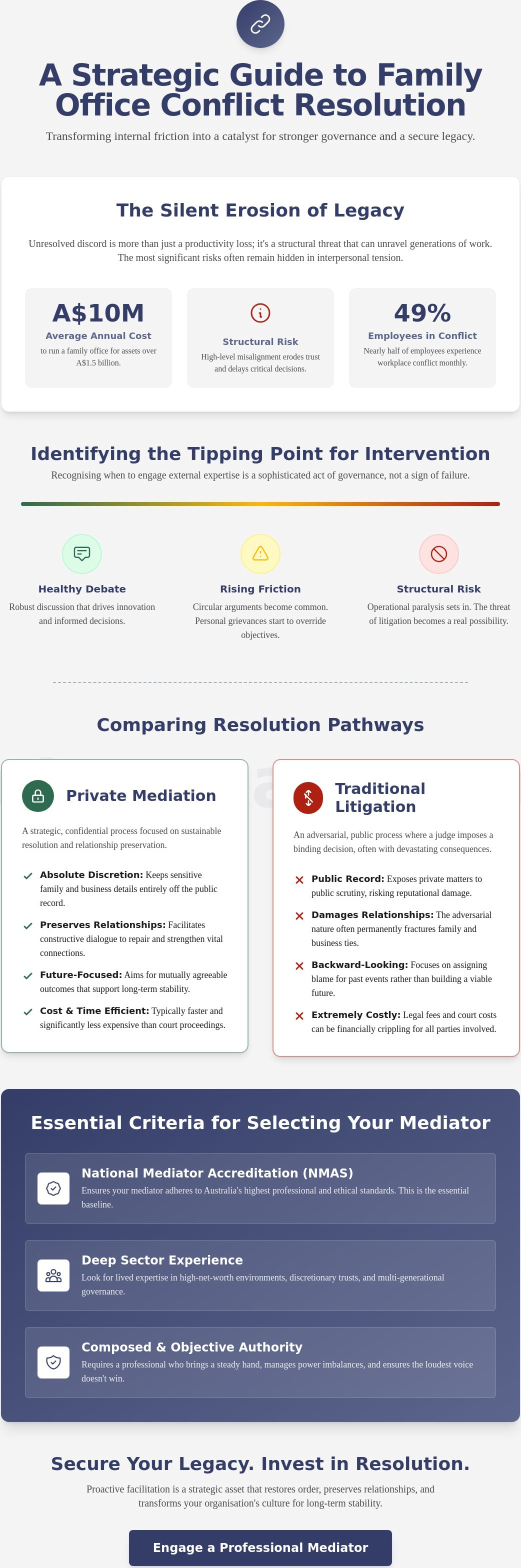
General HR issues often involve individual performance or interpersonal gripes. High-level stakeholder misalignment, however, is a structural threat. It erodes trust, delays critical investment decisions, and leaves assets vulnerable to the whims of emotional volatility. A 2022 survey found that nearly half of all employees experience workplace conflict monthly, resulting in an estimated A$540 billion in annual productivity losses globally. For a family office, these losses aren't just figures on a balance sheet; they are fractures in a legacy that can take generations to repair.
Identifying the Tipping Point for External Intervention
Internal facilitators often struggle because they are woven into the very fabric of the dispute. It's difficult to remain objective when you have shared history or personal skin in the game. The moment personal grievances begin to override commercial objectives or family legacy goals, the tipping point has been reached. Many leaders choose to wait it out, hoping time will heal the rift. This is a fallacy. Delay only allows the conflict to calcify, making the eventual resolution far more complex and costly to achieve.
The Strategic Value of Total Objectivity
A neutral third party provides what internal actors cannot: a safe harbour for difficult truths. When a seasoned professional enters the room, the psychological atmosphere shifts from defensive posturing to structured inquiry. This process of professional conflict mediation allows stakeholders to voice concerns without the fear of immediate social or professional reprisal. It creates a space where the focus is on the problem, not the person.
The presence of an external expert helps maintain composure during periods of high emotional volatility. They act as a steady hand, ensuring that the dialogue remains grounded in logic and structural integrity. By transitioning from reactive crisis management to proactive facilitation, organisations can transform friction into a catalyst for better governance. This is the hallmark of a leader who understands that a professional conflict mediation service is a tool for long-term stability.
Evaluating Expertise: Essential Criteria for Selecting a Mediator
Choosing a mediator is an exercise in discernment. It requires looking beyond a basic list of credentials to find a professional who can hold the weight of your organisation's future. Credentials matter. Context matters more. While the National Mediator Accreditation System (NMAS) provides a vital ethical baseline in Australia, it's merely the entry point for a truly effective conflict mediation service. A practitioner must possess the quiet confidence to manage high-stakes environments where power imbalances are the norm rather than the exception.
When evaluating expertise, look for a facilitator who understands that a family office is not a standard corporate entity. It's a delicate ecosystem of shared history, collective assets, and individual aspirations. You need someone who speaks the language of discretionary trusts, succession planning, and multi-generational governance. A passive observer will fail in these rooms. You require a seasoned professional who brings composed authority to the table, ensuring that the loudest voice doesn't dictate the final outcome.
Accreditation vs. Practical Sector Experience
NMAS accreditation ensures your mediator adheres to Australian professional standards, but it doesn't guarantee they understand the nuances of your specific industry. Practical experience in high-net-worth environments is essential. Lived expertise in these settings is the capacity to navigate the intersection of fiduciary duty and family loyalty without losing sight of the commercial objective. Without this depth, a mediator may miss the subtle cues that signal a breakdown in structural integrity.
The Importance of a Bespoke Methodology
Cookie-cutter mediation models often fail because they ignore the unique emotional register of the group. A premium conflict mediation service begins long before the joint session. It starts with individual intake interviews, where the mediator can assess the psychological landscape of each stakeholder. This methodical approach allows for a tailored resolution path that respects the specific dynamics at play. It's about moving from friction to flow through a process designed specifically for your needs. For those seeking a sophisticated approach to organisational conflict management, the focus must always remain on long-term structural health rather than a quick, superficial fix.
Sustainable outcomes are the only true measure of success. This requires a framework that results in documented, durable agreements that all parties can respect. The goal is not just to stop the fighting. The goal is to restore order and establish a clear path forward for the entire organisation.
Comparing Resolution Pathways: Private Mediation vs. Traditional Litigation
Privacy. Discretion. Control. These three pillars form the foundation of a sophisticated dispute resolution strategy. When a conflict reaches the level of a formal dispute, the choice between the public courtroom and the private conference room is one of the most consequential decisions a leadership team will make. Traditional litigation is, by its very nature, an adversarial process. It's a system designed to produce a winner and a loser, often at the expense of the underlying relationships and the organisation's public reputation.
Choosing a professional conflict mediation service allows the parties to retain agency over the outcome. In a courtroom, a judge who may have limited understanding of your specific structural needs imposes a decision based on narrow legal principles. Mediation, conversely, invites a bespoke resolution. It allows for creative, documented agreements that address the human and commercial realities of the situation. This transition from being a passive subject of the law to an active participant in a resolution is both empowering and stabilising.
Preserving Privacy in a Digital Age
The public record is unforgiving. In the Australian judicial system, once a statement of claim is filed, the details of your family's internal friction or your organisation's strategic vulnerabilities become accessible to the public and the press. For high-profile families, this digital footprint is a permanent threat to the legacy. A premium conflict mediation service operates under strict confidentiality protocols that ensure sensitive negotiations remain behind closed doors. These agreements act as a shield, protecting the brand from the reputational damage that often accompanies public legal battles.
Cost, Speed, and the Preservation of Capital
Litigation is an appetite that grows with every billable hour. When evaluating private mediation vs. traditional litigation, the financial and temporal contrast is stark. Beyond the direct legal fees, there's the exhausting indirect cost of diverted management attention. Leadership teams can spend years in a state of hyper-vigilance, unable to focus on growth or governance. Verified data suggests the average time to settle a case through mediation is significantly faster, often concluding in a single day, compared to an average of 2.5 years for litigation. This speed preserves capital and, more importantly, it restores the order necessary to move forward with composure.
The Road to Resolution: Preparing Your Stakeholders
Preparation is the invisible work that determines the success of any formal intervention. It's the transition from defensive posturing to constructive engagement. Before a single word is spoken in a joint session, stakeholders must be aligned on the purpose of the meeting. This isn't about litigating the past; it's about architecting the future. Engaging a professional conflict mediation service provides the framework for this preparation, ensuring that all parties arrive with a shared understanding of the stakes involved.
Managing expectations is equally vital. Resolution is rarely instantaneous. It requires a commitment to the timeline and an acknowledgement of the emotional heavy lifting involved. All key decision-makers must be present and fully committed to the outcome. If the person with the power to sign off on an agreement is absent, the process loses its structural integrity and the momentum for change is often lost.
Selecting a neutral, professional environment is paramount. Meeting in a family home or a corporate boardroom can inadvertently reinforce existing power dynamics or trigger historical grievances. A neutral space provides a blank canvas where the hierarchy is flattened and the focus remains entirely on the resolution. It allows participants to step out of their daily roles and into a space of objective problem-solving.
Defining Desired Outcomes and Non-Negotiables
The objective must shift from winning an argument to securing a structural future for the organisation. Clarity is the most effective tool for reducing friction. By identifying non-negotiables early, you prevent the process from stalling on secondary issues. Stakeholders should describe their requirements in terms of the entity's long-term health rather than focusing on the perceived failings of others, which helps maintain a sense of shared purpose and composure.
Managing Emotional Volatility and Resistance
Resistance is often a mask for fear. Some stakeholders may worry that the process will expose vulnerabilities or strip them of influence. A professional mediator manages this by conducting thorough intake sessions, where these concerns can be aired in private. Emotional regulation is not about suppressing feelings; it's about ensuring those feelings don't derail the commercial or familial objectives.
The mediator's role is to act as a steady hand, de-escalating tension before it reaches a point of operational paralysis. This methodical approach ensures that the dialogue remains productive even when the subject matter is deeply personal. For those ready to begin this process, our team provides expert stakeholder facilitation to guide your organisation through these difficult transitions with order and clarity.
Securing the Legacy: Why Bespoke Mediation is a Strategic Asset
Legacy. Stability. Continuity. These are the markers of a truly resilient organisation. While many view a conflict mediation service as a reactive measure to be used only when a crisis erupts, the most sophisticated leaders recognise it as a strategic investment in governance. It's the difference between merely surviving a dispute and emerging with a more robust structural foundation. By addressing the root causes of friction, you move the leadership team from a state of constant dispute management toward a culture of conflict competence.
This evolution is essential for preserving the integrity of a family office or complex business. When stakeholders learn to navigate disagreement with composure, the entire organisation becomes more agile. You're no longer tethered to the emotional cycles of the past. Instead, you're free to focus on the strategic objectives that define your success. This shift ensures that the weight of responsibility is shared through clear, documented frameworks rather than being carried by a few exhausted individuals.
A successful resolution does more than just settle a current argument. It strengthens the foundation for future generational transitions. By establishing clear protocols for communication and decision-making, you remove the ambiguity that often fuels resentment. This methodical approach transforms conflict from a destructive force into a catalyst for improved organisational health.
Sustainable Outcomes for Future Generations
Succession is the ultimate test of any family structure. Without a clear mechanism for resolving disputes, the transition of power and assets can become a point of total failure. Building resolution frameworks that outlast the current disagreement is the only way to ensure a smooth intergenerational wealth transfer. It's about creating a legacy that can withstand the inevitable pressures of time and changing family dynamics. Addressing Family Succession Conflict through bespoke facilitation ensures that the foundation remains intact for those who will follow.
Choosing a Steady Hand for Volatile Times
In high-stakes environments, the value of an unruffled, external perspective cannot be overstated. You need a mediator who remains calm when the room is volatile. This steady hand brings total objectivity to clouded situations, allowing for a vision of structured resolution that internal efforts simply cannot achieve. The Conflict Manager approach is built on this principle of composed authority, providing a neutral third party that understands the weight of your legacy without becoming entangled in the friction.
Preserving structural integrity requires the courage to invite external expertise. It's a proactive step that signals a commitment to order and longevity. Don't wait for the next disagreement to become a structural risk. Enquire about a bespoke conflict mediation service today and begin the transition toward a more stable, resolved future.
Restoring Order and Protecting Your Legacy
The choice to seek external intervention is a profound act of leadership. It's a signal that the preservation of the entity is more important than the persistence of the dispute. By prioritising private resolution over public litigation, you protect not only your assets but the reputation you've spent decades building. A professional conflict mediation service provides the necessary distance to view volatile situations with total objectivity; this allows stakeholders to move from defensive posturing toward a documented, sustainable future.
Expertise. Discretion. Integrity. At Conflict Manager, our NMAS accredited mediators specialise in the complex dynamics of high-net-worth family offices and Australian organisations. We provide national service coverage with a commitment to total confidentiality, ensuring your sensitive matters remain entirely off the public record. Order and continuity are the foundations of a lasting legacy.
Secure your legacy with expert mediation; contact Conflict Manager today. Taking this step ensures that your organisation remains a stable, productive environment for the generations to come.
Frequently Asked Questions
What is the difference between a conflict mediation service and legal representation?
A professional conflict mediation service provides a neutral facilitator rather than an advocate for a single party. Legal representation focuses on protecting specific rights or winning a case within an adversarial system. Mediation, conversely, seeks a mutually acceptable resolution where parties retain control over the outcome. It's about structural integrity rather than legal victory.
How long does the typical mediation process take for a family office dispute?
Timelines are significantly shorter than traditional litigation. While a complex family office dispute may involve several weeks of preparation and individual intake, the actual joint sessions often conclude within one to three days. This efficiency allows the organisation to restore order and return to strategic priorities without the multi-year delay common in Australian courts.
Is the outcome of a private mediation session legally binding in Australia?
The outcome becomes legally binding once the parties sign a formal settlement agreement or a Heads of Agreement. In Australia, this document functions as a private contract that can be enforced through the courts if necessary. This provides a sustainable, documented resolution that ensures all stakeholders remain accountable to the agreed terms.
What happens if one stakeholder refuses to participate in the mediation?
Participation is voluntary, so a party cannot be forced into the room. However, a seasoned mediator often engages reluctant stakeholders during the pre-mediation phase to address their specific concerns or fears. If refusal persists, the process may still proceed with those willing to negotiate, though the finality of the resolution may be limited by the absence of a key decision-maker.
Can mediation help with disputes involving complex trust structures and assets?
Mediation is highly effective for disputes involving discretionary trusts, complex asset portfolios, and intergenerational wealth. A specialist conflict mediation service understands the intersection of fiduciary duties and family dynamics. The process allows for creative solutions that a judge might not have the jurisdiction or sector-specific knowledge to order.
How do we ensure total confidentiality throughout the mediation process?
Total discretion is maintained through a combination of professional standards and signed confidentiality agreements. In Australia, the National Mediator Accreditation System (NMAS) mandates strict ethical guidelines regarding privacy. All communications during the session are typically "without prejudice," meaning they cannot be used as evidence in future court proceedings.
What qualifications should I look for in an Australian conflict mediator?
You should prioritise mediators who hold National Mediator Accreditation System (NMAS) status. This ensures they meet the professional and ethical standards required in Australia. Beyond accreditation, look for a practitioner with a background in corporate governance or psychology; this combination provides the composed authority necessary to handle high-stakes human and structural dynamics.
Is mediation suitable for resolving conflict during a major organisational restructure?
Mediation is a vital tool during restructures to manage stakeholder misalignment and prevent operational paralysis. It provides a structured environment to address the friction that inevitably arises during significant transitions. By resolving these tensions early, leadership teams can ensure the new organisational structure is built on a foundation of clarity rather than unresolved historical grievances.


