

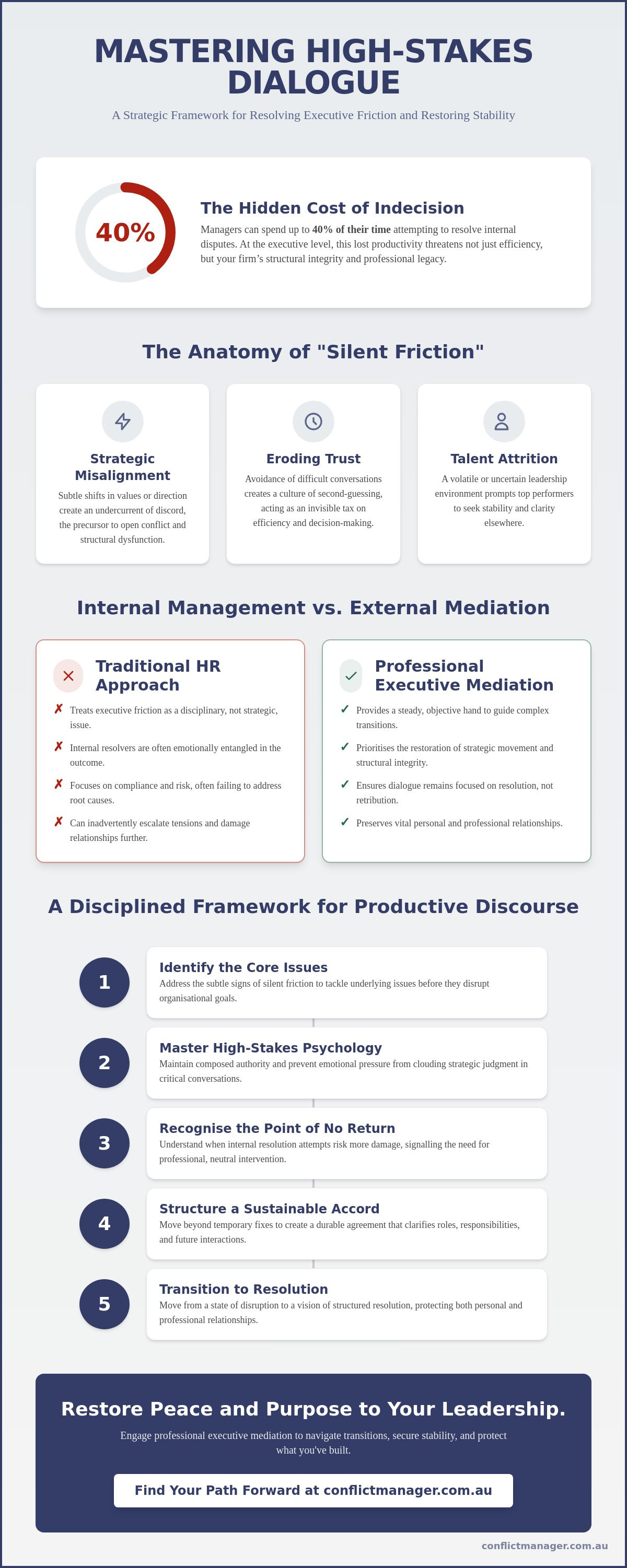
Stagnation. Friction. Uncertainty. These aren't just obstacles to your leadership; they're the primary mechanism through which executive clarity and organisational stability are forged. You're likely aware that managers can spend up to 40 per cent of their time trying to resolve internal disputes. When these tensions escalate at the leadership level, the stakes involve more than just lost hours. They threaten your professional legacy and the very structural integrity of your firm. Engaging professional executive mediation services provides a steady, objective hand to guide you through these transitions. It allows you to address the underlying causes of discord without becoming emotionally entangled in the fallout.
We understand the exhaustion that comes from ongoing friction and the quiet fear of reputational damage. You want to protect what you've built while finding a clear path forward. This guide offers a framework to master high-stakes dialogue with a composed, methodical approach. You'll learn how to resolve executive friction, achieve clarity on necessary structural changes, and preserve vital relationships. We'll examine the logic of external stakeholder facilitation and the specific strategies required to reach sustainable, long-term accords that restore peace to your workplace.
Key Takeaways
- Identify the subtle signs of silent friction within your leadership team to address underlying issues before they disrupt your organisational goals.
- Master the psychology of high-stakes dialogue by maintaining composed authority, preventing emotional pressure from clouding your strategic judgment.
- Recognise the point of no return where internal resolution attempts risk further damage, signalling the need for professional executive mediation services.
- Follow a disciplined five-step facilitation framework that ensures every difficult conversation is approached with the necessary weight and preparation.
- Transition from a state of disruption to a vision of structured resolution, creating sustainable accords that protect both personal and professional relationships.
The Anatomy of Executive Friction: Why Difficult Conversations Stall
Friction is inevitable. In the quiet corridors of Australian boardrooms, conflict rarely begins with an outburst. It starts as a subtle hum; a misalignment of values, a slight shift in strategic direction, or a growing silence between key stakeholders. We call this "silent friction." It is the precursor to open discord, and if left unaddressed, it hardens into structural dysfunction. Facilitation in an executive context is not merely a polite discussion. It is a structured, neutral dialogue designed to achieve absolute clarity. Unlike standard management meetings, it provides the psychological safety required to dismantle complex grievances without destroying the underlying business foundation.
Many organisations rely on a traditional HR approach to handle disputes. While compliance-heavy and risk-averse, this method often fails at the leadership level because it treats executive friction as a disciplinary matter rather than a strategic one. Strategic executive mediation services offer a different path. This approach prioritises the restoration of movement and structural integrity. By adhering to the foundational definition of mediation, we act as a neutral third party to facilitate communication, ensuring that the dialogue remains focused on resolution rather than retribution. Internal efforts often struggle because those tasked with the resolution are often emotionally entangled in the outcome themselves.
The Cost of Avoidance in High-Stakes Environments
Trust is fragile. When leaders avoid the difficult work of alignment, they inadvertently create a culture of second-guessing that permeates every level of the organisation. This erosion of trust acts as an invisible tax on efficiency; decisions take longer, risks are avoided, and top talent begins to look elsewhere. For family offices, the stakes are even higher. Unaddressed conflict doesn't just threaten a quarterly report; it threatens a legacy that may have taken decades to build. Executive friction is the misalignment of strategic intent and personal dynamics. Without a steady hand to navigate these transitions, the friction eventually becomes a permanent barrier to progress.
Common Triggers: From Structural Change to Legacy Disputes
Difficult conversations are often sparked by specific, high-pressure events. In the current Australian landscape, intergenerational succession remains a primary driver of friction as founders and successors navigate differing visions for the future. Organisational restructuring also creates significant heat. When roles shift and power dynamics are redefined, even the most composed leaders can experience an emotional response that clouds their strategic vision. Business-critical decisions, from AI implementation to global expansion, act as catalysts for these underlying tensions. Recognising these triggers early allows a firm to engage executive mediation services before the friction leads to a total loss of productivity at the leadership level.
The Psychology of High-Stakes Dialogue: Moving Beyond Emotion
Stress. Response. Narrowed vision. When a boardroom dispute reaches its peak, the physiological response often overrides strategic intelligence. This is frequently described as the "Amygdala Hijack," a state where the brain's emotional centre takes control, effectively bypassing the prefrontal cortex responsible for nuanced decision-making. In this state, a leader’s strategic horizon shrinks. They stop looking at the five-year plan and start focusing on immediate survival or victory. For those in high-stakes environments, this biological reality makes it nearly impossible to navigate complex transitions without a steady, external hand to ground the conversation.
Neutralising a volatile atmosphere requires what we term "composed authority." This isn't an exercise in dominance; it's the projection of a grounded, unruffled presence that signals safety to all participants. An effective facilitator uses "objective empathy" to acknowledge the emotional weight of the situation without becoming entangled in the friction. By maintaining this distance, they can observe the movement of the dialogue and identify where structural integrity is failing. This is particularly vital when managing sizable family assets. In these contexts, internal friction isn't just a business problem; it’s a threat to personal history and future legacy. The overlap of blood and business creates a unique psychological weight that often requires specialised family conflict resolution to navigate with the necessary discernment.
Depersonalising the Dispute
Separation. Structure. Reframing. Successful resolution requires moving the problem from between the people to the centre of the table. Instead of viewing a colleague as the obstacle, we guide stakeholders to separate the individual from the structural problem. This involves the technique of reframing personal attacks into strategic concerns. If a director claims a partner is "being difficult," we reframe that as a concern regarding the speed of decision-making or a lack of clarity in reporting lines. Clarity is found when the problem is moved to the centre of the table, not between the people.
The Role of Neutrality in Rebuilding Trust
Neutrality is a steady hand, not a judge's gavel. When stakeholders engage in formal workplace mediation, they are given permission to lower their pulse and engage logically. A neutral third party doesn't take sides or assign blame. Instead, they facilitate a shared outcome where both parties feel their core concerns have been acknowledged. This process is essential for rebuilding trust in environments where a lack of trust is often the primary driver of conflict. By removing the need for defensiveness, executive mediation services allow leaders to stop protecting their positions and start protecting the organisation’s future.
Internal Management vs. External Mediation: When to Call for a Steady Hand
Complexity. Proximity. Entanglement. These are the primary reasons why internal attempts to resolve executive friction often stall. When leadership is emotionally invested in a dispute, the capacity for total objectivity vanishes. You might find that your internal HR team or a senior partner attempts to facilitate, but they are inevitably viewed through the lens of their own history within the firm. Engaging professional executive mediation services isn't an admission of failure; it's a strategic decision to protect the structural integrity of the organisation by introducing a steady, external hand. The logic of external intervention becomes undeniable when we consider that 60 per cent of managers have never received formal conflict management training. Entrusting a high-stakes dispute to an untrained internal party often risks escalating the very friction you seek to resolve.
The Risk of Internal Conflict Management
Internal facilitators often fall into the "bias trap." Even with the best intentions, their proximity to the stakeholders makes them appear as though they have an agenda. This perception alone can prevent a genuine breakthrough. We often see "temporary fixes" that merely mask the symptoms of a deeper structural issue. These superficial accords fail to address the core friction, leading to a cycle of recurring disputes that eventually "poison the pantry" of your boardroom culture. In high-stakes environments, such as family offices, these failed internal attempts can escalate tensions to a point where the family legacy itself is placed at risk. Clarity is impossible when the person holding the mirror is also standing in the frame.
The Strategic Advantage of Professional Facilitation
An external mediator acts as a neutral third party with the sole purpose of achieving clarity. Because they remain unruffled by internal politics or the weight of the company's history, they can view volatile situations with complete discernment. This objectivity is a premium asset. It allows stakeholders to lower their defensive guard and engage in a methodical, logical progression toward resolution. Professional executive mediation services provide a sense of order during periods of intense organisational disruption. By ensuring total confidentiality and a structured environment, an external facilitator creates the space necessary for sustainable, long-term accords that preserve both personal and professional relationships. This process moves the reader from a state of complexity toward a vision of structured resolution, ensuring the business remains focused on its primary objectives.
A Framework for Facilitation: The 5-Step Process for Productive Discourse
Order. Clarity. Movement. Resolution is not an accident; it is the result of a methodical, logical progression that moves participants from a state of reactive emotion toward a vision of structural stability. When high-stakes friction occurs, the path forward must be clearly defined to prevent further erosion of trust. Professional executive mediation services provide this structure, ensuring that every word spoken contributes to a sustainable outcome rather than deepening the divide. This framework is designed to lower the collective pulse of the room, allowing for a transition from defensive posturing to collaborative problem-solving.
- Step 1: Preparation and Environment. The setting must reflect the weight of the responsibility. We ensure the physical or digital space is neutral and prepared to facilitate focused dialogue.
- Step 2: Establishing Shared Intent. We begin by identifying a common goal, such as legacy preservation, market stability, or the continued health of a family office.
- Step 3: Navigating the Friction. This phase allows for nuanced stakeholder views to be heard. The facilitator manages the heat of the conversation, ensuring that different perspectives on the firm's direction are expressed without descending into personal grievance.
- Step 4: Structural Problem Solving. Here, the focus shifts from "who" is at fault to "how" the system can be stabilised. We examine reporting lines, decision-making protocols, and governance.
- Step 5: Cementing the Accord. A resolution only holds value if it is actionable. We create a sustainable roadmap that outlines specific commitments and future behaviours.
Setting the Stage for Composed Authority
Environment dictates behaviour. Choosing a neutral, off-site location is essential to break the "office rhythm" and the power dynamics associated with familiar boardrooms. In this neutral space, we establish ground rules that prioritise objective communication and mutual respect. The facilitator’s steady voice sets the pace for the entire room, providing a grounded presence that suggests order even when the subject matter is volatile. If you require a neutral hand to guide your leadership team through these transitions, explore our stakeholder facilitation services.
The Art of the Strategic Question
Questions are the primary tools of the facilitator. We use open-ended, strategic questions to uncover structural blind spots that participants might be too close to see. For instance, asking "How does this current friction impact our legacy in five years?" reframes the dispute from a present-day annoyance to a long-term strategic threat. Through reflective listening, we validate the emotional weight of a stakeholder's position without necessarily agreeing with their conclusion. This allows the conversation to transition smoothly from "what happened" in the past to "what needs to happen next" for the organisation to thrive.
Securing the Outcome: Professional Mediation as a Catalyst for Stability
Stability. Continuity. Accord. These are the definitive markers of a successful executive dialogue. Once the friction has been addressed through a methodical framework, the focus must shift toward securing the outcome for the long term. Professional executive mediation services do more than merely end a dispute; they act as a catalyst for organisational stability. This is achieved through a vision of structured resolution where every stakeholder gains absolute clarity on their role within the new order. Without precise documentation and a rigorous commitment to follow-up, even the most profound breakthroughs can lose their momentum. Conflict Manager provides the steady hand required by Australian organisations to ensure these transitions remain permanent and productive.
Our approach to executive mediation services prioritises the creation of a thematic foundation for future cooperation. We don't just facilitate a single meeting; we help establish the movement and structural integrity required for the next phase of your organisation's life. This involves a logical progression from identifying the disruption to cementing a roadmap that all parties can support with confidence. By acting as a compassionate guide and an authoritative expert, we bring a sense of order that internal efforts often struggle to achieve under pressure. The result is a sustainable accord that allows the leadership team to return their focus to strategic growth.
From Disruption to Order
The emotional and structural relief that follows a mediated agreement is often profound. It replaces the exhaustion of ongoing friction with the renewed energy of defined governance and clear expectations. When roles and decision-making protocols are formalised, the potential for future disputes is significantly reduced. This is particularly vital for maintaining asset integrity within high-net-worth family structures. By resolving the interpersonal static that clouds strategic vision, mediation ensures that both the organisational and family legacies are protected from the corrosive effects of unmanaged conflict. Clarity in governance isn't just about avoiding arguments; it's about ensuring the long-term health of the entire system.
Engaging a Partner in Resolution
Leadership carries a significant weight. Entrusting your firm's internal dynamics to a seasoned expert allows you to step back from the heat of the moment and view volatile situations with total objectivity. The journey toward a vision of structured resolution begins with the recognition that external intervention is not a sign of weakness, but a sophisticated strategic choice. A neutral third party brings the discernment needed to navigate the weight of responsibility without becoming emotionally entangled in the outcome. To restore clarity and order to your leadership team, you may enquire about executive mediation services and begin the methodical process of moving from complexity toward a sustainable, long-term accord.
Advancing Toward Structural Clarity and Leadership Alignment
Clarity. Resolve. Progress. These aren't just goals; they're the inevitable results of a disciplined approach to conflict. We've explored how executive friction, while disruptive, serves as a catalyst for deeper organisational integrity. You now understand that high-stakes dialogue requires more than just good intentions. It demands a structured framework that depersonalises the dispute and centres the problem. Relying on specialised executive mediation services ensures that your leadership team navigates these transitions with the steady hand of a neutral third party.
Conflict Manager brings seasoned expertise to high-stakes environments across Australia, with a specific focus on the complex dynamics of Family Offices. Our professional mediators provide the total objectivity needed to preserve your legacy and restore productivity. Restore clarity and order to your leadership team. Contact Conflict Manager today. Your organisation's future depends on the decisions made during these critical moments. By choosing a methodical path to resolution, you're not just ending a disagreement; you're building a foundation for sustainable growth.
Frequently Asked Questions
How do you start a difficult conversation with a senior executive?
Begin by acknowledging your shared commitment to the organisation's long-term success. Choose a neutral, private setting to ensure the executive feels respected rather than blindsided by the discussion. Focus your opening remarks on the specific impact the current friction has on strategic goals. This approach depersonalises the issue and centres the conversation on the health of the business rather than individual failings.
What is the difference between workplace mediation and executive facilitation?
Workplace mediation typically focuses on resolving specific disputes or grievances between employees to restore a functional working relationship. Executive facilitation is a more strategic engagement designed for leadership teams. It focuses on high-level alignment, decision-making protocols, and structural clarity. Both processes aim to move parties from a state of complexity toward a vision of structured resolution through neutral guidance.
When is a conflict too far gone for internal resolution?
Conflict is too far gone when the parties involved can no longer view the situation with any degree of objectivity. If internal attempts to resolve the friction risk escalating the tension or damaging the firm’s reputation, external intervention is necessary. Engaging professional executive mediation services at this point prevents the "bias trap" and provides the steady hand needed to protect the organisation's structural integrity.
How long does a typical executive mediation process take in Australia?
The duration depends entirely on the complexity of the friction and the number of stakeholders involved. Many focused disputes can be addressed in a single, well-prepared day of dialogue. More intricate cases involving significant structural changes or family office dynamics may require several sessions over a few weeks. We prioritise a methodical pace that ensures the resulting accord is both sustainable and thorough.
Can mediation help with disputes in a family office or trust structure?
Yes. Specialist mediation is highly effective for navigating the unique pressures found within family offices and trust structures. These environments often suffer from an overlap of personal history and professional responsibility. A neutral facilitator helps separate these dynamics, allowing family members to address asset integrity and succession without destroying personal relationships. This creates a clear path for legacy preservation.
Is executive mediation confidential and legally privileged?
Confidentiality is a foundational element of the mediation process. All discussions held during the facilitation are private, which allows stakeholders to speak with total candour. While the process is designed to be confidential, the specific nature of legal privilege can vary. You don't want to assume legal protections apply in every scenario; it's best to check with your legal counsel regarding the current Australian regulations.
What happens if one party refuses to participate in a difficult conversation?
Participation in mediation must be voluntary to be effective. If a party is hesitant, we focus on identifying their specific concerns and explaining how a structured, neutral dialogue protects their interests. Often, a formal invitation from an external expert feels less threatening than an internal request. We find that when leaders understand the process is designed for resolution rather than retribution, they are more willing to engage.
How do we measure the success of a conflict resolution engagement?
Success is measured by the restoration of movement and the clarity of future governance. We look for the implementation of a sustainable roadmap where all parties understand their roles and decision-making boundaries. A successful engagement results in the disappearance of "silent friction" and the return of leadership focus to strategic growth. Ultimately, the goal is a long-term accord that preserves both the business and its vital professional relationships.


