

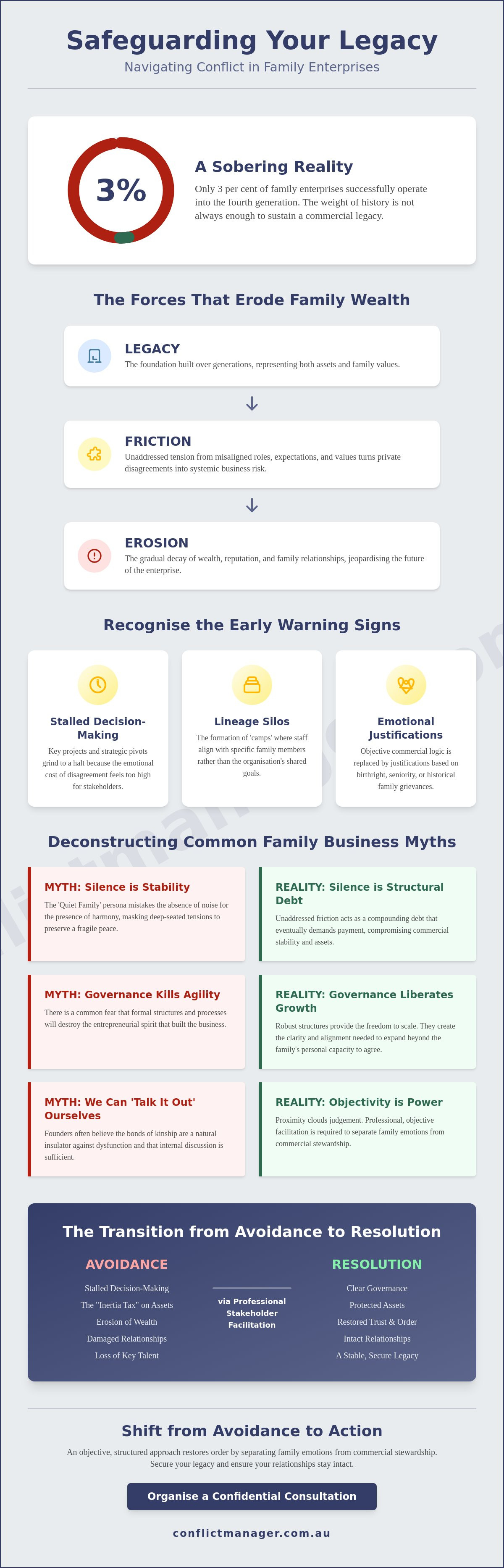
Only 3 per cent of family enterprises successfully operate into the fourth generation. It’s a sobering reality that suggests the weight of history isn’t always enough to sustain a commercial legacy. Legacy. Friction. Erosion. These forces often collide when family conflict threatens business operations, turning private disagreements into systemic risks that jeopardise both your wealth and your reputation. You might feel that keeping the peace through silence is the safest path, but unaddressed tension acts as a form of structural debt that eventually demands payment.
You likely believe that protecting the family bond is just as vital as protecting the balance sheet. We agree that the emotional toll of mixing Sunday lunch with boardroom disputes is unsustainable, yet ignoring the friction only accelerates the erosion of your hard-earned assets. This article explores why the traditional approach to family disputes often fails and how you can safeguard your future through objective, structured resolution. We will examine a framework that separates family emotion from commercial strategy, ensuring your transition remains stable and your relationships stay intact.
Key Takeaways
- Recognise that silence isn't stability. Avoiding difficult conversations creates a false sense of security that eventually compromises your commercial legacy.
- Understand the precise mechanisms at play when family conflict threatens business and learn to identify the shift from personal disagreement to systemic risk.
- Reframe governance as a tool for liberation. Robust structures provide the clarity you need to scale operations without the burden of unresolved interpersonal friction.
- Quantify the "Inertia Tax" on your family assets. Stalled decision-making and leadership distractions lead to tangible wealth erosion and missed market opportunities.
- Shift from avoidance to resolution through professional stakeholder facilitation. This objective approach restores order by separating family emotions from commercial stewardship.
The Facade of Harmony: When Silence Isn't Stability
Misalignment. Friction. Erosion. In a family enterprise, conflict isn't just about loud arguments at the dinner table; it's a fundamental misalignment of roles, expectations, and values. Many families pride themselves on "getting along," adopting the persona of the 'Quiet Family'. They mistake the absence of noise for the presence of stability. This silence is often a veneer. It masks deep-seated tensions that remain unaddressed to preserve a fragile peace. However, when family conflict threatens business continuity, this facade becomes a significant liability. It creates a false sense of security while structural debt accumulates beneath the surface.
Understanding the common sources of family business disputes is the first step toward objective resolution. These disputes often stem from the overlap of family and commercial systems, where personal history collides with professional strategy. We don't view this friction as a failure of leadership or a lack of family loyalty. Instead, it's a natural byproduct of transition. As businesses scale and generations shift, the old ways of communicating often prove insufficient for the new complexities of the market. The tipping point occurs when private friction begins to manifest as commercial instability, affecting everything from operational cash flow to long-term market reputation.
Recognising the Early Warning Signs
Awareness is the beginning of order. You might notice that critical strategic initiatives are perpetually "under review" because the leadership team cannot reach a consensus. This usually isn't a lack of data; it's a presence of interpersonal tension. Identifying these signs early prevents the rot from reaching the core of the organisation.
- Stalled decision-making: Key projects and strategic pivots grind to a halt because the emotional cost of disagreement feels too high for the participants.
- Lineage silos: The formation of 'camps' within the leadership team where staff and managers align with specific family members rather than the company's shared goals.
- Emotional justifications: A noticeable shift where objective commercial logic is replaced by justifications based on birthright, seniority, or historical family grievances.
The Cultural Cost of Avoidance
The damage isn't confined to the family circle. Non-family executives are often the first to feel the weight of unresolved friction. They value transparency and professional governance. When they see decision-making clouded by family politics, their trust in the organisation's future wanes. This leads to a phenomenon known as Legacy Drift. The original mission and values of the founder become obscured by the noise of current disputes. Without a clear boundary between family membership and business stewardship, you risk losing the very talent and stakeholder confidence required to sustain the enterprise over the long term.
Myth vs. Reality: Deconstructing Family Business Disputes
Perception. Reality. The gap between the two is where most family enterprises lose their way. Many founders operate under the assumption that the bonds of kinship serve as a natural insulator against commercial dysfunction. This is a fallacy. In truth, proximity often clouds objectivity. When you're standing too close to the fire, you can't see the structural flaws in the fireplace. When family conflict threatens business longevity, it's usually because these myths have been allowed to dictate the strategy for too long. Breaking these cycles requires a cold, analytical look at the assumptions holding your legacy hostage.
The first myth is the belief that "talking it out" as a family is sufficient. While transparency is valuable, internal discussions often lack the necessary distance to be productive. You might also fear that formal governance will kill your entrepreneurial spirit. The reality is quite the opposite. Structure provides the freedom to scale. Without it, your growth is capped by the personal capacity of the family to agree. Furthermore, don't mistake friction for failure. With 78 per cent of family businesses expecting a CEO transition by 2036, conflict is often just the heat generated by necessary movement. It's a sign of growth, provided it's managed through professional stakeholder facilitation rather than left to fester.
Why 'Talking it Out' Often Fails
Families are prone to circular arguments. These are the disputes that have been rehearsed for decades, often rooted in historical scripts and childhood dynamics that have no place in a modern boardroom. A fifty-year-old executive can easily revert to the role of the "rebellious younger sibling" when challenged by a patriarch. More communication isn't the answer if the communication itself is flawed. You don't need more talk; you need facilitated communication that bypasses these ancient patterns and focuses on objective commercial reality.
The Governance Illusion
A shareholder agreement is a vital document, but it's not a shield against emotional fallout. Many leaders fall into the trap of believing that legal compliance equals relational alignment. It doesn't. You can be perfectly compliant with the law while your leadership team is in a state of total collapse. Governance can even be weaponised in a dispute, used as a tool for exclusion rather than a framework for cooperation. True stability comes from separating family membership from business stewardship, ensuring that your governance structures serve the enterprise first and the ego second.
Asset. Integrity. Alignment. When we discuss the preservation of wealth, we often focus on market volatility or tax legislation. Yet, a more insidious threat exists within the boardroom itself. Unresolved friction doesn't just hurt feelings; it actively erodes the structural integrity of your family office assets. When family conflict threatens business operations, the primary casualty is often the strategic momentum required to stay competitive. This creates what we term the 'Inertia Tax', a hidden cost born from missed opportunities and delayed pivots while the leadership team is preoccupied with internal strife.Consider the 2025 Kreischer Miller findings, which noted that 15.8 per cent of businesses cite "people issues" as a primary roadblock to formal succession planning. This delay isn't benign. It represents a period where capital is static and purpose is diluted. Top-tier non-family managers, who represent a growing majority of leadership in companies with over $1 billion in revenue, have little appetite for such environments. If they perceive that family loyalty, an emotional anchor, is consistently prioritised over commercial agility, they will simply leave. Their departure hollows out the enterprise, leaving it vulnerable to competitors who operate with greater clarity.
The Erosion of Decision-Making Authority
Conflict creates a vacuum at the top. When the governing body is split, operational paralysis follows. We often see 'veto power' being used not to protect the commercial interests of the firm, but to settle personal scores or assert dominance within the family hierarchy. This misuse of power halts progress on everything from supply chain adjustments to geopolitical risk management. Asset integrity is the alignment of purpose, people, and capital.
Reputational Risk in the Australian Market
The Australian private wealth sector is a small, interconnected world. Reputational damage travels with remarkable speed through the networks of banks, co-investors, and regulatory bodies. If a family is seen as unstable or prone to infighting, the cost of capital often increases; strategic partnerships become harder to secure. Protecting the 'Family Brand' is not merely an exercise in vanity; it's a core component of long-term succession. A tarnished reputation can take decades to rebuild, long after the original dispute has been settled.
Navigating the Transition: Moving from Avoidance to Resolution
Transition. Clarity. Resolution. Moving beyond the facade of harmony is a deliberate choice that requires a shift from subjective emotion to objective operational reality. It's not a one-off event. It's a methodical process of untangling the personal from the professional. When family conflict threatens business, the path forward requires more than just a desire for peace; it requires a structural redesign of how the family interacts with the enterprise. The first step is acknowledging that friction exists without assigning blame. We view this as a move toward objective reality, where the focus shifts from "who is right" to "what serves the legacy."
Once the friction is acknowledged, you must define the boundaries between family membership and business stewardship. This isn't about exclusion. It's about ensuring that each role is performed with the appropriate mindset and within the correct forum. This clarity allows for the creation of a conflict management framework that outlives the current dispute, providing a permanent governance layer for future generations. By formalising these processes, the family can realign on their "North Star," the original mission and shared values that built the wealth in the first place.
Defining the Boundaries of Engagement
Decision-making must be segmented to prevent emotional spillover. We recommend a clear distinction between 'Family Council' discussions, which focus on relational health and legacy, and 'Board of Directors' decisions, which focus on commercial strategy. Mixing these two forums is a primary cause of operational paralysis. It's also vital to establish physical and temporal boundaries. Shop talk should not happen at the dinner table. Creating a 'safe harbour' for difficult conversations outside of the office environment allows stakeholders to speak freely without the weight of the corporate setting or the distraction of daily operations.
The Role of the Neutral Third Party
Internal efforts to fix conflict often fail because the person attempting to mediate is part of the system. They have a history, a bias, and a personal stake in the outcome. An external professional provides the steady hand that internal stakeholders cannot. This isn't about clinical psychotherapy or legal representation. It's about professional stakeholder facilitation. A neutral party doesn't just fix a single issue; they build a process that allows the family to navigate their own way forward. They use objective questioning to de-escalate high-emotion situations, ensuring that the conversation remains grounded in commercial logic rather than historical grievances.
The External Perspective: Restoring Order with Professional Facilitation
Order. Stability. Perspective. When internal efforts reach their natural limit, the introduction of a neutral third party acts as a necessary circuit breaker. When family conflict threatens business continuity, the emotional noise often drowns out commercial logic. Many stakeholders mistake litigation for a solution, yet legal battles are blunt instruments that often erode the very wealth they are meant to protect. Professional conflict management offers a more sophisticated alternative. It provides a sense of composed authority, ensuring that the legacy remains intact while friction is resolved through structured facilitation rather than public combat. While experienced professional mediators in 2026 typically charge between $200 and $500 per hour, the cost of a stalled CEO transition or a public legal dispute is infinitely higher.
The ultimate goal of external intervention is to achieve sustainable outcomes that honour both the family assets and the underlying bonds. We don't view conflict as a sign of failure, but as a byproduct of movement. By introducing a steady, objective hand, we can lower the pulse of the organisation and create a space where logic prevails over historical grievances. This methodical progression moves the family from a state of complexity toward a vision of structured resolution, ensuring the business remains operational and the family remains intact.
A Composed Approach to Volatile Situations
The Conflict Manager methodology is grounded, objective, and deeply empathetic. We understand that high-stakes transitions are rarely just about the numbers; they are about the people behind them. Our approach guides stakeholders through volatile emotional landscapes without becoming entangled in the history of the dispute. By maintaining total objectivity, we create a bespoke resolution process tailored to your unique family dynamics. We employ a high-level corporate and psychological register to navigate the difficult transitions that define generational wealth. Our facilitation isn't a generic service; it's a premium intervention designed for executive stakeholders who value discretion and structural integrity.
Securing the Future of the Family Office
Sustainable outcomes require more than a temporary truce. The ultimate goal is to move from a state of disruption toward a vision of structured, long-term resolution. This transition provides the peace of mind that only comes from having a steady hand at the helm during a difficult conversation. By separating family emotion from commercial strategy, you protect both your assets and your relationships. With 78 per cent of family businesses expecting a leadership change within the decade, the ability to manage these transitions with quiet confidence is a competitive advantage. This is the difference between surviving a crisis and securing a legacy.
Discover how our composed approach can help resolve family conflict and secure your business legacy.
Securing Your Commercial Legacy
Clarity. Integrity. Continuity. These are the hallmarks of an enterprise that has successfully untangled personal history from professional strategy. Silence is rarely a sign of peace; it's often a precursor to disruption. We've explored how avoiding difficult conversations creates a "Quiet Family" myth that eventually erodes wealth and reputation. When family conflict threatens business operations, the most effective response isn't simply more talk, but a commitment to better structure. You've seen that separating family council dynamics from boardroom decisions is the only way to preserve both the balance sheet and the family bond.
Our methodology for stakeholder facilitation provides the steady hand required to navigate high-stakes transitions with total objectivity. We focus on sustainable outcomes that prioritise asset integrity and relational health, ensuring your transition remains a source of strength rather than a point of failure. You don't have to manage this friction alone. Composed, neutral facilitation for high-emotion disputes offers a professional path through even the most complex family dynamics.
Secure your family legacy with our composed, expert-led conflict resolution services.
Restoring order is a deliberate choice. By opting for objective resolution over avoidance, you ensure that your legacy remains a source of pride and prosperity for generations to come.
Frequently Asked Questions
How do I know if our family conflict is 'normal' or a threat to the business?
Conflict becomes a systemic threat when it results in operational paralysis or the formation of lineage silos. Healthy friction involves debated ideas that lead to a consensus. Threatening conflict is characterised by "Inertia Tax," where strategic pivots are stalled because the leadership team is preoccupied with historical grievances. If personal tensions are dictating commercial logic, the integrity of your assets is already at risk.
Can mediation work if one family member refuses to acknowledge there is a problem?
Facilitation often succeeds by shifting the focus from personal feelings to commercial stewardship. A reluctant family member may not want to discuss "emotions," but they usually care about the preservation of wealth and legacy. By framing the process as a way to protect the enterprise's structural integrity, we can encourage participation. Our role is to act as a neutral third party that brings clarity without becoming emotionally entangled.
What is the difference between family mediation and traditional legal representation?
Legal representation is inherently adversarial and focuses on dividing assets through rights and obligations. In contrast, our stakeholder facilitation focuses on alignment and preservation. We don't seek to "win" a case; we seek to build a framework where the family can continue to operate together. While litigation often destroys the very value it seeks to divide, a structured resolution process protects the commercial agility of the firm.
How long does the professional conflict resolution process typically take?
The timeline depends on the complexity of the dynamics, but it's always a methodical progression rather than a quick fix. Most families move from initial discovery to a formal conflict management framework over several months. This steady pace allows for the de-escalation of high-emotion situations. It ensures that the resulting governance structures are robust enough to outlive the current dispute and serve future generations.
Is our family's private business kept confidential during the facilitation process?
Total discretion is a cornerstone of professional facilitation. Unlike public litigation, which can cause rapid reputational damage in the small-world Australian market, this process remains entirely private. We understand the weight of responsibility that comes with a family legacy. Keeping these discussions behind closed doors protects your "Family Brand" and maintains your standing with banks, co-investors, and regulatory bodies.
What happens if we can't reach a consensus during the mediation?
If a total consensus isn't immediately possible, the focus shifts to establishing a "disagreement framework." This involves creating agreed-upon governance rules that allow the business to function even when opinions differ. The goal is to prevent a lack of consensus from turning into operational paralysis. We guide you toward a vision of structured resolution where the business's needs are prioritised over individual veto power.
How much does unmanaged family conflict actually cost a business in the long run?
The cost is often the total loss of the enterprise. Statistics show that only 3 per cent of family businesses operate into the fourth generation. When family conflict threatens business stability, it leads to asset erosion and the flight of top-tier non-family talent. The long-term cost isn't just financial; it's the permanent destruction of a legacy that may have taken decades or even centuries to build.
Can we implement conflict management structures before a major dispute arises?
Proactive governance is the most effective tool for legacy preservation. You don't need to be in a state of crisis to benefit from stakeholder facilitation. Establishing clear boundaries between the Family Council and the Board of Directors early on ensures that everyone understands their role. This clarity acts as a natural insulator, preventing future friction from escalating into a threat that jeopardises your wealth and relationships.


