

What if the greatest threat to your family legacy or corporate structure isn't a market shift, but the quiet erosion of trust between those at the helm? Friction. Stagnation. Decay. In high-stakes environments, unresolved tension often leads to operational paralysis and the slow erosion of a hard-won reputation. You likely understand that when internal dynamics fracture, the cost is rarely just financial; it's a loss of momentum and clarity. Engaging professional mediation services Australia provides a structured pathway to navigate these transitions without the public exposure or the $100,000 price tag often associated with protracted litigation.
We're here to help you move from a state of disruption toward a vision of structured resolution. This article explores how expert-led mediation preserves asset integrity and restores organisational stability through a neutral, highly professional approach. You'll discover the impact of the 2025 Family Law reforms and the new AMDRAS accreditation standards, which ensure your resolution process is handled with the highest level of discernment. We will examine how stakeholder facilitation and family conflict resolution can protect your interests while allowing you to refocus on growth and legacy.
Key Takeaways
- Learn how structured, expert-led mediation moves your organisation from a state of paralysis to one of focused growth and stability.
- Understand the strategic advantages of professional mediation services Australia, ensuring your family legacy or corporate integrity remains intact through a neutral, third-party lens.
- Discover the methodical progression of a mediated resolution, which lowers the emotional pulse of a dispute and prioritises objective clarity over adversarial conflict.
- Evaluate the cost and privacy benefits of collaborative facilitation compared to the public exposure and high financial burden of traditional litigation.
- Identify the essential criteria for selecting a mediator with the industry-specific knowledge required to handle complex structural and financial transitions.
The Role of Professional Mediation in Australia’s High-Stakes Environments
Structure. Neutrality. Resolution. Professional mediation is a methodical process of facilitated negotiation designed to restore order where internal efforts have reached an impasse. It's a structured intervention that moves participants away from the heat of the moment toward a cool, analytical assessment of their shared future. Unlike informal discussions that often loop back into old grievances, Mediation in Australia operates within a sophisticated framework of Alternative Dispute Resolution (ADR), providing a clear path through complexity.
When stakeholders seek professional mediation services Australia, they aren't merely looking for a referee. They're seeking a mechanism to preserve structural integrity during periods of high stress. The transition from internal friction to objective clarity requires a steady hand. An external mediator brings total objectivity, viewing the situation without the emotional entanglement that inevitably binds those within the conflict. This distance is what allows for the restoration of order and the protection of long-term interests.
Distinguishing professional services from informal facilitation is essential for high-stakes outcomes. Professionalism in this context means a commitment to a rigorous, neutral process that respects the weight of the responsibility involved. The landscape of mediation has evolved, particularly with the introduction of the AMDRAS accreditation standards in 2024. These standards ensure that practitioners possess the necessary qualifications and ethical grounding to handle complex human and structural dynamics. This level of rigour is what separates a professional service from a well-meaning but unstructured internal attempt at resolution.
Mediation for Family Offices and Wealthy Estates
Managing multi-generational assets involves more than just financial oversight; it requires the delicate balancing of legacy, duty, and individual aspiration. When significant wealth is involved, emotion often clouds logical financial decisions. Family conflict resolution focuses on preserving the family legacy, ensuring that the friction of the present doesn't dismantle the foundations built by previous generations. It's about finding a way forward that respects the past while securing the future.
Corporate and Organisational Facilitation
Structural changes, leadership transitions, or shifts in governance can trigger deep-seated resistance within an organisation. Executive-level friction isn't just uncomfortable. It's an operational risk that leads to paralysis and strategic drift. Organisational conflict management introduces a neutral stabiliser into the boardroom. The mediator’s role is to facilitate stakeholder negotiation, ensuring that the focus remains on organisational performance rather than interpersonal grievances, allowing the business to return to its core mission of growth.
The Anatomy of Resolution: How Expert Facilitation Restores Stability
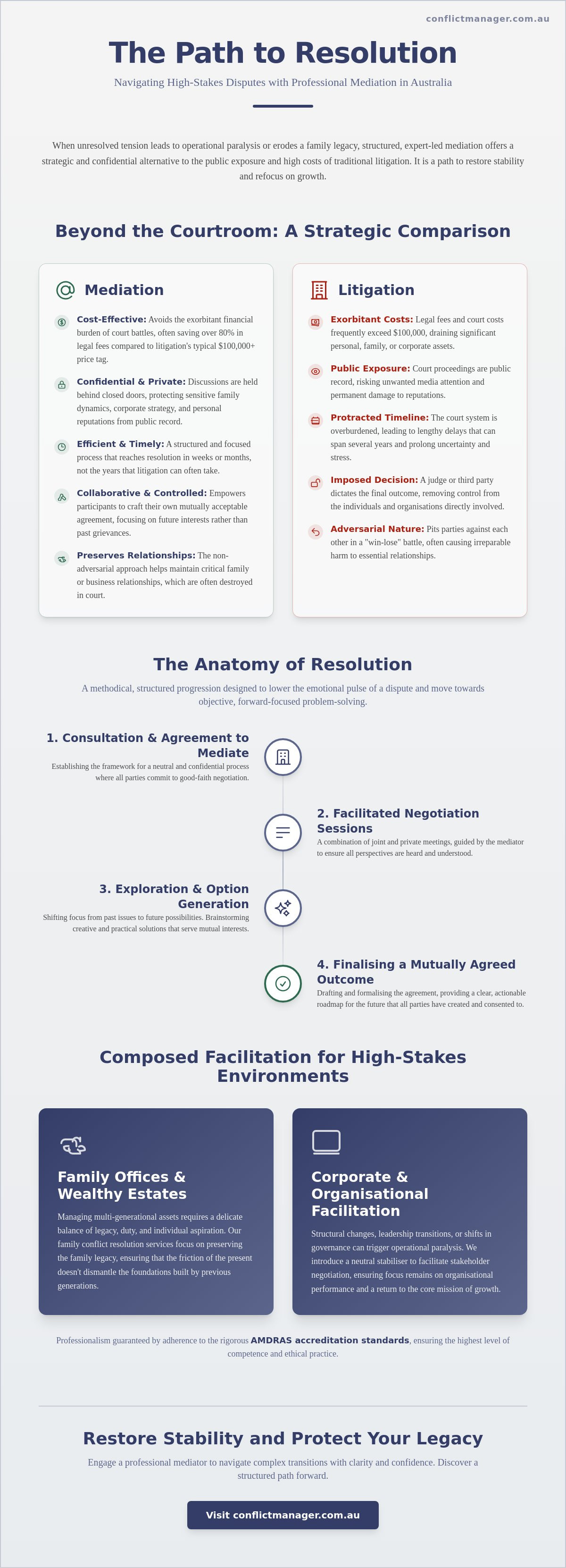
Logic. Order. Resolution. The journey from a state of disruption to one of structured agreement is never accidental; it requires a deliberate and methodical progression. When engaging professional mediation services Australia, stakeholders enter a space specifically designed to lower the emotional pulse of the dispute. This calming effect is deeply rooted in the psychology of neutrality. When a third party remains unruffled by the high stakes, it creates a psychological anchor for everyone involved, allowing for a transition from reactive defensiveness to proactive problem-solving.
Privacy remains the cornerstone of every successful facilitation. Unlike court proceedings, which can become a matter of public record and lead to unwanted exposure, mediation ensures that sensitive family dynamics and proprietary business structures are kept strictly confidential. This protection of reputation and privacy is often the primary driver for high-net-worth individuals and corporate boards. While the Federal Circuit and Family Court of Australia outlines the framework for mediation for families and organisations, private professional services offer a bespoke level of discretion. This level of care is essential for maintaining the integrity of a brand or a family legacy during a difficult transition.
Nuance is critical when navigating complex negotiations. The use of precise language and sophisticated punctuation, such as the deliberate semicolon, allows for internal contrast within a discussion. It provides the space needed to clarify complex points without losing the overall pace of the negotiation. This attention to detail ensures that the final agreement is not just a temporary truce, but a sustainable foundation for future growth.
Creating a Neutral Ground for Difficult Conversations
The centre of a mediation, whether held in a physical boardroom or a secure digital space, must feel entirely balanced. The mediator acts as a custodian of this balance, actively managing power imbalances that might otherwise stifle genuine negotiation. De-escalation is achieved not through force, but through the patient untangling of grievances. This allows stakeholders to move past the immediate friction of the dispute and focus on the practicalities of the resolution.
Navigating Structural and Interpersonal Dynamics
It is vital to distinguish between interpersonal friction and underlying structural flaws. Often, what appears to be a personality clash is actually a failure in governance or a lack of role clarity. By using objective data to anchor subjective disagreements, we ensure that the commercial objective remains the priority. This approach allows every voice to be heard without allowing the conversation to drift into unproductive territory. Those seeking to restore stability can find a composed path toward resolution through expert facilitation.
Beyond the Courtroom: Why Mediation is the Preferred Path for Private Interests
Control. Agency. Resolution. Entering a courtroom often means surrendering the power to decide your own future to a judicial officer who lacks the intimate context of your family or business dynamics. For those managing complex interests, this loss of agency represents a significant risk. Professional mediation services Australia offer a counter-narrative where stakeholders retain total control over the final outcome. Instead of a binary "win or lose" judgment, mediation facilitates a collaborative environment where nuance and specific needs are prioritised. It's a process that respects the intelligence of the participants, allowing them to author their own solutions.
Efficiency is another compelling factor. The Australian court system currently faces significant backlogs, often resulting in delays that stretch across several years. This period of uncertainty can paralyse a business or strain a family trust to the point of collapse. In contrast, mediation can be organised and concluded within weeks. As noted by the Federal Circuit and Family Court of Australia on mediation, this process is designed to be less formal and significantly faster than traditional litigation. It also addresses the primary concern regarding effectiveness; mediated agreements can be drafted into legally binding contracts or consent orders, ensuring they carry the full weight of the law without the trauma of a public trial.
The High Cost of Public Litigation
Litigation is public by nature. For high-net-worth families and established brands, the reputational risk of having private disputes aired in open court is immense. Once a matter is filed, it becomes a public record, potentially damaging brand equity or family standing for decades. The financial impact is equally severe. Prolonged legal battles often bleed family trusts of capital that should have been preserved for future generations. Professional mediation services Australia provide a private forum where these sensitive matters are resolved behind closed doors, protecting both the asset and the name.
Sustainable Outcomes and Relationship Preservation
Agreements reached through mediation tend to have higher compliance rates than those imposed by a judge. This is because the participants have actively authored the terms themselves. A judge is limited by the law to specific remedies, but a mediator can help craft bespoke solutions that address the unique structural or emotional needs of the parties. By focusing on stakeholder facilitation, the process can even strengthen relationships. It allows parties to move past a point of friction while maintaining the ability to collaborate in the future, a result that litigation rarely achieves.
Criteria for Selecting Professional Mediation Services for Complex Disputes
Discernment. Expertise. Integrity. Selecting professional mediation services Australia is a strategic decision that extends far beyond merely finding a neutral party to chair a meeting. In high-stakes environments, the mediator must possess a deep understanding of the structural complexities inherent in corporate governance and high-level finance. This technical literacy allows the facilitator to move beyond surface-level grievances and address the systemic issues that often drive long-term conflict. Without this foundation, a mediation risks becoming an exercise in superficial compromise rather than a robust, sustainable resolution.
The Australian landscape for dispute resolution has seen significant professionalisation recently. As of July 1, 2024, the Australian Mediation Dispute Resolution Accreditation Standards (AMDRAS) began replacing the old National Mediator Accreditation System (NMAS). This new framework introduced a tiered structure; Accredited, Advanced, and Leading Mediators. When dealing with multi-generational wealth or complex organisational change, seeking a practitioner at the Advanced or Leading tier ensures you're working with someone who has met rigorous practice and CPD requirements. This level of accreditation provides a baseline of trust, indicating the practitioner is equipped to handle volatile situations with total objectivity.
Beyond formal qualifications, the persona of the mediator is a critical factor. A sense of composed authority is essential when navigating disputes where emotions run high and the stakes involve significant assets or reputations. You need a steady hand; someone who remains unruffled by the friction of interpersonal dynamics. This quiet confidence allows the mediator to act as a wise, external counsellor who can view the situation with total clarity, even when the participants cannot. Assessing a mediator’s track record in multi-generational disputes or structural business changes will reveal their ability to maintain this order under pressure.
Essential Qualifications and Expertise
Ensure your chosen practitioner understands the unique pressures of family office dynamics or corporate structural shifts. The ability to synthesise complex financial information during a session is vital for resolving disputes involving trusts or asset division. Practitioners should be transitioning to or already hold AMDRAS status, reflecting their commitment to the latest ethical and safety standards in the field. This technical rigour ensures that the resulting agreement is both commercially sound and practically viable.
Evaluating the Mediator’s Approach
Is the firm’s tone aligned with your brand or family values? A professional mediation firm should offer a methodical, logical progression from disruption toward resolution. They should provide a sense of order that lowers the pulse of the dispute. When you are ready to engage a steady hand to navigate your transition, you can find professional mediation services tailored to complex Australian interests. The goal is to move from complexity toward a vision of structured resolution that protects your legacy.
Conflict Manager: Composed Facilitation for Families and Organisations
Clarity. Order. Integrity. Conflict Manager operates as a steady hand within the volatile currents of high-stakes disputes. When you engage professional mediation services Australia, you aren't just hiring a mediator; you're securing a strategic partner capable of viewing your situation with total objectivity. Our approach is grounded in a deep understanding of both complex human dynamics and the rigid requirements of corporate governance. We act as a neutral third party, bringing a sense of order to periods of high stress or organisational friction. This progression from complexity toward structured resolution feels inevitable when guided by a seasoned professional who remains unruffled by high-stakes environments.
We understand that internal efforts to resolve conflict often struggle under the weight of history and emotional entanglement. Our role is to provide the external intervention necessary to break the cycle of stagnation. By choosing professional mediation services Australia, you're opting for a methodical and logical sequence that prioritises the health of the entity, whether that is a multi-generational family office or a national corporation. We don't just manage the conversation; we safeguard the structural integrity of your interests. Our presence allows stakeholders to exhale, lowering the pulse of the room and creating the space required for genuine, sustainable agreement.
Expertise in Family Wealth and Succession
Protecting the integrity of family trusts and estates requires a delicate balance of empathy and total objectivity. Multi-generational wealth transfers are often fraught with unspoken expectations and historical friction that can lead to the erosion of a family's standing. By preserving family legacy through expert mediation, we ensure that the transition of assets does not lead to the permanent fracture of the family unit. We provide a bespoke consulting framework that respects the weight of your responsibility while navigating the nuances of succession with quiet confidence.
Strategic Management for Business Stakeholders
In the corporate world, leadership friction is an operational risk that can lead to strategic drift and financial decay. Organisational conflict management is about resolving these tensions to ensure long-term stability and growth. Whether your business is undergoing a major structural change or a sensitive leadership transition, our facilitation ensures that all voices are heard without losing sight of the commercial objective. We invite you to enquire about our professional mediation services to restore focus on your growth and legacy, moving your organisation from a state of disruption toward a vision of structured clarity.
Securing Your Legacy Through Structured Resolution
Transitioning from disruption to clarity is a deliberate choice. You've seen how expert-led facilitation protects asset integrity and maintains privacy in ways litigation simply cannot. By prioritising neutral, third-party intervention, you ensure that complex human and structural dynamics don't derail your long-term objectives. Engaging professional mediation services Australia allows you to author a sustainable agreement that reflects the unique needs of your boardroom or family office.
Conflict Manager provides the steady hand required during volatile transitions. Through expertise in high-net-worth family office dynamics and bespoke facilitation for complex organisational change, our NMAS accredited professional mediators establish the objective distance necessary for resolution. It's time to move past the friction and return your focus to growth. Restore clarity to your organisation or family with Conflict Manager. Stability is within reach when you choose a path of composed facilitation.
Frequently Asked Questions
What exactly are professional mediation services in an Australian context?
Professional mediation services Australia are a structured form of facilitated negotiation where a neutral third party assists participants in reaching a voluntary agreement. This process focuses on future-oriented solutions rather than assigning blame for past events. It provides a methodical framework to move stakeholders from a state of disruption toward a vision of order and structural integrity.
How does mediation protect the privacy of high-net-worth families?
Mediation protects family privacy by keeping the entire process behind closed doors and away from the public eye. Unlike litigation, which creates a public record in the Federal Circuit and Family Court of Australia, mediation is strictly confidential. This ensures that sensitive details regarding family trusts, assets, and interpersonal dynamics remain private; safeguarding the family's reputation for future generations.
Can mediation be used for corporate shareholder and board disputes?
Yes, mediation is an effective mechanism for resolving friction between shareholders and board members. Stakeholder facilitation allows for the objective analysis of governance issues and structural flaws without the adversarial heat of a courtroom. It helps restore operational stability and ensures that the focus remains on the commercial growth of the organisation.
How long does the professional mediation process typically take?
The timeline for mediation is significantly shorter than the years often required for court litigation. While the total duration depends on the complexity of the dispute, most professional mediation services Australia can be organised and concluded within several weeks. This includes a period of preparation followed by one or two full days of intensive, facilitated negotiation.
What happens if one party is more high-emotion than the other during mediation?
A mediator is trained to manage power imbalances and de-escalate high-emotion interactions through a neutral, steady presence. If one party is emotionally overwhelmed, the mediator uses techniques such as separate sessions to lower the pulse of the discussion. This ensures that the conversation remains focused on objective data and commercial outcomes rather than becoming entangled in personal grievances.
Is a mediated agreement legally enforceable in Australia?
Mediated agreements are legally enforceable when they are drafted into a formal contract or filed as consent orders. While the mediation process itself is a collaborative negotiation, the resulting document carries the full weight of the law once signed. This provides participants with the security of a binding resolution without the trauma of a protracted legal battle.
How do I know if our family office dispute requires an external mediator?
An external mediator is necessary when internal efforts have reached an impasse or when the emotional cost of the friction threatens the family legacy. If discussions consistently loop back to old grievances or if decision-making has become paralysed, a neutral third party can provide the objective clarity needed to move forward. It's about securing a steady hand to view the situation without emotional entanglement.
What is the difference between mediation and traditional legal representation?
The primary difference lies in the nature of the relationship; a mediator is a neutral facilitator while a legal representative is a partisan advocate. Lawyers are hired to fight for a specific side's interests in an adversarial system. In contrast, mediation focuses on collaborative problem-solving, where the mediator helps all stakeholders find a sustainable, mutually beneficial agreement.


