

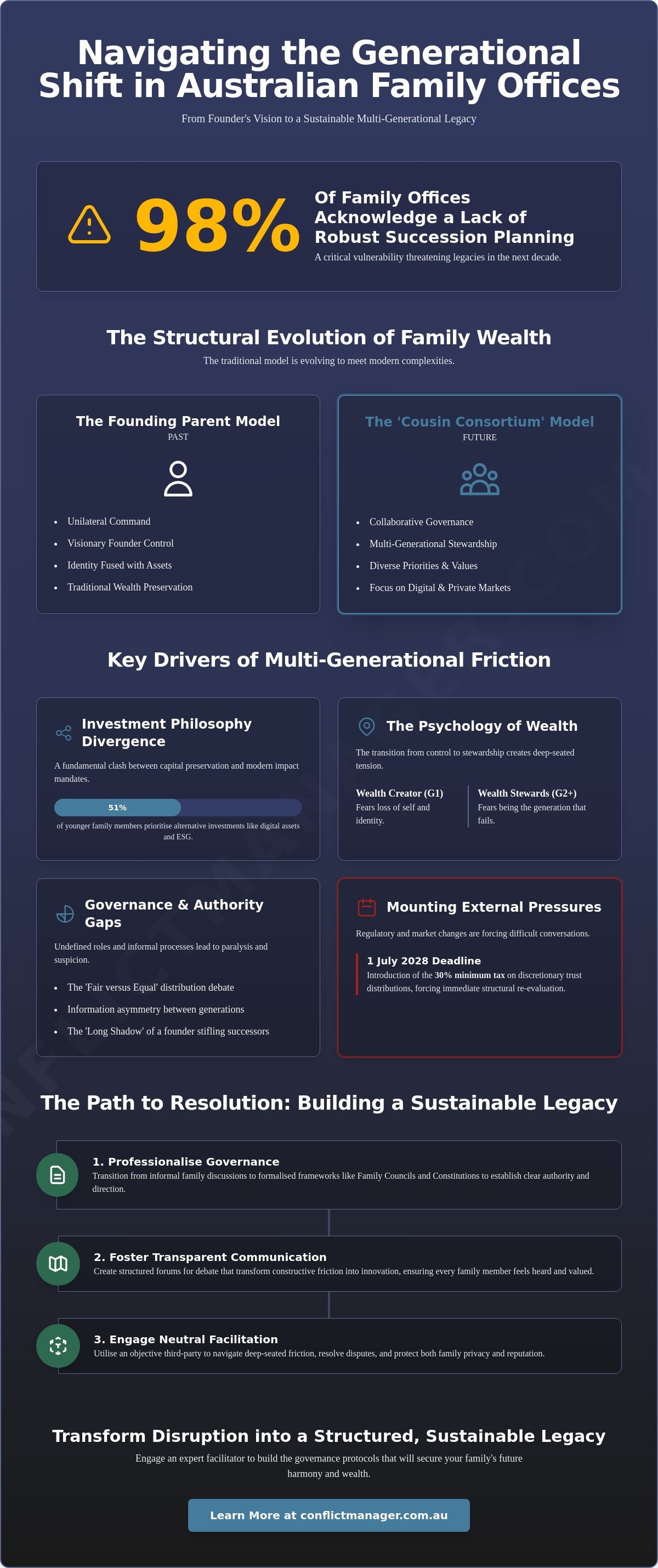
98% of family office respondents now acknowledge that their organisations lack the robust succession planning required to survive the next decade. Friction. Fragmentation. Uncertainty. These aren't just interpersonal hurdles; they're structural signals that your current governance architecture is struggling to bridge the gap between traditional wealth preservation and the evolving priorities of younger heirs. When multi-generational family office conflict arises, it often stems from a fundamental misalignment between established values and the 2026 shift toward digital assets and private markets.
You likely feel the weight of this transition as the 1 July 2028 introduction of the 30% minimum tax on discretionary trust distributions approaches. It's a stressful period where the fear of public reputational damage often silences necessary private conversations. This article provides a sophisticated analysis of why these generational fractures occur and how to transform disruption into a structured, sustainable legacy. We'll explore the path from internal friction to a restored sense of family harmony through precise governance protocols that satisfy every branch of your family tree.
Key Takeaways
- Adapt your wealth architecture from a founding parent model to a collaborative 'Cousin Consortium' to meet the complexities of the 2026 Australian market.
- Recognise the structural triggers of multi-generational family office conflict, specifically the friction between legacy wealth creators and the next generation of stewards.
- Transition from informal family discussions to professionalised governance frameworks that protect your legacy from emotional volatility.
- Implement Family Councils and formal constitutions to establish clear authority protocols and a unified strategic direction for all family branches.
- Learn how neutral stakeholder facilitation provides the objectivity needed to resolve deep-seated friction without compromising family privacy or reputation.
The Structural Evolution of Australian Family Offices in 2026
Australia's private wealth landscape is currently undergoing a profound metamorphosis. Billions of dollars are shifting from the hands of visionary founders to a wider, more diverse group of heirs. This transition marks the end of the traditional 'Founding Parent' model. In its place, we see the rise of the 'Cousin Consortium', a structure where collaboration replaces unilateral command. Understanding What is a Family Office? becomes vital here. It's no longer just a private investment firm; it's a complex mechanism for maintaining family unity across generations. Traditional governance often fails because it treats the office as a sterile ledger. It ignores the heavy emotional weight of legacy.
The Great Australian Wealth Transfer
The 2026 Federal Budget has introduced structural pressures that accelerate these internal tensions. With the 30% minimum tax on discretionary trust distributions set to take effect on 1 July 2028, families are forced to re-evaluate their legacy structures immediately. Recent research from April 2026 shows that 98% of family office respondents believe more robust succession planning is required within their organisations. Younger generations are increasingly globally mobile, often managing Australian interests from London or New York. This mobility complicates local governance models. We also see a clear divergence in values. 51% of younger family members now prioritise alternative investments and digital assets. This shift toward ESG and impact investing often creates friction with the capital preservation strategies favoured by the first generation.
Defining Multi-Generational Conflict
It's essential to distinguish between constructive friction and destructive dispute. Constructive friction drives innovation. It challenges stagnant investment strategies and encourages growth. Destructive dispute, however, erodes the very foundation of the family's mission. Multi-generational family office conflict is rarely about the money itself. It's typically about the loss of agency and the fear of being unheard. Silence is the most dangerous precursor to structural failure. When family members stop debating, they start retreating into silos. A successful family office must act as both an investment vehicle and a social adhesive. It needs to balance private family values with the public-facing corporate responsibility that modern stakeholders demand. Addressing these issues requires a move from individual control to institutionalised stewardship.
Structural Drivers of Multi-Generational Friction
Conflict is not a symptom of dysfunction. It is often the inevitable result of a maturing wealth structure. In the Australian context, where property and private equity dominate, the transition from a single 'Wealth Creator' to a group of 'Wealth Stewards' creates natural friction. The creator’s identity is often fused with the balance sheet. Relinquishing control feels like a loss of self. Conversely, the stewards feel the immense weight of preservation. They fear being the generation that loses the legacy. This psychological divide is a primary driver of multi-generational family office conflict.
The 'Fair versus Equal' debate adds another layer of complexity. Should a family member who works in the office receive the same distribution as one who pursues an outside career? This question often paralyses decision-making. When transparency is lacking, suspicion fills the void. Information asymmetry occurs when G1 holds the keys to the kingdom, leaving G2 and G3 to guess at the strategic direction. A structured approach to stakeholder facilitation can help clarify these distributions before they become points of resentment.
Investment Philosophy Divergence
G1 often relies on tangible assets like Australian residential property or established commercial portfolios. However, research from April 2026 shows that 51% of younger family office members are now interested in alternative investments, including digital assets. This creates a fundamental clash. Is the portfolio's purpose 'Pure Return' or does it have an 'Impact Mandate'? Divergent investment choices are rarely just about the numbers; they are a proxy for the family's changing moral compass and social identity.
Authority and Leadership Vacuums
The 'Long Shadow' of a founder can stifle even the most capable successor. Without defined roles, the office enters a state of operational paralysis. This is a critical phase in any Family Office Generational Transition. The influence of external spouses also introduces new perspectives. These voices can either enrich the conversation or create further misalignment if they aren't managed through clear governance. When roles remain vague, the resulting vacuum is usually filled by emotional reactivity rather than strategic intent.
The Psychology of Wealth: From Control to Stewardship
Informal dialogue often fails when the stakes are this high. The dinner table is a sanctuary for connection, yet it's frequently the site of complex structural friction. Attempting to resolve deep-seated multi-generational family office conflict during a casual meal usually results in emotional escalation rather than strategic clarity. Professionalism requires a deliberate shift from individual control to institutional governance. This transition isn't merely about the assets. It's about the psychological weight of stewardship. Identity. Legacy. Power. These abstract drivers underpin the movement from a founder-led model toward a professionalised institution that can survive the 2026 economic landscape.
Disputes frequently emerge from the tension between entitlement and contribution. One family member might feel entitled through lineage, while another feels validated by their operational role within the office. Without a formal framework to address these perceptions, resentment builds. Reframing this friction as a necessary evolution allows the family to view conflict as a signal for growth. It's a step toward a more resilient legacy that isn't dependent on the presence of a single personality. By acknowledging the emotional roots of financial disputes, families can begin to separate their personal identities from the office's balance sheet.
The Founder's Dilemma
For the wealth creator, the family office represents a life’s work. When the next generation suggests a pivot toward new asset classes, the founder might perceive this as a rejection of their original vision. This emotional complexity makes it difficult to treat the office as a shared family asset. Validating past achievements is a prerequisite for any future change. It requires a composed approach that honours the foundation while making necessary room for the next generation's perspective. It's about evolving from a commander to a mentor.
The Burden of Succession for G2 and G3
The next generation carries a unique weight. They must manage a legacy they didn't build while often feeling their personal ambitions are secondary to family obligations. This creates a specific type of pressure that can lead to withdrawal or quiet resentment. Professional facilitation creates a safe space for these difficult admissions. It allows G2 and G3 to voice these pressures without fear of appearing ungrateful. It moves the collective focus from "what is owed" to "how we contribute," ensuring the family mission remains relevant for the long term.
Governance Frameworks for the Modern Australian Family
Stability. Clarity. Order. These are the pillars of a functional wealth structure. In the face of multi-generational family office conflict, governance frameworks provide the necessary guardrails to protect both the capital and the kin. Relying on unspoken understandings is a strategy of the past. As the Australian regulatory environment tightens, particularly with the 2026 Federal Budget changes to discretionary trusts, the need for formalised decision-making has never been more acute. Governance isn't about restricting freedom. It's about creating a predictable environment where every family branch understands their rights and responsibilities.
Establishing an Independent Advisory Board is a critical step in this evolution. These boards bring objective, non-family perspectives that are unencumbered by decades of dinner-table dynamics. They provide the "steady hand" required when internal opinions diverge. To prevent board-level stalemates, sophisticated families implement clear voting mechanisms and dispute escalation protocols. These structures ensure that even when consensus is elusive, the family office remains operational and the portfolio stays protected from internal paralysis.
The Family Constitution as a Conflict Buffer
A 2026-ready constitution is far more than a legal template. It's a living record of shared purpose that should address everything from philanthropic goals to specific exit strategies for family members. Involving all generations in the drafting process is essential to ensure genuine buy-in. While a constitution often lacks the technical binding power of a commercial contract, its moral weight serves as the primary deterrent against fragmented interests. It defines how the family will navigate the 1 July 2028 trust tax changes and how they'll manage the rising interest in digital assets among younger members.
Separating Governance Channels
Mixing family emotion with investment strategy is a recipe for structural failure. Modern Australian family offices must maintain distinct forums for investment strategy, philanthropy, and family welfare. This separation reduces the "leakage" of personal grievances into the portfolio management process. High-stakes meetings benefit significantly from stakeholder facilitation to ensure that the loudest voice doesn't always dictate the outcome. By utilising external facilitators to chair these sessions, you create a neutral environment where strategic clarity takes precedence over historical hierarchy.
The Path to Resolution: Engaging Composed External Facilitation
Resolution requires distance. Objectivity. Perspective. Professionalism. Internal attempts to manage multi-generational family office conflict often run aground on the shores of historical grievance. When family members attempt to facilitate their own disputes, they inevitably fall into the 'Blind Spot' effect. This is where long-standing sibling rivalries or parent-child dynamics obscure the strategic reality of the situation. An external hand is required to navigate these volatile waters without becoming submerged in them. It's a move from emotional reactivity toward a vision of structured resolution.
Moving from reactive mediation to proactive conflict management and governance design is the hallmark of a maturing family office. It's about building a structure that anticipates friction before it manifests as a crisis. By engaging in formalised stakeholder facilitation, families can address the underlying tensions that threaten their long-term stability. This process isn't just about settling a current argument; it's about re-engineering the way the family communicates to ensure the preservation of both capital and kinship. The goal is a sustainable outcome where the family's shared purpose outlives any individual disagreement.
The Role of the Neutral Third Party
Establishing trust is the first priority in a high-stakes, private environment. A neutral facilitator is unencumbered by family history or internal hierarchy. They act as a vital circuit breaker for dynamics that may have been entrenched for decades. Unlike legal arbitration, which focuses on rights and obligations, empathetic facilitation focuses on interests and shared purpose. It's a nuanced approach that allows every voice to be heard without allowing any single voice to dominate the room. This objectivity brings clarity to clouded situations, allowing the family to move forward with a sense of order and quiet confidence.
Securing the Legacy for the Next Generation
The proverb of 'Shirtsleeves to Shirtsleeves' in three generations remains a persistent fear for many Australian families. It describes the erosion of wealth when the third generation lacks the unity or purpose of the first. Taking action before friction becomes an irreparable fracture is a necessity, not an option. Structured resolution today prevents the friction of 2026 from becoming the collapse of 2030. It ensures that the transition to new tax environments and investment classes is a source of strength rather than a catalyst for division. Discover how our composed approach to family office mediation can restore clarity to your legacy.
Establishing Structural Harmony for the Decades Ahead
Transition. Legacy. Continuity. These are the enduring objectives of any successful wealth transfer. As we've explored, the 2026 Australian wealth landscape requires a deliberate shift from informal family dynamics toward institutionalised governance. Effectively managing multi-generational family office conflict isn't merely about resolving a single dispute; it's about re-engineering your family's structural integrity to accommodate the evolving priorities of every generation.
Achieving this level of clarity requires a steady, external hand. Our expert-led mediation for high-net-worth families provides a neutral space where high-emotion disputes can be addressed with total objectivity. With a specialised focus on Australian family office structures, we ensure your governance architecture is prepared for the regulatory shifts on the horizon. If you're ready to move from internal friction toward a vision of structured resolution, speak with a senior consultant regarding your family office governance.
The challenges of today are simply the signals that your legacy is ready to evolve. With the right facilitation, you can transform current disruption into a sustainable foundation that protects your family's harmony and capital for generations to come.
Frequently Asked Questions
What are the first signs that family office conflict is becoming destructive?
Destructive conflict manifests as strategic paralysis and a retreat into secretive silos. When family members stop debating openly and begin withholding information, the office's operational integrity is compromised. These patterns often precede significant reputational damage and lead to a total breakdown in the decision-making process.
How can we involve the third generation in governance without causing friction with G2?
Establishing a Junior Family Council allows G3 to contribute to the family mission without overstepping G2’s current operational authority. This tiered approach provides a controlled learning environment that respects existing hierarchies. It ensures the next generation is prepared for future stewardship without triggering immediate power struggles over day-to-day management.
Is a family constitution legally binding in Australia?
A family constitution is primarily a moral and social contract rather than a legally binding document in Australian courts. While it sets the framework for shared values and purpose, it's often supported by separate, legally enforceable shareholder agreements or trust deeds. You should check with your legal counsel regarding how these documents interact with your specific legal obligations.
What is the difference between family mediation and traditional legal representation?
Mediation focuses on collaborative stakeholder facilitation to reach a mutually beneficial agreement that preserves the family unit. Traditional legal representation is often adversarial, focusing on individual rights and specific legal entitlements under Australian law. Our process aims to restore harmony, whereas legal disputes frequently lead to permanent family fractures.
How do we manage conflict when one family member wants to exit the family office?
Managing an exit requires a pre-negotiated protocol for asset valuation and liquidity to ensure the family remains intact. When a member wishes to leave, the focus shifts to ensuring a fair transition that doesn't destabilise the remaining portfolio. This is a common trigger for multi-generational family office conflict that requires a neutral facilitator to manage effectively.
Can external facilitators help with investment strategy disputes or just personal ones?
Facilitators assist with the process of resolving investment strategy disputes by ensuring objective criteria are used during the debate. We don't provide financial advice, but we help family members navigate the emotional and strategic friction that prevents a consensus. This ensures that investment decisions are based on logic rather than historical family grievances.
How long does a typical family office conflict resolution process take?
The timeline for resolution depends on the complexity of the family structure and the depth of the existing friction. Most families find that a series of structured engagements over three to six months provides the necessary momentum for lasting change. This pace allows for thorough analysis and reflection without creating a state of perpetual negotiation.
How do we ensure the privacy of our family disputes during the mediation process?
Privacy is maintained through strict confidentiality agreements and the use of private, off-site sessions that remain entirely separate from the office environment. Professional mediation ensures that sensitive family matters remain within a controlled, secure space. This prevents private disputes from becoming public reputational liabilities, which is a primary concern in multi-generational family office conflict.


