

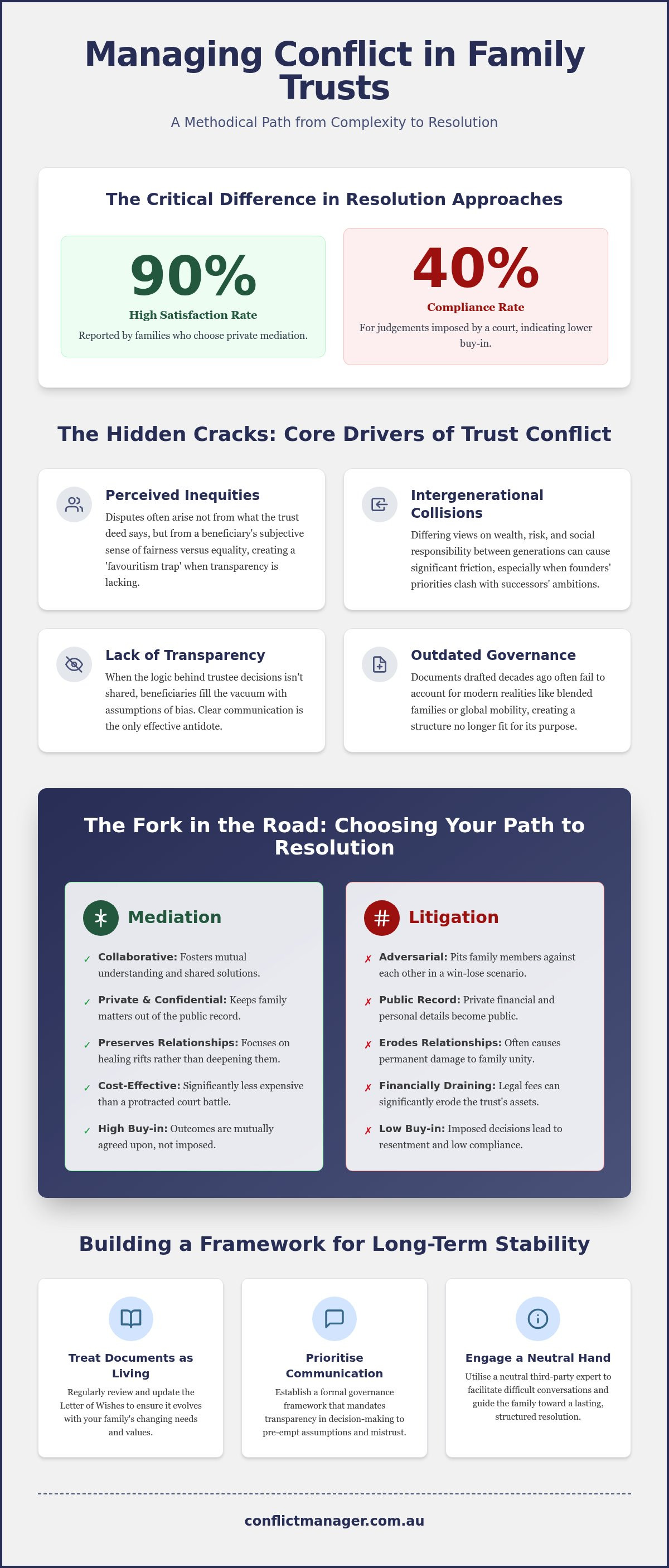
Did you know that while court-imposed judgements see compliance rates as low as 40 per cent, over 90 per cent of those who choose mediation report high satisfaction with the outcome? Conflict. Friction. Erosion. Managing conflict in family trusts isn't just about interpreting a deed; it's about untangling the knotted threads of intergenerational expectations and historical grievances.
You likely feel the weight of this responsibility every day, fearing that a public legal stoush will not only drain the family coffers but also permanently sever ties with those you love. It's a heavy burden to carry. This guide offers a steady hand to help you navigate these volatile waters, showing you how to address the emotional undercurrents that structural documents often ignore.
We'll explore a methodical path toward resolution that prioritises private mediation over the courtroom, ensuring your family's legacy remains intact. By the end, you'll understand how to restore clear communication and establish a trust structure that stands the test of time, moving from a state of complexity toward a vision of structured resolution.
Key Takeaways
- Clarity. Order. Stability. Recognise how a trust intended for protection can fracture when emotional friction overrides structural security.
- Pinpoint the psychological drivers behind beneficiary disputes and the impact of shifting intergenerational values on your family's investment strategies.
- Explore why private mediation is the most effective approach for managing conflict in family trusts, offering a collaborative alternative to the public erosion of assets in court.
- Strengthen your governance framework by treating the Letter of Wishes as a living document that evolves alongside your family's needs.
- Understand how engaging a neutral third party provides the steady hand required to move from volatile complexity toward a lasting resolution.
The Complexity of Family Trusts: When Structures Fracture
Stability. Order. Preservation. These are the pillars upon which most family trusts are built. A trust is, at its core, a vessel designed for the quiet protection of a legacy. It's meant to be a mechanism of security, yet when human dynamics shift, this vessel can develop hairline fractures that threaten the entire structure. Managing conflict in family trusts requires us to look past the legal parchment to the people holding the pen. While the assets are often the subject of the argument, they are rarely the catalyst. The root cause usually lies in perceived unfairness, a lack of transparency, or unaddressed grievances that have simmered for years.
We often speak about the structural integrity of family governance. This isn't merely a reference to the strength of the trust deed, but rather the scaffolding of trust between individuals. When this integrity fails, the transition from structural security to interpersonal disruption is swift and often painful. It's a move from a state of collective purpose to one of individual defence.
From Safety Net to Source of Friction
A well-constructed trust acts as a safety net. It provides for the vulnerable and protects the industrious. However, these same well-intentioned arrangements can become flashpoints for conflict when communication breaks down. Trustees often feel an immense weight of responsibility, attempting to balance rigid fiduciary duties with the fluid needs of family harmony. Meanwhile, beneficiaries may harbour expectations that don't align with the settlor's original intent. Trust friction is the palpable gap between legal intent and human reality. While global principles vary, looking at U.S. Trust Law Fundamentals provides a useful baseline for the fiduciary duties that often become the centre of these disputes, even if the emotional reality in Australia feels unique.
The High Cost of Unresolved Conflict
Silence is expensive. When disputes are left to simmer, the integrity of the assets themselves is at risk. In the Australian context, where complex family wealth structures are common, the stakes are particularly high. If managing conflict in family trusts isn't prioritised, the financial erosion can be staggering. Beyond the balance sheet, the emotional toll is even more significant. It spans generations. A disagreement between siblings today can alienate cousins for decades. The erosion of family unity happens slowly, then all at once. This is why early intervention by a neutral party is critical to maintaining both financial and emotional stability before the damage becomes irreversible.
Identifying the Core Drivers of Trust Conflict
Perception. Emotion. History. While the legal framework of a trust provides a rigid boundary, the human experience within it is often fluid and fraught with complexity. Managing conflict in family trusts requires an acute understanding that disagreements rarely stem from a simple misunderstanding of the law. Instead, they are born from the psychological weight of the past. Disagreements often emerge when the objective distribution of assets clashes with a beneficiary's subjective sense of worth. This tension between equality, giving everyone the same amount, and fairness, giving everyone what they need or deserve, is a primary driver of structural fracture.
Many trusts currently operating in Australia rely on governance documents drafted decades ago. These papers often fail to account for modern family dynamics, such as blended families or the rise of global mobility, creating a vacuum where assumptions replace clear intent. When the governing structure is no longer fit for purpose, the resulting friction is almost inevitable.
Perceived Inequities and Distribution Disputes
Beneficiaries often feel unfairly treated even when a trustee follows the deed to the letter. This is the favouritism trap. It manifests when one family member receives a discretionary distribution for a specific life event, such as a first home deposit, while others do not. Without absolute transparency, this act of support is viewed through the lens of bias rather than benevolence. Transparency is the only effective antidote to this perceived favouritism. By sharing the logic behind decisions, trustees can lower the emotional temperature and prevent the narrative of the "favoured child" from taking root.
Intergenerational Value Collisions
The way different generations view wealth, risk, and social responsibility can lead to significant friction. Founders often prioritise liquidity and the preservation of what they built; meanwhile, successors may be more inclined toward aggressive growth or sustainable impact. A value collision occurs when the ethical or environmental priorities of a younger generation conflict with the traditional investment strategies of the trust's originators. This isn't just a debate over portfolio percentages. It's a conflict over identity and legacy. If these collisions aren't managed, they can lead to a complete breakdown in the trust's investment programme and long-term strategy.
When these internal dynamics become too tangled for the family to resolve alone, engaging in professional stakeholder facilitation can provide the neutral ground needed to regain perspective and protect the family's shared future.
Navigating Resolution: Mediation vs. Litigation
Confrontation. Exposure. Depletion. When managing conflict in family trusts, stakeholders often find themselves at a crossroads between the public arena of the courtroom and the private confines of mediation. While litigation is sometimes viewed as the only way to achieve a definitive result, it frequently results in a pyrrhic victory where the assets are technically preserved, but the family unit is permanently destroyed. The adversarial nature of the legal system is designed to identify a winner and a loser, a binary outcome that rarely accounts for the complex emotional architecture of a high-net-worth family.
The Limitations of the Courtroom
The court is an adversarial machine. It's designed to find fault, not to heal. For high-net-worth families in Australia, the lack of privacy in the legal system is a significant risk. Public filings can expose sensitive financial details and internal grievances to the wider world. Once a matter enters the court system, you lose control. A judge, who is a stranger to your family's history, makes the final call based on rigid legal principles. The financial drain is also immense. Research from 2026 indicates that taking a trust dispute to trial can cost between $200,000 and $500,000, or even more. This doesn't just reduce the trust's value; it erodes the very legacy you worked to build.
The Logic of Private Mediation
Mediation offers a different path. It's a structured environment where stakeholders can navigate high-emotion situations with composure. A neutral third party acts as a steady hand, lowering the emotional pulse of the room. This allows for a focus on sustainable, clear outcomes. Unlike a court order, which is often a blunt instrument, mediation allows for bespoke solutions. You can create agreements that address specific family nuances that a judge simply cannot consider. The satisfaction rates speak for themselves. Over 90 per cent of mediation participants report high satisfaction with the process. Managing conflict in family trusts through this method typically costs between $65,000 and $140,000, which is significantly less than the cost of trial. Compliance with mediated agreements is also high, sitting between 80 per cent and 90 per cent, compared to just 40 per cent for court-imposed judgements. It's about moving from a state of volatility toward a vision of resolution.
Strengthening Trust Governance for Long-Term Stability
Structure. Integrity. Foresight. These are the hallmarks of a resilient trust. While many families focus purely on the legal deed, managing conflict in family trusts effectively requires a focus on the human architecture of governance. Proactive governance acts as a pressure release valve. It moves the trust from a static legal entity to a dynamic family instrument. By formalising communication protocols, you reduce the reliance on guesswork and emotional intuition, ensuring that the trust serves its purpose without becoming a source of resentment.
Clarifying Intent through Letters of Wishes
A Letter of Wishes is a non-binding document, but its importance cannot be understated. It provides the necessary context for a trustee’s decisions, acting as a bridge between the rigid language of the deed and the settlor's personal values. When a settlor's intent is clearly articulated, beneficiaries are less likely to perceive bias or favouritism. However, a letter written in 2010 rarely reflects the family reality of 2026. Regular reviews ensure that the document evolves alongside the family. This prevents the "dead hand" effect where outdated instructions spark modern resentment. Treating this letter as a living document allows the spirit of the trust to remain relevant as the family grows and diversifies.
Establishing Regular Communication Forums
Silence breeds assumption. Assumption breeds conflict. Establishing regular, facilitated family forums is a cornerstone of managing conflict in family trusts, providing a neutral space where expectations can be aligned. Without a facilitator, these meetings often devolve into old family patterns. Long-standing sibling rivalries or parent-child dynamics can easily take centre stage, obscuring the objective needs of the trust. A structured forum allows for the formalisation of communication protocols within the family office, ensuring that every stakeholder feels heard without the conversation becoming volatile.
Consider this framework for a successful governance meeting:
- A defined agenda circulated at least one week prior to the gathering.
- The presence of a neutral third party to manage the emotional pulse of the room.
- Clear documentation of the logic behind major investment or distribution decisions.
- A dedicated time for younger generations to ask questions about the trust's purpose and future.
If your internal efforts to align the family are struggling under the weight of historical friction, engaging in professional stakeholder facilitation can provide the steady hand needed to restore order. This approach moves the family from a state of complexity toward a vision of structured resolution.
Engaging a Neutral Third Party to Restore Clarity
Objectivity. Distance. Discernment. When managing conflict in family trusts, internal efforts to restore order often struggle under the weight of shared history. It's difficult to be the voice of reason when you're also a stakeholder in the outcome. This is where an external counsellor provides a steady hand. They view the situation with total objectivity, seeing the structural friction and emotional undercurrents without becoming entangled in them. By introducing a neutral third party, you move the conversation from a state of reactive volatility toward a vision of structured resolution.
The transition from internal struggle to external guidance marks a turning point for many high-net-worth families. It signals a commitment to preservation over destruction. This methodical approach ensures that every stakeholder is heard, yet no single voice is allowed to dominate the narrative at the expense of the collective legacy. It's about bringing order to a period of high stress through a grounded and reassuring presence.
The Role of the Composed Facilitator
A professional mediator operates with a sense of quiet authority. They don't offer legal representation or clinical psychotherapy. Instead, they provide conflict resolution expertise. This distinction is vital. While a lawyer might define your rights, a facilitator helps you define your future. They lead a family through difficult transitions by identifying the hidden drivers of dispute that legal documents simply cannot address. This external perspective allows for a methodical and logical progression, lowering the pulse of the room and building trust through a sequence of clear, manageable steps. They remain unruffled by high-stakes environments, providing the stability needed to navigate even the most complex human and structural dynamics.
Transitioning Toward Sustainable Outcomes
The sense of relief that follows a successful mediation is palpable. Order replaces chaos. Once the emotional friction is addressed, the structural integrity of the trust can be restored. This process preserves the family's assets, but more importantly, it protects the intergenerational bonds that litigation often severs. Resolution isn't just about reaching an agreement. It's about establishing a framework for long-term stability. It allows the family to move forward with a shared understanding of their legacy and their responsibilities to one another. Managing conflict in family trusts through this structured approach ensures that the resolution is not just a temporary fix, but a sustainable foundation for the future.
Explore how Conflict Manager can guide your family toward clarity.
Restoring Your Family Legacy
The path from disruption to order requires a deliberate shift in perspective. You've explored how the high costs of litigation, both financial and emotional, can be avoided through the collaborative framework of private mediation. By treating governance documents like the Letter of Wishes as living instruments and establishing regular family forums, you build a resilient structure that prevents future friction. Managing conflict in family trusts is ultimately a commitment to the people behind the assets.
A neutral third party provides the distance needed to view volatile situations with total objectivity. This grounded and reassuring approach ensures that intergenerational bonds are preserved while structural integrity is restored. Expert-led mediation offers a methodical sequence toward sustainable outcomes that protect your family's future. You don't have to navigate these complex human and structural dynamics without a steady hand to guide you.
Achieve clarity and stability with Conflict Manager
There is always a way forward that leads to lasting peace and a preserved legacy.
Frequently Asked Questions
What are the most common causes of conflict in Australian family trusts?
Disagreements often stem from perceived inequities in distributions, a lack of transparency between trustees and beneficiaries, or outdated governance documents that don't reflect modern family dynamics. In the Australian context, intergenerational value shifts regarding investment risk or social responsibility frequently trigger friction. While wealth is the subject, the root is usually a breakdown in trust and communication. Identifying these underlying emotional drivers is the first step toward restoring order.
How does mediation differ from legal representation in a trust dispute?
Mediation is a collaborative process focused on mutual agreement, whereas legal representation is adversarial and focused on individual rights and fault-finding. A mediator facilitates dialogue to reach sustainable outcomes; a lawyer advocates for a client's specific legal position. Conflict Manager provides facilitation and mediation but does not offer legal representation. This distinction is critical as mediation seeks to preserve family bonds that the courtroom often destroys.
Can a beneficiary challenge a trustee’s decision without going to court?
Yes, beneficiaries can address grievances through internal dispute resolution mechanisms or professional mediation. Managing conflict in family trusts often involves creating a neutral space where concerns about transparency or fairness can be aired and resolved collaboratively. This approach avoids the public exposure and high costs of the legal system, allowing for bespoke solutions that a judge simply cannot provide within the constraints of strict trust law.
What is the role of a neutral third party in family office mediation?
A neutral third party acts as a steady hand, viewing volatile situations with total objectivity to bring order during high-stress periods. They guide stakeholders through high-emotion transitions without becoming emotionally entangled themselves. In family office mediation, their role is to lower the emotional pulse of the room, ensuring that every voice is heard while maintaining focus on the long-term stability of the trust structure and the family legacy.
How can we prevent trust disputes before they start?
Prevention requires proactive governance and regular, facilitated communication. Establishing a living Letter of Wishes and holding annual family forums ensures that expectations remain aligned across generations. Formalising communication protocols within the family office reduces assumption and guesswork. By addressing potential friction points early, families can maintain structural integrity and prevent the minor misunderstandings that often escalate into full-scale disputes over time.
Is family trust mediation private and confidential?
Mediation is a private and confidential process, which is a primary reason high-net-worth families prefer it over public litigation. Discussions held during mediation generally cannot be used as evidence in court, and the details of the dispute remain within the family circle. This protection of privacy is essential for maintaining a family's public reputation and ensuring that sensitive financial information remains secure from the public record.
What happens if we cannot reach an agreement through mediation?
If mediation does not result in a final agreement, the parties remain free to explore other avenues, including further facilitation or the legal system. However, the mediation process often clarifies the core issues even if a total resolution isn't reached immediately. Because mediated agreements are reached through mutual consent, they see compliance rates between 80 per cent and 90 per cent, far higher than court-imposed judgements.
How long does the conflict resolution process typically take for a family trust?
The timeline for managing conflict in family trusts varies depending on the complexity of the dispute and the number of stakeholders involved. A structured mediation process can often reach a resolution within a few weeks or months. This is significantly faster than the court system, where trust litigation can drag on for several years, causing prolonged emotional exhaustion and the continued erosion of family wealth through legal fees.


