

Did you know that 71% of shareholder oppression cases in our courts arise from family-owned or closely held enterprises? This statistic highlights a sobering reality for many investors. Isolation. Marginalisation. Erosion. When navigating minority shareholder disputes Australia offers specific legal protections, yet the emotional toll often outweighs the statutory ones. You likely feel the weight of your investment diminishing while the burden of the conflict grows heavier each day. It's a state of disruption that threatens both your financial security and your professional peace of mind.
You deserve a resolution that prioritises structural clarity over protracted legal warfare. We'll show you how to navigate these complex dynamics through professional mediation and stakeholder facilitation. This guide examines the thresholds for oppressive conduct under the Corporations Act 2001 and outlines pathways to secure a fair exit or restore communication. By shifting the focus from interpersonal friction to objective organisational stability, you can protect your assets and move toward a sustainable future without the volatility of a public court battle.
Key Takeaways
- Recognise the subtle signs of marginalisation and "squeeze-out" tactics that threaten your influence and the long-term value of your investment.
- Learn how the Corporations Act 2001 protects you from oppressive conduct and how courts evaluate commercial fairness in minority shareholder disputes Australia.
- Assess the hidden costs of protracted litigation, such as the erosion of organisational culture, to determine if mediation offers a more sustainable path.
- Use a methodical framework to separate structural friction from interpersonal grievances. It's the best way to ensure emotions don't cloud your strategic objectives.
- Discover the value of neutral third-party facilitation in restoring order and achieving a clean, fair resolution that preserves your professional legacy.
Understanding the Dynamics of Minority Shareholder Friction in Australia
Minority shareholder disputes in Australia are rarely just about the balance sheet. They represent a fundamental breakdown in the structural integrity of an organisation. Friction. Isolation. Resentment. These are the precursors to formal conflict. In many cases, the dispute is a symptom of deeper organisational or family friction that has finally breached the surface of corporate governance. It's a difficult reality to face, but acknowledging this disruption is the first step toward a calm resolution.
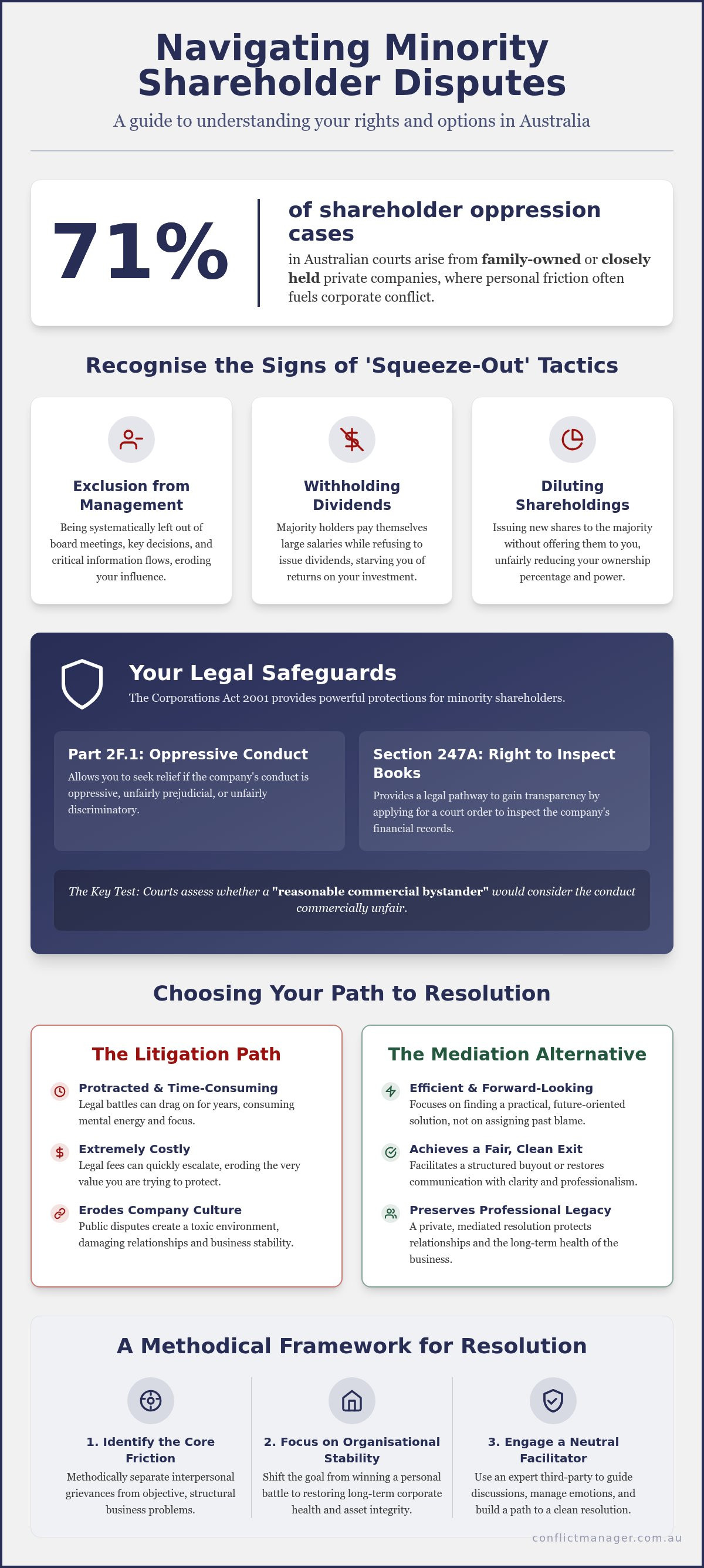
A common manifestation of this friction is the "Squeeze-Out". This occurs when majority stakeholders use their control to marginalise minority voices. Tactics often include excluding minority members from board meetings, withholding dividends while increasing director salaries, or diluting shareholdings through unannounced capital raises. For the minority holder, this feels like an intentional erosion of their influence and asset value. It creates a state of high stress where the intersection of financial interest and personal legacy becomes a source of constant anxiety.
The Anatomy of Disruption: Why Disputes Arise
Instability often begins with change. Structural shifts, such as intergenerational succession or sudden leadership transitions, can trigger a move from collaborative growth to defensive posturing. When the original founders step back, the remaining stakeholders may find their interests no longer align. This shift isn't always malicious, but it's almost always disruptive to the established order.
Information asymmetry further complicates these transitions. When minority holders are excluded from the "inner circle", trust evaporates. Decisions made in private, without transparency, create a vacuum that is quickly filled by suspicion. This lack of clarity is often the primary driver of Shareholder Oppression claims under Australian law. Without a steady flow of information, the minority party is left to wonder if the business is being managed for the benefit of all, or just for the few in control.
The Australian Context: Private Companies and Family Wealth
The Australian market is uniquely defined by its reliance on proprietary limited (Pty Ltd) companies. Research from the 2024-25 period indicates that approximately 71% of shareholder oppression disputes occur in family-owned or closely held companies. These structures are inherently fragile because they blend professional responsibilities with personal histories. It's a delicate balance that is easily upset by interpersonal grievances.
In a family office or a "Mum and Dad" business, a dispute isn't just a commercial disagreement; it's a threat to a personal legacy. Family dynamics often bypass traditional corporate governance, leading to informal decision-making that leaves minority members vulnerable. When internal conflict remains unmanaged, the integrity of the underlying assets is placed at risk. Managing minority shareholder disputes Australia requires a steady hand that understands these complex human and structural dynamics. Restoring order requires looking beyond the legal symptoms to address the underlying friction.
The Legal Landscape: Oppressive Conduct and Statutory Safeguards
Statute. Precedent. Equity. These are the pillars that support the Australian corporate framework. The primary legislation governing minority shareholder disputes Australia is the Corporations Act 2001. Specifically, Part 2F.1 provides a vital mechanism for shareholders to seek relief when a company's affairs are conducted in a manner that is oppressive, unfairly prejudicial, or unfairly discriminatory. Australian courts apply the "Reasonable Person" test to evaluate these claims. They ask whether a reasonable commercial bystander would find the conduct unfair. This objective lens is essential. It provides a sense of order and helps stakeholders move beyond personal grievances toward a structured legal reality.
Common examples of oppression often involve the tactical use of majority power. This might include the persistent withholding of dividends despite healthy profits, the awarding of excessive director salaries to majority holders, or the total exclusion of a minority voice from management. Beyond oppression claims, shareholders possess rights under Section 247A to apply for a court order to inspect company books. This transparency is often the first step in enforcing minority shareholder rights when trust has been compromised. Access to information acts as a check against the asymmetry of power that often defines these disputes.
Identifying Oppressive Conduct
It's vital to distinguish between commercial disappointment and legal oppression. A minority shareholder’s lack of control is not, in itself, evidence of oppression. Courts are generally reluctant to interfere in "indoor management" or legitimate commercial decisions, even if those decisions lead to poor financial outcomes. Oppressive conduct is a departure from the standards of fair dealing and a violation of the conditions which a shareholder is entitled to expect would be observed. To succeed in a claim, one must prove that the conduct was commercially unfair, rather than just being a decision they personally disliked.
The Role of the Shareholders’ Agreement
A well-drafted shareholders' agreement provides the primary framework for maintaining organisational stability. It often contains bespoke "deadlock" provisions that dictate exactly how the company should proceed when stakeholders reach an impasse. While the Corporations Act provides a safety net, these private contracts can modify how certain statutory rights are exercised or waived. Understanding these layers of governance is a prerequisite for effective stakeholder facilitation. When internal structures are clear, the path to resolution becomes more predictable. This clarity is the best defence against the erosion of asset value during periods of high-stakes friction.
Strategic Alternatives: Why Litigation Isn’t the Only Path
Expense. Delay. Exposure. These are the inevitable companions of the courtroom. While the law provides a framework for minority shareholder disputes Australia, the path of litigation is often a blunt instrument used in a situation that requires a scalpel. In the Federal Court of Australia, the 2026 fee for a corporation to commence proceedings is $5,255; however, the total financial commitment for a contested matter often ranges from $30,000 to well over $150,000. Beyond the balance sheet, the erosion of organisational culture is a cost that few businesses can truly afford. Choosing mediation isn't an act of compromise; it's a strategic decision to preserve asset value and professional privacy.
The "Quiet Approach" prioritises the preservation of market confidence by resolving internal friction behind closed doors. When a dispute becomes public, it signals instability to creditors, employees, and competitors. By opting for stakeholder facilitation, parties can maintain a steady hand on the business's reputation while working toward a resolution that feels equitable for all involved. This methodical progression allows for outcomes that a judge cannot provide, such as restructured governance or bespoke exit strategies that reflect the true value of a stakeholder's contribution.
The Limitations of the Courtroom
Legal judgements are inherently binary. Someone wins, someone loses, and the business often suffers in the crossfire. A court order for a share buy-out or, in extreme cases, a winding-up order, lacks the nuance required to manage complex human dynamics. Furthermore, the risk of sensitive family or business information entering the public record is significant. Once a matter is filed, the details of your internal friction become a matter of public scrutiny, potentially damaging the very legacy you're attempting to protect. Courts focus on "commercial unfairness", but they rarely have the capacity to heal the underlying breakdown in communication.
Mediation: Restoring Order through Facilitation
Mediation acts as a neutral third party that lowers the emotional temperature of a dispute. It moves stakeholders away from rigid positions—"I want this"—and toward a deeper understanding of their actual interests—"I need this". For high-net-worth families with complex trust structures, professional facilitation is essential. It provides a structured environment where the weight of responsibility can be discussed without the threat of cross-examination. This process brings clarity to clouded situations, allowing for a sustainable agreement that restores organisational stability and protects the long-term integrity of the family office or enterprise.
Facilitating Clarity: A Methodical Approach to Stakeholder Alignment
Objective. Engagement. Discovery. Generation. Agreement. These five stages form the architecture of a deliberate resolution. Managing minority shareholder disputes Australia requires moving beyond the initial reactive phase toward a disciplined framework that prioritises the health of the entity. When internal efforts to resolve friction have stalled, the introduction of a methodical, external process provides the necessary structure to lower the pulse of the organisation. It moves the conversation from the boardroom table to a neutral space where logic can prevail over legacy.
The process begins with an objective assessment, where we separate the structural friction from the interpersonal grievances that often cloud the core issues. Neutral engagement follows, as a seasoned professional is introduced to guide stakeholders through the discovery of their actual interests. Once these core needs are uncovered, we move into option generation; a creative phase where we craft solutions that a court, constrained by the binary nature of the law, could never mandate. The final step is the formalisation of a sustainable agreement, ensuring that the resolution provides long-term stability rather than a temporary truce.
Separating Emotion from Equity
Psychological distance is a prerequisite for sound business decisions. In high-stakes environments, the "Legacy Burden" can make it nearly impossible for family members or long-term partners to view their equity with objectivity. Facilitation provides the buffer required to address financial interests without the interference of historical resentment. The primary goal of mediation is the restoration of organisational equilibrium. By establishing this distance, stakeholders can evaluate their position based on current realities rather than past disappointments; a shift that is essential for preserving the integrity of the family office or enterprise.
Crafting Bespoke Resolutions
A court-ordered buyout is often a blunt instrument that ignores the nuances of a functioning business. Through stakeholder facilitation, parties can explore a wider spectrum of outcomes, such as revised dividend policies, enhanced board representation, or a complete structural restructuring. These bespoke resolutions are designed to be sustainable, preventing the "revolving door" of recurring conflict that often follows a poorly negotiated settlement. It is important to understand that resolution is a process, not a single event, and requires ongoing commitment to the new structural alignment. Our team at Conflict Manager provides the stakeholder facilitation necessary to navigate these transitions with total objectivity and professional composure.
Restoring Organisational Stability through Expert Mediation
Order. Clarity. Resolution. These are the outcomes of a disciplined approach to conflict. The journey from disruption to clarity is rarely accidental; it requires a deliberate choice to move away from the friction of the past toward a structured future. Managing minority shareholder disputes Australia necessitates more than just a legal strategy. It requires a commitment to organisational conflict management that addresses the root causes of friction rather than just the symptoms of legal oppression. By prioritising stakeholder facilitation, you protect the integrity of your family office or business enterprise. You ensure that the legacy you've built isn't dismantled by the very people meant to uphold it. Conflict Manager acts as a wise, external counsellor, providing the steady hand needed to navigate these volatile transitions with total objectivity and professional composure.
Choosing mediation over adversarial litigation is a strategic move to preserve both financial value and interpersonal relationships. While the law focuses on whether conduct is commercially unfair, mediation focuses on how the organisation can function effectively moving forward. This methodical progression moves the reader from a state of complexity toward a vision of structured resolution. It's a calming process that replaces the heat of conflict with the cool logic of a professional agreement, ensuring that the business remains a stable vehicle for wealth and legacy.
The Value of a Neutral Third Party
Internal efforts to resolve friction often fail under the weight of historical grievance. When emotions are high, even the most logical stakeholders struggle to see a path forward. Historical resentment and personal history create a fog that obscures commercial reality, making internal negotiation feel like a repetitive loop of past disappointments. This is where a professional facilitator adds immense value. We remain unruffled by high-stakes environments, acting as a neutral party that brings order to clouded situations. Our approach guides stakeholders toward a vision of structured resolution, allowing for a level of communication that is impossible when parties are emotionally entangled. It's about restoring a sense of order during periods of high stress, ensuring the business continues to move forward despite interpersonal tension.
Next Steps for Minority Shareholders
Transitioning from a state of complexity toward a methodical resolution is a sign of seasoned leadership. It shows a dedication to the long-term health of the organisation and the preservation of its assets. If you find yourself marginalised or squeezed out, the path of adversarial litigation isn't your only option. You can choose a path of composed resolution that maintains your privacy and protects your investment from the public scrutiny of the courts. To begin this process, you can enquire about professional mediation services for a confidential facilitation of your shareholder dispute. We provide the neutral third-party objectivity required to secure a sustainable outcome and restore organisational stability for all stakeholders involved.
Securing a Sustainable Path for Your Organisation
Resolving minority shareholder disputes Australia requires a fundamental shift in perspective. While the Corporations Act provides a necessary safety net, it's the process of professional mediation that offers a truly sustainable resolution. By separating interpersonal grievances from structural friction, you can protect the core value of your investment and the long-term integrity of your business. You've seen how litigation often results in a binary win-loss outcome; however, stakeholder facilitation allows for bespoke agreements that restore organisational stability and preserve professional privacy.
It's about moving from a state of disruption toward a vision of structured resolution. You don't have to navigate this volatility alone. Our expertise in high-net-worth family office mediation and specialised facilitation for complex organisational restructuring provides the neutral, steady hand needed for high-emotion business disputes. We're here to guide you through these difficult transitions with total objectivity. Navigate your shareholder dispute with composed authority; contact Conflict Manager today. You have the power to choose a path of composed resolution that protects your legacy and secures your future.
Frequently Asked Questions
What are the most common minority shareholder rights in Australia?
Shareholders possess statutory rights primarily under the Corporations Act 2001. These include the right to bring a claim for oppression under Section 232 and the right to apply for a court order to inspect company books under Section 247A. These protections are designed to ensure that minority voices aren't unfairly marginalised. Understanding these rights is a prerequisite for restoring organisational stability and protecting your investment within the Australian corporate framework.
Can a minority shareholder be forced to sell their shares?
Majority stakeholders can trigger compulsory acquisition if they reach 90% ownership during a takeover process. Additionally, a court may order a share buy-out as a remedy for minority shareholder disputes Australia if oppression is proven. Outside of these specific statutory triggers, a shareholder cannot usually be forced to divest. Mediation provides a more controlled environment to negotiate a fair exit strategy that reflects the true value of your contribution.
How does mediation differ from arbitration in a shareholder dispute?
Mediation is a collaborative process where a neutral facilitator helps parties reach a mutually acceptable agreement. It focuses on interests rather than just rigid legal positions. Arbitration is a more adversarial process where a third party imposes a binding decision on the stakeholders. Conflict Manager prioritises stakeholder facilitation because it allows for bespoke, sustainable outcomes that preserve the integrity of the business and the family legacy.
Is a minority shareholder dispute always a legal matter?
Disputes often begin as interpersonal friction or structural misalignment rather than legal breaches. While the Corporations Act provides a safety net, the underlying issues are frequently psychological or organisational in nature. Addressing these dynamics through expert-led mediation can prevent a disagreement from escalating into a public legal battle. It's about bringing order to clouded situations before the high cost of litigation becomes inevitable for the parties involved.
What is the cost of a minority shareholder dispute in Australia?
The financial burden depends on the chosen path. Litigation in Australian courts is notoriously expensive, with contested matters often costing stakeholders between $30,000 and $150,000 in legal fees alone. Mediation represents a strategic investment in a faster, private resolution. It avoids the hidden costs of business disruption and reputational damage, which can be far more damaging to the long-term value of a family office or enterprise.
How long does it typically take to resolve a shareholder dispute through mediation?
Efficiency is a primary benefit of professional facilitation. While the court system may take eighteen months or more to reach a final hearing, mediation can often resolve complex disputes within a matter of weeks. The timeline depends on the willingness of stakeholders to engage in the discovery of their core interests. A methodical approach ensures that the resolution is not just fast, but also sustainable for the future.
Can mediation help if the majority shareholders refuse to talk?
Facilitation is specifically designed to manage resistance and high-emotion environments. A neutral third party can engage with majority holders individually to lower the emotional temperature and explain the benefits of a structured resolution. By moving away from defensive posturing, stakeholders often find that a facilitated dialogue is less threatening than the prospect of a public court case. It's an effective way to restore communication when trust has evaporated.
What happens if a shareholder agreement is not in place?
Without a bespoke agreement, the company relies on the replaceable rules of the Corporations Act 2001 and its basic constitution. This lack of structure often exacerbates minority shareholder disputes Australia as there is no pre-defined roadmap for resolving a deadlock. In these cases, expert mediation is essential to create a new, clear framework for governance. It provides the structural clarity needed to manage sizable assets and maintain organisational stability.


