

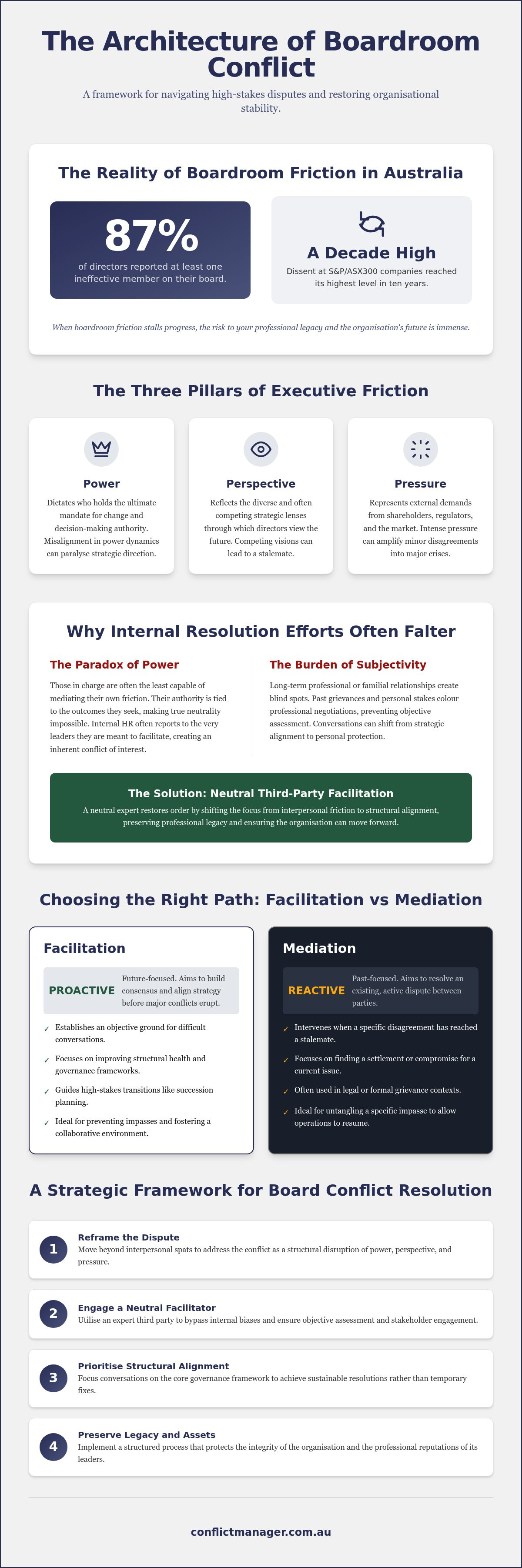
In 2026, research revealed that 87 per cent of directors reported at least one ineffective member on their board, while dissent at S&P/ASX300 companies reached its highest level in a decade. Governance. Integrity. Stability. These aren't just concepts; they are the foundations that crumble when boardroom friction stalls progress. When the environment becomes a site of emotional volatility, the risk to your professional legacy and the organisation's future is immense. You know that effective board of directors conflict resolution isn't about winning a debate. It's about protecting the structural health of your board and ensuring the business can move forward with clarity.
It's natural to feel the weight of these high-stakes disputes, especially when trust among key stakeholders or family members begins to fray. This article provides a methodical framework for resolving these impasses through expert, neutral facilitation. We'll explore how to establish an objective ground for difficult conversations and restore the movement your organisation requires. By shifting the focus from interpersonal friction to structural alignment, you can achieve a sustainable resolution that preserves your reputation and restores organisational stability.
Key Takeaways
- Reframe boardroom disputes as structural disruptions rather than interpersonal spats by addressing the core pillars of power, perspective, and pressure.
- Identify why the paradox of power often makes objective internal mediation impossible when professional or familial blind spots are present.
- Distinguish between proactive facilitation and reactive mediation to find the most effective path toward restoring organisational stability.
- Apply a strategic framework for board of directors conflict resolution that prioritises objective assessment and neutral stakeholder engagement.
- Utilise a neutral third party to guide high-stakes transitions while preserving your professional legacy and asset integrity.
The Architecture of Boardroom Conflict: Beyond Simple Disagreement
Disruption. Friction. Stagnation. When a boardroom becomes a site of tension, it's rarely just a matter of differing opinions. Instead, we must view these moments as a fundamental structural disruption. Effective board of directors conflict resolution requires moving past the surface-level symptoms of an interpersonal spat to address the underlying mechanics of the organisation. Board conflict is the friction between vision, ego, and collective responsibility.
Three distinct pillars often support executive friction: power, perspective, and pressure. Power dictates who holds the ultimate mandate for change. Perspective reflects the diverse, often competing, strategic lenses through which directors view the future. Pressure represents the external demands from shareholders, regulators, and the market. When these forces misalign within a corporate governance framework, the resulting tension can amplify minor disagreements into full-blown organisational crises that threaten the very core of the business.
The High Cost of Executive Impasse
An impasse at the executive level does more than just delay a single vote. It erodes the foundational trust required for rapid, decisive action. When decision-making speed drops, the organisation loses its competitive edge in a volatile Australian market. This friction creates a ripple effect. It destabilises lower-level teams who sense the lack of cohesion at the top, leading to a decline in morale and productivity. Ultimately, a prolonged stalemate risks damaging the organisation's reputation and shattering stakeholder confidence, making the need for professional board of directors conflict resolution a matter of survival rather than mere preference.
Emotional Volatility in High-Stakes Environments
It's a common misconception that seasoned professionals are immune to emotional volatility. In high-stakes environments, the weight of legacy and the protection of asset integrity can trigger defensive leadership behaviours. Directors aren't just arguing over policy; they're often fighting to preserve their professional identity or the long-term value of a family-held enterprise. Recognising when a dispute has moved beyond internal resolution capabilities is crucial. When conversations shift from strategic alignment to personal protection, the steady hand of a neutral third party becomes necessary to restore order and movement.
Why Internal Resolution Efforts Often Falter at the Executive Level
Authority. History. Bias. These internal weights pull on every attempt at self-regulation within a boardroom. While most leaders pride themselves on their objectivity, internal efforts at board of directors conflict resolution often face an invisible ceiling. When the individuals tasked with maintaining order are the same ones entangled in the dispute, true neutrality vanishes. This is the paradox of power. Those in charge are often the least capable of mediating their own friction because their authority is inextricably tied to the strategic outcomes they seek to influence.
Standard HR protocols, while effective for staff-level grievances, frequently lack the weight or the independence required for executive-level disputes. An internal HR director ultimately reports to the leadership they are meant to facilitate. This reporting line creates an inherent conflict of interest that makes total impartiality impossible. Instead of resolving the issue, internal efforts can inadvertently entrench existing factions. Board members may feel pressured to choose sides to protect their professional standing, which only deepens the organisational divide. When this occurs, seeking a steady hand for organisational conflict management becomes a necessary step to restore movement.
The Burden of Subjectivity
Personal history often colours professional negotiations in ways that are difficult to detect from the inside. Long-term professional or familial relationships create blind spots where past grievances influence current strategic debates. It's nearly impossible to maintain total objectivity when you hold a personal stake in the outcome. As highlighted in the Statement on Conflict of Interest, clarity and disclosure are essential for effective governance. Without an external perspective, internal observers often fall into the trap of taking sides. This natural, yet destructive, response ensures that the dispute remains personal rather than becoming a productive catalyst for structural change.
Complexity and Structural Change
Organisational restructuring creates fertile ground for leadership conflict. We often see friction between the old guard, who built the foundation, and new strategic directions required for growth. This is particularly prevalent when a business transitions from a founder-led model to a formal corporate governance structure. The shift from a singular vision to collective responsibility requires a level of structural integrity that internal teams may struggle to build. Managing this transition requires an objective view of human and structural dynamics that isn't clouded by the emotional weight of the change itself.
Facilitation vs Mediation: Choosing the Right Path to Stability
Clarity. Movement. Stability. While these terms are often used interchangeably in executive circles, the specific path you choose depends entirely on the current temperature of your boardroom. Proactive facilitation acts as a preventative measure, designed to align vision before friction becomes fire. Reactive mediation is the anchor used when the storm has already arrived. To achieve lasting board of directors conflict resolution, one must first identify whether the requirement is to guide a conversation or to settle a dispute. Each approach serves a distinct purpose in restoring the structural integrity of your organisation.
A neutral third party serves as the steady hand that lowers the collective pulse of the room. When tensions are high, seasoned professionals often find it difficult to separate strategic dissent from personal slights. An external expert brings total objectivity, viewing volatile situations without becoming emotionally entangled in the outcome. This presence allows for a shift from defensive posturing to collaborative problem-solving. Effective Managing Conflict on the Board requires this level of discernment to ensure that the board remains a functional governing body rather than a collection of competing interests.
The Power of Neutral Facilitation
Facilitation is most effective during periods of significant transition or strategic pivot. It guides stakeholders toward clarity by creating a safe harbour for difficult conversations. Unlike a standard meeting, a facilitated session focuses on movement and future stability rather than litigating past grievances. The goal is to identify common ground and build a sustainable framework for collective responsibility. By addressing potential friction points early, boards can avoid the stagnation that typically follows an unaddressed impasse.
Formal Mediation for Complex Disputes
When a boardroom reaches a state of total deadlock, formal mediation becomes necessary. This is particularly true for disputes involving sizable assets, family-held interests, or high-emotion structural changes. Mediation is a structured process that moves parties from a state of conflict to a documented, sustainable agreement. It ensures all stakeholders feel heard without compromising the organisation's overall integrity. This intervention is designed to protect professional legacies and ensure that even the most volatile disputes result in a resolution that allows the business to function once more.
Selection Framework for Boardroom Intervention:
- Facilitation: Use for strategic planning, board refreshes, or early-stage disagreements.
- Mediation: Use for asset-heavy disputes, deadlocked votes, or legal-adjacent friction.
- Stakeholder Facilitation: Use when external pressures or family dynamics complicate decision-making.
A Strategic Framework for Navigating High-Stakes Boardroom Disputes
Logic. Sequence. Resolution. When a boardroom reaches an impasse, the path back to stability is rarely found through sheer force of will. Instead, it requires a disciplined framework that prioritises structural integrity over personal victory. A methodical board of directors conflict resolution process moves the conversation from the emotional to the analytical, ensuring that every stakeholder's perspective is viewed through the lens of organisational health.
The framework follows five distinct stages:
- Objective Assessment: We begin by stripping away the noise to separate personality clashes from genuine structural friction.
- Stakeholder Engagement: Perspectives are gathered in a neutral environment, allowing for honest expression without the risk of immediate escalation.
- Strategic Facilitation: This is the navigation of the messy middle, where we hold the tension long enough to find a sustainable path forward.
- Outcome Definition: We co-create resolutions that are clear, documented, and focused on future movement.
- Implementation and Monitoring: A resolution is only as strong as its ability to hold under pressure; we ensure the new alignment is monitored and adjusted as needed.
Separating Emotion from Asset Integrity
High-emotion states are a natural byproduct of high-stakes environments, particularly when a family office or significant organisational assets are at risk. Protecting these assets requires a specific type of detachment. Resolution requires detachment, not from the people, but from the problem. By acknowledging the emotional weight of a dispute without letting it drive the decision-making process, we preserve the legacy and value of the enterprise. If your board is currently struggling to separate these dynamics, our expert stakeholder facilitation can provide the objective ground you need.
Governance as a Conflict Preventative
Clear governance structures act as the ultimate preventative measure against future leadership friction. These frameworks aren't just about compliance; they're about building conflict-ready leadership teams that can disagree without disintegrating. Professional facilitation helps boards design robust charters and communication protocols that define how disputes are handled before they become crises. This proactive approach ensures that when pressure mounts, the board has a predetermined path back to clarity and collective responsibility.
Conflict Manager: Restoring Order through Expert Facilitation
Authority. Clarity. Stability. In the high-stakes environment of an Australian boardroom, these qualities are the first to erode when friction takes hold. Conflict Manager acts as the steady hand required to navigate these volatile situations. We provide a neutral ground where difficult conversations can occur without the risk of emotional entanglement. Our expertise in board of directors conflict resolution is built on a deep understanding of both complex human psychology and rigid organisational structures. By viewing every dispute as a structural disruption rather than a personal failure, we help leaders move past the impasse toward a sustainable future.
A neutral third party brings a level of objectivity that's impossible to achieve from within the leadership team. We don't just settle arguments; we restore the structural integrity of the organisation. Our focus remains on preserving the professional legacy and asset integrity that directors have spent decades building. When the collective pulse of the room is lowered, directors can once again focus on their primary mandate: the health and growth of the business. It's about finding a path where movement is restored and professional reputations remain intact.
Composed Authority in Action
Method. Logic. Objectivity. Our approach is designed to lower the pulse of a dispute, replacing reactive tension with analytical clarity. An external perspective is essential when internal efforts have reached their limit. We view volatile situations with total objectivity, ensuring the focus remains on the organisation's health rather than individual egos. This process guides stakeholders through the complexity of their dispute, leading them toward a structured resolution that protects the business's core. Our counselors remain unruffled by high-stakes environments, providing the grounded presence needed to facilitate difficult transitions with total discernment.
Securing Your Organisational Future
Resolution is possible, even in the most entrenched situations. The key is to intervene before the friction causes irreparable structural damage to the company or its reputation. We specialise in high-emotion business disputes across Australia, ensuring that legacy and asset integrity are preserved throughout the transition. Acting early prevents the 'ripple effect' that destabilises lower-level teams and shakes stakeholder confidence. Don't wait for the impasse to dictate your organisation's fate. It's time to restore order and movement to your leadership team. Enquire about expert facilitation for your leadership team and secure the future of your professional legacy.
Restoring the Path to Decisive Leadership
Clarity. Purpose. Alignment. These are the markers of a board that functions with structural integrity. We've explored how shifting the focus from interpersonal friction to objective assessment allows for a sustainable resolution. By recognising that power dynamics and professional history often create blind spots, you can move toward a governance model that views disagreement as a catalyst for growth rather than a cause for stagnation.
Effective board of directors conflict resolution requires more than just internal policy; it demands the steady hand of a neutral third party. Whether you're navigating the complexities of a family office or managing a strategic pivot within a corporate entity, the goal remains the same: to protect your professional legacy and ensure the organisation's future stays secure. Our expert-led mediation for high-net-worth families provides national Australian service coverage, specialised in the high-emotion business disputes that seasoned professionals face.
Don't let a temporary impasse become a permanent disruption. It's possible to lower the collective pulse of the room and find common ground even in the most entrenched situations. Restore clarity to your boardroom with expert facilitation and reclaim the decisive leadership your organisation deserves. A structured path forward is within reach.
Frequently Asked Questions
What is the difference between boardroom conflict resolution and general workplace mediation?
Boardroom resolution focuses on structural integrity and governance rather than just interpersonal harmony. While general workplace mediation often deals with staff grievances or productivity, board of directors conflict resolution addresses high-stakes strategic alignment and the weight of collective responsibility. It requires a deep understanding of fiduciary duties and the human dynamics that drive executive-level decision-making. The focus is on movement and future stability for the entire organisation.
How long does a typical leadership facilitation process take for a complex organisation?
The timeline for leadership facilitation varies based on the complexity of the dispute and the number of stakeholders involved. A typical process might span several weeks to a few months. It often begins with individual assessments followed by structured group sessions. For complex organisations undergoing major structural change, the engagement is designed to be methodical rather than rushed. This ensures that the resulting resolutions are sustainable and can hold up under future market pressures.
Can board-level conflict be resolved if there is a complete breakdown in trust?
Resolution is still possible even after a complete breakdown in trust by shifting the focus from interpersonal feelings to shared structural goals. We don't necessarily need board members to like each other to function effectively. By establishing objective ground and clear communication protocols, a neutral facilitator helps directors find a way to work together professionally. The process focuses on documented agreements and governance frameworks that provide a sense of order despite the lack of personal trust.
When is the right time to engage a neutral third-party mediator for a board dispute?
You should engage a neutral third-party mediator as soon as internal discussions stop being productive and start becoming circular or personal. Waiting until a complete deadlock occurs can cause unnecessary structural damage to the business. Signs that it's the right time include stalled decision-making on key assets, growing emotional volatility during meetings, or the formation of rigid factions. Early intervention through professional facilitation preserves the organisation's reputation and prevents long-term erosion of stakeholder trust.
How do you manage high-emotion situations during family office conflict resolution?
Managing high-emotion situations in a family office requires a specialised approach that acknowledges personal history while protecting asset integrity. We use structured facilitation to create a safe harbour for difficult conversations. By separating individual identities from the assets being managed, we lower the collective pulse of the room. This allows family members to navigate transitions without becoming emotionally entangled in the friction. It ensures that legacy remains the primary focus throughout the resolution process.
What are the benefits of external facilitation over internal management for business owners?
External facilitation provides a level of total objectivity that internal management simply cannot match. Internal leaders are often part of the power dynamics they are trying to regulate, which creates inherent bias. A neutral third party brings a steady hand to board of directors conflict resolution, offering a fresh perspective to volatile situations. This independence allows for more honest stakeholder engagement and ensures that resolutions are based on organisational health rather than internal politics.
How does professional conflict resolution protect family wealth and legacy?
Professional conflict resolution protects family wealth by preventing the stagnation and poor decision-making that often follow unaddressed disputes. When leadership is deadlocked, sizable assets are at risk of mismanagement or devaluation. By restoring movement and clarity, we ensure that the family's legacy is preserved through stable governance. The process creates a methodical framework for managing transitions, ensuring that the integrity of the family's assets remains intact for future generations.
Is the resolution process confidential for high-profile leadership teams?
Yes, the resolution process is entirely confidential for high-profile leadership teams and family offices. We understand that reputation is a critical asset, and any public perception of internal friction can be damaging. All discussions and documented outcomes are handled with the highest level of discretion. This privacy allows directors to speak candidly in a neutral environment, which is essential for reaching a sustainable resolution without risking the organisation's public standing or stakeholder confidence.


