

The most significant threat to your company's value isn't the dissolution of a partnership, but the public friction that erodes the very assets you spent years building. When long-term directors decide to part ways, the immediate impulse often leans towards defensive posturing or legal escalation. Choosing mediation for business separation agreement discussions provides an understandable alternative to the deep-seated anxiety that comes with high-stakes transitions. You've likely felt the weight of this friction, worrying that a messy split might devalue the brand or tarnish a hard-earned legacy.
Clarity. Stability. Integrity. This expert-led approach offers a more composed, structured path forward than traditional adversarial routes. By opting for a neutral environment, you can move from emotional complexity towards a vision of ordered resolution. This guide details how professional facilitation protects asset integrity and ensures a discreet, legally robust exit. We'll examine the logic of external intervention and how it preserves organisational stability when internal efforts begin to struggle under pressure, allowing you to transition with your professional reputation intact.
Key Takeaways
- Transition. Strategy. Clarity. Learn to reframe a partnership dissolution as a strategic organisational transition that maintains the structural integrity of your business.
- Discover how mediation for business separation agreement negotiations shields your commercial assets from the public friction and financial costs often associated with litigation.
- Objectivity. Facilitation. Resolution. Understand how a neutral third party manages the high-stakes interpersonal dynamics that often prevent partners from reaching a sustainable consensus alone.
- Identify the essential steps of stakeholder mapping and asset assessment required to build a legally robust and professional exit strategy.
- Stability. Legacy. Future. Secure a path toward a discreet resolution that protects your professional reputation and ensures the ongoing viability of the enterprise.
Navigating the Complexity of Business Separation Agreements
A business separation agreement is far more than a final handshake; it's a strategic roadmap for a professional exit. It provides the structural framework needed to dismantle a partnership without dismantling the enterprise itself. High-stakes organisational change inevitably creates friction between partners who have spent years building a shared vision. This tension isn't a sign of failure, but a natural byproduct of complex human and commercial dynamics.
Clarity. Stability. Resolution. These are the three pillars that support a successful transition. Without them, the process often descends into a cycle of reactive decisions and defensive posturing. Internal attempts to finalise a separation often stall because the emotional pressure of the situation clouds objective judgement. When the stakes are high, the people closest to the problem are often the least equipped to solve it. This is where the logic of external intervention becomes undeniable.
The Distinction Between Legal and Structural Resolution
A signed document is merely one component of a successful separation. While legal papers define the "what," they often ignore the "how" of ongoing stakeholder dynamics. Achieving a structural resolution means addressing the operational realities that legal contracts overlook. You must maintain operational continuity during negotiations to ensure the business remains viable. If the internal machinery grinds to a halt while partners argue, the value of the asset you're dividing begins to evaporate. A truly robust agreement accounts for the movement of people and resources, not just the division of equity.
When Professional Mediation Becomes Essential
Knowing when to seek external guidance is a mark of leadership. Many partners reach a "deadlock" state where every conversation is circular and unproductive. At this point, the cost of delayed resolution starts to impact your business reputation and market value. Understanding what is mediation? can help partners see the process as a structured intervention rather than a surrender. Using mediation for business separation agreement discussions allows you to move from a state of disruption to a vision of a structured, professional exit. It provides the steady hand required to navigate volatile environments with total objectivity. It shifts the focus from past grievances to future stability.
The Role of Expert Mediation in Crafting Agreements
The mediator acts as a wise, external counsellor. They provide total objectivity when internal perspectives are clouded by years of shared history. In high-stakes environments, partners often reach a point where direct communication becomes impossible without immediate friction. An expert mediator facilitates these difficult conversations, acting as a neutral bridge between conflicting viewpoints. They establish a measured pace that intentionally lowers the collective pulse of all stakeholders involved. This deliberate slowing of the process ensures that decisions are made with logic rather than reactive impulse. Every party must feel heard to reach a sustainable, long-term outcome. Choosing expert mediation for business separation agreement development provides the objective distance necessary to see through the fog of conflict.
Facilitating High-Emotion Commercial Disputes
Business splits are rarely just about the balance sheet. They involve deep-seated egos and complex professional histories that can derail even the most logical negotiations. Professional distance is the key to preventing emotional entanglement in the dispute. By separating fact from feeling; an expert can address the underlying tensions without being consumed by them. This objective stance allows the mediator to identify common ground that partners might have overlooked. Managing these dynamics requires a specific type of stakeholder facilitation that prioritises the health of the organisation over individual grievances. It's about preserving the integrity of the business while acknowledging the human weight of the separation.
Structuring the Negotiation Framework
A successful mediation for business separation agreement relies on a grounded, authoritative framework. It isn't enough to simply talk; the process must move methodically through asset division, liability, and future competition. This structured approach provides a sense of order during a period of high stress. The logic of external intervention is simple: it brings a steady hand to a volatile environment. By following a clear sequence, the transition moves from complexity toward a vision of structured resolution. This methodical flow ensures that every commercial detail is scrutinised with the same level of discernment applied to the interpersonal dynamics. It provides the order necessary to secure a clean break and a professional legacy.
Preserving Asset Integrity: Mediation vs. Litigation
Litigation often functions as a scorched earth policy. It is a public, adversarial process where the pursuit of a legal win can inadvertently incinerate the very value being contested. For those seeking mediation for business separation agreement outcomes, the primary objective is the preservation of what has been built. Litigation is slow; it is expensive; it is emotionally depleting. In contrast, mediation offers a private, bespoke alternative to the public court system, ensuring that the structural integrity of the business remains the priority throughout the transition. While litigation costs can easily reach tens or even hundreds of thousands of dollars, the true price is often paid in lost market confidence and internal disruption.
The Financial Logic of Amicable Separation
Every day spent in a public courtroom is a day where the market questions your company's stability. Avoiding the litigation tax on business equity and cash flow is essential for maintaining the confidence of external stakeholders and employees. Asset integrity in the 2026 Australian business landscape represents the preservation of both tangible capital and intangible brand equity through the strategic management of organisational transitions. Using mediation for business separation agreement negotiations allows for a level of control that the court system simply cannot provide. When a separation is handled discreetly, the business continues to move forward without the friction of public uncertainty or the drain of protracted legal fees.
Protecting the Family and Professional Legacy
Discretion is a core component of high-net-worth conflict management. Mediation prevents the airing of dirty laundry in public records; it keeps sensitive commercial data and family dynamics behind closed doors. This privacy is particularly vital for family offices where the line between professional and personal is often blurred. By choosing a path of composed resolution, you ensure that the professional legacy of all partners remains untarnished. Sustainable outcomes allow for future professional interactions, turning a potentially destructive end into a respectful evolution of the business structure. It is about moving from a state of disruption toward a vision of long-term stability, ensuring that your exit is as professional as your entrance.
Practical Steps to Organise a Sustainable Agreement
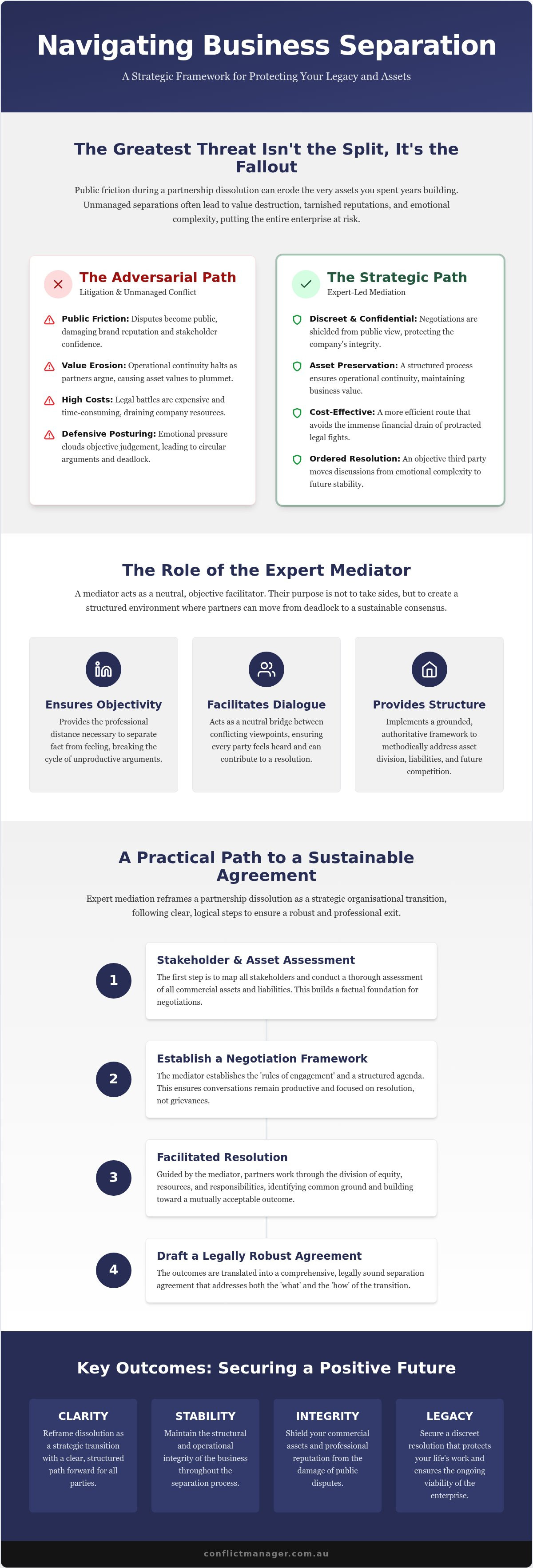
Assessment. Mapping. Finalisation. These phases form the backbone of a successful transition. The process begins with an initial assessment to gain a steady view of the current organisational friction; a necessary step when internal perspectives are clouded by the weight of responsibility. Identifying who must be involved through stakeholder mapping ensures that no critical interest is overlooked. This methodical flow moves the parties from a state of clouded complexity toward a vision of structured resolution. It requires a level of discernment that internal teams often lack when they're emotionally entangled in the outcome. Successful mediation for business separation agreement outcomes relies on this logical, phased sequence to maintain order.
Iterative drafting involves building a consensus through a series of measured facilitation sessions. Instead of attempting to solve every complexity at once, the mediator breaks the transition into manageable components. This approach maintains the collective pulse at a manageable level and prevents the decision fatigue that often leads to poor long-term choices. By the time the finalisation phase is reached, the agreement isn't just a legal necessity. It's a clear reflection of a shared, sustainable vision for the future of the enterprise. This ensures the outcome is robust, clear, and immediately actionable for all parties involved.
Preparing for the Mediation Process
Preparation is the foundation of order. You must gather essential financial and operational data without triggering further defensive posturing between partners. Establishing ground rules for professional conduct ensures the dialogue remains within a sophisticated corporate register. This environment of quiet confidence allows for the objective analysis of assets and liabilities. It prevents the sessions from devolving into a list of historical grievances. If you're ready to begin this process, our organisational conflict management services provide the steady hand needed to navigate these high-pressure environments with total objectivity.
Navigating Multi-Generational Stakeholder Interests
Heritage. Ambition. Continuity. In many Australian enterprises, the friction between founding partners and successors can stall even the most logical negotiations. Managing the expectations of family members within a family office requires a deep understanding of both psychological and structural dynamics. The final mediation for business separation agreement must respect the history of the firm while securing its future viability. This balance is achieved by ensuring that the agreement respects the legacy of the founders while providing the clarity the next generation needs to lead. It turns a potential point of fracture into a moment of structured evolution.
Conflict Manager: Facilitating Clarity through Transition
Stability. Objectivity. Resolution. Conflict Manager provides the steady hand required during periods of intense organisational friction. We recognise that the dissolution of a long-term partnership isn't merely a legal event, but a profound structural transition that impacts every level of the enterprise. For Australian businesses undergoing such change, the logic of external intervention becomes inevitable when internal efforts stall under the weight of emotional pressure. Successfully navigating a mediation for business separation agreement requires a mediator who remains unruffled by high-stakes environments, offering a grounded presence that lowers the collective pulse of all stakeholders. Our role is to act as a wise, external counsellor, viewing volatile situations with total objectivity to bring order where there is disruption.
Our focus remains firmly on organisational stability and the preservation of asset integrity. By acting as a neutral third party, we provide the discernment necessary to see through the fog of conflict. We understand the weight of responsibility that comes with managing sizable assets and family office wealth, ensuring that every transition is handled with the sophistication it deserves. Our national coverage ensures that businesses across Australia have access to expert-led facilitation that prioritises sustainable, clear outcomes over adversarial posturing.
Our Approach to Organisational Conflict
Complexity. Friction. Clarity. Our methodical flow moves stakeholders from a state of disruption toward a vision of structured resolution. We specialise in managing high-emotion situations where history and ego often threaten to derail commercial logic. This premium, bespoke service is designed for those who value a sophisticated approach to stakeholder facilitation. By maintaining professional distance, we prevent emotional entanglement while facilitating the difficult conversations that partners can no longer have alone. Our experience ensures that your transition is managed with the quiet confidence of a seasoned expert who understands both human and structural dynamics. We don't just manage the dispute; we manage the movement toward a new organisational reality.
Securing Your Professional Future
Legacy. Continuity. Evolution. Reaching a sustainable outcome is about more than just the current agreement; it's about protecting your professional reputation for years to come. We help you secure a path that respects the history of the business while providing a clear roadmap for the future. The reassurance of working with a seasoned professional who remains unruffled by volatile dynamics allows you to focus on what comes next. You can move forward with the knowledge that your exit was as professional and discreet as your entrance. Contact Conflict Manager to organise a confidential facilitation and begin the movement toward a composed, structured resolution.
Securing a Structured Future for Your Enterprise
Transition. Clarity. Legacy. A business separation is not an end, but an evolution that requires a steady hand to maintain structural integrity. By prioritising discretion and objectivity, you protect the commercial value that public litigation often consumes. Choosing mediation for business separation agreement discussions ensures that every stakeholder is heard, allowing for a resolution that respects your history while securing your future. We specialise in high-net-worth family office disputes and bring national Australian expertise to every structural conflict we facilitate.
Our neutral third-party approach ensures asset integrity remains paramount throughout the process. It's possible to navigate even the most volatile organisational friction with composure and professional discernment. If you're ready to move from complexity toward a vision of ordered resolution, request a confidential consultation with our expert mediators. You don't have to manage this transition alone. A clear and sustainable path forward is within reach.
Frequently Asked Questions
What is the primary difference between business mediation and legal arbitration?
Mediation is a facilitative process where a neutral third party helps stakeholders reach their own consensus. Arbitration, however, is adjudicative; an arbitrator hears the case and makes a binding decision for the parties. Mediation allows for more creative, bespoke outcomes that maintain commercial control. This distinction is critical for those seeking a sustainable mediation for business separation agreement that prioritises the long-term health of the enterprise over a simple win-loss outcome.
How long does a typical business separation mediation process take in Australia?
The timeframe for a business separation mediation in Australia varies based on the complexity of the organisational structure. A focused dispute might be resolved in a few sessions over a fortnight, while high-stakes family office transitions often require a more deliberate pace over several months. This methodical approach ensures that every stakeholder is heard and that the final agreement is robust enough to withstand future scrutiny and operational pressure.
Can a mediation agreement be made legally binding for a business split?
A mediation outcome becomes legally binding once it is formalised into a written deed or contract and signed by all parties. While the mediator facilitates the negotiation, the resulting document serves as a strategic roadmap for the exit. It's standard practice for partners to involve their own legal advisors to review the final terms. This ensures the mediation for business separation agreement is clear, actionable, and enforceable within the Australian legal framework.
Is mediation suitable for high-conflict business partners who are no longer speaking?
Mediation is particularly suitable for high-conflict partners because it provides a structured environment that manages interpersonal friction. The mediator can facilitate discussions through separate sessions, often called shuttle mediation, to prevent direct confrontation. This professional distance allows the parties to focus on objective commercial realities rather than emotional triggers. It ensures that even when communication has broken down, a structured and professional resolution remains possible.
How does mediation protect the value of a family office during a separation?
Mediation protects family office wealth by providing a private forum that avoids the public disclosure of sensitive financial information. By resolving disputes discreetly, families can maintain market confidence and protect their professional legacy from the damage of a public legal battle. This approach focuses on asset integrity and sustainable outcomes, allowing for the complex multi-generational interests inherent in family offices to be addressed with total objectivity.
What happens if we cannot reach an agreement through mediation?
If an agreement isn't reached, the parties can still pursue litigation or arbitration to finalise the split. Mediation is typically conducted on a "without prejudice" basis, meaning that the details of the negotiations cannot be used as evidence in future court proceedings. This confidentiality encourages partners to explore all possible options for resolution without the risk of their proposals being used against them if the process doesn't reach a conclusion.
Do we still need individual lawyers if we engage a mediator?
Individual lawyers are typically involved to provide independent advice, as a mediator does not offer legal representation. The mediator's role is to facilitate the negotiation and build a framework for consensus, while lawyers ensure their clients' specific legal interests are protected. This collaborative approach ensures the final separation agreement is both commercially viable and legally sound. It allows the mediator to remain a neutral, unruffled guide throughout the transition.
How is the cost of a business separation mediator usually shared between partners?
The cost of engaging a business separation mediator is usually shared equally between the partners. This arrangement supports the mediator's neutrality and ensures that both parties have an equal stake in the outcome. While a 50/50 split is the standard industry practice in Australia, partners may agree on a different cost-sharing structure during the initial assessment. This shared financial commitment often helps to maintain a focused and professional pace during the sessions.


