

The most expensive component of an Australian will dispute isn't the mediator's fee; it's the irreversible erosion of the estate's capital during eighteen months of adversarial litigation. Friction. Depletion. Exposure. These are the quiet thieves of a family legacy when conflict is left to the public theatre of the court system. You likely worry that legal fees will consume the very inheritance you're seeking to protect, leaving nothing but a hollow victory and fractured relationships. Understanding the cost of will dispute mediation Australia involves looking beyond the immediate invoice to the structural preservation of your assets.
It's natural to feel overwhelmed by the complexity of fee structures while managing the weight of familial grief. This guide provides a strategic breakdown of the financial components, comparative savings, and long-term value of choosing mediation over the traditional court cycle. We'll examine how private mediation packages and intake sessions function, providing you with a clear path toward a resolution that prioritises privacy and speed over public friction. While we don't provide legal representation, our focus remains on facilitating sustainable outcomes that protect the integrity of the family unit. By the end of this article, you'll have the clarity needed to manage these difficult transitions with confidence, ensuring the estate remains a source of support rather than a catalyst for financial ruin.
Key Takeaways
- Reframe the cost of will dispute mediation Australia as a strategic investment in asset integrity rather than a simple legal expense.
- Understand the primary drivers of professional fees, including the complexity of family trusts and the depth of preparation required for multi-stakeholder disputes.
- Evaluate the financial and emotional return on investment when choosing a rapid mediated settlement over a multi-year Supreme Court battle.
- Identify how the geographical spread of assets and the number of stakeholders influence the final bill while ensuring a private resolution.
- Learn how expert-led facilitation focuses on sustainable outcomes that prevent future re-litigation, though these services do not constitute legal representation.
Understanding the Investment: The Landscape of Will Dispute Mediation
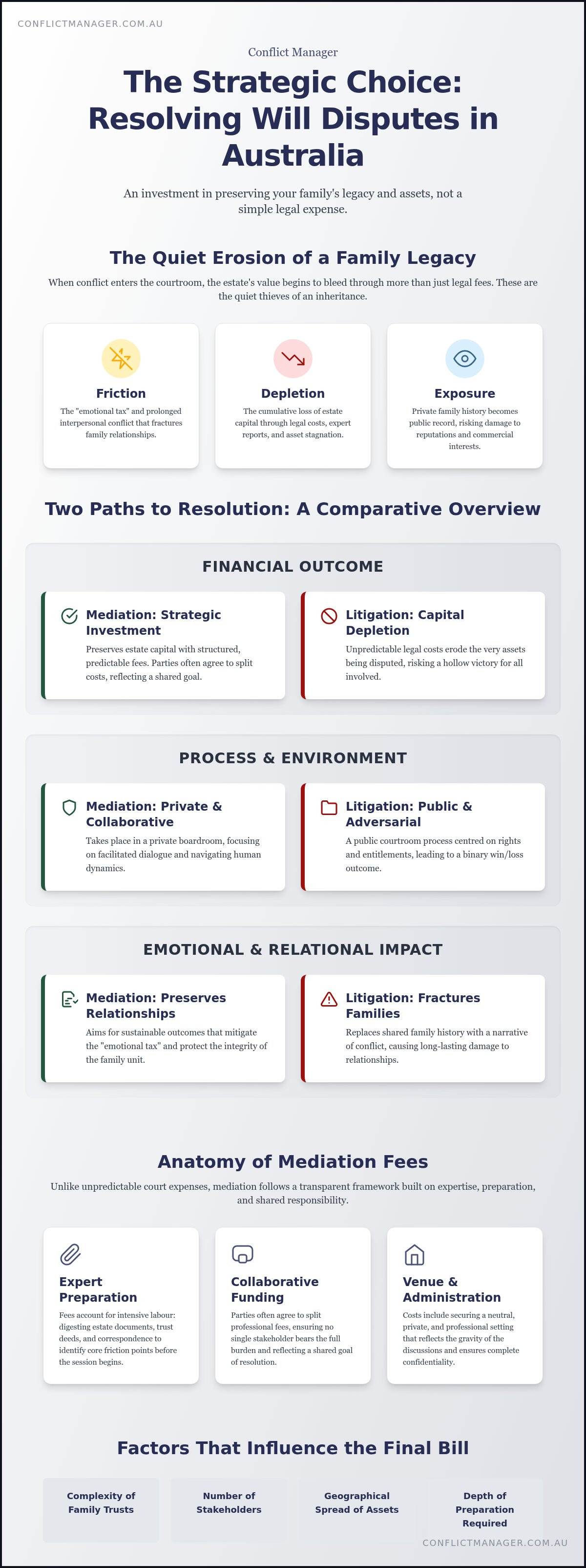
Viewing the financial outlay for resolving an estate dispute as a mere expense is a fundamental miscalculation. It's a strategic investment. High-stakes estate disagreements often trigger a reflexive move toward the courtroom, yet this path frequently leads to the depletion of the very assets at the centre of the conflict. Transitioning from adversarial litigation to a collaborative resolution model allows for the preservation of both capital and family equilibrium. This shift acknowledges that the true cost of will dispute mediation Australia involves more than professional fees; it encompasses the mitigation of the "emotional tax" that arises from prolonged interpersonal friction.
A key distinction must be made between a legal advocate and a professional mediator. While lawyers focus on rights, entitlements, and the binary outcomes of success or failure, Mediation introduces a neutral third party whose role is to facilitate dialogue and navigate complex human dynamics. We don't provide legal representation; instead, we offer a steady hand to guide stakeholders through volatile transitions. This approach brings order to chaos without the blunt force of a judicial order.
The Shift from Courtrooms to Boardrooms
Modern Australian families, particularly those managing family offices or significant private wealth, increasingly favour the boardroom over the Supreme Court. Public litigation invites scrutiny. It exposes private family history to the public record, which can damage reputations and commercial interests. Mediation provides a structured, private environment where complex asset discussions, including family trusts and overseas holdings, can occur away from the public eye. It's a pragmatic choice for those who value discretion as much as they value a fair outcome.
The Concept of Legacy Erosion
Legacy erosion is the cumulative loss of capital and trust during a dispute. When a will is contested in court, the estate's value begins to bleed through legal costs, expert reports, and the stagnation of managed assets. Beyond the ledger, there is a social erosion where the family's shared history is replaced by a narrative of conflict. Early intervention in the conflict lifecycle is essential to halt this decay. By addressing friction before it becomes entrenched, families can protect the financial and social integrity of their inheritance.
Components of Mediation Fees in Australia
Transparency. Equity. Structure. Unlike the unpredictable nature of courtroom expenses, the cost of will dispute mediation Australia typically follows a more transparent and structured framework. Parties often agree to split the professional fees, ensuring that no single stakeholder bears the full burden of the process. This collaborative approach to funding reflects the shared goal of reaching a sustainable outcome. While the official process for will disputes often leads toward a court-mandated mediation, choosing a private, expert-led path allows for greater control over the environment and the facilitator's expertise.
Professional Fees and Preparation
Expertise. Diligence. Foresight. A mediator's fee isn't merely a charge for a day's attendance. It accounts for the intensive labour required to digest voluminous estate documents, family trust deeds, and historical correspondence. Seniority matters in this context. A seasoned professional unruffled by high-stakes environments brings a level of discernment that a generalist lacks. They spend significant time in preliminary conferences, identifying the underlying structural and psychological friction points before the parties ever meet.
Thorough preparation is the foundation of a successful resolution. It allows the mediator to understand the nuances of the succession dynamics and the specific movement of assets within the estate. Opting for a low-cost, surface-level mediation often results in fragile agreements that fail under the slightest pressure. Investing in thorough preparation ensures that the resolution is durable and clear, preventing the need for future re-litigation.
Venue and Administrative Disbursements
Neutrality. Privacy. Order. High-net-worth stakeholder facilitation requires a setting that reflects the gravity of the situation. Neutrality is essential. Professional dispute resolution centres provide a secure, orderly environment where parties can engage without the emotional triggers of a family home or the intimidating atmosphere of a law firm's office. Disbursements typically cover venue hire, catering, and administrative support. These components are not luxuries; they are tools that maintain the methodical flow of the day.
Orderly environments foster calm, objective discussions. Administrative support ensures that the process remains methodical, allowing the facilitator to focus entirely on the human and structural dynamics at play. If you are seeking to manage high-emotion situations with composure, engaging an expert for family conflict resolution can provide the steady hand necessary for a successful transition. This approach ensures that all participants feel heard within a balanced, premium environment that respects the privacy of the family office.
Mediation vs Litigation: A Financial and Emotional ROI
Exposure. Attrition. Uncertainty. These are the hallmarks of a contested Supreme Court matter. When a family chooses litigation, they enter a process where the financial burn rate is both relentless and unpredictable. The cost of will dispute mediation Australia represents a controlled investment, whereas litigation often feels like an open-ended drain on the estate's capital. Choosing a path of facilitated dialogue over a judicial hearing isn't just about saving money; it's about protecting the structural integrity of the family's wealth and well-being.
The Financial Burn Rate of Litigation
In a contested estate matter, legal fees aren't static. Barrister fees, solicitor hours, and expert reports accumulate rapidly, often escalating into significant six-figure sums before a trial even commences. There's also the looming risk of "costs orders," where the court may mandate that the unsuccessful party pays the legal bills of their opponent. This creates a volatile environment where the potential for loss extends far beyond the inheritance itself. Mediation offers a measure of fixed-cost certainty. It allows stakeholders to ring-fence their expenses and focus on a pragmatic resolution rather than the spiralling costs of a public battle.
The Time-Value of Resolution
Time is a finite asset that litigation consumes greedily. A resolution achieved today holds significantly more structural value than a potentially higher settlement reached after three years of legal attrition. For estates involving family-owned businesses or complex trusts, stagnation is a significant threat. Assets frozen in a legal vacuum can't be reinvested, managed, or transitioned effectively. Speed is particularly vital when elderly or vulnerable beneficiaries are involved. Reducing the duration of high-stress periods allows these individuals to find closure and security sooner.
Opportunity. Liquidity. Finality. These outcomes are rarely found in a courtroom. Litigation carries the persistent risk of appeals, which can restart the cycle of delay and expense even after a judgment is handed down. Mediation provides a definitive conclusion. Once an agreement is reached and documented, the process ends. This finality allows the estate to be distributed, enabling the family to move forward with their lives and their legacy intact. By prioritising a swift, mediated settlement, you're choosing to value the future over a prolonged and painful examination of the past.
Factors that Influence the Final Mediation Bill
Complexity. Volume. Friction. The cost of will dispute mediation Australia is not a static figure; it scales according to the specific structural and psychological dynamics of the estate. While the process offers a more predictable financial path than litigation, several variables determine the final investment required to reach a sustainable resolution. Recognising these factors early allows stakeholders to manage their expectations and resources with greater precision. We focus on providing a steady hand through these volatile transitions, ensuring that the process remains methodical regardless of the scale of the dispute.
Interpersonal friction plays a significant role in the resource allocation for a successful mediation. When emotions are high, or trust has completely eroded, the mediator may need to conduct extensive pre-mediation coaching or separate intake sessions. These sessions are essential for stabilising the environment before a joint discussion occurs. They ensure that when parties finally meet, the dialogue remains objective and focused on the future rather than becoming entangled in past grievances. The duration of the engagement also fluctuates. While many disputes find resolution in a single day, complex multi-generational conflicts may require a series of facilitated sessions to address every layer of the disagreement.
Stakeholder Volume and Complexity
Disputes involving multiple siblings, blended family claimants, or distant beneficiaries naturally increase the preparation time required. Each participant brings a unique perspective and a set of competing interests that must be mapped and understood before the mediation begins. Managing the logistics of diverse stakeholders requires a sophisticated approach to facilitation. Our role is to align these disparate family goals, moving the group toward a shared vision of resolution that respects the integrity of the family office. The more voices at the table, the more intensive the pre-mediation phase becomes to ensure every perspective is heard without derailing the process.
The State of Documentation and Disclosure
Transparency. Clarity. Efficiency. The condition of the estate's records is perhaps the most significant tool for managing the cost of will dispute mediation Australia. When family trusts, overseas holdings, and asset registers are organised and readily available, the time required for mediator review is significantly reduced. Conversely, hidden conflict often emerges during the discovery phase when documentation is incomplete or obscured. This lack of transparency creates friction and delays, as the neutral third party must spend additional time unearthing the structural reality of the estate. Providing clear, comprehensive disclosure at the outset is the most effective way to ensure the process remains efficient and focused on the resolution rather than the investigation. If you're managing a complex transition, engaging an expert for stakeholder facilitation can help navigate these intricacies with composure and authority.
The Conflict Manager Approach: Strategic Value Beyond the Invoice
Objectivity. Discernment. Composure. At Conflict Manager, we view the cost of will dispute mediation Australia through a lens of long-term structural integrity rather than immediate billable hours. While process-followers focus on the mechanics of a meeting, our approach is that of a seasoned external counsellor. We aren't a law firm and don't provide legal representation. Instead, our focus remains on the human and structural dynamics of the dispute. We understand that the weight of responsibility in a family office environment requires a steady hand capable of viewing volatile situations with total objectivity. By lowering the pulse of high-emotion disputes, we ensure that decisions are made with clarity rather than reactive friction.
Guiding the Transition with Composure
High-stakes environments demand a specific type of presence. When organisational friction threatens to derail a succession plan, our role is to provide order. We remain unruffled by the interpersonal dynamics that often cloud the vision of those directly involved. High-net-worth families trust this level of professional detachment. It allows us to act as a neutral third party, navigating difficult transitions without becoming emotionally entangled. This structural stability is a key component of the value we provide. It ensures that the resolution process remains methodical and logical from inception to conclusion.
Achieving Sustainable Outcomes
A legal settlement is often a binary outcome; a genuine resolution is a sustainable one. Sustainability in this context means an agreement that survives the test of time and the inevitable shifts in family dynamics. We focus on outcomes that prevent future re-litigation by addressing the root causes of conflict rather than just the surface-level claims. This prevents the legacy erosion that occurs when families are trapped in a cycle of legal attrition. Our commitment to Preserving Family Legacy through Expert Mediation ensures that the estate remains a source of support for future generations. When calculating the total cost of will dispute mediation Australia, the most significant saving is the prevention of future legal battles. If you're ready to protect your estate from the friction of unresolved disputes, we invite you to Enquire about our professional mediation services.
Strategic Resolution for the Family Estate
Privacy. Speed. Stability. These are the dividends of a strategic resolution. The decision to move away from adversarial litigation is a commitment to the future of your family estate. By prioritising confidentiality, you avoid the legacy erosion that often defines a multi-year court battle. The cost of will dispute mediation Australia is best understood as a safeguard for your capital and your relationships. It replaces the persistent uncertainty of a judicial order with a structured, collaborative outcome.
Our approach at Conflict Manager focuses on providing a steady hand through these volatile transitions. We don't provide legal representation; instead, we offer the objectivity needed to lower the pulse of high-emotion disputes and achieve sustainable outcomes. You can protect your family's structural integrity and find a path toward order. Secure a composed resolution for your family estate. Clarity is possible, and a peaceful transition is well within your control.
Frequently Asked Questions
Is the cost of mediation usually paid by the estate in Australia?
In many Australian estate disputes, the court has the discretion to order that the reasonable costs of mediation be paid from the deceased's estate. This is particularly common in successful family provision claims. However, it's not an absolute rule. If a party's conduct is deemed unreasonable or the claim is without merit, they may be ordered to bear their own expenses. Parties often agree to split the mediator's fee as a gesture of good faith.
How much does a private mediator cost per day for a will dispute?
Private mediator fees vary based on the practitioner's seniority and the complexity of the estate. Rather than a simple daily rate, the total investment typically covers intensive preparation, preliminary conferences, and the mediation session itself. For high-net-worth families, the value lies in the mediator's ability to navigate complex family trusts and multi-generational dynamics with composure. This structured approach ensures the resolution is durable, preventing the far higher expense of future re-litigation.
What happens if we attend mediation but don’t reach an agreement?
If an agreement isn't reached, the parties remain free to proceed to a court hearing. The mediation process is conducted on a "without prejudice" basis, meaning discussions and offers made during the session cannot be used as evidence in court. While a non-agreement may feel like a setback, it often clarifies the core issues in dispute. This clarity can lead to a settlement later in the litigation cycle, before a final trial commences.
Can I include the cost of my solicitor in the mediation settlement?
Yes, legal fees are a central component of settlement discussions. When calculating the cost of will dispute mediation Australia, parties usually negotiate how solicitor and barrister fees will be covered. A common outcome is for a portion of these costs to be paid from the estate as part of the overall agreement. This allows beneficiaries to understand their net inheritance clearly once all professional fees and disbursements have been settled.
Are mediation fees tax-deductible for family trusts or estates?
The tax deductibility of mediation fees depends on the specific nature of the dispute and the structure of the estate or family trust. Generally, costs incurred in defending a legacy or resolving capital distribution issues are considered capital in nature rather than operating expenses. However, if the dispute involves the ongoing income-producing capacity of a trust, the situation may differ. We recommend consulting with a qualified tax professional to determine the specific implications.
How does the cost of a private mediator compare to a court-appointed one?
Court-appointed mediators, such as Deputy Registrars, are often available at a lower cost, but they operate within a rigid judicial schedule. This can lead to significant delays during periods of high court volume. Private mediation is a premium alternative that offers immediate availability and a bespoke environment. For families managing sizable assets, the investment in a private expert provides the privacy and specialised facilitation necessary to protect the family's reputation and asset integrity.
Is mediation mandatory before a will dispute can go to the Supreme Court?
Mediation is effectively mandatory in the majority of Australian jurisdictions. Supreme Courts usually issue orders requiring parties to attend mediation before a matter is permitted to proceed to a final trial. This requirement reflects the judicial system's preference for collaborative resolution over adversarial litigation. Engaging in the process early, rather than waiting for a court order, can significantly reduce the total cost of will dispute mediation Australia by avoiding months of unnecessary legal attrition.
What is the "hidden cost" of not choosing mediation for an estate dispute?
The most significant hidden cost is legacy erosion. When a dispute remains unresolved, the estate's capital is often stagnant, unable to be reinvested or transitioned effectively. Beyond the financial ledger, there is a profound "emotional tax" on family members, leading to fractured relationships that may never recover. Public litigation also risks exposing sensitive family office details to the public record, potentially damaging the family's social standing and commercial interests for years to come.


