

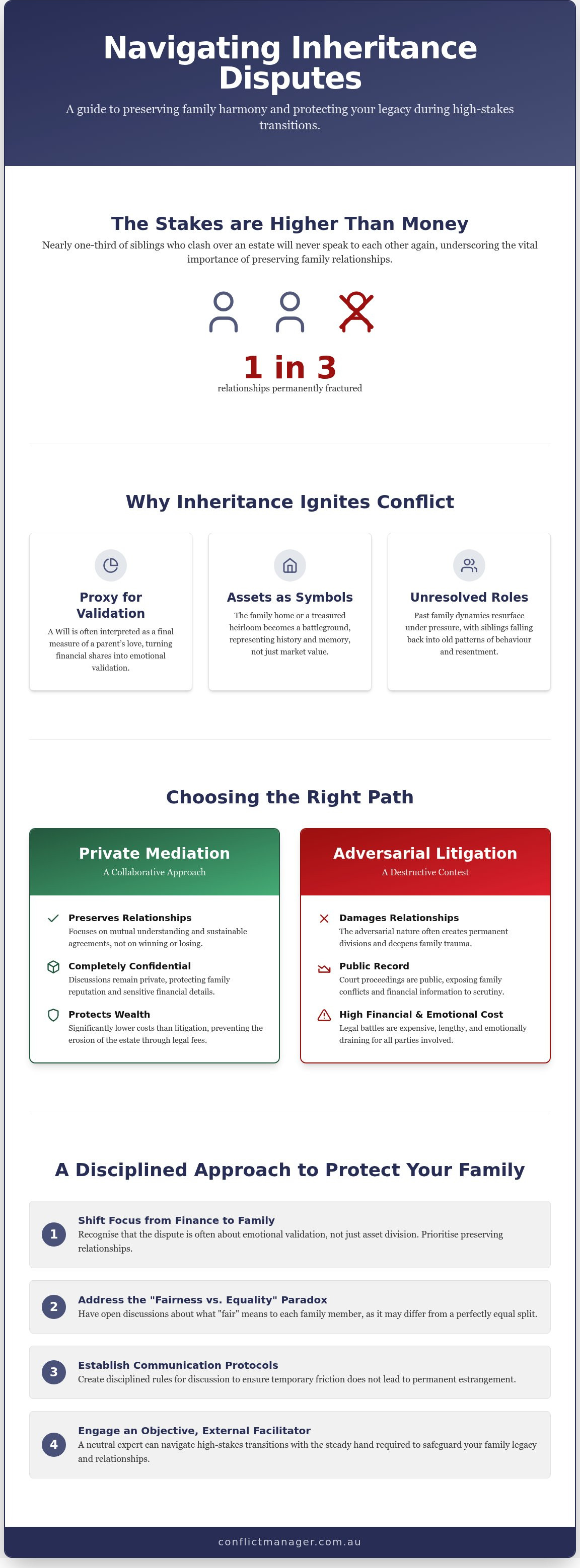
Did you know that nearly one-third of siblings who clash over an estate will never speak to each other again? This sobering reality underscores the vital importance of preserving family relationships during inheritance disputes. Grief. Friction. Uncertainty. When the emotional weight of loss meets the structural complexity of asset division, the resulting pressure often fractures even the most resilient bonds. You likely feel the mounting stress of adversarial posturing and the quiet anxiety of watching family wealth erode through mounting legal fees.
It's a difficult position to be in, but you don't have to choose between your inheritance and your family. This article explores how to navigate these sensitive transitions with a composed, methodical approach that protects the family unit. We'll examine the logic of external facilitation and structured resolution, providing you with a roadmap to secure a sustainable agreement that avoids the trauma of a courtroom. By shifting the focus from conflict to legacy, you can protect both your financial interests and the emotional bonds that truly define your family.
Key Takeaways
- Recognise that inheritance often serves as a proxy for emotional validation, requiring a deliberate shift from financial ledger balancing to relational preservation.
- Address the "fairness versus equality" paradox inherent in complex family office structures to maintain both asset integrity and multi-generational harmony.
- Opt for private, expert-led mediation to mitigate the high financial and emotional costs associated with adversarial litigation in public courtrooms.
- Establish disciplined communication protocols as a foundation for preserving family relationships during inheritance disputes, ensuring that temporary friction does not lead to permanent estrangement.
- Learn the value of engaging an objective, external facilitator to navigate high-stakes transitions with the steady hand required to safeguard your family legacy.
The Emotional Landscape: Why Inheritance Triggers Deep Family Conflict
Grief. Identity. Legacy. These forces collide when an estate is settled, transforming a financial transaction into a battleground of historical grievances. While the law focuses on assets, beneficiaries often view inheritance as the final measure of a parent’s affection. This perception turns a Will into a proxy for validation, where a smaller share is interpreted as a lack of love. External influences, such as in-laws or spouses, frequently escalate this internal friction by introducing defensive postures that siblings might otherwise avoid. In Australia, the cultural "fair go" principle often complicates matters; everyone agrees on fairness, yet few agree on its definition. One sibling might value equal distribution, while another believes their years of local caregiving merit a larger portion. Understanding these deep-seated triggers is the first step toward preserving family relationships during inheritance disputes.
The Psychology of the Beneficiary
Entitlement. Contribution. Identity. The psychological weight of an inheritance can be staggering for those unprepared for the shift in status. Beneficiaries often struggle with the "entitlement versus contribution" debate, particularly when one child has provided significant care for an elderly parent while others remained distant. These unresolved childhood roles frequently resurface, as the "responsible one" or the "black sheep" falls back into old patterns of behaviour. When families have a history of conflict, understanding dysfunctional family dynamics helps identify why these interactions become so volatile. The sudden influx of wealth can also destabilise an individual’s sense of self, leading to defensive actions that prioritise personal security over collective harmony.
When Assets Become Symbols
Sentiment. Structure. Value. Assets are rarely just numbers on a balance sheet; they are physical manifestations of a family’s history. The family home often becomes the primary site of contention, representing both a significant financial asset and a repository of childhood memories. While one sibling may wish to retain the property for its sentimental weight, another may require its liquidation for liquidity. High-net-worth structures, such as family offices or private ancillary funds, can inadvertently create a divide between those involved in the management and those who feel like mere observers. Distinguishing between the market value of an heirloom and its emotional gravity is a critical step in de-escalating the conflict before it reaches a point of no return.
Identifying the Structural Friction in High-Net-Worth Wealth Transfer
Wealth. Structure. Paradox. High-net-worth transfers are rarely simple distributions of cash; they involve complex webs of Family Trusts, private ancillary funds, and closely held businesses. The "Fairness vs. Equality" paradox often sits at the heart of these disputes. While a parent might intend for an equal split, the reality of a family business creates a sharp divide between active and passive beneficiaries. One sibling manages the daily operations and growth, while the other remains a silent stakeholder. Without clear governance, the passive beneficiary may feel sidelined, while the active manager resents the drain on capital. Preserving family relationships during inheritance disputes hinges on addressing these structural imbalances before they become irreconcilable. When governance structures are ambiguous, they invite opportunistic disputes that can erode both family wealth and social standing.
The Complexity of the Family Office
Authority. Transition. Liquidity. The transition of power from the founding generation to the rising generation is a period of extreme vulnerability. Family offices often rely on professional trustees to maintain order, yet these figures can inadvertently become lightning rods for family tension. If a trustee is perceived as favouring one branch of the family, the resulting friction can paralyse decision-making. The challenge lies in maintaining asset integrity while satisfying the diverse liquidity needs of individual members. Maintaining these bonds is difficult when structural friction occurs, but preserving family relationships during inheritance disputes is achievable when the focus shifts from individual gain to the health of the entire lineage. Engaging in professional stakeholder facilitation can provide the objectivity needed to bridge these gaps and restore a sense of collective purpose.
Common Structural Triggers
Ambiguity. Expectation. Silence. Friction frequently arises when "letters of wishes" contradict formal legal deeds. These informal guides, intended to provide nuance, often create legal grey areas that opportunistic parties can exploit. When distributions are unequal based on past support or perceived need, the lack of transparency during the planning phase ensures that these decisions are met with shock rather than understanding. Open communication is the only antidote to the suspicion that thrives in the absence of data. Without a clear framework for wealth transfer, the vacuum of information is filled by historical sibling rivalries and the influence of external stakeholders who may not have the family's best interests at heart.
Choosing the Right Path: Mediation vs. Adversarial Litigation
Privacy. Autonomy. Discretion. When an inheritance dispute escalates, families face a binary choice: the public friction of the courtroom or the private precision of mediation. Adversarial litigation is often a war of attrition. The financial burn rate is significant, but the emotional cost is frequently higher. For high-net-worth families, the risk of publicity is a major deterrent. Open courtrooms create public records of private grievances, potentially damaging the family's reputation for generations. A "legal win" in this environment is often a pyrrhic victory. It secures the asset but destroys the lineage. Preserving family relationships during inheritance disputes requires a path that prioritises the family's long-term health over short-term legal dominance.
The Mechanics of Professional Mediation
Mediation offers a structured alternative that focuses on lowering the collective pulse of the family. A neutral third party creates a safe environment where stakeholders can speak without the filter of aggressive legal posturing. This process allows for creative solutions, such as bespoke buy-outs or shared usage agreements for sentimental properties, that a judge simply cannot order. By moving from rigid "positions" to underlying "interests", families find common ground that preserves the structural integrity of the estate. This methodical approach ensures that every voice is heard, reducing the sense of marginalisation that often fuels further conflict.
Why Litigation Often Fails the Family
Litigation is designed to find a winner, not a resolution. This "winner-take-all" mentality is the primary driver of permanent family estrangement. Aggressive correspondence from solicitors often acts as a series of legal grenades, shattering whatever trust remains between siblings. While a court order provides a final decision, it rarely addresses the root causes of the friction. Without addressing the underlying emotional dynamics, the settlement often feels like a forced truce rather than a sustainable peace. True resolution requires a process that respects the complexity of human dynamics, something the blunt instrument of the law is not equipped to provide. Choosing mediation is an act of composed authority, signalising that the family legacy is too valuable to be left to the discretion of a stranger in a wig.
Practical Strategies for Maintaining Relational Integrity
Discipline. Restraint. Protocol. Preserving family relationships during inheritance disputes requires more than just goodwill; it demands a rigorous commitment to communication boundaries. One of the most effective strategies is the immediate cessation of "legal grenades." These are the provocative, late-night emails or text messages designed to score an emotional point rather than solve a structural problem. Implementing a strict "Twenty-Four Hour Rule" for all correspondence ensures that responses are measured and objective. By separating the "problem" from the "person," stakeholders can address the complexities of the estate without attacking the character of their siblings. It's about viewing the dispute as a shared challenge to be managed, not a battle to be won.
Focus. Legacy. Unity. Centring discussions on the legacy of the deceased often provides the unifying objective needed to break a deadlock. Most parents don't intend for their hard-earned wealth to become the catalyst for family collapse. Reminding each other of this shared history can lower the collective pulse and refocus the group on the bigger picture. It’s a way of honouring the past while securing the future. When the family’s reputation and emotional health are placed at the centre of the negotiation, the financial details often become easier to organise.
De-escalating High-Emotion Conversations
Validation. Empathy. Silence. High-emotion conversations often derail because participants feel unheard or marginalised. Using "I" statements allows a sibling to express their needs without assigning blame. For example, saying "I feel anxious about the timeline for the sale" is far more productive than accusing another of rushing the process. Active listening serves as a powerful tool to validate a sibling’s perspective. It doesn't mean you agree with their conclusion, but it shows you value their voice. When tension reaches a boiling point, a "strategic pause" is essential. Stepping away from the table prevents the kind of verbal blow-ups that lead to permanent estrangement.
Building a Framework for the Future
Structure. Governance. Continuity. Resolution is not a single event; it's a new way of operating. Drafting a "Family Charter" provides a clear set of rules for future interactions and the shared use of inherited assets. This document acts as a relational constitution, defining what "fairness" looks like for your specific lineage through a collective exercise. Scheduling regular, facilitated check-ins ensures the agreement remains sustainable and that minor frictions don't fester. If your family is struggling to build this framework, engaging in professional Family Conflict Resolution can provide the steady hand needed to guide these delicate negotiations.
Restoring Order: The Role of Professional Facilitation
Order. Clarity. Resolution. When internal efforts to settle an estate reach a stalemate, the intervention of a neutral third party becomes a necessity rather than an option. High-stakes disputes often generate a level of noise that makes rational discussion impossible. Unlike legal advocates who are duty-bound to fight for a single client’s advantage, a professional facilitator focuses on the health of the entire family system. This shift in perspective is vital for preserving family relationships during inheritance disputes. The Conflict Manager approach brings a sense of composed authority and quiet confidence to the table. It's about moving the group from a state of reactive disruption toward a vision of structured resolution. By acting as a steady hand, a facilitator ensures that the friction of the present moment does not permanently tarnish the family’s long-term legacy.
The Value of Total Objectivity
Insight. Discernment. Integrity. A neutral third party identifies the emotional blind spots that family members are often too close to see. When siblings are entangled in historical rivalries, they frequently misinterpret neutral actions as hostile ones. A facilitator remains unruffled by these dynamics, viewing volatile situations with total objectivity. They provide the professional perspective required to achieve clarity when internal discussions have reached an impasse. This steady hand is essential for navigating high-stakes transitions where the structural integrity of the estate and the emotional health of the beneficiaries are equally at risk. Total objectivity allows for the identification of shared interests that would otherwise remain obscured by the fog of conflict.
Next Steps for Your Family
Assessment. Initiative. Transition. Deciding whether your family is ready for professional facilitation involves looking at the current communication flow. If legal correspondence has replaced direct dialogue, the time for intervention has arrived. Proposing mediation to other beneficiaries is not a sign of weakness; it is a strategic move that signalises a commitment to the family’s survival. It suggests that you value the lineage more than the immediate conflict. Taking this step moves the family away from adversarial posturing and toward a sustainable, structured future where order is restored. To begin this journey and protect your family’s emotional and financial wealth, you can Enquire about Family Conflict Resolution with Conflict Manager. This path ensures that the resolution is as durable as the legacy it seeks to protect.
Securing Your Family’s Future Through Composed Resolution
Inheritance is a transition of identity as much as it is a transfer of assets. Success is measured by the family’s survival, not just the final split of the ledger. By addressing the psychological drivers of conflict and the structural friction inherent in high-net-worth estates, you can navigate these periods of disruption with precision. Choosing mediation over the public friction of a courtroom is a decisive step toward preserving family relationships during inheritance disputes. It's about prioritising sustainable, creative agreements that a judge simply cannot provide.
Conflict Manager specialises in the complex dynamics of multi-generational family offices. We provide a composed, neutral approach to high-emotion disputes, focusing on asset integrity and the relational health of your lineage. Our goal is to move your family from a state of reactive stress toward a vision of structured order. We act as a steady hand, ensuring that your wealth serves as a foundation for the future rather than a catalyst for estrangement.
Restore clarity to your family legacy with expert mediation. You have the power to safeguard your bonds and ensure that your family’s reputation remains intact for generations to come. With the right facilitation, you can find a path forward that honours the past while securing the future.
Frequently Asked Questions
Is it possible to resolve an inheritance dispute without going to court?
It's entirely possible to resolve these matters outside of a courtroom through professional facilitation. Most families find that structured mediation allows for more flexible and creative outcomes than a judge could ever order. This path is essential for preserving family relationships during inheritance disputes because it avoids the public friction of litigation. By focusing on stakeholder interests rather than rigid legal positions, you can reach a sustainable agreement that protects both the assets and the lineage.
What is the difference between an estate lawyer and a family mediator?
An estate lawyer acts as an advocate for a single party, focusing on securing the best legal outcome for their client. In contrast, a family mediator is a neutral third party who facilitates communication between all beneficiaries. While lawyers manage the legalities, a mediator manages the human dynamics and structural friction. This objective approach ensures that the resolution process remains balanced and focused on the collective health of the family rather than a winner-take-all result.
How long does the mediation process typically take for a family office dispute?
The duration of the process depends on the complexity of the assets and the depth of the friction. Most family office disputes can be resolved within a few weeks or months of active facilitation. This is significantly faster than the years often required for a matter to move through the Australian court system. A methodical approach ensures that while the process is efficient, it remains thorough enough to address the underlying emotional and structural issues.
Can mediation work if my siblings and I are no longer on speaking terms?
Mediation is specifically designed for high-emotion situations where communication has broken down. You don't need to be on speaking terms to begin the process; the mediator acts as the bridge that restores a sense of order. By establishing strict communication protocols and managing separate sessions if necessary, a facilitator can guide the family toward a resolution without the need for direct, volatile confrontation. This structured environment helps de-escalate tension and rebuilds a foundation for future interaction.
Who pays for the cost of professional conflict resolution in an estate matter?
The payment structure varies depending on the family's specific situation. In many cases, the costs are covered by the estate itself as a necessary expense of administration. Alternatively, beneficiaries may agree to split the fees equally to ensure everyone has an equal stake in the outcome. This shared investment often reinforces a commitment to reaching a sustainable agreement. It’s a pragmatic way to protect family wealth from being eroded by the high costs of adversarial litigation.
What happens if we reach an agreement in mediation but someone changes their mind later?
Agreements reached during mediation are typically documented in a Heads of Agreement or a similar formal record. While the mediation process itself is confidential, the resulting document can be made legally binding through the involvement of your respective legal advisors. This ensures that the resolution is durable and provides a clear framework for future governance. A well-facilitated process addresses potential objections early, reducing the likelihood of a party withdrawing their support later.
How do we protect the privacy of our family assets during a dispute?
Privacy is one of the primary benefits of choosing mediation over the public courtroom. All discussions and financial disclosures made during the facilitation process remain strictly confidential. This is particularly important for high-net-worth families who wish to keep their asset structures and internal friction out of the public record. Preserving family relationships during inheritance disputes is much easier when the details of the disagreement aren't accessible to external parties or the media.
Can a mediator help us rewrite a Will that feels unfair?
A mediator cannot physically rewrite a Will, as that is a legal function. However, they can facilitate a discussion that leads to a Deed of Family Arrangement. This is a documented agreement where all beneficiaries consent to alter the distribution of the estate to achieve a more equitable outcome. This process allows the family to correct perceived unfairness while maintaining asset integrity. It’s a collaborative way to ensure the final distribution reflects the family’s current needs.


