

Legacy. Stewardship. Friction. With an estimated $3.5 trillion in assets set to change hands across Australia by 2050, why do so many families find themselves fractured by the very prosperity they worked to build? It's a difficult reality that the "Bank of Mum and Dad" often creates more resentment than relief, especially when Baby Boomer values clash with Millennial expectations. You likely understand that intergenerational wealth conflict is rarely just about the money; it's about the deep-seated fears of losing both hard-earned assets and family harmony.
This article offers a path toward resolving these complex interpersonal frictions through structured facilitation and neutral expertise. We'll examine how to achieve a stable transition of assets, even amidst shifting tax landscapes and superannuation complexities, while restoring the communication necessary to ensure your legacy survives well beyond the final balance sheet. By moving from a state of disruption toward a vision of structured resolution, you can protect the structural integrity of your family's future.
Key Takeaways
- Structure. Governance. Limitations. Understand why legal frameworks are often insufficient to manage the complex interpersonal dynamics triggered by a significant wealth transfer.
- Identity. Control. Friction. Identify how the "Founder’s Shadow" and differing generational values fuel intergenerational wealth conflict, moving beyond financial metrics to address root psychological causes.
- Silence. Absence. Disengagement. Detect the subtle early warning signs of organisational friction, including the transition from open dialogue to information siloing among key family stakeholders.
- Mediation. Integrity. Stability. Evaluate the benefits of neutral facilitation over legal litigation as a means to protect asset integrity while maintaining the long-term stability of the family unit.
The Great Australian Wealth Transfer and the Friction of Inheritance
Abundance. Transition. Friction. Australia stands at the threshold of a monumental shift in capital, with an estimated $3.5 trillion in assets projected to move between generations by 2026. This transfer represents more than a simple change in ownership; it signifies a profound restructuring of family dynamics and financial responsibility. While previous generations often passed down residential property, the current landscape involves intricate diversified portfolios, private equity, and complex family businesses. This shift requires a level of sophistication and communication that many families haven't yet developed.
The "Bank of Mum and Dad" has evolved. What was once viewed as a generous leg-up into the property market has, for many, become a source of structural tension. When financial support comes with unstated expectations or perceived control, it creates a psychological debt. This often manifests as intergenerational conflict, where the desire for autonomy among successors clashes with the founder's need for security and legacy. Within this environment, intergenerational wealth conflict is rarely a disagreement over numbers; it's a collision of values and identities that can destabilise even the most robust financial structures.
The Scale of the 2026 Wealth Transition
The sheer volume of wealth moving from Baby Boomers to Gen X and Millennials is unprecedented. In the current Australian economic climate, where property prices and living costs remain high, there's a palpable impatience around inheritance that can strain even the most stable relationships. The family office, once viewed as a shield for protecting assets, can quickly become a lightning rod for dispute if roles and expectations aren't clearly defined. We see this when information is siloed or when the next generation feels excluded from the decision-making processes that will eventually govern their lives.
The High Cost of Unresolved Friction
Unmanaged friction carries a heavy "conflict tax." This isn't merely an abstract concept. It manifests as substantial legal fees, the forced liquidation of assets that might have otherwise grown, and the loss of business continuity. The emotional toll is equally devastating. When disputes reach the point of litigation, the damage to the family unit is often permanent. Intergenerational wealth conflict is a direct threat to both the preservation of family legacy and the long-term integrity of capital.
Why Intergenerational Wealth Conflict Occurs: Identity, Control, and Expectation
Control. Identity. Validation. For many who have built a significant enterprise from the ground up, the business isn't just an asset; it's an extension of their very self. This "Founder’s Shadow" makes the act of relinquishing authority feel like a surrender of purpose. When a patriarch or matriarch continues to micromanage from the boardroom long after a formal handover, it sows the seeds of intergenerational wealth conflict. Successors feel patronised, while founders feel their life's work is at risk in less experienced hands. It's a delicate balance that requires a steady hand to navigate.
Beyond the boardroom, divergent values often create a chasm between generations. Baby Boomers may prioritise capital preservation and traditional growth, whereas Millennials frequently lean toward social responsibility and impact investing. These differences aren't merely stylistic; they represent fundamental disagreements on what wealth is actually for. Without transparency, families fall into the "silent expectation" trap. Assumptions about who will take over specific roles or how assets will be divided lead to inevitable friction when reality fails to meet those unvoiced hopes. Industry data highlights that communication breakdowns are among the most significant challenges faced by Australian families during wealth transitions.
Identity and the Loss of Professional Purpose
The transition from "operator" to "benefactor" is psychologically taxing. Many Australian business owners have spent decades as the primary decision-maker. Stepping into a role of governed oversight requires a shift in identity that many aren't prepared for. This lack of professional purpose often leads to defensive behaviours. What looks like financial micromanagement to a successor is often just the founder's attempt to remain relevant in a world that's moving on. Recognising this psychological weight is the first step toward restoring order.
The Competence Gap and the "Flight Risk"
Friction also arises from a perceived gap in financial literacy. Some industry professionals report that a vast majority of next-generation heirs switch wealth managers almost immediately after receiving their inheritance. This "flight risk" often stems from a lack of engagement during the planning phase. When the younger generation is excluded from decision-making, they don't develop the competence or the loyalty required to maintain the existing family office structure. Transitioning from active management to a more collaborative model of stakeholder facilitation can help bridge this gap before the friction becomes an irreparable fracture.
Beyond the Trust Deed: Relational vs Structural Conflict Management
Governance. Documents. Dialogue. A common misconception in estate planning is that a robust legal structure is a vaccine against dispute. It isn't. While Wills and Trust Deeds define the distribution of assets, they are silent on the emotional complexities that arise when those assets change hands. Relying solely on structural solutions to address relational friction is a strategic oversight. It treats a human transition as a technical transaction, often ignoring the simmering resentments that legal paperwork cannot resolve.
Structural integrity in a family business is inextricably linked to the emotional stability of its stakeholders. When the focus remains entirely on the "what" of inheritance rather than the "how" of communication, the risk of intergenerational wealth conflict increases. Effective management requires a dual approach. You must maintain the legal skeleton while nurturing the relational pulse that keeps the family unit functioning. Without this balance, the most sophisticated trust structure remains vulnerable to internal collapse.
The Limits of Legal Representation
The Australian legal system is inherently adversarial. It's designed to produce a winner and a loser, a binary outcome that is often catastrophic for high-net-worth families. When intergenerational wealth conflict enters a courtroom, the focus shifts from preservation to litigation. This environment encourages the hardening of positions rather than the softening of hearts. A legal victory in court often signals a permanent defeat for the family's relational health. The public nature of court proceedings also risks exposing private family offices to unnecessary scrutiny, damaging the reputation the founder worked to build.
Implementing a Governance Framework
True stability requires moving beyond the static nature of legal deeds toward a dynamic governance framework. This involves the creation of a family constitution; a living document that outlines values, roles, and clear paths for dispute resolution. By establishing a formal Family Council, stakeholders can engage in facilitated dialogue before friction escalates into a crisis. This shift transitions the family office from a personality-led entity, dependent on the founder's whims, to a process-led organisation. It provides a "safe container" where grievances are aired with objectivity and composure, ensuring the legacy survives the transition.
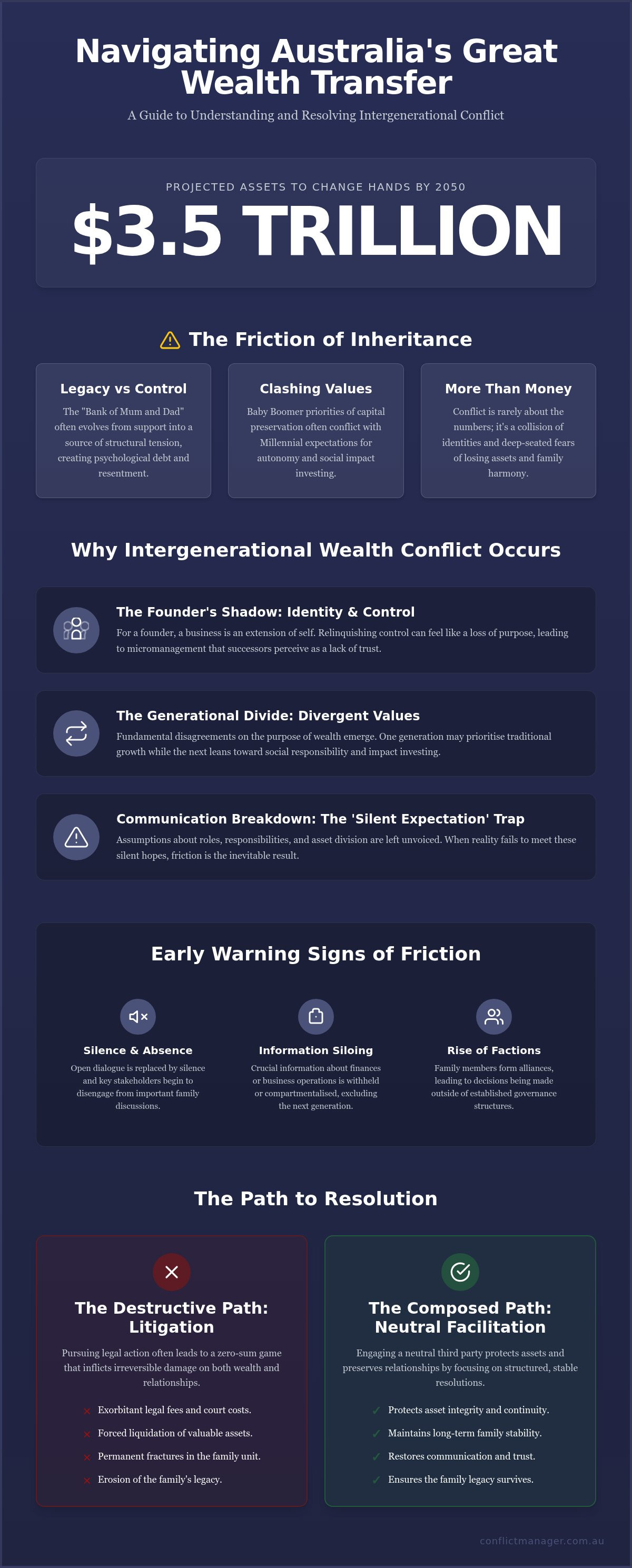
Identifying the Early Warning Signs of Family Office Friction
Silence. Evasion. Fragmentation. While the flashpoints of intergenerational wealth conflict often seem sudden, they're usually the culmination of subtle, unaddressed shifts in behaviour. Recognising these early warning signs is essential for preserving the structural integrity of a family office before the friction becomes a full-scale crisis. One of the most common indicators is the transition from open, collaborative dialogue to "information siloing." When family members begin withholding data or creating exclusive pockets of knowledge, it suggests a breakdown in trust that can quickly destabilise the entire wealth structure.
- Information siloing: The deliberate withholding of financial data from certain family members.
- Persistent absenteeism: A sudden lack of engagement or attendance at key governance meetings.
- Risk appetite friction: Escalating micro-aggressions regarding spending habits or investment choices.
- Liquidation pressure: An urgent push for asset liquidation or "cashing out" by the younger generation.
Attendance patterns often tell a similar story. Increased absenteeism in board meetings or a sudden lack of engagement with family office updates are rarely accidental. They frequently signal a deeper disengagement or a feeling of powerlessness among the next generation. This often coincides with the emergence of "side-bar" conversations; private discussions that exclude key stakeholders and foster an environment of suspicion. These behaviours are the precursors to more overt disputes, such as sniping about risk appetites or a sudden, urgent push for asset liquidation from younger family members looking to exit the structure.
The Communication Breakdown
Healthy debate is a sign of a functioning organisation, but when dialogue shifts toward entrenched positions, the risk of permanent fracture increases. You might notice that financial discussions are no longer about the merits of an investment, but are instead driven by emotional triggers and past grievances. The most dangerous sign in a high-stakes environment is "the silent treatment." This tactical withdrawal from communication prevents any form of resolution and forces the family into a state of paralysis, where decisions are made by default rather than by design. It's an environment where intergenerational wealth conflict thrives in the shadows.
Structural Red Flags
Friction is often baked into the very architecture of the family office. An over-reliance on a single decision-maker who refuses to share financial data creates a bottleneck that stifles growth and breeds resentment. This often leads to vague succession timelines that keep the next generation in a state of "perpetual adolescence," where they have the title but none of the authority. Additionally, conflicts between family members and non-family executives can signal that the family’s internal friction is spilling over into the professional management of the estate. If you recognise these patterns in your own organisation, engaging in professional family conflict resolution can provide the objective perspective needed to restore order.
The Composed Path to Resolution: Engaging Neutral Facilitation
Objectivity. Clarity. Resolution. When internal efforts to manage intergenerational wealth conflict reach an impasse, the intervention of a neutral third party becomes essential. Family dynamics are often too emotionally entangled for stakeholders to view the situation with total objectivity, which is where a neutral facilitator acts as a steady hand, providing a sense of order during periods of high stress. This external perspective allows for the de-escalation of high-emotion business disputes without the adversarial damage of litigation. By acting as a neutral third party, we bring a needed sense of order to clouded situations.
Facilitation creates a "safe container" where grievances can be aired without causing permanent damage to the family unit. The core of sustainable resolution lies in moving the dialogue from "Positions"—rigid demands regarding asset distribution—to "Interests"—the underlying needs, fears, and values that drive those demands. By focusing on interests, we ensure that the structural integrity of the estate is preserved while restoring the communication necessary for long-term stability. This methodical approach lowers the pulse of the organisation and builds trust through a logical sequence of discovery and agreement.
The Process of Facilitated Clarity
We begin with a methodical assessment of both the structural and human dynamics at play. It's necessary to understand the friction before attempting to resolve it. Initial private sessions allow each stakeholder to speak freely, ensuring that all perspectives are captured before bringing the generations together in joint sessions. This progression feels inevitable and calming, moving the family from a state of complexity toward a structured roadmap with clear, sustainable outcomes. The goal is always to provide a sense of order during periods of organisational friction.
Securing the Legacy for the Next Generation
Securing the legacy requires more than just a financial settlement; it requires a restoration of trust. By resolving intergenerational wealth conflict through facilitation, the family office is strengthened for all future transitions. There's a profound psychological relief in having a seasoned professional guide the process, ensuring that the weight of responsibility doesn't lead to relational collapse. To protect your family's future and ensure a stable transition of assets, you can enquire about our family office mediation services to begin the journey toward a structured resolution.
Protecting Your Legacy Through Facilitated Clarity
Order. Stability. Continuity. As the significant shift in Australian capital continues, the structural integrity of your estate depends on more than just airtight trust deeds. It requires a commitment to transparent communication and a willingness to address the root causes of intergenerational wealth conflict before they necessitate adversarial litigation. You've seen how identity loss and siloed information can disrupt even the most sophisticated family offices. By implementing a process-led governance framework and engaging neutral expertise, you can move from a state of reactive friction toward a vision of long-term asset preservation.
We specialise in high-emotion, high-asset environments, providing the total objectivity needed to view volatile situations without becoming entangled in them. Our focus remains on achieving sustainable, clear outcomes that honour both the founder's vision and the successor's aspirations. Restore clarity to your family office with expert mediation and ensure your hard-earned prosperity serves as a foundation for unity rather than a source of division. A stable transition is entirely within reach when you have a steady hand to guide the way.
Frequently Asked Questions
What is intergenerational wealth conflict in the Australian context?
Intergenerational wealth conflict is the friction that arises between those transferring assets and those receiving them during the transition of family prosperity. In Australia, this often involves disagreements over property portfolios, superannuation death benefits, and family business succession. It's rarely just about the financial figures; it's about the collision of values and expectations between Baby Boomers and their successors.
How can a mediator help if my family refuses to talk to each other?
A mediator acts as a neutral third party to facilitate communication through structured, private sessions before bringing parties together. This process creates a "safe container" where grievances can be aired without escalating the friction. By managing the high-emotion environment with composure, a mediator helps families move past silence toward a functional dialogue based on shared interests.
Is mediation cheaper than taking a family estate dispute to court?
Mediation is typically a more cost-effective path than litigation because it avoids the protracted timelines and adversarial fees associated with the Australian court system. Beyond the direct financial savings, it prevents the "conflict tax" of asset liquidation and business disruption. Choosing facilitation preserves the family's capital and its relational integrity, which is often lost in a binary court win.
At what stage of the wealth transfer should we engage a conflict manager?
The most effective time to engage a conflict manager is before a formal dispute arises, ideally during the initial estate planning or succession phase. Early intervention allows for the creation of a governance framework that defines roles and expectations clearly. Proactively addressing potential intergenerational wealth conflict ensures that the transition of assets is a planned movement rather than a reactive crisis.
Can mediation help if there is already a legal challenge to a family trust?
Yes, mediation can be used to resolve the underlying relational friction even after legal proceedings have commenced. While legal documents define the structure, mediation addresses the human dynamics that led to the challenge in the first place. It provides a confidential space to reach a sustainable outcome that a court-ordered judgment, focused purely on legal technicalities, might not achieve.
How do we handle a "Bank of Mum and Dad" dispute without causing resentment?
Handling these disputes requires a transition from informal gifts to structured, transparent agreements with clearly defined expectations. Resentment often grows from unvoiced assumptions or perceived control attached to financial support. By facilitating an open discussion about the purpose and boundaries of the support, families can maintain the structural integrity of their relationships while providing the intended financial leg-up.
What is the difference between a financial adviser and a conflict mediator?
A financial adviser focuses on the technical management of assets and portfolios, whereas a conflict mediator focuses on the relational dynamics and communication between stakeholders. While the adviser ensures the capital grows, the mediator ensures the family remains stable enough to manage it. Both roles are essential for a successful wealth transfer, but they address entirely different structural and psychological needs.
How long does the family mediation process typically take?
The timeline varies depending on the complexity of the family dynamics and the assets involved, but many resolutions are reached within a few months of facilitated sessions. Unlike the years-long delays often found in the legal system, mediation is a methodical and efficient process. It moves the family through a logical sequence of assessment, private discovery, and joint resolution at a deliberate, calming pace.


