

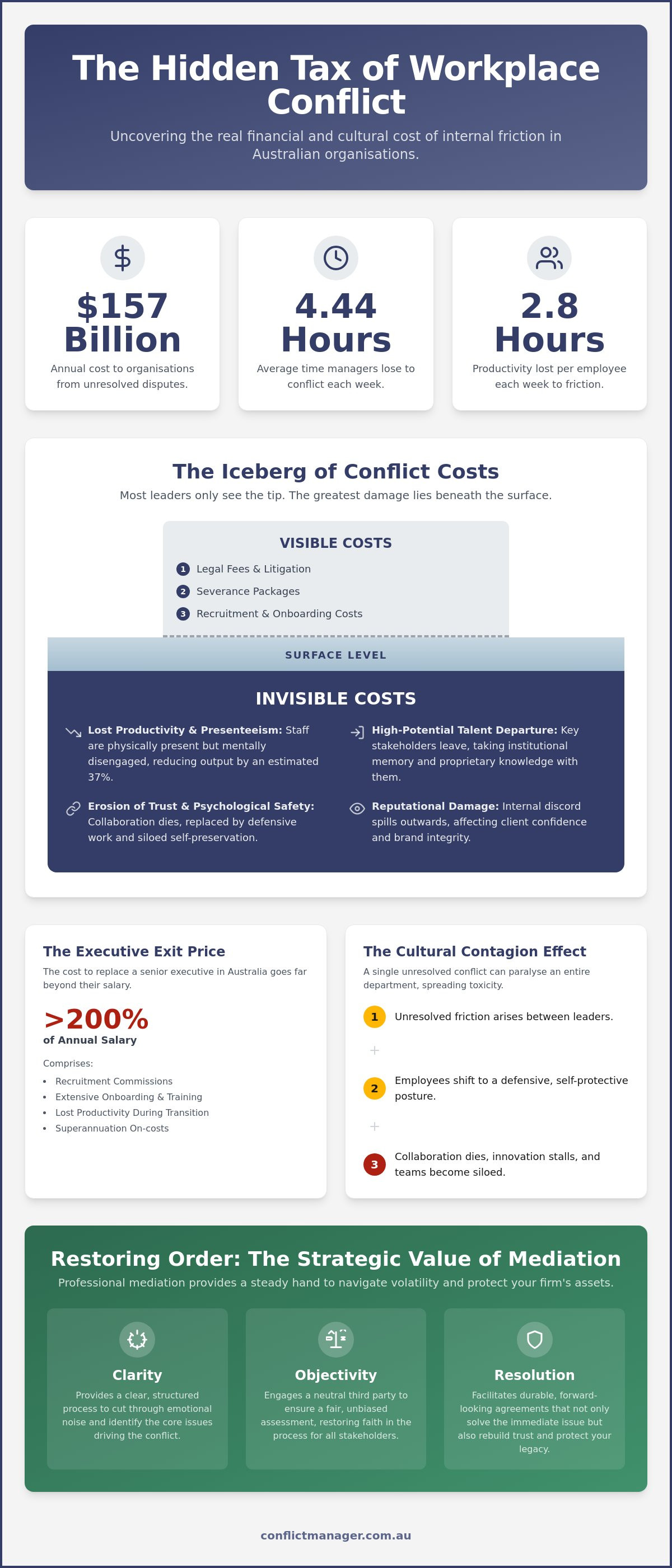
Friction. Erosion. Attrition. These are the hallmarks of the structural tax, a levy paid by every firm that allows internal tension to go unaddressed. The cost of unresolved workplace conflict is a silent predator. Recent 2026 data from Pollack Peacebuilding reveals that manager time spent on disputes costs organisations $157 billion annually. Leaders now lose an average of 4.44 hours every week to these frictions. This isn't just lost time. It's the slow decay of leadership authority and the inevitable flight of key stakeholders who no longer feel the ground is stable beneath them.
You've likely felt the exhaustion that comes from mediating the same personality clashes while your strategic goals remain stalled. It's a profound drain on the clarity required for effective governance. This analysis offers a clear framework to help you understand conflict as a concrete financial liability rather than a vague cultural problem. We'll examine the logic of engaging a neutral third party to restore order and protect your assets. By the end, you'll see a definitive path back to organisational health and the preservation of your professional legacy.
Key Takeaways
- Capital. Integrity. Resilience. Distinguish between obvious legal expenses and the deeper, invisible drain on your firm's structural integrity.
- Trust. Stability. Order. Recognise how lingering friction acts as a slow-release solvent on your culture, requiring a methodical approach to restore internal confidence.
- Legacy. Continuity. Discretion. Assess the specific vulnerabilities in high-stakes environments where personal dynamics and multi-generational asset management frequently collide.
- Risk. Inaction. Inertia. Quantify the cost of unresolved workplace conflict as a compounding liability that eventually reaches a tipping point of destructive friction.
- Clarity. Objectivity. Resolution. Discover the strategic value of professional mediation as a means to provide a steady hand during volatile organisational transitions.
Defining the Tax: The Visible and Invisible Costs of Workplace Conflict
Capital. Momentum. Integrity. These are the essential assets of any successful enterprise, yet they are the first to be eroded when internal friction is left to fester. We must view organizational conflict not as an inevitable byproduct of human interaction, but as a measurable drain on a firm's financial and structural health. This is the structural tax. It is a compounding levy paid by leaders who mistake silence for peace or hope that time alone will heal systemic fractures. To manage this risk, one must first identify where the capital is actually leaking.
The cost of unresolved workplace conflict is often bifurcated between the visible and the invisible. Most boards are proficient at tracking the visible tier. These are the line items that appear in the annual report: legal fees, severance packages, and the escalating prices of recruitment. However, the invisible tier represents the true weight of the tax. This includes the subtle loss of institutional momentum, the quiet departure of high-potential talent, and the reputational damage that occurs when internal discord becomes public knowledge. These hidden costs act as a slow-release solvent on the very bedrock of your organisation.
The Immediate Financial Drain: Turnover and Legal Exposure
Calculating the "exit price" of a senior stakeholder requires more than a simple salary comparison. In the Australian market, the total cost of replacing a senior executive can exceed 200% of their annual salary. This figure accounts for recruitment commissions, extensive onboarding, and the mandatory superannuation on-costs that accompany a new hire. Beyond these direct expenses lies the shadow of the Fair Work Commission. Litigation and settlement costs frequently dwarf the investment required for proactive facilitation. When a dispute reaches the point of formal legal intervention, the organisation has already lost. The average employee wastes 2.8 hours per week on friction, a figure that translates to weeks of lost productivity across a single financial year.
The Hidden Erosion: Productivity and Intellectual Capital
Intellectual capital is the lifeblood of a modern firm, yet it is highly volatile. When key stakeholders walk away from unresolved disputes, they don't just leave a vacancy; they take years of institutional memory and proprietary knowledge with them. This loss is often preceded by presenteeism. This occurs when staff are physically at their desks but have mentally disengaged due to a toxic environment. It's a quiet form of sabotage that reduces output by an estimated 37% per employee. There is also a distinct contagion effect. A single unresolved conflict between two leaders can paralyse an entire department, as subordinates spend more time navigating the political fallout than executing the firm's strategic goals. The cost of unresolved workplace conflict is, ultimately, the cost of a stalled future.
Beyond the Ledger: The Psychological and Cultural Toll
Culture. Stability. Integrity. These are not merely abstract HR concepts. They are the structural foundations of a resilient firm. The cost of unresolved workplace conflict often manifests as a psychological tax on these foundations. Trust, once fractured, requires more than a simple team-building exercise to repair. It demands a methodical reconstruction of the organisational framework. When friction becomes the norm, the workforce shifts from innovative work to defensive work. Employees stop looking for the next market opportunity. Instead, they look for ways to protect their own position from the next internal blast. This defensive posture is a silent killer of growth.
Contagion of Toxicity: How Friction Spreads
Unmanaged disputes don't stay contained within a single department. They create a bystander effect where the entire office begins to lower its standards of conduct. Under Australian workplace laws, employers now have a positive duty to manage psychosocial safety. This isn't just about preventing overt bullying. It's about maintaining a healthy psychological environment where people feel safe to contribute. When conflict is allowed to persist, collaborative problem-solving dies. It's replaced by siloed self-preservation. Staff spend more energy documenting their actions and protecting their reputation than they do creating value for the firm. This contagion turns a high-performing team into a collection of wary individuals.
Decision Paralysis and Leadership Fatigue
The drain on leadership is perhaps the most dangerous aspect of this structural tax. Executives find themselves trapped in a cycle of managing egos rather than executing strategy. This leads to profound decision fatigue. Boards become conflict-averse and start making "safe" choices that lack the boldness required for long-term success. They miss market shifts because they're too exhausted by the internal friction to take a calculated risk. The most talented stakeholders, those with the highest market value, are usually the first to stage a quiet exit. They don't have the patience for high-friction environments. Engaging in professional stakeholder facilitation can provide the objectivity needed to break this cycle. It allows leaders to return their focus to the horizon rather than the fire in the room. Restoring order isn't just about peace. It's about reclaiming the capacity to lead with clarity and confidence.
High-Stakes Friction: Costs in Family Offices and Leadership Teams
Legacy. Continuity. Stewardship. In the context of a family office or a high-level leadership team, the stakes of internal discord are fundamentally different from those in a standard corporate structure. Here, the boundary between professional asset management and personal emotion is often porous. Conflict does not merely threaten a quarterly target. It threatens a multi-generational legacy and the very integrity of the family’s assets. The cost of unresolved workplace conflict in these environments carries what we might call a complexity premium. It is a price paid in stalled momentum and fractured heritage.
External mediation provides a neutral centre that internal stakeholders cannot maintain. When family members or long-term partners are entangled in a dispute, objectivity is the first casualty. A neutral third party acts as a steady hand, viewing volatile transitions with total clarity. This external perspective is essential for navigating the friction of interpersonal dynamics without becoming emotionally entangled in the history of the relationship. It provides a structured environment where difficult truths can be spoken without destroying the underlying bonds.
Risk to Asset Integrity and Family Legacy
Stalled investment decisions are a primary financial drain. When intergenerational friction prevents a board from reaching a consensus, the opportunity cost can be staggering. In the private wealth sector, reputational risk is equally potent. A family dispute that becomes public knowledge can damage the standing of the entire enterprise. It's vital to preserve the human capital of the family alongside the financial capital. Without a structured approach to conflict, the social fabric that holds the wealth together begins to unravel. The preservation of legacy requires more than just financial growth; it requires the maintenance of relational integrity.
The Price of Stalled Succession
Succession planning is frequently the flashpoint for high-emotion disputes. Leadership transitions are delicate periods of structural change. When these transitions are frozen by conflict, the organisation enters a state of limbo. This uncertainty creates a vacuum of authority that can lead to talent flight and strategic drift. The cost of unresolved workplace conflict during a succession crisis is the cost of instability. Ensuring a smooth handover requires more than a legal document. It requires active facilitation to manage the underlying human friction. Stability for stakeholders is only possible when the transition is managed with objectivity and professional discernment.
The Calculation of Inaction: Assessing the Risk of Waiting
Inertia. Stagnation. Decay. Inaction is rarely a neutral position; it's a choice that carries a compounding interest rate. The eventual settlement price for a dispute only grows the longer it's permitted to simmer. Many leaders fall into the trap of believing in "natural resolution," the optimistic hope that high-stakes friction will simply dissipate over time. In reality, the cost of unresolved workplace conflict only escalates when ignored. Complex disputes involving significant assets or leadership authority rarely settle themselves. Instead, they go underground. They continue to erode the firm's structural integrity from within, manifesting as a slow-release solvent on your strategic goals. Identifying the tipping point, that precise moment where healthy debate transforms into destructive friction, is the first step in a necessary conflict audit.
Identifying the Warning Signs of Escalation
Absenteeism often serves as the first clear signal of structural decay. When senior staff begin taking frequent "mental health days" or withdrawing from non-essential meetings, the structural tax is already being levied. You should also watch for the sudden silence. This occurs when robust, face-to-face communication is replaced by formalised and guarded emails. This shift suggests that trust has been replaced by a need for self-protection and evidence-gathering. When stakeholder facilitation begins to feel like a chore rather than a collaborative exercise, the quality of your outcomes will inevitably decline. These are not merely personality quirks; they are symptoms of a failing internal framework that requires objective intervention.
Opportunity Cost and Lost Strategic Momentum
The true cost of unresolved workplace conflict is often found in the deals that were never signed and the innovations that never launched. When a leadership team is distracted by internal politics, they lose the psychological bandwidth required to identify and execute on market opportunities. Delayed restructuring during periods of necessary organisational change is another silent drain on capital. In the context of board-level conflict, opportunity cost is the quantifiable value of strategic growth and market advantage sacrificed while leadership attention is consumed by internal friction. If you recognise these signals of decay in your own organisation, it's time to engage in professional organisational conflict management to stabilise your operations. Restoring order today is the only way to protect the value you've built for tomorrow.
Restoring Order: The Strategic Value of Professional Mediation
Order. Clarity. Resolution. When the structural tax becomes too heavy to bear, the logic of external intervention becomes undeniable. Professional mediation is not a soft option for those unable to handle difficult conversations; it is a strategic intervention designed to preserve organisational value and protect the integrity of your human capital. The cost of unresolved workplace conflict is a debt that eventually requires a professional settlement. By engaging a neutral third party, you introduce a steady hand into a volatile environment. This allows leaders to step back from the friction and return to their primary roles. It ensures the firm's strategic momentum is not permanently lost to internal discord.
Neutral Facilitation as a Risk Mitigation Tool
Neutral facilitation serves as a critical risk mitigation tool. A professional mediator creates a safe container for high-emotion business disputes, allowing for a level of candour that internal processes rarely achieve. There is a fundamental difference between an informal HR chat and independent facilitation. Internal teams are inherently part of the organisational system. They carry their own histories, hierarchies, and biases. A neutral expert brings total objectivity to the table. This independence protects the integrity of the process and ensures genuine buy-in from all stakeholders. It moves the conversation away from the desire to win a dispute and toward the achievement of a sustainable, clear outcome for everyone involved.
Sustainable Resolution vs. Temporary Ceasefires
The goal of any intervention must be structural resolution rather than a temporary ceasefire. We aim to fix the system, not just the symptom. A temporary peace is often just a period of rearming before the next flare-up. Sustainable resolution provides the clarity and stability required to move forward with confidence after a period of intense organisational friction. The cost of unresolved workplace conflict is only truly mitigated when the root causes are addressed with precision. It ensures that the underlying dynamics are corrected so that the same tax is not levied again in the next financial year. If you are ready to address the friction within your team, you can enquire about professional conflict resolution for your organisation. Restoring order is the first step toward reclaiming your future.
Reclaiming Structural Integrity and Strategic Focus
Leadership. Legacy. Stability. These are the vital assets that remain at risk when internal friction is permitted to linger. We've seen that the cost of unresolved workplace conflict is not merely an interpersonal inconvenience; it's a compounding financial and cultural liability that erodes the very bedrock of your firm. Shifting your perspective from managing people to protecting assets allows you to transform disruption into a period of structural renewal. The path back to order often requires more than internal effort. It demands the total objectivity that only a seasoned external counsellor can provide.
Conflict Manager offers expert-led mediation for high-stakes environments and specialised facilitation for high-net-worth families. Our composed, objective approach to complex structural disputes ensures that your focus remains on growth rather than friction. You can restore clarity and stability to your organisation with Conflict Manager. It's time to stop paying the structural tax and start investing in the long-term integrity of your professional legacy. We're ready to provide the steady hand your next transition requires.
Frequently Asked Questions
How do you calculate the actual dollar cost of workplace conflict?
Calculating the cost of unresolved workplace conflict requires a combination of visible on-costs and hidden productivity drains. You must aggregate direct expenses such as legal fees, severance payments, and recruitment commissions, which in Australia can exceed 200% of a senior executive's annual salary. To this, add the quantifiable loss of manager time. Research indicates that leaders spend an average of 4.44 hours each week addressing friction, a figure that represents a significant percentage of your annual payroll dedicated to disruption rather than growth.
Is internal mediation as effective as engaging an external professional?
Internal efforts rarely achieve the same level of sustainable resolution as an external professional. Staff members within the organisation are inherently part of the existing hierarchy and social system, making total objectivity impossible to maintain. An external mediator provides a steady hand and a neutral perspective that internal HR teams cannot replicate. This independence is essential for ensuring all stakeholders feel the process is equitable and for reaching outcomes that prioritise the long-term integrity of the firm over internal politics.
What are the main causes of high-level organisational conflict in Australia?
Current data suggests that personality clashes and a lack of trust are the primary drivers of friction, accounting for 49% and 73% of disputes respectively. In the Australian corporate landscape, poor communication remains a significant factor, contributing to over half of all documented conflicts. The rise of hybrid work models has added a layer of complexity, as misunderstandings frequently escalate on digital platforms without the benefit of face-to-face cues. These factors often combine to create a cost of unresolved workplace conflict that stalls strategic decision-making.
When should a family office consider professional dispute management?
A family office should engage professional facilitation as soon as personal emotions begin to cloud professional asset management or investment decisions. High-stakes environments where the boundary between family legacy and corporate governance is porous are particularly vulnerable to destructive friction. If succession planning has reached a stalemate or if intergenerational tension is threatening the integrity of the family assets, external mediation provides the necessary structure to restore order. It's about protecting the human capital of the family alongside their financial capital.
Can unresolved conflict lead to legal liabilities under Australian law?
Yes, failing to address persistent friction can lead to significant legal exposure. Australian workplace laws now include a positive duty for employers to manage psychosocial safety, meaning that allowing a toxic environment to fester can be seen as a breach of health and safety obligations. Beyond the Fair Work Commission, unresolved disputes often escalate into formal bullying or harassment claims. Proactive resolution is not just a cultural preference; it's a necessary risk mitigation strategy to protect the firm from litigation and reputational damage.
What is the difference between mediation and arbitration in a business context?
Mediation is a collaborative, facilitated process where a neutral third party helps stakeholders reach a mutually acceptable agreement. The parties retain control over the final outcome, focusing on sustainable resolution and the preservation of relationships. Arbitration is a more formal, adversarial process where an independent adjudicator listens to both sides and makes a binding decision. While arbitration provides a final ruling, mediation is often preferred in high-stakes environments because it allows for more nuanced, bespoke outcomes that maintain structural integrity.
How long does a professional conflict resolution process typically take?
The duration of the process depends entirely on the complexity of the structural dynamics and the number of stakeholders involved. Some focused disputes can be resolved in a single day of intensive facilitation. More deep-seated organisational or family office issues may require a methodical approach over several weeks to ensure the resolution is sustainable. We prioritise a pace that is slow and deliberate, designed to lower the pulse of the organisation and build trust through a logical sequence of interventions.
Does engaging a mediator signal that leadership has failed?
Engaging a professional mediator is a sign of strategic maturity rather than a failure of leadership. Recognising when a situation requires total objectivity and specialised expertise is a hallmark of a responsible board or executive team. It demonstrates a commitment to the firm's strategic goals and the preservation of organisational value. By introducing a "steady hand" to navigate volatile transitions, leaders show they have the discernment to prioritise the health of the firm over personal egos or internal inertia.


