

Friction. Resistance. Silence. These are the unmistakable markers of organisational restructuring conflict, yet they don't signify a failed strategy. Instead, they reflect the natural tension of human systems undergoing necessary evolution. You've likely felt the weight of deep-seated resentment among your leadership team or watched with concern as top-tier talent begins to eye the exit during a transition. It's a heavy burden to carry when you're trying to stabilise a business amidst rising insolvency rates and the new complexities of the 2026 workplace relations amendments.
Stability. Clarity. Resolution. We understand that the pressure to perform doesn't pause for interpersonal friction. This guide offers a clear path from volatility toward a sustainable resolution that preserves your professional relationships. You'll discover how to transform structural friction into a foundation for long-term trust. We'll explore the logic of objective facilitation and how a composed, neutral hand can move your organisation from a state of complexity toward a successful, strategic restructure.
Key Takeaways
- Reframe restructuring friction as an inevitable systemic response rather than a strategic failure, allowing for a more objective and grounded leadership approach.
- Identify the hidden power dynamics and legacy pressures that frequently drive organisational restructuring conflict, especially within Australian family-led enterprises.
- Distinguish between constructive, growth-oriented disagreement and destructive, ego-driven friction to maintain focus on your organisation's strategic objectives.
- Implement a methodical five-step framework to transition from volatility to stability, anchored in active listening and the facilitation of unsaid stakeholder concerns.
- Understand the critical role of a neutral third party in providing the total objectivity required to resolve complex disputes and preserve long-term professional trust.
Navigating the Friction of Organisational Restructuring in Australia
Disruption. Uncertainty. Recalibration. At its core, organisational restructuring conflict is the friction generated when strategic intent meets the human response. It isn't a sign of a flawed strategy, but rather an inevitable byproduct of shifting roles, power dynamics, and professional identities. In the Australian corporate landscape, where expectations for transparency and procedural fairness are high, this friction often becomes more pronounced. This is particularly true following the Workplace Relations Legislation Amendment (Building Cooperative Workplaces No. 1) Act 2026, which has heightened the focus on how disputes are managed during periods of change.
Leaders often view resistance as a hurdle to be cleared. However, viewing the nature of organisational conflict through a more objective lens reveals it as a critical diagnostic tool. Friction highlights the exact points where the new structure hasn't yet accounted for human workflow or where communication has failed to bridge the gap between the boardroom and the desk. When handled with composed authority, these disagreements provide the data needed to refine the restructure for long-term stability.
The Psychology of Change: Why Restructuring Triggers Conflict
When professional security is compromised, the brain's limbic system often triggers a threat response. This isn't a conscious choice by employees; it's a biological reaction to the loss of autonomy and the perceived erosion of status. As influence shifts within a new hierarchy, individuals may feel their expertise is being devalued, leading to interpersonal friction that can paralyse decision-making. Restructuring anxiety is the psychological gap between an individual's current professional identity and the ambiguity of their future role.
Identifying Early Warning Signs of Structural Friction
Detecting the early markers of conflict allows for intervention before the situation becomes volatile. Leaders should look for specific behavioural shifts that suggest the human element of the restructure is under strain:
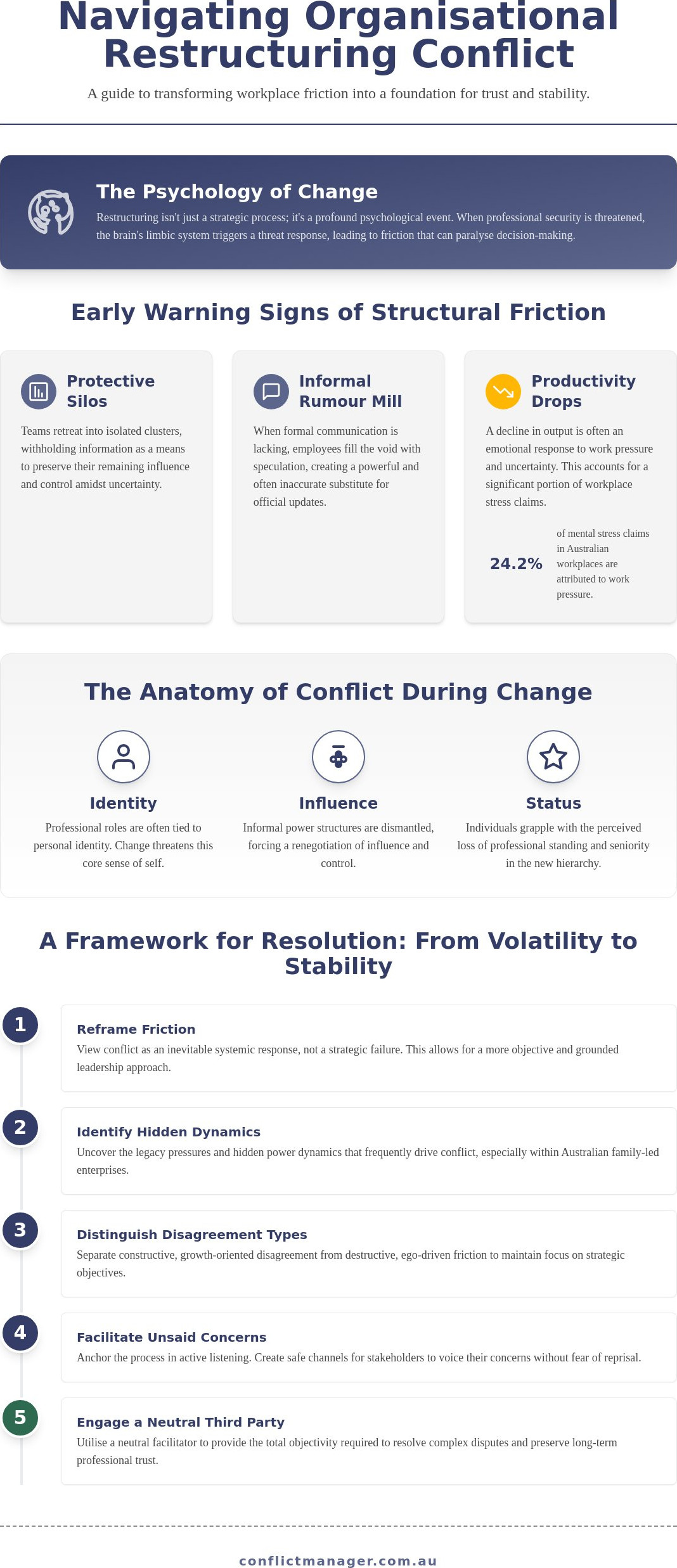
- Protective Silos: Teams may retreat into isolated clusters, withholding information from other departments as a way to preserve their remaining influence.
- The Informal Rumour Mill: When facilitated communication is absent, employees fill the void with speculation, which often becomes a substitute for official updates.
- Emotional Productivity Drops: A decline in output is frequently an emotional response to work pressure, which accounts for 24.2% of mental stress claims in Australian workplaces as of 2026.
Recognising these signs early ensures that the friction remains a tool for improvement rather than a catalyst for the loss of key talent.
The Anatomy of Conflict During Structural Change
Identity. Influence. Status. These are the silent pillars of any organisational structure, and they're the first to be challenged during a transition. While a restructure might appear as a simple redrawing of reporting lines on a spreadsheet, it's actually a profound reordering of the informal hierarchy that keeps a business stable. This reordering is the primary driver of organisational restructuring conflict, as individuals grapple with the perceived loss of their professional standing and influence.
In many Australian enterprises, particularly family-led organisations and family offices, the concept of legacy carries immense weight. Here, the lines between personal identity and professional role are frequently blurred. When a restructure threatens a long-held position or shifts the power away from a founding member, the resulting friction isn't just about business efficiency. It's a high-emotion dispute over the very integrity of the family's legacy. These situations require a steady hand to ensure that personal grievances don't compromise the organisation's core assets. For those managing such delicate transitions, professional stakeholder facilitation can provide the objectivity needed to separate family dynamics from strategic requirements.
Power Dynamics and the Fear of Loss
Restructuring inevitably forces a confrontation between the way things were and the necessity of evolution. This tension is most acute when the informal power structures, built over years of collaboration, are dismantled. Leaders often find themselves navigating deep-seated resentment among their executive teams, as individuals fear their expertise is being sidelined. This isn't merely a technical problem. It's a psychological one where the loss of status triggers a defensive posture, leading to the paralysis of decision-making and a breakdown in professional relationships. It's a difficult reality to acknowledge, but internal efforts to resolve these power shifts often struggle because the leaders themselves are entangled in the transition.
Misalignment Between Strategy and Stakeholder Values
Conflict also thrives in the gap between the board's strategic vision and the executive team's operational reality. The board may prioritise short-term efficiency or compliance with new regulations, such as the Payday Super requirements effective from July 2026. However, the executive team must manage the cultural fallout of these changes. If the why of the restructure doesn't resonate with the values of those executing it, the result is friction. This misalignment often manifests as a tension between achieving immediate strategic goals and maintaining long-term cultural health, which can lead to the loss of key talent if not managed with empathy and clarity.
Moving from Volatility to Stability: A Framework for Resolution
Stability. Order. Resolution. These are the objectives of any strategic intervention when organisational restructuring conflict threatens to derail progress. Moving from volatility to a state of structured calm requires more than a simple policy update. It demands a framework that distinguishes between the natural friction of growth and the corrosive impact of ego-driven disputes. Leaders who operate with composed authority understand that the goal isn't just to end the disagreement, but to reach a sustainable outcome that preserves the organisation's long-term health. Quick fixes are the enemy of structural integrity; they merely mask the symptoms while the underlying tension continues to fester.
The antidote to restructuring chaos is facilitated clarity. This process involves stripping away the emotional layers of a dispute to reveal the core structural or interpersonal misalignments. By addressing these issues directly, leaders can move their teams from a defensive posture toward a collaborative one. This transition is essential for maintaining momentum and ensuring that the strategic goals of the restructure are actually achieved rather than being lost in a sea of internal friction.
Constructive vs. Destructive Disagreement
Not all conflict is harmful. In fact, constructive disagreement is often the catalyst for more robust decision-making. However, when disagreement turns into destructive conflict, it begins to erode the foundation of the organisation. Recognising the difference is the first step toward effective resolution. The following comparison highlights how each type of friction impacts your organisational health:
- Constructive Disagreement: Focuses on systemic problems and solutions. It encourages open, transparent dialogue and searches for common ground to drive future growth. The result is increased clarity and strengthened professional bonds.
- Destructive Conflict: Focuses on personalities and individual blame. It relies on defensive, guarded posturing and maintains a rigid adherence to legacy structures. This leads to a breakdown in trust and the eventual loss of key talent.
Rebuilding Trust Through Transparent Facilitation
Trust is often the first casualty of structural change. Rebuilding it requires a methodical approach that prioritises transparency and objectivity. A neutral third party brings a level of total objectivity that internal HR or leadership teams often find impossible to maintain during a transition. By validating all perspectives without becoming emotionally entangled, a facilitator creates a space where high-emotion disputes can be de-escalated through structured dialogue. This objective lens allows stakeholders to feel heard, which is a prerequisite for moving toward a shared vision of the future.
Structured dialogue prevents the escalation of conflict by replacing the informal rumour mill with clear, facilitated communication. Leaders who prioritise facilitating clarity during leadership team conflict often find that the friction of change actually accelerates the development of more resilient professional bonds. This process doesn't just resolve the immediate crisis; it establishes a new standard for how the organisation handles future challenges, ensuring that stability is not just restored, but sustained.
Leading Through the Storm: Practical Strategies for Executives
Patience. Perspective. Presence. Leading through organisational restructuring conflict requires an executive to act as the emotional anchor for the entire system. When the structure is in flux, the leadership team must provide a sense of order that the new organisational chart cannot yet deliver. This isn't about suppressing disagreement, but about managing it with a level of composed authority that prevents friction from turning into a permanent fracture. Successful leaders maintain an objective distance from the chaos while showing genuine empathy for the individuals affected by the change.
A methodical five-step approach can help stabilise a volatile environment. First, establish a steady presence by grounding your own emotional state. Second, engage in deep inquiry to hear the unsaid concerns of key stakeholders. Third, facilitate dialogue using a structured framework to move past defensive posturing. Fourth, align new roles with the personal dignity of your team members. Finally, focus on re-contracting professional relationships to ensure the new structure is supported by a foundation of mutual trust. For leaders navigating these volatile waters, engaging expert organisational conflict management can provide the external perspective needed to restore order and trust.
Facilitating Difficult Conversations with Composure
Preparation is the foundation of any successful intervention. Before entering a high-stakes meeting, set your physical and emotional centre to ensure you remain unruffled by potential outbursts or resistance. Use the O-I-C framework to guide the dialogue: start with an objective Observation of the friction, explain the Impact it has on the organisational goals, and then move toward a Collaborative solution. Silence is often the most potent tool in a leader's arsenal; it provides the necessary space for stakeholders to process the weight of structural shifts without feeling pressured to react immediately.
Structural Integrity: Aligning New Roles with Personal Dignity
A new organisational chart is more than a map of reporting lines; it's a statement of value. To maintain structural integrity, ensure that new roles respect the professional history and expertise of your team members. This is particularly vital when managing the exit of legacy members. These transitions must be handled with a level of grace that honours their contribution while minimising disruption to the remaining staff. You might find our Managing Conflict during Structural Change checklist helpful for ensuring these steps are followed with precision. When personal dignity is preserved, the path from volatility to stability becomes much clearer for everyone involved.
The Value of a Neutral Third Party in High-Stakes Restructuring
Objectivity. Distance. Discernment. These are the qualities most difficult to maintain when you are standing at the centre of an organisational restructuring conflict. While internal HR teams and executive leaders possess deep institutional knowledge, that very proximity often becomes a liability during a restructure. They are, by definition, part of the system undergoing change. This entanglement makes it nearly impossible to view volatile situations with total objectivity, as every decision carries personal or professional consequences for those involved.
An external counsellor acts as a steady hand, capable of observing high-emotion disputes without becoming emotionally entangled in them. This neutral perspective is a strategic necessity for boards and high-net-worth families who must balance the weight of responsibility with the friction of interpersonal dynamics. By providing a sense of order during periods of high stress, a third party restores the structural integrity of the business while ensuring that the human element is treated with the dignity it deserves.
When Internal Efforts Reach Their Limit
There is a point where internal facilitation no longer suffices. You may notice that discussions have become circular, or that defensive posturing has replaced productive dialogue. When conflict becomes this deeply entrenched, the risk of legal escalation increases. With the Fair Work Commission implementing more procedural flexibility and faster dispute handling in 2026, the cost of failing to resolve issues internally can be significant. An external mediator lowers the organisational pulse. They build trust by validating all perspectives, moving the conversation away from individual blame and toward systemic resolution.
Achieving Sustainable Outcomes with Conflict Manager
Our approach at Conflict Manager is grounded in the belief that resolution must be sustainable. We don't offer quick fixes that mask underlying tensions. Instead, we provide bespoke facilitation that respects the unique dynamics of Australian firms and family offices dealing with organisational restructuring conflict. This focus on clarity and stability ensures that the long-term integrity of your business assets remains intact, even in the most volatile environments. By moving from a state of complexity toward a vision of structured resolution, we help you preserve the professional relationships that are essential for future growth.
Consult with Conflict Manager to navigate your organisational transition with composure.
Restoring Order and Structural Integrity
The path from volatility to stability is rarely linear. It requires a deliberate shift in perspective, moving away from seeing resistance as a hurdle and toward viewing it as a vital signal. By addressing the deep-seated power dynamics and legacy concerns that drive organisational restructuring conflict, you can protect the core assets of your business and ensure the long-term health of your leadership team. Composure, empathy, and objective facilitation are the tools that allow a leader to navigate these high-emotion transitions without losing their best people or eroding trust.
Sustainable outcomes are built on a foundation of clarity and procedural fairness. Whether you're managing a complex corporate realignment or a delicate transition within a family office, a neutral third party provides the total objectivity needed to resolve disputes and preserve professional legacies. You don't have to carry the weight of these transitions alone. Achieve clarity and stability in your organisation with Conflict Manager. Our approach provides expert mediation for high-emotion business disputes, offering a steady, objective hand for complex Australian organisations seeking outcomes that endure. You have the capacity to transform this period of friction into a catalyst for a more resilient, unified future.
Frequently Asked Questions
Why does organisational restructuring always seem to cause conflict?
Restructuring causes conflict because it reorders the informal power dynamics and professional identities that maintain systemic stability. When roles shift, individuals often experience a biological threat response due to a perceived loss of status and autonomy. This isn't a failure of leadership; it's a natural human reaction to professional uncertainty. By acknowledging this reality, leaders can manage the resulting friction before it becomes a permanent fracture.
How can we distinguish between healthy resistance and destructive conflict?
Healthy resistance is growth-oriented and focuses on the strategic problems or systemic workflows at hand. It encourages transparent dialogue and a search for common ground to improve the final outcome. Conversely, destructive organisational restructuring conflict is ego-oriented and relies on defensive posturing or personal blame. Recognising this difference early allows leaders to apply objective facilitation rather than reactive management to stabilise the environment.
What is the role of a mediator in a business restructure?
A mediator acts as a neutral third party who brings total objectivity to volatile situations. They facilitate structured dialogue that allows all stakeholders to feel heard without the mediator becoming emotionally entangled in the outcome. This process lowers the organisational pulse and moves the team from a state of complexity toward a vision of structured resolution. Their presence restores order when internal efforts have reached their limit.
Is it possible to restructure without losing our core company culture?
Maintaining culture requires aligning the new organisational chart with the personal dignity and professional history of your team members. You must ensure that the "why" of the restructure resonates with the core values of those executing it. Re-contracting professional relationships post-restructure ensures that the new hierarchy is supported by mutual trust. This prevents the erosion of culture by prioritising human value alongside strategic efficiency.
When should an Australian business involve an external conflict specialist?
You should involve an external specialist when internal efforts result in circular discussions or when defensive posturing begins to paralyse decision-making. If the friction threatens the loss of key talent or increases the risk of formal disputes, objectivity is required. Early intervention by a specialist provides a steady hand to navigate organisational restructuring conflict before it escalates into a situation that compromises the business's structural integrity.
How do we manage conflict in a family office during structural changes?
Managing conflict in a family office requires a delicate balance between personal legacy and strategic evolution. You must separate family identities from professional roles to ensure that strategic requirements are met without damaging personal relationships. Neutral facilitation is essential in these environments. It provides a grounded perspective that respects the unique family dynamics while prioritising the long-term stability and integrity of the organisation's assets.
What are the risks of ignoring interpersonal friction during a merger or restructure?
Ignoring friction leads to decision-making paralysis and the eventual loss of your most valuable talent. It also increases the risk of mental stress claims, which remain a leading cause of workplace disruption in Australia. Unresolved resentment can fester long after the restructure is complete. This destroys trust and makes future strategic shifts nearly impossible to execute because the foundation of professional relationships has been compromised.
Can professional mediation prevent Fair Work claims during restructuring?
Professional mediation reduces the likelihood of Fair Work claims by prioritising procedural fairness and transparent communication. By resolving disputes internally through structured facilitation, you create sustainable outcomes that satisfy the underlying concerns of all parties. This proactive approach ensures that disagreements are handled with composure and empathy. It prevents the escalation of high-emotion disputes into formal legal proceedings by addressing friction before it becomes a grievance.


