

Privacy. Discretion. Continuity. For a family of significant means, the public nature of the Australian legal system isn't just an inconvenience; it's a systemic threat to the legacy you've spent generations building. Seeking alternatives to court for family disputes is no longer a matter of mere preference. It's a strategic necessity for those who understand that a courtroom is rarely the place where complex emotional and financial webs are untangled with the necessary nuance. The rigid structures of the law often fail to account for the delicate interpersonal dynamics that define high-stakes environments.
You likely recognise that the friction of a protracted legal battle risks more than just capital. It risks the structural integrity of the family unit itself. This article provides a clear window into how sophisticated families resolve complex disputes through expert mediation and facilitation, entirely bypassing the public exposure of the Australian court system. We'll explore a methodical path toward a private, sustainable resolution; a journey that prioritises the preservation of family wealth and the restoration of order with minimal friction.
Key Takeaways
- Understand why the public nature of the Australian legal system can pose a risk to your family's privacy and how to avoid the fragmentation of intergenerational wealth.
- Explore discrete alternatives to court for family disputes, including how expert mediation provides a neutral centre for navigating high-emotion conversations.
- Learn the differences between Family Dispute Resolution, Collaborative Law, and private arbitration to select the path that best preserves your family's structural integrity.
- Discover how to prepare for a successful resolution by distinguishing between emotional friction and the complex requirements of family trusts or business structures.
- Gain insight into the value of a neutral, external perspective when managing volatile transitions to ensure a sustainable and orderly family legacy.
Why Court is the Last Resort for Private Family Disputes
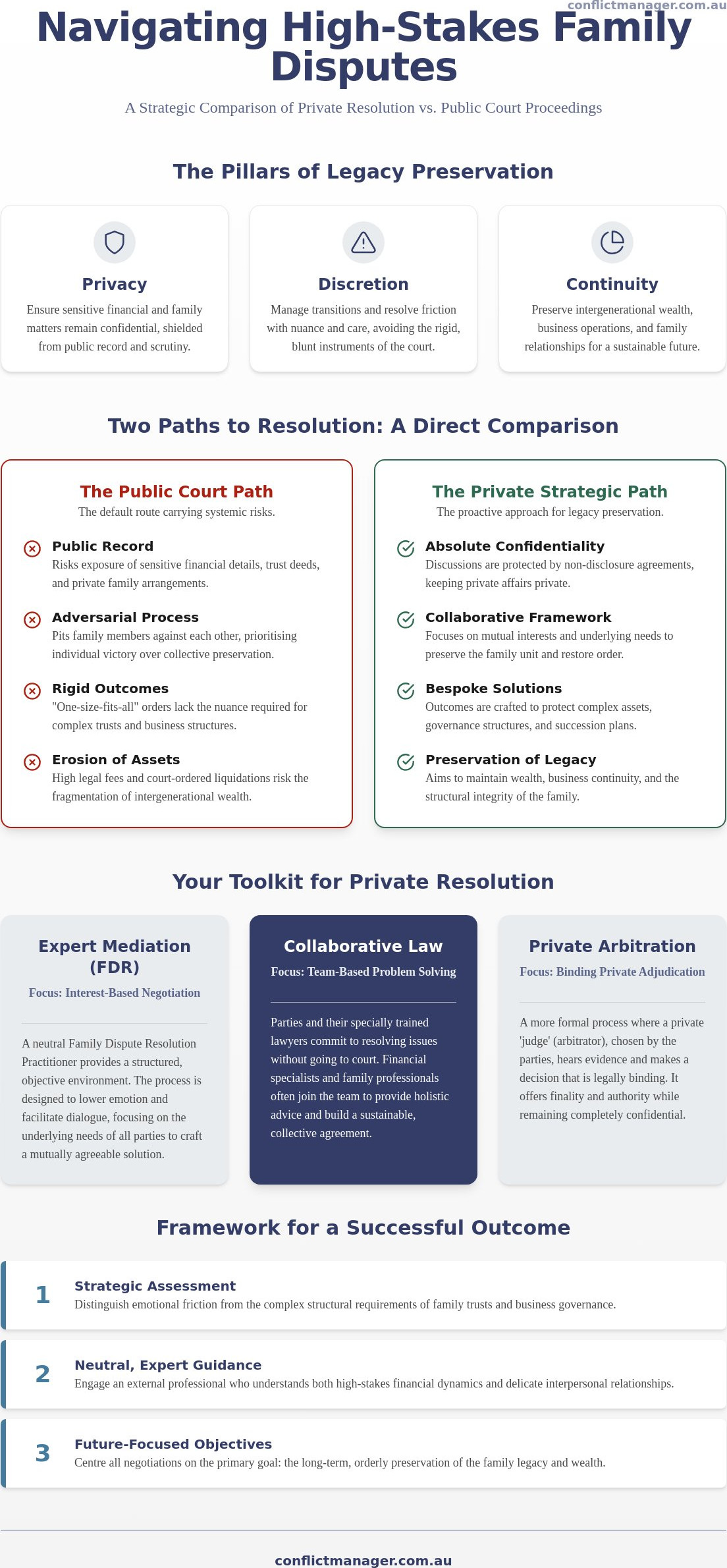
Privacy. Control. Continuity. These are the pillars upon which enduring family legacies are built. Yet, when internal friction arises, the instinctive turn toward litigation often dismantles these very foundations. The Australian court system is designed for public transparency and standardised outcomes; it's not a bespoke solution for the intricate governance needs of a high-net-worth family. Choosing Collaborative Law or mediation over litigation isn't just about avoiding a fight. It's a strategic decision to prevent the fragmentation of intergenerational wealth that occurs when assets are liquidated to satisfy rigid, court-imposed orders. For those seeking alternatives to court for family disputes, the goal is to shift from a mindset of combat to one of structured governance.
Litigation inevitably creates an adversarial trap. In this environment, legal strategies prioritise individual victory over the preservation of the collective family unit. This escalation often turns manageable disagreements into permanent schisms, making future cooperation impossible. By framing out-of-court resolution as a proactive governance strategy, families can maintain their structural integrity while addressing the underlying emotional friction. This methodical approach allows for a tailored path forward that respects the specific history and values of the family office. It's about finding a steady hand to guide the transition from chaos back to order.
The Hidden Costs of Family Litigation
The true price of a court battle extends far beyond legal fees. It encompasses the erosion of business continuity, the stalling of succession plans, and the public tarnishing of a hard-won reputation. Court orders are often "one-size-fits-all" instruments that lack the surgical precision required to handle complex trust structures or the nuanced requirements of multi-generational shareholders. When a judge decides the fate of a family enterprise, the result is frequently a compromise that satisfies no one and destabilises the organisation's future. The emotional toll on relationships can be irreparable, turning a temporary dispute into a permanent legacy of discord.
Privacy and the Family Office
Confidentiality is the currency of the family office. Once a matter enters the Federal Circuit and Family Court of Australia, it becomes part of a public record, risking the disclosure of sensitive asset holdings, trust deeds, and private financial arrangements. Private mediation settings, reinforced by robust non-disclosure agreements, offer a secure environment for resolution. This ensures that the details of your family's wealth remain where they belong: within the family. Transitioning to alternatives to court for family disputes provides the necessary protection to navigate volatile periods without the glare of public scrutiny, ensuring your private affairs stay private.
Family Dispute Resolution (FDR) and Expert Mediation
Order. Clarity. Resolution. For families navigating significant transitions, mediation is far more than a legal requirement under the Australian Family Law Act; it's a specialised forum for complex recalibration. An accredited Family Dispute Resolution Practitioner acts as the neutral centre, providing a structured environment where high-emotion conversations are grounded in objective reality. Unlike the rigid, rules-based nature of a courtroom, expert mediation focuses on interest-based facilitation. This approach seeks to understand the underlying needs of each stakeholder rather than simply adjudicating on legal rights. It's a process designed to lower the pulse of the room, allowing logic to prevail over the friction of interpersonal history.
High-net-worth families require a mediator who possesses an acute understanding of corporate governance, discretionary trusts, and the nuances of intergenerational wealth. A standard, legalistic approach often fails to account for the intricate structural integrity of a family office. This form of alternative dispute resolution transcends simple compromise by aligning individual interests with the long-term survival of the family legacy. When exploring alternatives to court for family disputes, the choice of a facilitator who understands these specific dynamics is the difference between a temporary truce and a permanent, sustainable solution. It's about finding a steady hand to guide the family back toward a state of equilibrium.
The Framework of Private Mediation
Intake. Assessment. Dialogue. Agreement. The framework of private mediation is methodical and deliberate. It begins with individual intake sessions to identify core issues and assess the readiness of each party. During joint sessions, the mediator manages power imbalances by ensuring every stakeholder has the space to contribute without being overshadowed by dominant personalities. A professional with composed authority can navigate these volatile transitions, acting as a neutral third party who brings order to clouded situations. This structured progression moves the family from a state of disruption toward a vision of shared resolution.
Achieving Sustainable Outcomes
The objective of expert mediation is to move away from the binary concept of "winning" or "losing" toward finding a sustainable path forward. These agreements are not merely verbal promises; they can be formalised into legally binding consent orders that provide the same certainty as a court judgment without the public exposure. Ongoing facilitation can also be integrated into the family's governance structure to prevent future friction from escalating. If you are currently facing a period of high organizational or family stress, engaging a professional facilitator can provide the stability required to reach a lasting agreement.
Collaborative Law, Arbitration, and Expert Facilitation
Precision. Choice. Strategy. While mediation provides a space for dialogue, more structured frameworks are often required to resolve technical impasses without the unpredictability of a public hearing. For those evaluating alternatives to court for family disputes, the landscape offers several paths that balance legal certainty with the need for total discretion. Collaborative law, for instance, represents a fundamental shift in how legal counsel is utilised. In this model, all parties and their legal representatives sign a binding agreement to reach a settlement without litigation. If the process fails, the lawyers must withdraw. This creates a powerful shared incentive to find common ground, ensuring the family legacy isn't sacrificed for a tactical legal win.
Choosing the right tool depends entirely on the level of friction and the complexity of the assets involved. Sometimes, a family requires a neutral third party to facilitate a conversation about future governance before a dispute even crystallises. In other cases, a definitive, binding decision is necessary to move past a deadlock. By selecting a bespoke resolution method, you maintain control over the process, the timeline, and the personnel involved. This is a level of agency that the public court system simply cannot provide. It's about applying the right amount of structure at the right time to preserve the family's equilibrium.
Arbitration: A Private Decision-Maker
Arbitration acts as a private version of a court hearing. A qualified arbitrator is appointed to hear the evidence and make a binding decision, known as an award, which can be registered with the court for enforcement. In 2026, as court waitlists continue to stretch, arbitration offers a significantly faster route to resolution. It's one of the most efficient alternatives to court for family disputes when a final decision is required on property or financial matters. Crucially, you can choose an arbitrator with specific expertise in complex trusts and family office structures, ensuring the decision-maker actually understands the nuances of your financial landscape.
Facilitation for Family Offices and Businesses
Stakeholder facilitation is a proactive governance tool. Unlike traditional mediation, which often reacts to an existing conflict, facilitation is designed to guide families through difficult transitions or structural changes before they reach a breaking point. The Conflict Manager approach focuses on bringing order to organisational and family friction by providing a steady, objective hand. This process allows for the recalibration of roles and responsibilities within a family business without the need for immediate legal intervention. It's a methodical way to address the human and structural dynamics that often fuel high-stakes disagreements, ensuring the business continues to function smoothly during periods of internal stress.
How to Prepare for a Successful Resolution Process
Preparation is the bridge between disruption and order. It requires a clinical assessment of what is actually at stake before any formal dialogue begins. Is the friction truly about the allocation of capital, or is it a deeper struggle for recognition and legacy? Before exploring alternatives to court for family disputes, you must collate a comprehensive map of your family trusts, business structures, and shareholder agreements. This transparency allows the process to move from abstract grievances to concrete structural solutions. Without this foundation, the resolution process risks becoming mired in technical delays that fuel further emotional friction.
Engaging a neutral third party early prevents the hardening of positions that typically precedes a legal breakdown. Once the "point of no return" is crossed, the focus shifts from resolution to retribution, making a sustainable outcome far more difficult to achieve. Managing expectations is a critical component of this phase. You must recognise that a durable resolution requires a level of compromise that prioritises the health of the family office over individual ego. It's a strategic trade-off; you exchange the desire for total victory for the certainty of long-term stability and privacy.
The Analytical Approach to Conflict
Separating the people from the problem is a psychological necessity for any high-stakes transition. We must define the desired state for both the business and the family unit, looking beyond the current state of disruption. This analytical distance allows stakeholders to view the conflict as a structural challenge rather than a personal affront. A sustainable resolution is a robust agreement that balances individual interests with the long-term structural integrity of the family office to ensure enduring stability.
Engaging Stakeholders
Approaching a reluctant or high-emotion family member requires a steady hand and a clear value proposition. Propose mediation not as a concession, but as a sophisticated governance strategy designed to protect the family reputation. The role of the wise counselor is to create a safe, neutral space where difficult conversations can occur without the threat of public exposure or legal escalation. If you are ready to transition from conflict to a structured resolution, you can organise a confidential facilitation session to establish a clear path forward for all stakeholders.
Preserving the Family Legacy with Conflict Manager
Order. Stability. Continuity. Conflict Manager operates on the fundamental belief that most family friction is the result of structural misalignment combined with high emotional stakes. We provide a neutral, external perspective that internal efforts often lack when under pressure. By prioritising the preservation of the family office structure, we ensure that the legacy remains intact even during volatile transitions. These alternatives to court for family disputes aren't just about avoiding legal fees; they're about maintaining the structural integrity of the family unit itself. Our philosophy is rooted in the logic of external intervention to move stakeholders from a state of disruption toward a vision of shared, structured resolution.
Customised strategies are essential for high-net-worth families. A generic approach is insufficient for the complexities of discretionary trusts, intergenerational wealth, and multi-layered shareholder agreements. Our process is methodical and logical, designed to build trust through a sequence of objective analysis and steady facilitation. We don't just manage the immediate crisis; we help recalibrate the family's governance to prevent future friction from destabilising the enterprise. It's a transition from chaos back to a state of equilibrium, guided by a professional who remains unruffled by the high-stakes environment.
A Steady Hand in High-Stakes Environments
Composed authority is required to navigate high-emotion environments where the weight of responsibility can feel overwhelming. We act as a neutral third party that brings clarity to clouded situations, ensuring that individual grievances don't overshadow the collective need for stability. Our focus remains steadfast on asset integrity and the long-term preservation of the family office. The Conflict Manager approach is a blend of professional expertise and compassionate guidance. This balance ensures that while the human element is respected, the structural needs of the family and business are never compromised.
National Reach, Personalised Resolution
We provide national Australian service coverage, facilitating resolutions for complex families and organisations across the country. Engaging us marks the beginning of a deliberate transition from conflict to clarity. You can expect a process that is slow, methodical, and specifically designed to lower the pulse of all involved stakeholders. We move the reader from a state of complexity toward a vision of structured resolution. If you're ready to move toward a sustainable path forward, you can enquire about our family conflict resolution services to begin the journey back to order.
Securing Your Family Legacy Through Private Resolution
The preservation of a family legacy requires more than just careful financial management; it demands a sophisticated approach to conflict resolution that respects the absolute privacy of your private affairs. By moving away from the rigid and public nature of the Australian legal system, you ensure that complex asset structures and intergenerational relationships remain protected from unnecessary exposure. Exploring alternatives to court for family disputes allows for a methodical recalibration of both family and business dynamics, shifting the focus from individual friction toward long-term structural stability.
Success in these volatile transitions is achieved through clinical preparation and the engagement of a neutral third party who understands the unique pressures of a family office. We provide a steady, objective hand for high-stakes environments across Australia, specialising in the resolution of high-emotion disputes with composed authority and total discretion. Our focus remains on protecting your asset integrity while restoring order to your organisational and family structures. This professional intervention ensures that the weight of responsibility doesn't lead to the fragmentation of what you've built.
Contact Conflict Manager for a confidential discussion on family office mediation.
Moving from a state of disruption toward a vision of shared order is a strategic choice that secures your family's future and reputation for generations to come.
Frequently Asked Questions
What is the most common alternative to court for family disputes in Australia?
Family Dispute Resolution (FDR) is the primary alternative to court for family disputes in Australia. This structured mediation process is often a mandatory requirement under the Family Law Act before parties can apply for parenting orders. It provides a neutral space for stakeholders to address points of friction. For high-net-worth families, this process is frequently enhanced through specialised facilitation that accounts for complex trust and corporate structures.
Is family mediation legally binding in Australia?
A mediated agreement is not automatically legally binding in Australia. However, it serves as the foundation for Consent Orders, which are filed with the court and carry the same legal weight as a judicial decision. This transition from a private agreement to a formalised order provides the necessary certainty for complex financial arrangements. It allows families to maintain control over the terms while ensuring the outcome is enforceable and sustainable.
How much does family mediation cost compared to going to court?
Family mediation is typically a fraction of the cost of a protracted court battle. While litigation involves escalating legal fees, expert witness costs, and court filing charges, mediation focuses resources on a single facilitator. This efficiency is particularly valuable for family offices where the financial cost of disruption is high. By choosing private resolution, you avoid the compounding expenses associated with years of adversarial legal posturing and public hearings.
Can I resolve a family dispute without a lawyer?
You can resolve a family dispute without direct legal representation through expert facilitation or mediation. While lawyers provide advice on legal rights, a professional facilitator focuses on the structural and emotional dynamics of the conflict. For complex families, this approach often prevents the escalation that occurs when lawyers become the primary points of contact. It's a methodical way to reach clarity without the immediate friction of an adversarial legal process.
What happens if the other person refuses to attend mediation?
If a party refuses to attend mediation, an accredited practitioner may issue a Section 60I certificate. This document informs the court that mediation was attempted or that one party declined to participate, which is usually a requirement for initiating legal proceedings. In high-stakes environments, the refusal to engage in alternatives to court for family disputes often signals a breakdown in governance. A neutral third party can sometimes help by initiating a confidential conversation to re-engage the reluctant stakeholder.
How long does the family dispute resolution process take?
The timeframe for family dispute resolution is significantly shorter than the court system, often concluding in weeks rather than years. While the Federal Circuit and Family Court of Australia faces considerable backlogs, private mediation can be scheduled according to the family's own timeline. The duration depends on the complexity of the assets and the willingness of stakeholders to find common ground. This speed is essential for maintaining business continuity and family stability.
What is the difference between a mediator and an arbitrator?
A mediator facilitates a conversation to help parties reach their own agreement, whereas an arbitrator makes a binding decision for them. Mediation leaves the power of the outcome in the hands of the family members. Arbitration is a more formal alternative to court for family disputes where a private judge provides a final resolution. Choosing between them depends on whether the stakeholders need a guided dialogue or a definitive, external decision to break a deadlock.
Is mediation private and confidential?
Mediation is strictly private and confidential, with protections enshrined in the Family Law Act 1975. Statements made during the process generally cannot be used as evidence in court, which encourages open and honest dialogue. This confidentiality is a cornerstone of legacy preservation for families of significant means. It ensures that sensitive financial information regarding trusts and asset holdings remains within the private sphere, far from the public record.


