

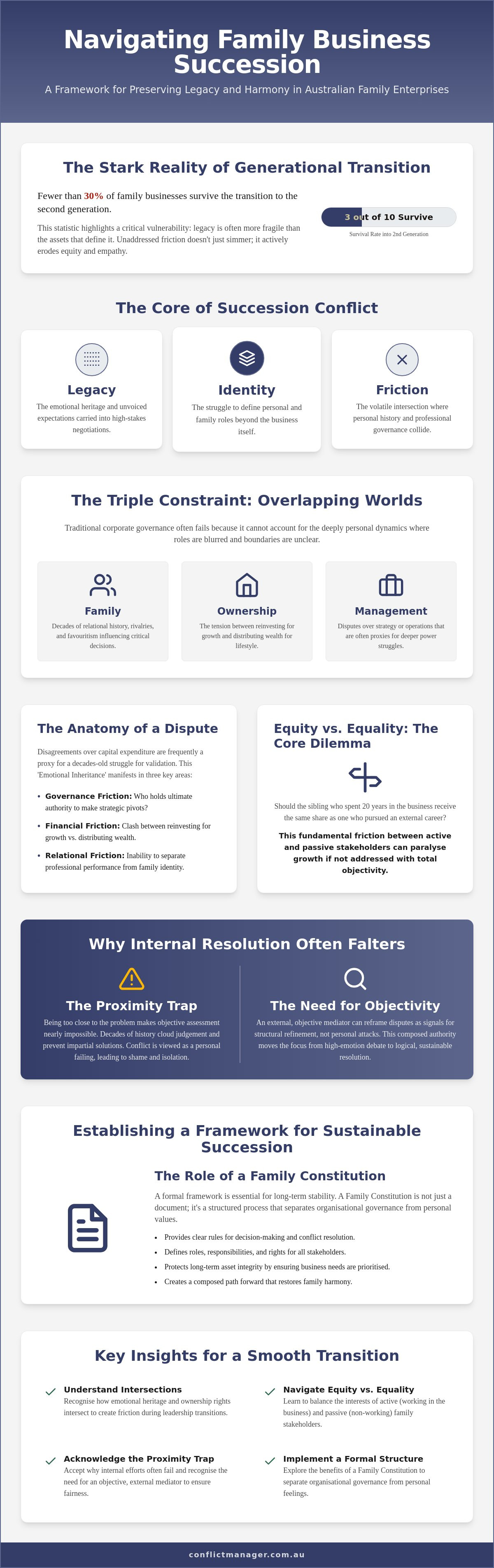
Fewer than 30% of family businesses survive the transition to the second generation, a stark reminder that legacy is often more fragile than the assets that define it. Legacy. Identity. Friction. You likely recognise the exhausting weight of these forces as they converge during an intergenerational handover. It is a period where high-emotion negotiations can quickly turn into a family business succession conflict, threatening both the integrity of your assets and the stability of your most cherished relationships.
It's a difficult reality to face, but the friction of transition doesn't have to lead to the erosion of your life's work. We promise to show you a composed path forward, one that replaces reactive tension with professional objectivity and a steady hand. This article provides a structured framework for decision-making that prioritises long-term continuity and restores harmony to the family unit, ensuring your business remains a source of pride rather than a point of contention for the long haul.
Key Takeaways
- Understand how emotional heritage and ownership rights intersect to create friction during complex leadership transitions.
- Learn to navigate the inherent tension between equity and equality when balancing the interests of active and passive family stakeholders.
- Discover why the proximity trap often prevents internal efforts from resolving a family business succession conflict without the presence of an objective, external mediator.
- Explore the structural benefits of a Family Constitution in separating organisational governance from personal values to protect long-term asset integrity.
- Gain insights into how a composed, expert-led approach to stakeholder facilitation can restore family harmony and secure a sustainable path for the business's future.
The Complexity of Family Business Succession Conflict in 2026
Legacy. Identity. Friction. At its core, family business succession conflict represents the volatile intersection where emotional heritage, ownership rights, and leadership transition meet. It is not merely a legal or financial hurdle. It is a profound structural shift that tests the resilience of both the balance sheet and the dinner table. In the Australian context of 2026, this complexity is heightened by an unprecedented intergenerational wealth transfer, where trillions of dollars are set to change hands. When these transitions occur, the stakes of silence are dangerously high. Unaddressed friction doesn't just simmer; it actively erodes equity and empathy, turning a lifetime of achievement into a source of organisational paralysis.
Viewing this conflict as a personal failing is a common mistake that leads to shame and further isolation. Instead, we must reframe these disputes as signals for structural refinement. Conflict is often the only way a system can communicate that its current governance no longer matches its modern reality. By approaching the friction with a sense of composed authority, we can move away from the exhausting weight of high-emotion negotiations and toward a logical, sustainable resolution.
The Triple Constraint: Family, Ownership, and Management
The primary challenge in any handover is the inherent lack of clear boundaries. You are rarely just an executive; you are a sibling, a child, or a cousin, often carrying decades of relational history into the boardroom. Traditional corporate governance models frequently fail in these environments because they are designed for detached stakeholders. They don't account for the deeply personal dynamics of family-owned enterprises, where a decision about a dividend can feel like a verdict on one's worth within the family unit. While a Family Office can provide a layer of professional distance, it cannot entirely insulate the business from the human element. Managing these competing interests requires a steady hand and a framework that acknowledges the validity of every role without letting one dominate the others.
Succession as a Catalyst for Dormant Friction
Handovers act as a powerful catalyst. They have a unique ability to bring long-standing grievances to the surface, often manifesting as a family business succession conflict over seemingly minor operational details. A dispute about a new technology rollout or a shift in market strategy is often a proxy for a much deeper intergenerational struggle for control. These moments force a confrontation with family identity: who are we if we aren't the people who run this company? Recognising that a business dispute is actually a legacy issue is vital. It allows us to separate the technical needs of the organisation from the emotional needs of the family. Only by identifying the root cause of the friction can we begin to build a path to continuity that protects the assets while restoring the harmony of the stakeholders involved.
The Anatomy of Intergenerational Disputes: Emotion vs. Equity
Legacy. Equity. Resentment. These are the invisible architects of a family business succession conflict. When we peel back the layers of a dispute, we often find an 'Emotional Inheritance' at the core. This is the silent ledger of past favouritism, childhood rivalries, and unvoiced expectations that suddenly dictates high-stakes board-level decisions. We typically see this manifest in three distinct structural areas:
- Governance friction: Disagreements over who holds the ultimate authority to make strategic pivots.
- Financial friction: The clash between reinvesting for growth and distributing wealth for lifestyle.
- Relational friction: The inability to separate professional performance from family identity.
What appears to be a disagreement over a capital expenditure is frequently a proxy for a decades-old struggle for validation. It's common for these emotional undercurrents to cloud the objective needs of the organisation, leading to a state of paralysis where no one feels empowered to act.
The tension between equity and equality remains the most significant structural hurdle. Should the sibling who has spent twenty years in the trenches of the family enterprise receive the same share as the one who pursued a career in another state? This fundamental friction between active and passive stakeholders can paralyse growth if not addressed with total objectivity. It often creates a clash between the business's need for aggressive reinvestment and the family's desire for stable dividends. Research suggests that constructive conflict management is essential here; it allows families to move past the 'Founder's Shadow' and establish the autonomy required for the next generation to lead effectively.
The Sibling Dynamic in the Boardroom
Managing rivalry becomes exceptionally difficult when professional competence meets childhood hierarchy. It is hard to view a Chief Financial Officer objectively when you still remember them as a younger brother. To maintain order, families must establish clear, merit-based performance metrics that apply to everyone, regardless of their surname. This helps to strip away the emotional baggage of the past. Keeping communication professional during financial discussions isn't just about etiquette. It's about protecting the business's structural integrity from the volatility of personal history and ensuring that leadership is earned rather than merely inherited.
Multi-Generational Friction and the Family Office
The shift from a 'Founder-led' model to a 'Cousin-consortium' introduces new layers of complexity. While a Family Office often acts as a necessary buffer, it can also become a flashpoint for internal disputes if its mandate isn't clearly defined. Bridging the gap between traditional values and modern investment strategies requires a neutral third party to facilitate the conversation. Older generations may prioritise capital preservation, while younger stakeholders often push for technological modernisation. For those struggling to maintain this balance, engaging in professional Family Conflict Resolution can provide the steady hand needed to navigate these transitions without compromising asset integrity or family bonds.
Why Internal Resolution Often Falters Under Pressure
Proximity. History. Bias. These are the quiet inhibitors of internal resolution. When a family attempts to settle its own disputes, it often falls into the 'Proximity Trap', a state where those closest to the issues are the least equipped to view them with the necessary objectivity. While many organisations believe that a family council or an internal board can navigate these waters, these structures often reach their limit when emotional volatility crosses a certain threshold. At this point, the very intimacy that built the business becomes the barrier to its survival.
Internal mediation attempts frequently entrench existing power imbalances rather than resolving them. In many cases, the most senior family member or the loudest voice dictates the terms, and others acquiesce simply to maintain a fragile peace. This leads to what we call 'pseudo-resolution', a dangerous state where a temporary agreement is reached, but the underlying structural friction remains unaddressed. Peace is essentially bought at the cost of future business stability, leaving the organisation vulnerable to the same family business succession conflict further down the track.
The complexities involved in navigating family business succession conflict often require a perspective that is entirely detached from the family's internal hierarchy. Without this distance, negotiations become exhausting, circular, and ultimately destructive to both the balance sheet and the family bond.
The Burden of Emotional Entanglement
Family members often operate from unconscious 'scripts', roles they have played since childhood that prevent honest, adult dialogue in a corporate setting. It is difficult to negotiate a multi-million dollar asset transfer when the participants are reacting to decades-old perceptions of fairness or capability. Maintaining objectivity during structural changes is nearly impossible when your personal identity is so deeply interwoven with the firm's legacy. Professional mediators provide the essential distance required to strip away these emotional layers, allowing stakeholders to see the situation as a series of logical, solvable challenges rather than personal attacks.
When to Engage a Neutral Third-Party Mediator
Identifying the 'point of no return' is critical for preserving asset integrity. If internal negotiations have stalled, or if the same arguments are being repeated without progress, the limit of internal capability has likely been reached. Engaging a steady, external hand isn't an admission of failure; it is an act of responsible stewardship. Professional facilitation ensures that the dialogue remains focused on sustainable outcomes and clear communication. By introducing a neutral party, you provide a safe environment where all stakeholders feel heard, which is the first step toward restoring harmony and securing a sustainable succession plan that protects the family's hard-earned legacy.
Establishing a Framework for Sustainable Succession
Order. Consensus. Clarity. Moving beyond the immediate friction of a family business succession conflict requires a shift from reactive emotion to proactive structure. The first step in this transition is the deliberate acknowledgement of all stakeholder perspectives. It's a process of validation that doesn't necessarily require total agreement; however, it does require a shared understanding of each individual's fears and aspirations. Without this baseline, any framework you build will be resting on unstable ground.
A central pillar of this framework is the 'Family Constitution'. This document serves as a bespoke set of guidelines that separates family values from business rules. It defines the boundaries of participation, the expectations for conduct, and the mechanisms for dispute resolution. By codifying these elements, you provide the organisation with a steady reference point that remains unruffled by personal grievances. It ensures that the business's movement toward its strategic goals isn't derailed by the weight of unvoiced expectations. If your organisation is currently struggling to find this middle ground, our expert Stakeholder Facilitation services provide the neutral, steady hand required to manage these complex transitions with grace.
Designing Objective Decision-Making Processes
Removing the 'personal' from the 'professional' is perhaps the most difficult aspect of succession. To achieve this, you must establish leadership criteria that are entirely independent of family status. When a role is defined by specific performance metrics and professional experience, the path to leadership becomes a matter of meritocracy rather than birthright. This transparency extends to financial and equity distributions. When the logic behind a dividend or a share allocation is clear and documented, you reduce the opportunity for perceived favouritism to take root. It's about building a system that rewards contribution and protects the asset's long-term viability.
Sustainable Outcomes: Beyond the Immediate Dispute
Transparency. Accountability. Resilience. A resolution that only addresses today's dispute is a temporary fix at best. To ensure true continuity, the framework must account for the implementation phase, where the actual handover of power and responsibility occurs. Ongoing facilitation during this period acts as a buffer, helping the family navigate the inevitable 'growing pains' of a new leadership structure. It's also an opportunity to foster a culture of 'constructive conflict'. By teaching the family how to disagree without damaging the business's structural integrity, you equip them with the tools to resolve future issues independently. The goal isn't the absence of tension, but the presence of a mature, objective way to manage it.
Restoring Stability: The Path to Resolution with Conflict Manager
Stability. Order. Continuity. These are the essential pillars of a lasting legacy, yet they are often the first elements to erode when a family business succession conflict takes hold. Conflict Manager provides a composed path through the structural and emotional friction that defines these intergenerational transitions. We act as a steady hand, bringing total objectivity to environments where history and identity have clouded the path forward. Our approach is methodical and grounded, designed to lower the pulse of the organisation while building a logical sequence toward resolution.
Our expert-led mediation is specifically tailored for the unique pressures of high-net-worth families and family offices. We understand that in these high-stakes environments, the preservation of asset integrity is just as critical as the restoration of family harmony. By acting as a neutral third party, we facilitate a process where every stakeholder is heard without the conversation becoming entangled in the grievances of the past. This focus on total objectivity allows us to guide families toward sustainable outcomes that protect their hard-earned legacy for generations to come.
Professional Facilitation for Complex Transitions
Seasoned professionals at Conflict Manager manage the immense weight of responsibility that comes with leading a family firm through change. We help you move through the fog of intergenerational dispute by establishing clear communication protocols and objective decision-making frameworks. This process isn't just about settling a single disagreement; it's about positioning your business for a future defined by stability rather than friction. By addressing the root causes of organisational tension, we ensure that the transition of power is a period of growth rather than a source of structural decay.
Take the Next Step Toward Resolution
Recognising the need for external intervention is a sign of leadership and maturity, not a mark of weakness. It shows a commitment to the business's survival and a profound respect for the family's shared history. Having a neutral third party involved provides the reassurance that the process is fair, transparent, and focused on the collective good. If you're ready to move from a state of complexity toward a vision of structured resolution, we're here to provide the steady hand you need. Discover how Conflict Manager facilitates sustainable resolution for family businesses and secure the continuity your legacy deserves.
Securing the Future of Your Legacy
Legacy. Integrity. Continuity. These are the markers of a successful handover. The transition of a family enterprise is a profound moment of change, a period where the weight of history often clashes with the necessity of future growth. By shifting your perspective to view family business succession conflict as a signal for structural refinement, you allow the organisation to evolve with clarity and purpose. Establishing objective frameworks ensures that the movement of leadership is defined by merit and strategy rather than emotional legacy. It's about protecting the asset's integrity while honouring your shared history.
Restoring order during these high-stakes periods requires a steady hand and total objectivity. Conflict Manager provides expert-led mediation for HNW families and sustainable resolution for complex organisational structures. Our composed, objective facilitation bridges the gap between intergenerational friction and long-term business stability. You've built a remarkable foundation; now is the time to ensure it remains unshakable for the generations to come.
Secure your family's legacy with expert conflict resolution
Frequently Asked Questions
What are the primary causes of family business succession conflict?
Identity. Equity. Control. Primary causes of friction usually involve the blurred boundaries between family, ownership, and management roles. Disagreements often arise from differing views on leadership readiness, business valuation, or the allocation of wealth between active and passive members. It's common for a family business succession conflict to stem from the fundamental tension between those working in the firm and those who only hold equity.
How can we resolve a dispute between siblings in a family business?
Resolving sibling disputes requires the deliberate removal of personal history from professional decision-making. We recommend establishing merit-based performance metrics that apply to all relatives equally, regardless of their position in the birth order. Using an objective external facilitator helps ensure that childhood hierarchies don't dictate current board-level strategies or financial distributions. This process creates a professional environment where siblings can interact as colleagues rather than relatives.
Is mediation better than legal action for family succession disputes?
Mediation is generally preferred because it focuses on preserving the family bond and the business's structural integrity. Legal action is often public and adversarial; it can cause irreparable damage to the brand and the family's standing in the community. A facilitated resolution allows for a private, bespoke agreement that addresses emotional heritage alongside commercial requirements, ensuring the business remains stable throughout the transition.
What is the role of a Family Office in conflict resolution?
A Family Office provides a necessary layer of governance that helps separate family assets from daily business operations. It acts as a professional buffer between generations, helping to manage expectations regarding wealth, investment strategies, and dividends. While it doesn't replace the need for active stakeholder facilitation, it creates a structured environment where financial planning can occur with a degree of professional distance and objectivity.
How do we handle a founder who refuses to step down?
Handling a reluctant founder requires a transition plan that honours their professional identity while allowing for the incoming generation's autonomy. We often facilitate a shift in role, such as moving the founder to a non-executive chairmanship; this keeps their wisdom accessible without hindering modern growth. This approach focuses on legacy preservation, ensuring the founder feels valued while the business gains the freedom to evolve.
Can a succession plan be changed if it causes family friction?
A succession plan should be a living document that can be refined if it creates significant organisational or personal friction. It's often better to pause and adjust the framework through stakeholder facilitation than to force a plan that lacks genuine consensus. This ensures that the final agreement is sustainable and has the support of all key family members, protecting both the assets and the relationships.
How long does the mediation process typically take for a family business?
The timeline for mediation depends on the complexity of the dispute and the number of stakeholders involved. Most families find that a series of structured sessions over several months provides the necessary space for reflection and logical consensus. It is a methodical process that prioritises thoroughness over artificial speed, ensuring that the resolution is robust enough to withstand the pressures of the future.
What are the costs of unresolved succession conflict for an Australian business?
Paralysis. Erosion. Collapse. Unresolved family business succession conflict can lead to the total failure of the organisation and the loss of multi-generational wealth. Beyond the financial loss of equity and market share, the costs include fractured sibling relationships and the departure of talented non-family executives. With only 30% of family firms surviving to the second generation, the price of inaction is often the complete destruction of the family legacy.


