

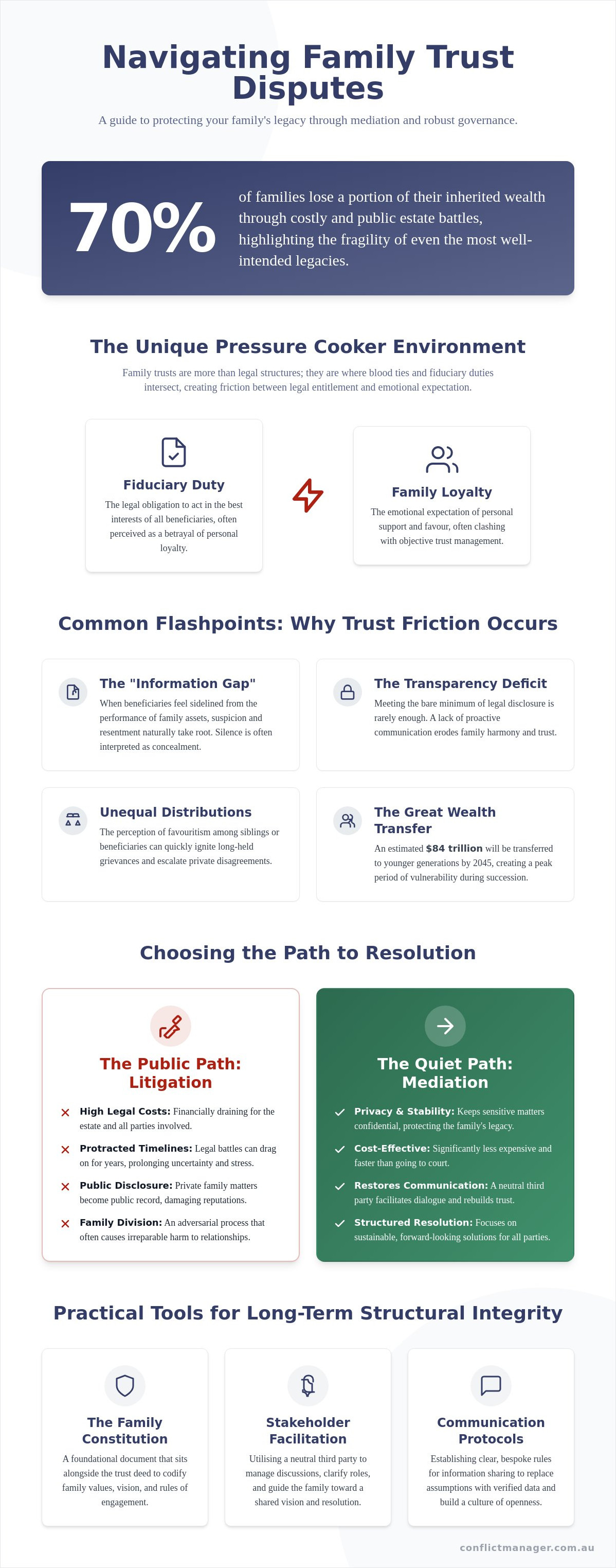
Roughly 70% of families lose a portion of their inherited wealth through estate battles, a statistic that highlights the fragility of even the most well-intended legacies. Privacy. Stability. Longevity. These are the pillars we aim to protect when internal friction threatens to spill into a public and costly courtroom. Managing conflict in family trusts requires more than a legalistic approach; it demands an understanding of the intricate human dynamics at play. You likely want to settle these disputes without the high legal costs and protracted timelines of litigation, yet the emotional weight often makes a clear path feel impossible to find on your own.
This guide explains how to navigate the structural and emotional complexities of trust disputes through professional mediation and robust governance. You'll learn how a neutral third party can bring clarity to clouded situations and restore communication between family members. We'll outline the specific protocols needed to prevent future friction and ensure your family's assets remain a source of support rather than a cause of division. It's about moving from a state of disruption toward a vision of structured, sustainable resolution.
Key Takeaways
- Recognise that family trusts are more than legal vehicles. They are vessels of legacy where blood ties and fiduciary duties often create a unique pressure cooker environment.
- Learn why managing conflict in family trusts requires a "quiet path" of mediation to avoid the public disclosure and high costs associated with the Supreme Court.
- Identify common flashpoints, such as distribution timing and the "information gap," that allow beneficiaries to feel sidelined from asset performance.
- Discover practical governance tools like the Family Constitution. These are designed to sit alongside your trust deed to ensure long-term structural integrity.
- Understand how professional stakeholder facilitation can provide the steady hand needed to move your family from a state of disruption toward a vision of resolution.
Understanding the Unique Nature of Family Trust Disputes
Legacy. Identity. Continuity. A family trust is rarely just a tax-effective structure or a vehicle for wealth protection. It is a vessel for a family's history and, quite frequently, a flashpoint for long-held grievances that have simmered beneath the surface for decades. The intersection of blood ties and fiduciary responsibilities creates a unique pressure cooker environment where technical compliance often clashes with deep-seated emotional needs. Managing conflict in family trusts requires a nuanced understanding that goes beyond the black-letter law of the deed. Disputes often arise not because of a failure in the legal drafting, but because of a misalignment in how different generations interpret the original settlor's intent. Trust conflict is the friction between legal entitlement and emotional expectation.
The Psychology of Wealth and Inheritance
Conflict often stems from a fundamental clash between two distinct mindsets: entitlement and stewardship. While the founding generation might view the trust assets as a hard-earned legacy to be preserved, younger beneficiaries may see them as a birthright designed to facilitate their own lifestyle choices. This tension is often exacerbated by the founding generation's reluctance to discuss the rationale behind the trust's structure. Silence is the greatest enemy of a healthy family trust. When communication stalls, beneficiaries fill the void with assumptions. These assumptions lead to resentment and a breakdown of the family unit long before any legal papers are served.
Fiduciary Duty vs. Family Loyalty
Being a trustee carries significant legal weight, involving a complex web of responsibility, personal liability, and the heavy burden of choice. Trustees must navigate their legal obligations to act in the best interests of all beneficiaries; this can feel like a betrayal to individual family members who expect personal loyalty over objective management. This perceived lack of transparency often leads to suspicion regarding asset performance or distribution timing. In certain legal environments, if a court finds that assets have been unfairly withheld or mismanaged, they may look toward a Constructive Trust as a Legal Remedy to rectify the situation. Professional facilitation acts as a vital bridge here. It helps clarify the distinction between the role of a family member and the role of a fiduciary, ensuring that managing conflict in family trusts focuses on structural integrity rather than interpersonal warfare.
Common Flashpoints: Why Trust Friction Occurs
Friction within a wealth structure rarely occurs without warning. It is usually the result of specific, identifiable catalysts that have been left unaddressed for too long. Transparency. Timing. Strategy. These three elements form the core of most disputes. Managing conflict in family trusts involves recognising that while the trust deed provides the legal framework, it cannot govern the emotional responses of those it serves. When these emotional responses are ignored, the structural integrity of the trust is placed at risk.
The "Information Gap" is perhaps the most common starting point for discord. When beneficiaries feel sidelined from the performance of family assets, suspicion naturally takes root. Trustees often withhold financial details in a misguided attempt to protect younger generations from the burden of wealth; however, this silence is frequently interpreted as concealment. This lack of clarity is particularly volatile during succession transitions. With an estimated $84 trillion expected to be transferred to younger generations by 2045, the "Great Wealth Transfer" is creating a peak period of vulnerability for family trusts. Unequal distributions or the perception of favouritism among siblings can quickly turn a private matter into a public dispute.
The Transparency Deficit
Trustees in Australia have a clear legal duty to provide beneficiaries with trust accounts and information regarding the trust's administration. Meeting the bare minimum of the law is rarely enough to maintain family harmony. Designing a bespoke communication protocol ensures that stakeholders feel respected and informed. This proactive approach is a cornerstone of Rebuilding Family Trust After Conflict, as it replaces assumptions with verified data. It's about creating a culture of openness that satisfies both legal duties and emotional expectations.
Intergenerational Vision Clashes
Conflict also arises when the goals of the beneficiaries diverge from the original purpose of the trust. A common example is when the third generation wishes to divest from a traditional family business to pursue sustainable investments or entirely different industries. Moving from a controlled, top-down trust to a collaborative family office model requires a significant shift in mindset. It involves aligning the family’s evolving values with the trust’s long-term investment strategy. Engaging in professional stakeholder facilitation can help bridge these generational gaps, ensuring the transition is handled with objectivity and care. By establishing clear governance before friction occurs, families can protect both their financial assets and their personal relationships.
Governance vs. Litigation: Choosing the Path to Resolution
When internal friction reaches a tipping point, stakeholders face a definitive crossroad. Litigation. Mediation. Governance. Choosing the correct path determines whether the family wealth survives the transition or is consumed by the process itself. Litigation is often a blunt instrument. It leaves the family legacy in tatters and, crucially, creates a public record of private grievances. Managing conflict in family trusts requires a more sophisticated approach than simply handing the reins to the legal system. While a court can enforce the letter of the law, it's rarely equipped to heal the underlying relational fractures that triggered the dispute in the first place.
The financial burden of the courtroom is equally significant. Current data for 2026 indicates that total litigation costs for trust disputes can easily reach $100,000 or $200,000, particularly when extensive discovery is required. These figures don't account for the emotional tax levied on family members who find themselves on opposing sides of a witness stand. Conflict Manager acts as the steady hand in these moments, guiding stakeholders away from the volatility of the Supreme Court and toward a vision of structured, sustainable resolution. By prioritising governance over adversarial legal action, families can preserve both their capital and their connections.
The Risks of the Courtroom
Publicity. Finality. Fracture. These are the inevitable outcomes of taking a trust dispute to court. In Australia, court proceedings are generally open to the public, meaning sensitive details regarding family wealth and private disagreements become part of the accessible record. Furthermore, a judge’s ruling is binary; it often satisfies neither party and lacks the nuance required for complex family dynamics. This rigid approach frequently causes a permanent fracture, as the adversarial nature of litigation prevents any realistic chance of future family reconciliation.
The Power of Professional Mediation
Professional mediation offers a "quiet path" that prioritises confidentiality and family integrity. An objective third party brings total neutrality to the table, viewing the situation without being entangled in the family's historical narrative. This external perspective is vital for managing conflict in family trusts, as it allows for the creation of agreements that the family actually wants to uphold. Mediation focuses on sustainable outcomes rather than legal victories, ensuring that the trust remains a source of collective support rather than a catalyst for ongoing division.
Practical Strategies for Managing Trust Conflict
Resolution is not an event; it is a process of structural reinforcement. Managing conflict in family trusts requires moving beyond the rigid confines of the trust deed to address the human architecture of the family. While the deed provides the legal skeleton, it lacks the flexibility to manage evolving relationships and shifting priorities. Successful families implement a secondary layer of governance that addresses intent, communication, and the inevitable friction of shared assets. This begins with the establishment of clear roles and responsibilities to reduce the overlapping authority that frequently triggers disputes.
Facilitated dialogue is a structured process for high-stakes communication. It allows for the exploration of sensitive topics without the conversation devolving into historical blame. By implementing regular stakeholder facilitation sessions, families can clear the air before minor disagreements ossify into entrenched legal battles. These sessions act as a pressure valve, ensuring that every voice is heard within a controlled, professional environment. It's about creating a culture where conflict is anticipated and managed, rather than feared and avoided.
The Family Constitution and Governance
A Family Constitution serves as a shared mission statement that sits alongside the legal trust deed. It covers the territory a deed cannot: the family's values, its philanthropic mission, and the specific protocols for resolving internal disagreements. Involving all generations in the drafting process is essential for ensuring long-term buy-in. When a younger beneficiary understands the rationale behind a distribution policy because they helped shape the governance framework, the likelihood of future litigation drops significantly. As the family grows and diversifies, these documents must be reviewed and updated to remain relevant to the current stakeholders.
Facilitating Difficult Conversations
The "Composed Approach" is a technique for de-escalating high-emotion meetings through objective facilitation. It involves setting a rigorous agenda that ensures every stakeholder feels heard, preventing any single individual from dominating the narrative. The facilitator maintains a measured pace; they use punctuation and deliberate pauses to clarify nuanced points and provide room for reflection. This steady hand is vital for navigating the volatile transitions mentioned earlier. If your family is struggling to find common ground, engaging in professional stakeholder facilitation can provide the external perspective needed to restore order. It's a method of moving from complexity toward a vision of structured resolution.
Conflict Manager: A Steady Hand for Your Family Legacy
Stability. Clarity. Resolution. When internal efforts to resolve trust disputes stall, the logic of external intervention becomes undeniable. Conflict Manager serves as a wise, external counsellor; we are a steady hand capable of viewing volatile situations with total objectivity. Managing conflict in family trusts is often hampered by the very proximity of the stakeholders. We provide the professional distance required to see the structural and emotional fractures clearly. Our approach is designed to lower the pulse of the room, moving the family from a state of complexity toward a vision of structured resolution. By acting as a neutral third party, we bring order to clouded situations and ensure the family legacy remains intact for the long term.
The Mediation Process
The mediation process begins with a comprehensive initial assessment. We seek to understand both the structural legal landscape and the emotional undercurrents that drive the current friction. This phase is about more than just reviewing a trust deed; it is about identifying the silent grievances that often fuel the fires of litigation. Once we've established a thematic foundation, we move into active facilitation. We guide stakeholders through the logic of resolution, ensuring that every decision is made with a clear head and a long-term perspective. Finally, implementation ensures that the agreed outcomes are documented and integrated into the trust’s governance. This methodical progression transforms a state of disruption into a durable, organised peace.
Why a Neutral Third Party is Essential
A neutral third party is essential because they remove the "history" from the room. Family members often operate within old, ingrained scripts; they respond to one another based on decades-old dynamics rather than current fiduciary realities. We bypass these patterns. Our presence allows stakeholders to communicate without the baggage of past interpersonal friction. This is vital for managing conflict in family trusts, as it allows for a focus on asset integrity. We prevent the destructive "burn the house down" mentality that so often accompanies protracted litigation. We understand the weight of responsibility and the friction of interpersonal dynamics without becoming emotionally entangled in them. If you're ready to move beyond the cycle of friction, we invite you to Enquire about our Family Office Mediation services. It's time to restore order and protect the wealth and relationships your family has spent generations building.
Securing Your Family Legacy Through Facilitated Resolution
Preservation. Integrity. Continuity. These are the pillars of a lasting legacy; yet, they are easily compromised when internal friction is left unaddressed. Managing conflict in family trusts requires a transition from reactive legal defence to proactive stakeholder facilitation. By choosing mediation over the Supreme Court, you protect your family wealth from public disclosure and ensure that communication remains a bridge rather than a barrier. We've explored how a Family Constitution and clear governance protocols provide the order needed to prevent future disputes.
Conflict Manager brings national Australian expertise in complex dispute management, providing the expert-led mediation high-net-worth families require. Our focus remains on sustainable, private outcomes that restore the structural integrity of your trust without the emotional and financial tax of litigation. We act as the steady hand, helping you navigate difficult transitions with total objectivity and professional discernment. It's possible to move beyond a state of disruption toward a vision of long-term stability and restored family harmony.
Restore clarity to your family trust; speak with a Conflict Manager today.
Frequently Asked Questions
What is the most common cause of conflict in an Australian family trust?
Transparency deficits and the "information gap" remain the primary catalysts for friction within these structures. When beneficiaries feel sidelined from financial performance or distribution decisions, suspicion naturally grows. This is often exacerbated by perceived favouritism among siblings or cousins during major life transitions or succession events. Addressing these gaps early through structured dialogue prevents minor misunderstandings from ossifying into entrenched legal battles.
Can a beneficiary sue a trustee for a lack of transparency?
Beneficiaries have a clear legal right to access trust accounts and essential information regarding the trust's administration. If a trustee withholds this data, a beneficiary can seek a court order to compel disclosure. However, managing conflict in family trusts through professional facilitation often resolves these requests before they escalate into formal litigation. It's about moving from a state of secrecy toward a vision of structured, professional openness.
How does mediation differ from legal representation in a trust dispute?
Mediation involves an objective third party who facilitates a collaborative agreement between all stakeholders. Legal representation is adversarial; each party's lawyer fights for a specific win-loss outcome. Mediation prioritises family harmony and privacy, whereas legal battles often lead to public disclosure and permanent relational fractures. A neutral facilitator brings clarity to clouded situations without the "burn the house down" mentality of the courtroom.
What happens if the family members refuse to speak to each other?
A breakdown in direct communication doesn't prevent a resolution. Professional facilitators use structured processes, such as "shuttle mediation," to relay perspectives and build consensus without requiring parties to be in the same room initially. This approach lowers the emotional pulse and allows for logical progress even when tensions are at their peak. It provides a safe environment to navigate difficult transitions without immediate interpersonal friction.
Is a family constitution legally binding in Australia?
A family constitution is generally a moral and social contract rather than a legally binding document like a trust deed. It serves as a governance framework that guides behaviour and intent. While it doesn't replace the law, it provides a powerful roadmap for managing conflict in family trusts by aligning the family's values with their financial structures. This alignment ensures that every stakeholder understands the rationale behind the trust's operation.
How long does the professional mediation process typically take for a trust dispute?
The timeline for mediation depends on the complexity of the assets and the number of stakeholders involved. Most disputes reach a sustainable resolution within several weeks or months. This is a significant contrast to the Australian court system, where trust litigation can frequently drag on for two years or more. Mediation offers a more efficient and controlled path toward restoring order and communication.
Can a neutral third party help if the trust deed is poorly written?
Facilitation provides a forum to clarify the settlor's original intent when the deed's language is vague or outdated. By reaching a consensus on how the trust should operate, families can avoid the need for a judge to provide a judicial construction of the document. This proactive alignment preserves asset integrity and reduces the risk of future legal challenges. It's a method of bringing structural integrity to a flawed legal framework.
What are the costs associated with mediating a family trust conflict compared to court?
Mediation costs are a fraction of the expense required for a full Supreme Court battle. Litigation costs in Australia for complex trust disputes often reach $150,000 or more per party when cases go to trial. Mediation allows families to bypass these high costs and the emotional tax of adversarial proceedings. It's a pragmatic choice that protects the trust's capital for future generations while seeking a private resolution.


