

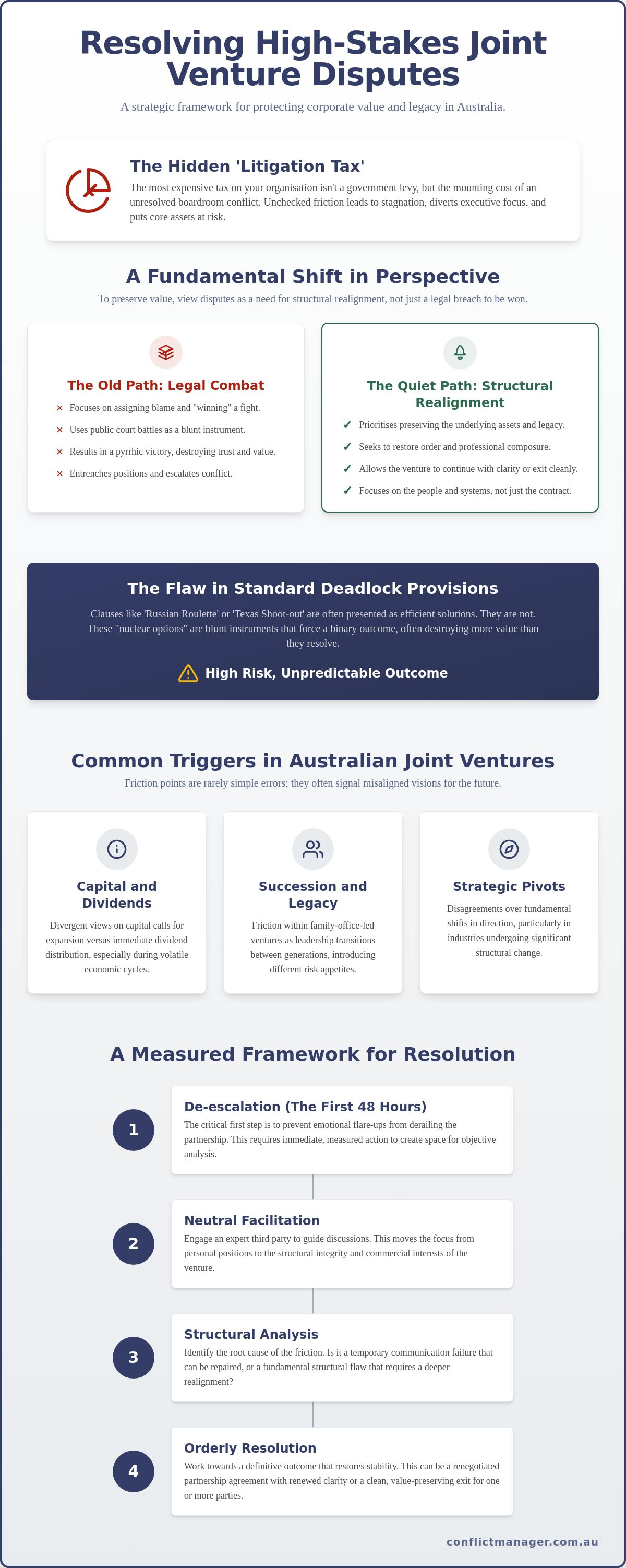
What if the most expensive tax on your organisation isn't a government levy, but the mounting litigation tax of an unresolved boardroom conflict? Friction. Stagnation. Risk. These elements often surface when partners lose alignment; however, the reflex to seek legal combat often costs more in time and reputation than the original disagreement. When you're tasked with resolving joint venture disputes in the Australian market, the goal shouldn't just be winning a fight. It's about protecting the underlying assets and the legacy you've built.
Internal efforts to settle these matters often stall because the parties are too close to the friction to see the structural solution. You likely recognise that public court battles are a blunt instrument that rarely preserves value. This article outlines how to navigate high-stakes friction through expert-led facilitation that restores professional composure and structural stability. We'll explore a methodical approach to restoring order, ensuring that your corporate legacy remains secure while allowing the venture to either continue with clarity or exit cleanly.
Key Takeaways
- Learn why viewing a dispute as a structural realignment rather than a legal breach preserves the long-term integrity of your corporate assets.
- Understand the strategic limitations of standard Australian deadlock provisions and why "nuclear" options often destroy more value than they resolve.
- Discover a measured framework for resolving joint venture disputes through neutral facilitation that prioritises professional composure over public litigation.
- Identify the critical de-escalation techniques required in the first 48 hours of a conflict to prevent emotional flare-ups from derailing the partnership.
- Gain insights into how expert-led mediation restores organisational order and protects the enduring legacy of family-owned or corporate ventures.
Beyond the Contract: Understanding the Friction in Joint Venture Partnerships
Alignment. Inertia. Erosion. These are the quiet forces that often dictate the health of a partnership long before a formal breach occurs. While many firms view the contract as the sole source of truth, a deeper understanding of joint ventures reveals that legal documentation is merely a snapshot in time. Resolving joint venture disputes requires more than a literal reading of a shareholder agreement; it demands a managed process of structural realignment. As businesses grow and markets shift, the fluid nature of commerce often outpaces the rigid clauses drafted years prior. When interpersonal trust erodes, even the most meticulously crafted agreement becomes insufficient to maintain the venture's momentum. Unresolved friction acts as a silent drain on capital, diverting executive focus from growth toward internal preservation and defensive posturing.
The Intersection of Structural Design and Human Dynamics
Formal hierarchies often mask the reality of "shadow governance," where informal influence and unvoiced expectations drive the actual decision-making process. In high-stakes stakeholder environments, emotional undercurrents can quietly subvert the most logical business frameworks. If a partner feels sidelined or undervalued, they may begin to obstruct progress through passive resistance or bureaucratic delays. This psychological friction is often more damaging than the technical disagreement itself. Seeking to "win" a legal point in these moments often results in a pyrrhic victory. You might secure the technical right to a decision, but you risk destroying the collaborative spirit required to sustain the venture's long-term value. True resolution focuses on the people behind the positions to ensure the structural integrity of the business remains intact.
Common Triggers within the Australian Corporate Landscape
In the Australian market, specific friction points frequently emerge that challenge the integrity of a partnership. These triggers are rarely about simple errors; they're usually about misaligned visions for the future. Common examples include:
- Capital and Dividends: Divergent views on capital calls for expansion versus immediate dividend distribution policies, particularly during volatile economic cycles.
- Succession and Legacy: Friction within family-office-led joint ventures as leadership transitions between generations, where new stakeholders may have different risk appetites than the founders.
- Strategic Pivots: Disagreements over fundamental shifts in direction during periods of significant structural change in local industries, such as energy, mining, or property development.
The process of resolving joint venture disputes in these contexts isn't about assigning blame. It's about restoring a sense of order and ensuring that the organisational machinery continues to function without the friction that leads to asset depletion. By acknowledging these triggers early, partners can transition from a state of conflict to one of structured resolution, preserving the legacy they've worked to build.
Evaluating Resolution Mechanisms: Moving Past Standard Deadlock Provisions
Precision. Clarity. Order. These are the hallmarks of a well-governed venture, yet they're often the first casualties when a board-level dispute arises. Most Australian joint venture agreements rely on rigid, binary outcomes that jump straight from disagreement to dissolution. When partners reach a stalemate, the default reflex is to trigger a "deadlock" clause, but these mechanisms are frequently too blunt for the nuances of modern commercial growth. Effectively resolving joint venture disputes requires a discerning eye to distinguish between a fundamental structural flaw and a temporary communication failure. A structural flaw might involve divergent long-term objectives that no longer align; a communication failure is often rooted in eroded trust or mismatched expectations that can be repaired through professional intervention.
The Limitations of 'Russian Roulette' and 'Texas Shoot-out' Clauses
In many corporate circles, 'Russian Roulette' or 'Texas Shoot-out' provisions are presented as efficient ways to end a stalemate. They aren't. These mechanisms force one party to buy out the other based on a single price offer, essentially turning business ownership into a high-stakes gamble. This often leads to suboptimal financial outcomes because the price is determined by liquidity and risk appetite rather than true market value. Such clauses favour the party with deeper pockets, not necessarily the party with the better strategic vision for the asset. The psychological toll of these "nuclear" options can permanently damage professional reputations and family legacies, leaving little room for a composed exit or a sustainable continuation.
Designing a Tiered Framework for Sustainable Recalibration
A more sophisticated approach involves a tiered framework designed for recalibration rather than immediate severance. In the Australian corporate landscape, the requirement to negotiate in "good faith" carries significant weight, yet it's often treated as a mere formality in the heat of conflict. Implementing mandatory mediation periods before any formal legal filing allows for a "cooling off" period where logic can prevail over defensive posturing. Engaging in professional stakeholder facilitation provides a neutral platform to explore these tiers before positions become entrenched. An independent facilitator doesn't just manage the meeting; they identify the underlying human friction that a standard legal clause ignores. This methodical approach ensures that if a venture must end, it does so cleanly, and if it continues, it does so with restored structural clarity and mutual respect.
The Quiet Path: Why Expert Facilitation Outperforms Commercial Litigation
Discretion. Dignity. Stability. These are the pillars of the "quiet path." While some firms rush to the steps of the Supreme Court, seasoned executives understand that public battles often diminish the very assets they seek to protect. Resolving joint venture disputes through expert facilitation offers a strategic alternative to the blunt force of commercial litigation. It's a method that prioritises the "composure factor," ensuring that professional reputations and brand equity remain untarnished by the scrutiny of a public forum. Unlike a court, which is bound by rigid legal precedents, facilitation allows for bespoke, creative outcomes that address the specific human and structural needs of the venture. This approach doesn't just settle a point of law; it restores the professional order required for long-term success.
Safeguarding Confidentiality and Organisational Momentum
Australian courts operate on the principle of open justice. This means sensitive financial data, family office arrangements, and strategic internal blueprints often become part of the public record. For high-net-worth stakeholders, this exposure carries an unacceptable reputational risk. Private resolution ensures that these intricate details stay behind closed doors, away from competitors and the media. This discretion allows for business continuity, as the broader organisation remains shielded from the volatility at the board level. A neutral facilitator acts as a buffer, preventing the friction from trickling down into daily operations. By keeping the resolution process private, partners can maintain a façade of unity, which is often essential for preserving market confidence and staff morale.
Avoiding the 'Litigation Tax' on Sizable Assets
Commercial litigation is a significant drain on both time and capital. Research from the 2025 International Arbitration Survey indicates that party costs, including legal fees and evidence preparation, account for 83% of the total cost of formal proceedings. In the Australian landscape, the hidden cost of "adversarial drift" is often more damaging than the direct expenses. This occurs when parties become so entrenched in the "win-loss" dynamic of a courtroom that they lose sight of the commercial objective. Court-imposed solutions are typically binary and rigid; they rarely account for the nuance of a growing business. This methodical approach is particularly effective when resolving joint venture disputes involving complex asset portfolios. By choosing facilitation, partners avoid this entrenchment. They focus instead on sustainable resolutions that protect the family or corporate legacy without the destructive overhead of a public trial.
Activating the Resolution Process: A Methodical Approach to Facilitation
Initiation. Composure. Method. These are the tools of a seasoned executive who understands that the first response to friction often dictates the final outcome. When resolving joint venture disputes, the priority in the critical first 48 hours is de-escalation. Emotional flare-ups, while common in high-stakes environments, lead to defensive posturing that can lock parties into rigid, unworkable positions. Moving from "positional bargaining"-where each side demands a specific concession-to "interest-based negotiation" allows stakeholders to refocus on the shared commercial objectives that originally formed the partnership. Engaging a neutral third party during this window shouldn't be viewed as a signal of weakness; rather, it is a strategic assertion of professional composure designed to prevent the friction from becoming a permanent structural failure.
Identifying the Threshold for External Intervention
Recognising the moment when internal board communication has reached a state of stasis is vital for asset protection. Healthy strategic debate is a sign of a robust venture, but it transforms into destructive structural friction when progress stalls and trust evaporates. Escalation is the moment internal friction begins to erode asset value. When you find that every meeting ends in a stalemate, or that informal "shadow governance" is bypassing formal channels, the threshold for external intervention has been met. This methodical approach is particularly effective when resolving joint venture disputes where family legacies or sizable corporate assets are at risk, as it introduces a "steady hand" before the conflict reaches the public record.
Preparing Stakeholders for Interest-Based Negotiation
Preparation involves more than just gathering financial data; it requires setting the "ground rules" for a facilitated recalibration to ensure mutual respect. Ensuring all parties have access to the same factual and financial information removes the suspicion that often fuels conflict. High-stakes, high-emotion conversations require a neutral environment to strip away the "home ground" advantage that can skew boardroom dynamics. This setting allows stakeholders to voice their concerns without the pressure of corporate theatre, moving the focus back toward structural clarity. If your board has reached a deadlock that threatens the venture's integrity, you can book a stakeholder facilitation session to begin the process of restoring order. This methodical approach ensures that the final resolution is based on logic and legacy preservation rather than reactive impulses.
Restoring Stability: The Role of Neutral Facilitation in High-Stakes Ventures
Order. Composure. Resolution. These values represent the final stage of a managed transition from conflict to structural clarity. While legal representatives focus on advocacy and rights, resolving joint venture disputes through a neutral lens focuses on the integrity of the entire business ecosystem. Conflict Manager acts as a steady hand, providing the objectivity required to navigate volatile shifts without becoming entangled in the interpersonal friction. This methodical guidance moves the conversation away from the heat of the moment and toward a sustainable outcome that protects both capital and reputation. By prioritising the health of the venture over the desire for a "win," stakeholders can achieve a level of stability that internal negotiations rarely produce on their own.
The Steady Hand: Navigating Volatility with Objectivity
Internal board members and partners often struggle to maintain objectivity when their own professional or personal legacies are at stake. Emotional pressure creates a narrow vision where the only perceived path forward is one of defensive posturing or aggressive escalation. A neutral third party provides a wider lens, identifying the structural gaps and communication breakdowns that internal efforts might miss. Acting as a wise counsellor, the facilitator guides stakeholders through the human friction that standard legal documents don't address. They remain unruffled by high-stakes environments, ensuring that the dialogue remains grounded in logic. This external perspective is particularly vital in the Australian corporate landscape, where the complexity of family office structures and cross-border partnerships requires a high degree of discernment and empathy.
Securing the Legacy through Structural Recalibration
Securing a legacy requires a focus on the logic of resolution rather than the emotion of the dispute. When the focus shifts to structural recalibration, the goal becomes the long-term resilience of the organisation. This involves crafting agreements that address the underlying interests of all parties, ensuring that the venture either continues with renewed purpose or exits with its professional dignity intact. For those managing multi-generational assets, you can find more on family office conflict resolution to understand the nuances of preserving wealth and reputation across generations. This methodical approach ensures that the final resolution isn't just a temporary truce, but a robust framework that prevents future friction from recurring. By restoring organisational order, we protect the sizable assets and corporate legacies that define the venture's true value.
Securing the Path Forward: From Friction to Structural Clarity
Order. Stability. Continuity. These are the markers of a partnership that has successfully transitioned from a state of deadlock to one of renewed clarity. It's clear that the most effective way to protect a venture's value is to address the human and structural friction before it reaches the public record. By prioritising interest-based negotiation and private facilitation, you ensure that the venture's legacy remains untarnished by the litigation tax of the courtroom. Resolving joint venture disputes requires a steady hand capable of viewing volatile situations with total objectivity.
Conflict Manager specialises in providing this neutral third-party expertise for complex organisational friction, especially within high-net-worth family offices and large-scale joint ventures. Our methodical approach is designed to deliver sustainable, private outcomes that preserve the integrity of your sizeable assets. You can achieve clarity and restore stability with our expert facilitation services. Taking this step allows you to move past the immediate disruption and toward a future defined by structural order and mutual respect.
Frequently Asked Questions
What is the most common cause of joint venture disputes in Australia?
Divergence in strategic vision and capital allocation remains the primary catalyst for friction. In the Australian corporate landscape, this often manifests as disagreements over reinvestment versus dividend distribution. Misalignment. Stagnation. Risk. These factors coalesce when partners fail to recalibrate their shared objectives during periods of rapid market transition or leadership succession within family offices.
Can a joint venture dispute be resolved without going to court?
Yes, resolving joint venture disputes is frequently achieved through private facilitation rather than public litigation. Most sophisticated partners prefer a managed process that restores structural order without the reputational damage of a court battle. This methodical approach allows for bespoke outcomes that a judge cannot provide; it ensures the venture's underlying assets remain protected throughout the transition.
How does a mediation clause work in a joint venture agreement?
A mediation clause acts as a contractual bridge between a disagreement and a formal legal filing. It typically requires parties to engage in a mandatory cooling-off period and participate in expert-led sessions to explore resolution before any adversarial proceedings begin. This tiered framework ensures that logic and professional composure prevail over reactive, high-stakes impulses during periods of transition.
What is the "quiet path" to resolving high-stakes business friction?
The "quiet path" refers to a confidential, expert-led facilitation process that operates entirely outside the public judicial system. Discretion. Privacy. Integrity. By managing the conflict behind closed doors, stakeholders shield the broader organisation from volatility and protect sensitive financial data from the public record. It is a strategic choice that prioritises brand reputation and long-term legacy preservation over public combat.
How long does the facilitation process typically take for a JV dispute?
The duration depends on the structural complexity of the venture and the depth of the interpersonal friction involved. Most intensive facilitation processes reach a definitive outcome within several weeks of structured sessions. This timeline is significantly shorter than the years often required for commercial litigation in Australian courts, allowing for a faster restoration of organisational momentum and asset stability.
Is a mediated resolution legally binding in an Australian commercial context?
A mediated resolution becomes legally binding once the agreed terms are formalised in a written settlement agreement or a deed of release. In the Australian commercial context, these documents carry the same weight as any other contract. If one party fails to adhere to the agreed terms, the other can seek enforcement through the legal system; however, the collaborative nature of mediation usually ensures higher compliance.
What happens if we reach a deadlock in our joint venture voting?
Deadlocks in voting typically trigger specific contractual mechanisms defined in your shareholder or joint venture agreement. These might include a chairperson's casting vote, referral to an independent expert, or more aggressive buy-sell provisions. Engaging a neutral facilitator at this stage provides a window for resolving joint venture disputes before these nuclear options destroy the venture's underlying value and professional relationships.
What is the difference between a mediator and a legal representative in a JV dispute?
A mediator acts as a neutral third party who facilitates dialogue between all stakeholders to find a mutually beneficial solution. Conversely, a legal representative is an advocate for a single party's specific rights and interests. While a lawyer seeks to win a point for their client, a facilitator seeks to restore the structural integrity of the partnership itself through objective, professional guidance.


