

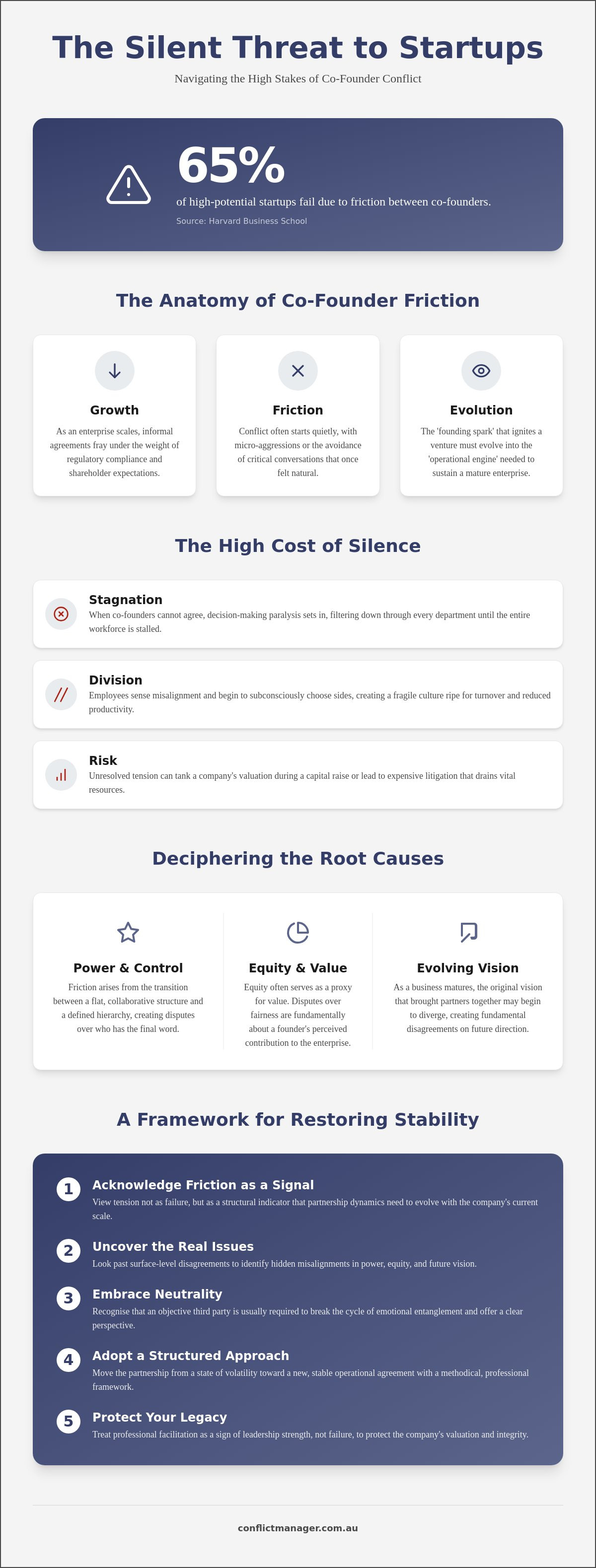
Did you know that 65% of high-potential startups fail because of friction between the people who started them? It's a sobering statistic from Harvard Business School that underscores a difficult truth. While we often focus on market fit or capital, the most significant risk to your organisation's survival is often the internal alignment of its leadership. When you're in the thick of it, resolving conflict between co-founders feels less like a strategic task and more like a battle for the company's soul. You've likely felt that distinct sense of paralysis when misaligned visions stall progress and put investor confidence at risk.
It's a heavy burden to carry, especially when a once-trusted partnership begins to feel like a liability. However, this friction doesn't have to signal the end of your venture. This guide offers a methodical, professional framework for navigating these high-stakes disputes and restoring structural stability to your enterprise. We'll examine how to transition from emotional volatility to operational clarity. By the end, you'll have a sustainable roadmap for communication that protects your assets, secures your legacy, and ensures your business remains a resilient, unified entity.
Key Takeaways
- Growth, friction, and evolution. View tension as a structural signal that your original partnership dynamics need to match the current scale of your organisation.
- Power, equity, and recognition. Identify the hidden misalignment in future vision that often sits beneath surface-level disagreements.
- Objectivity, neutrality, and perspective. Explore why resolving conflict between co-founders usually requires a third party to break the cycle of emotional entanglement.
- Stability, clarity, and performance. Adopt a methodical approach that moves the partnership from a state of volatility toward a new, stable operational agreement.
- Integrity, legacy, and maturity. Protect the company's valuation by treating professional facilitation as a sign of leadership strength rather than a failure of character.
The Anatomy of Co-Founder Friction in the Australian Enterprise
Growth. Friction. Evolution. Conflict isn't a sign of failure; it's often a symptom of success. As an Australian enterprise scales, the informal handshakes that once sufficed begin to fray under the weight of regulatory compliance, tax obligations, and shareholder expectations. In our local market, where reputation is a primary currency, the stakes of resolving conflict between co-founders extend far beyond the boardroom. Friction often starts as a quiet, almost imperceptible erosion. You might notice a sudden reliance on micro-aggressions or a complete avoidance of the critical conversations that once felt natural. If left unaddressed, these disputes don't just dampen morale. They compromise the very structural integrity of the organisation and its standing in the eyes of investors.
The High Cost of Silence
Stagnation. Division. Risk. Hesitation at the executive level acts like a slow-release toxin. When co-founders can't agree, decision-making paralysis sets in, filtering down through every department until the entire workforce is effectively stalled. This often triggers a "factionalism" effect. Employees are intuitive; they sense the misalignment and begin to subconsciously choose sides. This internal division creates a fragile culture that is ripe for turnover and reduced productivity. From a financial perspective, the risks are quantifiable. Unresolved tension can tank a company's valuation during a capital raise or lead to expensive litigation that drains the business of its most vital resources. It's a high price to pay for a lack of objective intervention.
Partnership as a Living Structure
Identity. Role. Governance. The "founding spark" that ignites a venture is rarely the same "operational engine" needed to sustain a mature enterprise. As a business evolves, so must the roles of its leaders. The individual who was perfect for the initial build might not be the right fit for the current phase of governance. Recognising this shift requires a high degree of maturity and a commitment to viewing the partnership as a professional asset rather than a personal identity. Implementing effective conflict resolution strategies is about more than just making peace. It's about re-aligning the leadership structure to support the company's long-term legacy. Resolving conflict between co-founders in this context becomes a deliberate act of stewardship. It ensures the organisation remains unruffled by the inevitable pressures of growth while protecting the interests of all stakeholders involved.
Deciphering the Root Causes: Power, Equity, and Evolving Vision
Intent. Power. Recognition. These are the silent currents beneath every surface-level disagreement. When co-founders argue over a specific hire or a budget allocation, they are rarely debating the task itself. Instead, they are navigating deeper questions of perceived value and future direction. Within the Australian enterprise, these tensions are often magnified by the weight of personal history and the high value placed on professional reputation.
Equity is frequently used as a proxy for value. A dispute over fairness is, at its core, a dispute over perceived contribution. As a business matures, the original vision that brought the partners together may begin to diverge. This leads to a fundamental disagreement on the centre of the company’s future. Successfully resolving conflict between co-founders requires looking past the immediate topic to address these underlying structural shifts with total objectivity.
The Power and Control Dynamic
Who holds the final word? In the early days of a venture, collaborative brainstorming is the default mode. However, as the organisation grows, the need for hierarchical execution creates friction. The transition from a flat structure to a defined hierarchy is rarely smooth. It requires a conscious relinquishing of control that many founders find difficult to navigate. One partner might feel micromanaged; the other might feel excluded from key pivots. These dynamics are often exacerbated by external stakeholders. Investor pressure can shine a harsh light on existing cracks in the relationship, forcing founders to defend their territory rather than the company’s interests. Insights from lessons from a couples therapist highlight how these professional disputes often mirror deep-seated psychological needs for autonomy and recognition.
Misaligned Incentives and Equity
Contribution. Resentment. Balance. The sweat equity debate is a common source of friction. If one founder feels they are carrying a heavier load, the original equity split starts to feel like an injustice. Structural complications like vesting schedules or golden handcuffs can make leaving feel impossible, trapping partners in a cycle of frustration. Restoring the balance usually requires a neutral, external perspective. A professional review of roles and responsibilities is often more effective than a protracted legal battle. Engaging in stakeholder facilitation provides a structured path to re-aligning these incentives, ensuring the partnership remains a functional asset for the business.
The Limits of Internal Resolution: Why Founders Struggle to Self-Correct
Emotion. Bias. Entanglement. When founders reach a stalemate, the instinct is often to push harder on their own narrative. This subjectivity is a natural byproduct of building something from nothing; it's the fuel that drives early-stage innovation. However, when resolving conflict between co-founders, this same passion becomes a significant hurdle. Objectivity is the first casualty of high-stakes friction. Partners often become so entrenched in their version of events that they lose sight of the enterprise's broader needs. They stop being collaborators and start being combatants.
The Trap of Subjectivity
Why do rational executives lose their composure in these moments? It's the "brainchild" effect. When your legacy or your most significant professional achievement is threatened, the logical mind often retreats. You stop asking what is right for the company and start obsessing over who is right. This is where an external facilitator becomes vital. They act as a mirror, reflecting the reality of the situation without the distorting lens of personal history or ego. A neutral third party provides a steady hand, offering a perspective that is unclouded by the years of shared baggage and unspoken resentments.
The Risks of DIY Mediation
Attempting to "have it out" without professional guidance is a dangerous gamble. It often leads to permanent ruptures and irreparable reputational damage within the industry. In the Australian market, where business networks are tightly knit, a public fallout can follow a leader for years. There's also the risk of involving the Board or key investors too early. If the founding team appears incapable of managing their own relationship, stakeholders may lose confidence and trigger unwanted oversight or even a leadership sweep. Using a structured framework for resolving conflict in a confidential, external space allows for the venting of frustrations before they become part of the public record.
Internal resolution efforts also frequently fall into the "Echo Chamber" trap. Founders may subconsciously surround themselves with "yes-men" who validate their grievances rather than challenging them. This often leads to "quasi-bombing campaigns," where each side recruits allies within the staff to bolster their position. This doesn't fix the rift; it merely institutionalises the division. Effectively resolving conflict between co-founders requires breaking this cycle of internal validation and inviting an objective voice to restore order to the leadership structure.
A Structured Framework for Restoring Partnership Stability
Resolution is not a victory; it's a re-calibration. When resolving conflict between co-founders, the objective isn't to determine who was right in the past, but to decide how the partnership will function in the future. A professional mediation process follows a logical, cooling sequence that moves the leadership team from a state of volatility toward a new operational agreement. Central to this process is the Co-Founder Charter, which we define as a living document that codifies roles, communication protocols, and dispute resolution paths. By lowering the collective pulse of the leadership team, founders can finally return to the rational strategic planning their organisation requires.
Step 1: Establishing a Neutral Ground
Clarity requires distance. It's nearly impossible to find a resolution while sitting in the same boardroom where the tension first ignited. A neutral physical and psychological centre, separate from daily operations, is essential. Within this space, we establish strict ground rules: total transparency and the suspension of blame language. The mediator’s role is to create an objective environment where difficult truths can be spoken without triggering defensive posturing or further division.
Step 2: Deconstructing the Dispute
Dissect. Analyse. Reconstruct. We must separate the people from the problem by identifying the structural triggers behind emotional outbursts. Through a Source of Truth exercise, we acknowledge that two different realities can exist simultaneously without one being false. This step involves mapping the impact of the rift, documenting exactly how the conflict is degrading the organisation’s performance and valuation. Identifying these costs helps re-frame the dispute from a personal grievance to a business risk that must be managed.
Step 3: Re-aligning on Vision and Governance
Structure provides safety. We redefine the Shared Goal by asking what success looks like for the business, independent of the founders' personal bond. This often involves updating the Shareholder Agreement or the Co-Founder Charter to reflect the current scale of the enterprise. We establish clear swim lanes, formalising roles to eliminate the friction caused by overlapping authorities. If your leadership team is currently experiencing this kind of structural misalignment, our team at Conflict Manager offers professional stakeholder facilitation to guide you through this transition and restore your company's operational integrity.
Securing the Enterprise: The Role of Professional Facilitation
Maturity. Stewardship. Order. Engaging an external counsellor is not an admission of defeat; it's a sign of leadership maturity. It represents a deliberate commitment to the long-term health of the organisation. Professional facilitation provides a structured path back to stability, ensuring that high-emotion disputes don't become permanent failures. When resolving conflict between co-founders, the goal is to return the enterprise to a state of equilibrium where the focus can shift from internal friction to market performance. This transition requires a steady hand capable of viewing volatile situations with total objectivity.
Sustainable Outcomes over Short-Term Fixes
A "peace treaty" is rarely enough to sustain a business through its next phase of growth. Without ongoing governance frameworks, the same structural triggers will eventually resurface. Sustainable outcomes are only reached when both parties feel heard, respected, and clear on their future path. This is particularly vital during "high-emotion" transitions like buy-outs or leadership successions. By employing professional facilitation, you provide the board and key stakeholders with a sense of security. It demonstrates that the situation is being managed with professional discernment and that the company's asset integrity remains a priority.
Choosing the Right Path Forward
Clarity. Resolution. Legacy. Sometimes the best outcome for the enterprise is a renewed commitment to the partnership. In other cases, the most responsible path is a "conscious uncoupling" that allows the business to thrive under a new leadership configuration. Conflict Manager guides stakeholders through these complex transitions with quiet confidence. We act as a neutral third party, viewing volatile situations with total objectivity to ensure that the preservation of the legacy you've built is never compromised. Our focus remains on the structural integrity of the organisation throughout the entire process.
Resolution is possible when the focus shifts from the friction of the past to the potential of the future. Successfully resolving conflict between co-founders isn't just about ending an argument. It's about securing the structural integrity of your life's work. By choosing a methodical, professional approach, you ensure that the organisation remains resilient, unified, and ready for whatever comes next. The path back to operational clarity is often just one objective conversation away.
Restoring the Foundation of Your Enterprise
Clarity. Resilience. Growth. Navigating the complexities of a professional partnership requires more than just shared history; it demands a robust framework for governance and a commitment to objective resolution. We've explored how friction often signals a need for structural evolution rather than a failure of character. By deconstructing disputes and re-aligning on vision, you protect the very asset you've worked so hard to build. It's about moving from a state of volatility toward a sustainable operational agreement that secures your company's market position.
Internal efforts often struggle under the weight of shared baggage and emotional subjectivity. This is where a neutral third party provides the steady hand necessary to lower the collective pulse and restore operational focus. Resolving conflict between co-founders through expert-led facilitation ensures that high-emotion transitions are managed with total objectivity and professional discernment. At Conflict Manager, we specialise in providing neutral facilitation that leads to sustainable outcomes for Australian enterprises. Whether the path forward involves a renewed partnership or a strategic exit, our focus remains on preserving the integrity of your organisation's legacy.
Restore clarity to your partnership with Conflict Manager. You've built something extraordinary. Now, ensure its future is as stable and resilient as its founding vision.
Frequently Asked Questions
Is co-founder mediation different from regular business mediation?
Co-founder mediation is distinct because it addresses the intersection of interpersonal dynamics and fiduciary duty. Traditional business mediation often focuses on transactional disputes between separate entities. Resolving conflict between co-founders requires a deeper analysis of the shared vision and the structural evolution of the partnership. It's about re-aligning the founding spark with the operational engine needed for your current scale.
Can a co-founder dispute be resolved if trust is completely broken?
Resolution is possible even when trust feels irreparable. However, the definition of success may shift from a re-marriage to a structured, professional separation. Facilitation provides a neutral space to determine if the partnership can be re-organised or if a conscious uncoupling is the best way to protect the company's valuation. The priority remains the integrity of the business asset and its future legacy.
How long does the co-founder resolution process typically take?
The timeframe depends on the complexity of the organisational structure and the depth of the misalignment. Most processes involve an initial intake followed by several focused sessions over a few weeks. This allows for the cooling of high emotions and the careful drafting of a new Co-Founder Charter. It's a deliberate pace designed to ensure sustainable outcomes rather than a rushed, temporary fix.
What happens if we cannot reach an agreement through facilitation?
If facilitation doesn't lead to a consensus, the process still provides value by clarifying the points of impasse. You'll have a documented understanding of the rift, which helps when moving toward formal legal paths or buy-out clauses. It ensures that if you must take the nuclear option, you've exhausted all objective avenues first. This protects your reputation with the board and your investors.
Should we involve our lawyers before seeking professional mediation?
While you should understand your legal standing, involving lawyers too early can sometimes harden positions and escalate tension. Resolving conflict between co-founders is often more effective when partners can speak openly in a confidential, non-adversarial environment. Mediation allows you to find a commercial solution before the dispute becomes a matter of public record or a permanent legal record.
How do we tell our board or investors that we are seeking mediation?
Frame the conversation as a proactive step toward leadership alignment or governance maturity. Investors value founders who can identify and manage risks to the business. Presenting mediation as a strategic tool to ensure long-term stability is far more reassuring than waiting until a total rupture occurs. It demonstrates that you're prioritising the company's health over personal grievances.
What is the cost of professional conflict resolution for co-founders?
The investment in professional facilitation is a fraction of the cost of a failed enterprise or a protracted legal battle. While specific fees vary based on the scope of the engagement, the focus should be on the preservation of asset integrity. Protecting your valuation and legacy from the fallout of an unresolved dispute is a critical strategic decision for any high-net-worth stakeholder.
Can mediation help with equity and shareholding disputes between partners?
Mediation is an ideal forum for equity disputes because it looks beyond the numbers to the underlying perceived contribution. Partners often use equity as a proxy for recognition and value. Facilitation allows you to deconstruct these resentments and re-align incentives in a way that feels fair and sustainable. It often results in updated Shareholder Agreements that reflect the current reality of each founder's role.


