

Clarity. Precision. Integrity. The most significant risk to your enterprise isn't a market shift or a regulatory change; it's the quiet erosion of value that occurs when internal friction remains unresolved. When business partners or family office stakeholders reach a point of departure, the instinct is often to retreat into legal silos. However, with contested court matters often costing upwards of $50,000 per party, the financial toll can be as damaging as the emotional one. A structured business separation mediation process offers a more composed alternative. It's a path designed to decouple interests with dignity, ensuring that the structural integrity of your assets remains intact while you navigate the complexities of transition.
We understand the weight of this responsibility. It's natural to feel the pressure of potential reputational damage and the exhaustion that comes from protracted internal conflict. You're seeking a resolution that's both legally sound and professionally sustainable. This article will show you how a methodical mediation framework provides the clarity needed to separate assets, protect your professional standing, and allow all parties to move forward with their capital and reputations preserved.
Key Takeaways
- Understand how a structured, confidential forum provides the distance required to negotiate a professional decoupling with objectivity and poise.
- Navigate the five methodical stages of the business separation mediation process to move your organisation from internal friction toward a state of resolution.
- Explore the advantages of surgical asset division over litigation, ensuring the core value of the business is preserved rather than eroded by legal fees.
- Identify the strategic preparation required to align your financial data and emotional state, setting the foundation for a successful and dignified exit.
- Learn how expert facilitation acts as a steady hand, helping stakeholders restore stability and protect their long-term professional reputations.
What is the Business Separation Mediation Process in Australia?
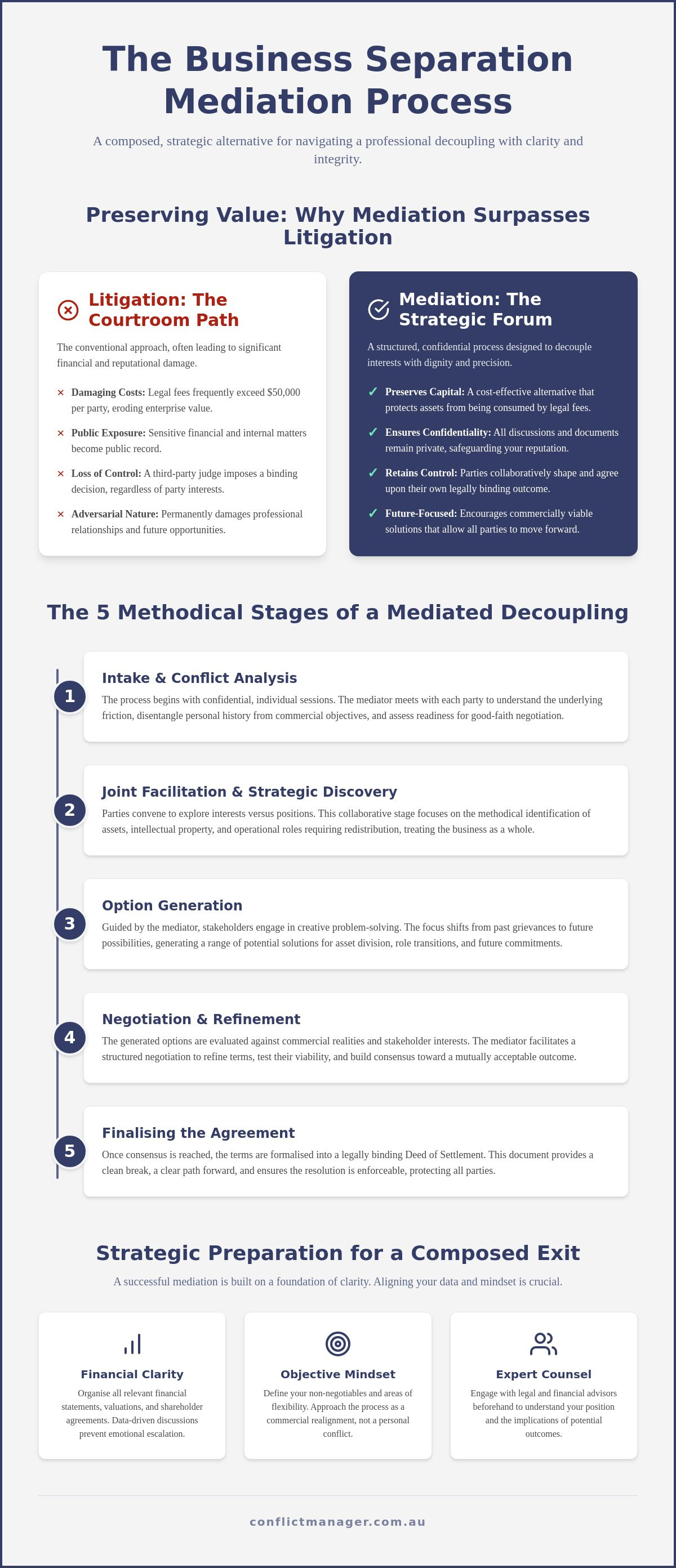
Structure creates safety. When stakeholders decide to move in different directions, the absence of a clear framework can lead to the rapid erosion of enterprise value; mediation provides the necessary architecture to prevent this. The business separation mediation process is a structured, confidential forum where partners negotiate the terms of their professional decoupling without the public exposure or cost of a courtroom. Business separation mediation is a strategic alternative to litigation that prioritises asset integrity.
This process is voluntary and facilitated by an objective expert who understands both the cold logic of a balance sheet and the heat of interpersonal friction. Through the lens of Mediation, parties are encouraged to view the transition as a commercial realignment rather than a personal defeat. The goal is a binding agreement reached through consensus, allowing the parties to retain control over the outcome instead of handing that power to a judge.
The Distinction Between Business and Marital Separation
Clarity is often clouded when the lines between personal and professional life blur. Unlike a marital split, business mediation requires a rigorous focus on shareholder agreements, director duties, and corporate governance. We look at the movement of roles and the redistribution of equity with surgical focus. In a family office or a closely held partnership, the emotional register is high, yet the resolution must remain grounded in commercial reality. We prioritise the structural integrity of the business, ensuring that the decoupling doesn't compromise the entity's ability to function or its legacy within the Australian market.
The Legal Framework for Mediation in Australia
The Australian commercial landscape increasingly relies on Alternative Dispute Resolution (ADR) to manage complex transitions. As of 2026, ADR standards emphasise procedural efficiency and the preservation of capital. Once a resolution is reached, the mediated terms are typically formalised into legally binding deeds of settlement. These documents provide a clean break and a clear path forward. Confidentiality remains a cornerstone of this framework; it protects your brand reputation and ensures that sensitive financial data doesn't become a matter of public record. This privacy is often the most valuable asset preserved during the entire process.
The 5 Key Stages of a Mediated Business Decoupling
Order. Sequence. Resolution. A successful business separation mediation process is not a singular event but a methodical journey. It's designed to lower the pulse of the dispute through a logical sequence; ensuring all stakeholders feel heard while maintaining focus on the structural endgame. Guided by a steady hand, this progression prevents the process from stalling on minor grievances and moves the parties toward a vision of structural clarity. Every successful resolution follows this methodical progression from disruption to clarity.
Intake and Conflict Analysis
The process begins with individual intake sessions. The mediator meets with each party separately to understand the underlying friction that has led to the current impasse. This is a period of deep analysis. We identify the abstract nouns at play: control, legacy, security, and autonomy. For family offices in Australia, this stage is particularly vital as it disentangles personal history from commercial objectives. We assess the readiness of stakeholders to engage in good-faith negotiation, ensuring that the foundation for the coming sessions is stable and objective.
Joint Facilitation and Strategic Discovery
Once the individual perspectives are understood, the parties move into joint facilitation. This stage starts with opening statements that establish a thematic foundation for the resolution. It moves beyond the binary of "who is right" and focuses instead on the methodical exploration of interests versus positions. Understanding the principles of Alternative Dispute Resolution (ADR) allows stakeholders to see the value in this collaborative discovery. We identify the specific assets, intellectual property, and operational roles that require redistribution, treating the business as a living entity that needs a surgical realignment. This discovery phase ensures no stone is left unturned before moving toward a final agreement.
Option Generation and Finalising the Agreement
Creativity often surfaces when the threat of litigation is removed. During option generation, we brainstorm exit strategies that legal representatives in a courtroom might overlook. These are bespoke solutions tailored to the unique needs of the Australian commercial landscape. We draft a sustainable outcome that ensures future organisational stability and protects the family legacy. The transition from a verbal agreement to a formalised, written settlement is the final act of this process. It provides the legal certainty required for all parties to move forward. If your organisation is facing such a transition, engaging in stakeholder facilitation can provide the steady hand needed to reach this conclusion.
Preserving Asset Integrity: Why Mediation Surpasses Litigation
Efficiency. Discretion. Stability. These are the hallmarks of a managed exit. Litigation is an inherently destructive process that often consumes the very value parties are fighting over; it's an adversarial system designed for winners and losers, not for the preservation of complex asset structures. In contrast, the business separation mediation process allows for surgical precision. It separates interests without the collateral damage typical of a public legal battle. By resolving disputes behind closed doors, stakeholders can maintain business-as-usual operations, ensuring that the enterprise's structural integrity remains uncompromised while the details of the decoupling are refined. The mediator acts as an authoritative expert, a steady hand who protects the entity from the volatility of internal friction.
The Cost of Public Friction
Public records are permanent. In a litigious environment, the exposure of internal disputes can damage future investment opportunities or erode hard-won client trust. The financial drain is equally significant. In Australia, a contested matter can cost between $50,000 and $200,000 per party to take through the court system, a figure that dwarfs the investment required for a facilitated resolution. Mediation is a premium, bespoke service that offers a higher ROI on resolution. It avoids the exhaustive costs of discovery and the high fees of expert witnesses that often inflate legal bills without adding genuine value to the final settlement. Choosing a private forum ensures that your financial data and strategic vulnerabilities remain confidential, protecting your brand from the prying eyes of competitors or the media.
Control and Autonomy in Decision Making
In a courtroom, a judge acts as an outsider who decides your future based on rigid legal templates. In mediation, you retain the pen. This autonomy allows for the flexibility to craft outcomes that suit specific family office or corporate needs that a court might simply ignore. By following the guidelines for a successful business divorce mediation, parties focus on sustainable outcomes rather than short-term tactical wins. Because the agreement is co-created, stakeholders are significantly more likely to adhere to the terms without future conflict. This sense of ownership transforms a potentially bitter exit into a professional transition. It ensures that the finality of the agreement is respected, allowing all parties to move forward with their capital and their dignity intact.
Strategic Preparation for a Composed Exit
Preparation. Diligence. Composure. These are the pillars of a successful transition. Success in the business separation mediation process is often determined before the first joint session begins. It requires a dual commitment to structural accuracy and emotional regulation. Stakeholders must prepare both their financial data and their emotional register to ensure the conversation remains productive rather than reactive. Approaching the table with a sense of quiet confidence, rather than defensive posturing, allows for a more fluid navigation of complex terms. As a prerequisite, stakeholders should compile all relevant shareholder agreements, financial statements, and historical tax records to establish a shared baseline of truth.
Gathering the Essential Documentation
A shared understanding of the facts prevents the process from stalling on technicalities. This involves a meticulous review of trust deeds, partnership agreements, and recent valuation reports. We often find that "grey areas" in existing contracts, where language is silent or ambiguous, become the primary focal points for negotiation. Identifying these gaps early allows the mediation to serve as a tool for clarification rather than a source of further confusion. Ensuring all parties have access to the same baseline of information fosters a sense of transparency. It reduces the suspicion that often accompanies high-stakes decoupling and allows the focus to remain on the movement of assets and the redistribution of equity.
Managing the Psychological Register
The weight of responsibility is significant. We acknowledge the friction that naturally arises from long-term partnerships, where personal history and professional goals are deeply entwined. Strategies for remaining unruffled during high-stakes discussions are as important as the financial data itself. This is where the role of the mediator becomes critical. By viewing volatile situations with total objectivity, the mediator acts as a steady hand that keeps the dialogue grounded in logic. If you find that internal efforts are struggling under the pressure of interpersonal dynamics, engaging in professional organisational conflict management can provide the external perspective needed to move from complexity toward a vision of structured resolution. This psychological readiness ensures that when difficult decisions arise, they're met with discernment rather than entitlement.
Restoring Stability through Expert Facilitation
Stability. Continuity. Resolution. The conclusion of a separation is not merely a legal finality; it marks the beginning of a new phase of organisational or family life. While the path to decoupling can feel volatile, a structured business separation mediation process ensures that the transition is managed with precision. Conflict Manager acts as the neutral third party that brings clarity to clouded situations, allowing stakeholders to view their future through an objective lens. Our approach focuses on guiding you through the resolution process to reach sustainable outcomes that protect both the family legacy and the commercial enterprise. It's a call to move from a state of complexity toward a vision of structured resolution.
When to Engage a Professional Mediator
Timing is critical. There are clear signs that internal efforts are struggling under the pressure of high stakes: circular arguments, defensive posturing, and a palpable erosion of trust. When internal friction begins to compromise daily operations, it's time to seek external intervention. A seasoned professional remains neutral in the face of high emotion, providing a steady hand that internal stakeholders often cannot maintain. Engaging early prevents a temporary disruption from becoming a total collapse. It allows for a surgical separation of interests before the value of the business is irreparably damaged by protracted conflict. We often see that waiting too long increases the financial and emotional toll, making the eventual resolution more complex than it needed to be.
The Path Forward with Conflict Manager
Our commitment is to provide a steady hand during periods of high stress. We facilitate communication between stakeholders to achieve clarity, ensuring that every voice is heard while the focus remains on the structural endgame. This methodical progression lowers the pulse of the dispute and builds a foundation for long-term stability. By acting as a wise, external counselor, we view volatile situations with total objectivity. This allows us to navigate the friction of interpersonal dynamics without becoming emotionally entangled in them. If you're ready to move toward a sustainable outcome, consult with a Conflict Manager expert today. We provide the expertise required to navigate these difficult transitions with dignity and structural integrity, ensuring you can move forward with total clarity.
Achieving Structural Clarity through Facilitated Transition
Order. Clarity. Resolution. Navigating a professional decoupling requires more than just legal documentation; it demands a steady hand capable of preserving the structural integrity of your enterprise. By choosing a business separation mediation process, you opt for a path that prioritises asset protection and professional dignity over the destructive nature of public litigation. We've explored how a methodical five-stage framework and strategic preparation can transform a state of disruption into a sustainable new beginning.
Conflict Manager provides composed, objective facilitation for complex disputes, specifically tailored for high-net-worth families and family offices across Australia. Our expert-led mediation focuses on organisational stability, ensuring that the legacy you've built remains uncompromised by internal friction. This process allows stakeholders to decouple interests with surgical precision while maintaining the continuity of their commercial operations. It provides the distance necessary to view volatile situations with total objectivity.
Secure a sustainable resolution for your business separation and move forward with the confidence that your interests are protected. You don't have to manage this transition alone; clarity is within reach.
Frequently Asked Questions
How long does the business separation mediation process typically take?
The duration of a business separation mediation process depends largely on the complexity of the asset structure and the readiness of the parties to engage. Most commercial disputes reach a resolution within two to four weeks of the initial intake sessions, often culminating in one or two full days of joint facilitation. This is a stark contrast to the court system, where matters can languish for eighteen months or longer before a trial date is even set.
Is a mediated business settlement legally binding in Australia?
A mediated settlement becomes legally binding once it is formalised into a written deed of settlement or a court-filed consent order. While the discussions themselves are privileged, the final signed document is a contract that can be enforced in an Australian court. This ensures that the structural clarity achieved during the sessions is permanent and provides all stakeholders with the legal certainty required to move forward with their respective interests.
What happens if one partner refuses to cooperate in mediation?
Mediation is a voluntary process that requires the good-faith participation of all stakeholders. If one partner refuses to engage, the process cannot move forward. In such instances, we often suggest individual intake sessions to address specific anxieties or misconceptions about the process. A neutral third party can help reluctant partners understand that avoiding the business separation mediation process often leads to more destructive, public, and expensive legal outcomes that erode the value they wish to protect.
How does mediation protect the reputation of a family office?
Privacy is the primary shield for a family office during a separation. Unlike litigation, where affidavits and financial disclosures become part of the public record, mediation is entirely confidential. This prevents competitors, the media, or the public from accessing sensitive data about the family's wealth or internal friction. By resolving disputes behind closed doors, you maintain your professional standing and ensure that your brand's reputation remains untarnished by the decoupling.
Can our lawyers be present during the mediation sessions?
Stakeholders are encouraged to have their legal representatives present or available for consultation during the sessions. While the mediator facilitates the communication and manages the psychological register, lawyers ensure that any proposed agreement is legally sound and protects their client's specific interests. This collaborative approach ensures that the final resolution is both sustainable and legally robust, allowing for a clean break that satisfies all corporate governance requirements.
How much does business mediation cost compared to going to court?
Mediation represents a significant cost saving when compared to the exhaustive financial drain of the court system. In Australia, a contested commercial matter can easily cost each party over $50,000 in legal fees alone, whereas mediation involves a more predictable investment in professional facilitation. By choosing a private forum, you avoid the high costs of discovery and expert witnesses, ensuring that more of the business's capital remains with the stakeholders rather than being consumed by legal overheads.
Is the mediation process completely confidential?
Confidentiality is a cornerstone of the Australian mediation framework. Statements made during the process are protected by "without prejudice" privilege, meaning they cannot be used as evidence in future court proceedings. This legal protection encourages stakeholders to speak candidly and explore creative exit strategies without the fear of tactical disadvantage. This safe environment is essential for resolving the complex human and structural dynamics that define high-stakes business separations.
What is the role of the mediator in a shareholder dispute?
In a shareholder dispute, the mediator acts as a neutral third party who manages the friction between competing interests. They don't provide legal advice or impose a decision; instead, they facilitate a methodical progression toward a consensus. By viewing the situation with total objectivity, the mediator helps identify the underlying needs of each shareholder, such as autonomy or financial security, and guides the group toward a resolution that preserves the integrity of the organisation.


