

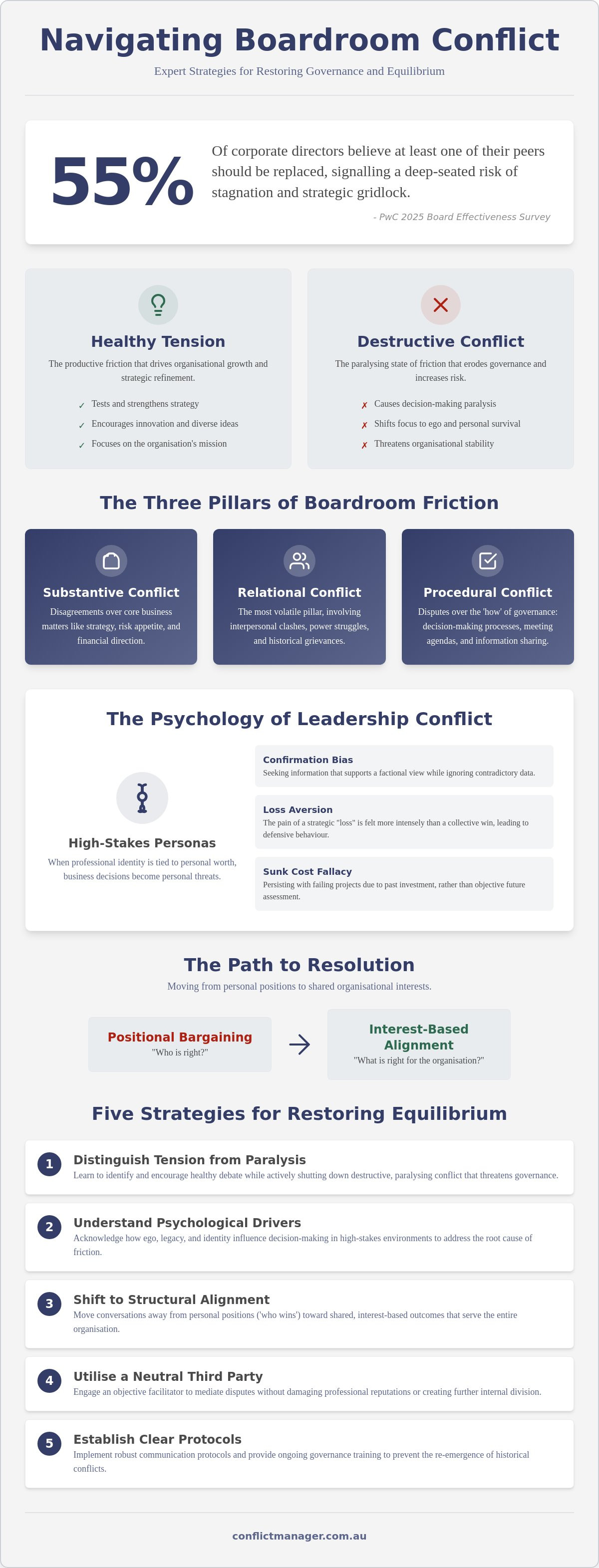
Stagnation. Gridlock. Risk. When 55% of corporate directors admit that at least one of their peers should be replaced, the veneer of boardroom unity begins to thin. This 2025 PwC survey finding highlights a reality where personal friction and strategic gridlock threaten the very legacy you've worked to build. Implementing effective board of directors conflict resolution strategies is no longer about simple mediation; it's about restoring a sense of order and functional governance before internal disputes paralyse decision-making.
You likely understand the heavy weight of these high-stakes environments, where a single impasse can ripple through every level of the organisation. It's exhausting to manage brilliant minds when their alignment has fractured. This article provides sophisticated, expert-led strategies to navigate these volatile disputes and restore equilibrium to your boardroom. We'll explore the movement from positional bargaining toward structural alignment, ensuring your assets and reputation remain protected through methodical, objective intervention.
Key Takeaways
- Learn to distinguish between the healthy tension that drives innovation and the destructive paralysis that threatens your organisation's governance.
- Understand the psychological drivers behind leadership friction; particularly how ego and legacy influence decision-making in high-stakes environments.
- Discover expert-led board of directors conflict resolution strategies that shift focus from positional bargaining toward interest-based structural alignment.
- Assess the value of a neutral third party in providing the objectivity required to resolve disputes without damaging professional reputations or assets.
- Establish clear communication protocols and ongoing governance training to prevent the re-emergence of historical conflicts and secure the organisation's future.
Defining Boardroom Conflict: Beyond Simple Disagreements
Boardroom conflict is a structural breakdown in communication that requires objective recalibration. It's rarely about a single disagreement. Instead, it's a state of persistent friction that prevents a board from fulfilling its governance obligations. In the Australian context, this is particularly complex. Directors must balance strict statutory duties with the nuance of long-standing interpersonal relationships. When this balance tips, the board ceases to function effectively. Stagnation follows. Risk increases. The organisation's legacy begins to erode under the weight of indecision.
Distinguishing between healthy tension and destructive conflict is vital for any chair or director. Healthy tension drives innovation. It's the rigorous debate that tests a strategy before it's implemented. Destructive conflict, however, causes paralysis. It moves the focus from the organisation's mission to personal survival or ego preservation. At this stage, standard board of directors conflict resolution strategies must move beyond simple mediation. They must address the underlying structural integrity of the group within the broader framework of Corporate Governance to ensure long-term stability.
The Three Pillars of Boardroom Friction
- Substantive conflict: These are disagreements over the core business. Disputes regarding strategy, risk appetite, or financial direction fall into this category. While they feel professional, they can quickly become personal if not managed with objectivity.
- Relational conflict: This is the most volatile pillar. It involves interpersonal clashes, power struggles, and historical grievances. In family offices or long-tenured boards, these issues often simmer for years before boiling over during a crisis.
- Procedural conflict: These disputes centre on the "how" rather than the "what". They involve disagreements over decision-making processes, information sharing, or how meeting agendas are set.
Why Boards Struggle to Resolve Internal Disputes
Internal efforts often fail because of the "echo chamber" effect. Insular board cultures can amplify minor disagreements, turning a small rift into a chasm. The weight of responsibility also plays a significant role. When directors manage high-value assets, the pressure triggers defensive behaviours. They stop listening and start protecting their positions. Many boards find that their internal bylaws are insufficient when emotions are high. These documents are designed for orderly governance, not for the messy reality of human friction. When internal mechanisms reach their limit, board of directors conflict resolution strategies require a steady, neutral hand to restore order and clarity.
The Psychology of Leadership Team Conflict
Pride. Identity. Responsibility. These are the silent architects of boardroom friction. Leaders in high-stakes environments often develop a specific "High-Stakes Persona" where their professional influence is inextricably linked to their personal sense of worth. When structural changes or strategic shifts occur, these individuals don't just see a business pivot; they perceive a threat to their standing. This psychological friction is why many internal efforts at resolution fail. The dispute isn't about the balance sheet; it's about the fear of losing relevance in a space they helped create.
In multi-generational boardrooms or family offices, this is amplified by the weight of legacy. Ego often disguises itself as stewardship. A director might fight a necessary divestment not because the corporate logic is flawed, but because it feels like a betrayal of a previous generation's vision. Effective board of directors conflict resolution strategies must facilitate a shift from "who is right" to "what serves the organisation's integrity". This transition requires a level of emotional detachment that is difficult to achieve without expert stakeholder facilitation to bridge the gap between personal history and future strategy.
Cognitive Biases in the Boardroom
- Confirmation bias: Directors often subconsciously seek information that supports their factional view, effectively filtering out data that contradicts their preferred narrative.
- Loss aversion: The psychological pain of losing a strategic "battle" is often twice as powerful as the joy of a collective win. This leads directors to fight harder for failing strategies than they would for new opportunities.
- The Sunk Cost fallacy: Boards frequently persist with long-term projects that no longer serve the organisation simply because of the significant capital and reputation already invested.
The Impact of High Emotion on Decision-Making
High-stress environments narrow the cognitive focus. When the "fight or flight" response is triggered during a heated meeting, the brain's ability to consider creative alternatives diminishes. This is where the Chairperson's emotional intelligence becomes a critical asset. Their role is to create a space for composed dialogue amidst volatility, ensuring that the board moves toward constructive conflict resolution strategies rather than retreating into defensive silos. By acknowledging the emotional weight of the decision, a leader can lower the collective pulse of the room. This measured approach allows for the objective application of board of directors conflict resolution strategies, moving the board from a state of reactive friction to one of structured stability.
Strategic Frameworks for Board Resolution
Clarity. Accountability. Alignment. These are the structural pillars that support effective board of directors conflict resolution strategies. While the psychological drivers of friction are complex, the frameworks used to resolve them must be methodical and transparent. Most boardroom disputes stall because directors engage in "Position-Based" negotiation; they dig into a specific demand or outcome. A more sophisticated approach is "Interest-Based" resolution. This framework peels back the surface-level demand to identify the underlying need, whether that is risk mitigation, asset protection, or long-term growth. By focusing on shared interests rather than competing positions, the board can find a path forward that serves the organisation's integrity.
Internal Governance Mechanisms
The first line of defence is always internal. A robust Board Charter acts as the primary reference point, clarifying roles and responsibilities to prevent the "mission creep" that often fuels procedural conflict. When friction occurs between the Chairperson and the CEO, the Lead Independent Director serves as a vital circuit breaker. They provide a neutral internal voice that can de-escalate personal tension before it reaches the public domain. Regular, formal board performance reviews are also essential. These shouldn't be tick-box exercises. Instead, they should be used to identify systemic issues in communication or decision-making before they manifest as a crisis. Structuring board meetings to pre-emptively manage friction is equally critical. This involves setting clear agendas that allow for rigorous debate without allowing any single director to dominate the floor, ensuring all stakeholders feel heard without compromising the schedule.
External Mediation: The Neutral Perspective
There is a point where internal efforts become counter-productive. This impasse is often reached when the same arguments repeat in a loop, or when the "echo chamber" effect makes objective analysis impossible. At this stage, external stakeholder facilitation is required. A neutral third party brings total objectivity to a volatile environment. They aren't entangled in the historical grievances or the ego-driven personas that often derail internal mediation. The facilitation process creates a structured environment where difficult conversations can occur without the risk of further fracturing the board. Recognising the point of impasse early is a hallmark of a seasoned Chairperson. It's the moment they realise that the board's internal resources have been exhausted and that the risk of reputational damage is now higher than the cost of intervention. Implementing external board of directors conflict resolution strategies is often the only way to achieve sustainable outcomes that preserve the organisation's legacy and protect its high-value assets.
Five Essential Strategies for Restoring Boardroom Equilibrium
Disruption. Paralysis. Recalibration. These are the stages of a board in transition. Moving from a state of friction toward one of clarity requires more than just a change in agenda; it demands a fundamental shift in how the group interacts with its own authority. When implementing board of directors conflict resolution strategies, the primary goal is the restoration of structural stability. Successful resolution is measured not by the absence of disagreement, but by the integrity of the decision-making process. This commitment to objectivity ensures that the organisation's legacy remains intact even when personal opinions diverge.
1. Re-establishing the Shared Objective
Mission. Duty. Legacy. These three concepts provide the foundation for any successful intervention. When disputes become entrenched, directors often lose sight of their primary fiduciary duties. The first step in restoring equilibrium is a return to the core mission. This involves a formal values alignment session where personal grievances are explicitly separated from the organisation's strategic needs. By refocusing on the long-term health of the firm, the board can move past the immediate friction of individual egos. This process isn't about forced agreement; it's about acknowledging that the organisation's survival outweighs any single director's preference.
2. Implementing Structured Communication Protocols
Information is power, and its uneven distribution is a frequent source of boardroom heat. To prevent asymmetric information disputes, the board must define exactly how and when data is disseminated. This includes setting rigid ground rules for respectful dissent during meetings. If a debate becomes too volatile, the Chairperson should trigger a mandatory "cooling-off" period. Pausing a decision for 48 hours allows emotions to settle and cognitive biases to lose their grip. This measured pace prevents reactive choices that could lead to reputational risk or financial loss.
3. Leveraging Neutral Facilitation
Internal efforts often reach a natural limit when history and hierarchy are involved. At this point, engaging a professional mediator is the most responsible course of action. A neutral party can employ "shuttle diplomacy", meeting with individual stakeholders to understand their concerns before the full board reconvenes. This ensures every voice is heard without allowing a single faction to dominate the room. For boards managing high-value assets, professional stakeholder facilitation provides the steady hand needed to navigate these complex interpersonal dynamics with total objectivity.
4. Defining Accountability and Boundaries
Conflict often stems from a lack of clarity regarding where one role ends and another begins. Restoring order requires a precise re-evaluation of the Board Charter. By clearly documenting the boundaries of authority for the Chairperson, CEO, and independent directors, you remove the ambiguity that fuels power struggles. This structural realignment ensures that every member understands their specific contribution to the collective governance effort.
5. Integrating Scenario-Based Risk Planning
Heightened geopolitical and economic risks are now permanent fixtures on the board agenda. According to the "What Directors Think 2026" report, 84% of boards have changed their approach to scenario planning in the last five years. By incorporating potential conflict scenarios into regular risk assessments, the board can develop pre-emptive board of directors conflict resolution strategies. This proactive approach turns potential friction into a manageable business risk rather than an emotional crisis.
Securing the Future: Moving from Conflict to Stability
Stability. Integrity. Continuity. These are the markers of a board that has successfully navigated a period of friction and emerged with a renewed sense of purpose. Reaching a resolution is a significant milestone, yet the true value lies in the subsequent preservation of that equilibrium. To ensure the dispute does not re-emerge, boards must formally document the outcomes of their board of directors conflict resolution strategies. This isn't about assigning blame; it's about creating a clear, structural record of the agreed-upon path forward. By integrating these outcomes into the permanent governance record, the board provides a reference point for future directors, effectively immunising the organisation against the return of historical grievances.
Moving toward sustainable stability requires a shift in perspective. Resolution is not a one-time event, but a strategic investment in the organisation's longevity. Leading Australian boards are now incorporating specialised conflict management into their ongoing governance training. This proactive approach ensures that directors are equipped with the tools to identify and de-escalate friction before it reaches a point of impasse. It transforms conflict from a threat to be feared into a manageable dynamic within the broader framework of strategic oversight. When resolution is treated as a core competency rather than a crisis response, the board's capacity for complex decision-making is significantly enhanced.
The Role of Professional Mediation in Australia
Conflict Manager acts as the steady hand for high-net-worth families and complex organisations during these critical transitions. Our approach is defined by a sense of quiet authority, providing the total objectivity required to view volatile situations without emotional entanglement. We understand the weight of responsibility that comes with managing significant assets and legacies. By acting as a neutral third party, we help restore the sense of order necessary for effective governance, ensuring that structural integrity is maintained even in the most high-stakes environments. This external perspective is often the only way to bridge the gap between entrenched factions and a unified strategic vision.
Next Steps for the Board
Once the immediate friction has subsided, the board should conduct a post-resolution audit of its culture. This is an opportunity to assess whether the new communication standards are being upheld and to identify any remaining pockets of resistance. Governance documents, such as the Board Charter or communication protocols, should be updated to reflect these improved standards. These updates serve as a tangible commitment to a more functional future. If your board is currently experiencing strategic gridlock or interpersonal friction, reaching out for external guidance is a mark of professional discernment. Contact Conflict Manager for a confidential discussion on board facilitation to begin the process of restoring your boardroom's equilibrium and securing your organisation's legacy.
Restoring the Foundations of Governance
Restoring the foundations of governance requires a shift from personal friction to structural alignment. We've explored how identifying cognitive biases and implementing interest-based frameworks can move a board from gridlock toward clarity. Effective board of directors conflict resolution strategies don't just solve a single dispute; they protect the organisation's legacy and its assets from the volatility of human dynamics. This transition from disruption to order is essential for maintaining the trust of shareholders and stakeholders alike.
Clarity. Order. Resolution. Conflict Manager provides the steady hand required for these high-stakes transitions. We're specialists in high-net-worth family office disputes and complex organisational restructuring. Our team brings a composed, neutral approach to high-emotion environments, viewing volatile situations with total objectivity. Stability is the goal. We understand that the weight of responsibility can be heavy, but it's manageable with the right facilitation. Secure your board's future with expert facilitation from Conflict Manager. By choosing to address friction now, you ensure the long-term stability and success of your organisation's mission.
Frequently Asked Questions
What are the most common causes of board of directors conflict in Australia?
Divergent views on risk appetite, particularly regarding emerging technologies like AI and geopolitical volatility, are primary drivers of friction in Australian boardrooms. Disagreements often centre on the execution of strategy rather than its development. When directors fail to align on the organisation's risk tolerance, the result is strategic gridlock. Implementing proactive board of directors conflict resolution strategies ensures these differences of opinion remain constructive debates rather than becoming destructive disputes that threaten the organisation's stability.
How do you deal with a difficult board member who is also a major shareholder?
Managing a difficult board member who holds significant equity requires a clear separation of their shareholder rights from their fiduciary duties as a director. While they may have a large stake, their legal obligation is to act in the best interests of the company as a whole. A neutral facilitator can help navigate this power dynamic by refocusing the conversation on shared outcomes. This objective approach prevents the individual's influence from overbearing the board's collective governance responsibilities.
When should a board consider hiring an external mediator instead of resolving things internally?
A board should engage an external mediator when internal efforts lead to a repetitive cycle of arguments or when personal grievances have clouded objective decision-making. If the Chairperson is personally involved in the dispute, internal resolution becomes impossible. External intervention provides the total objectivity required to view volatile situations without emotional entanglement. It's a strategic choice to protect the organisation's assets and reputation before a boardroom rift becomes a public crisis.
Can a Chairperson be removed if they are the source of the conflict?
Yes, a Chairperson can be removed, though the process is governed by the company's constitution and the Corporations Act. Typically, the board or the shareholders can vote to replace the Chair if their leadership has become the primary source of conflict. In these sensitive situations, the Lead Independent Director often manages the transition to ensure it doesn't cause further disruption. It's a serious step that requires careful documentation and a focus on restoring boardroom equilibrium.
What is the difference between mediation and arbitration for boardroom disputes?
The primary difference lies in control and the nature of the outcome. Mediation is a collaborative process where a neutral facilitator helps the parties reach their own mutually agreeable resolution. It's private and focuses on preserving relationships. Arbitration, however, is a more formal, adversarial process where an independent third party makes a binding decision for the board. Most boards prefer mediation because it allows for more nuanced, sustainable outcomes that protect the firm's legacy.
How does board conflict impact the organisation's fiduciary duties?
Persistent boardroom conflict often leads to a failure of oversight, which can be viewed as a breach of fiduciary duties. When a board is paralysed by friction, it cannot effectively monitor risk or execute strategy. This stagnation leaves the organisation vulnerable to financial loss and regulatory scrutiny. Utilising expert board of directors conflict resolution strategies is a key part of fulfilling your duty to act with care and diligence, ensuring the company remains functional and secure.
How can family offices manage conflict when business and family roles overlap?
Family offices must establish clear boundaries between family dynamics and business governance to manage overlap effectively. This often involves creating a family council to handle interpersonal issues, leaving the board to focus strictly on commercial strategy and asset protection. Successful families use external facilitators to navigate these high-emotion environments. This structured approach ensures that family grievances don't derail the professional management of the family's assets or the organisation's long-term stability.
What steps can be taken to prevent conflict before it reaches a crisis point?
Prevention starts with regular board performance reviews and a robust Board Charter that clearly defines roles and boundaries. Boards should also engage in scenario-based risk planning to prepare for potential disputes before they occur. Cultivating a culture of transparency where potential conflicts are disclosed early is also vital. By building these protocols into the ongoing governance programme, the board creates a resilient structure that can absorb healthy tension without descending into destructive conflict.


