

Stagnation. Friction. Uncertainty. Approximately 70% of business partnerships eventually fail, a statistic that often begins with the quiet, persistent realisation that the original vision has fractured. It’s a heavy burden to carry, especially when the fear of destroying a family legacy or hard-earned business value starts to outweigh the drive for growth. You’re likely wondering what happens when business partners want different things, feeling the drain of constant friction and the paralysis that comes when every decision becomes a battleground.
We understand that this tension isn’t a failure of character, but a natural structural transition that requires a steady, objective hand to navigate. You deserve a clear path forward that protects your reputation and restores operational stability to the organisation. This article explores how professional mediation and stakeholder facilitation can transform partnership friction into structural clarity; providing you with the tools to decide whether to move forward together or part ways with dignity.
Key Takeaways
- Recognise that strategic divergence is often a natural evolution of a maturing Australian business rather than a sign of leadership failure.
- Understand what happens when business partners want different things, particularly when individual goals like retirement or liquidity conflict with long-term growth.
- Identify the "silent tax" of indecision, where decision-making paralysis erodes business value and team morale over time.
- Adopt a structured framework that shifts the conversation from emotional friction to objective, structural clarity.
- Explore how professional stakeholder facilitation provides a steady hand to resolve complex disputes while preserving personal reputations and assets.
The Reality of Strategic Divergence in Business Partnerships
Strategic divergence is the natural byproduct of a maturing enterprise. It occurs when the initial alignment that once fueled a business partnership begins to fray as individual priorities, life stages, or market perspectives shift. This isn't a failure of leadership; it's a structural evolution. In the Australian context, this is a common milestone for businesses transitioning from founder-led agility to more complex, professionalised structures. It's the point where "business as usual" no longer serves the individual needs of the owners.
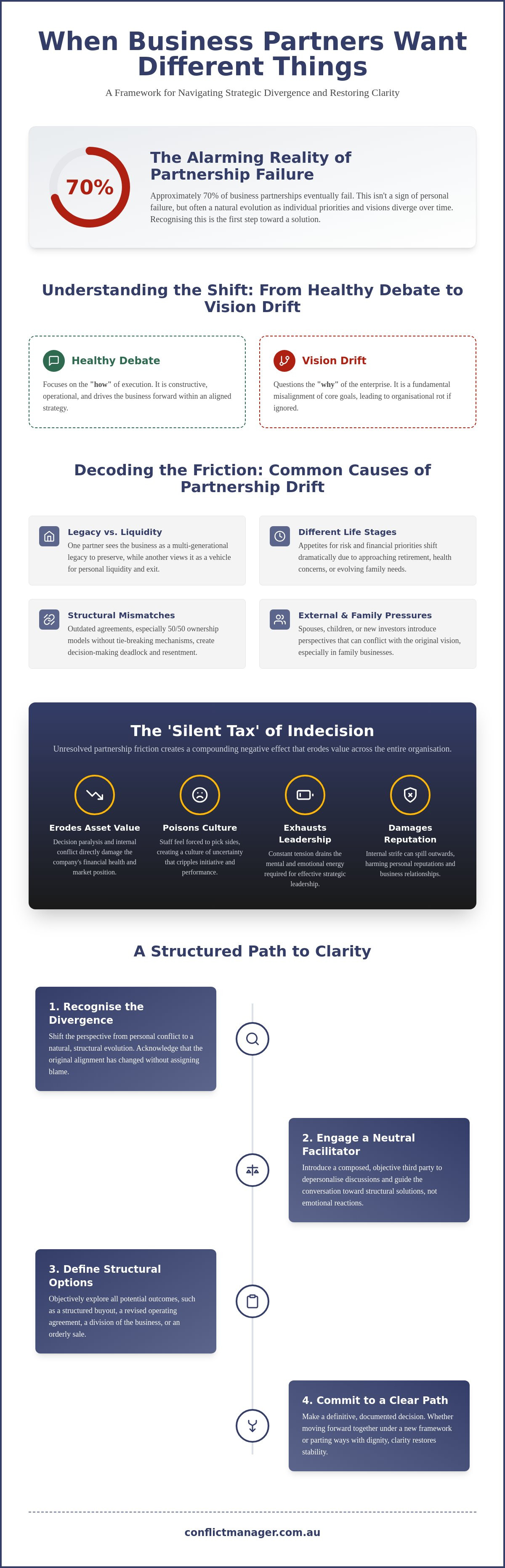
The difficulty lies in distinguishing between healthy operational debate and fundamental vision drift. Healthy debate focuses on the "how" of execution, while vision drift questions the "why" of the entire enterprise. When the latter occurs, ignoring the rift often leads to organisational rot. This isn't just about hurt feelings. It's about the steady erosion of asset value and the loss of competitive advantage. Understanding what happens when business partners want different things is the first step in protecting the legacy you've built over decades of hard work.
Signs That Your Visions Are Decoupling
Vision drift rarely announces itself with a single event. It's a slow decoupling that manifests in the day-to-day mechanics of the company. When you start to wonder what happens when business partners want different things, the answer is often found in frequent stalemates in board meetings. Capital allocation is the primary flashpoint. One partner may be focused on aggressive reinvestment for future expansion, while the other prioritises profit distribution or debt reduction. This tension is frequently underpinned by varying appetites for risk as partners enter different life stages and their financial priorities shift.
The Emotional Weight of Partnership Friction
The cost of this friction is deeply personal. Constant tension drains the mental clarity required for effective leadership, leaving partners emotionally exhausted and reactive. This internal friction ripples through the staff, creating a culture of uncertainty where employees feel forced to pick sides or hesitate to take initiative. Unspoken conflict in a leadership team acts as a psychological anchor, dragging down the collective energy required to sustain a high-performing culture. When the steady hand at the top begins to shake, the entire organisation feels the tremor, leading to a loss of operational stability and a decline in overall performance.
Decoding the Friction: Why Partners Drift Apart
Partnerships are built on shared intent. Over time, this intent inevitably shifts. One partner may view the business as a multi-generational legacy to be preserved, while the other sees it as a vehicle for personal liquidity. This "Legacy versus Liquidity" dilemma is a primary driver of strategic divergence. It's often the root of what happens when business partners want different things, triggered by life-stage changes like approaching retirement, health concerns, or shifting family priorities. When these personal realities collide, the business becomes the proxy for a much deeper conflict.
External influences frequently complicate these dynamics. Spouses, children, or new investors introduce fresh perspectives that may not align with the original partnership agreement. This is particularly evident when a business needs to move from a "founder" mindset to professional management. The very traits that built the company, such as total control and intuitive decision-making, often become the obstacles to its future growth. Partners must find ways to realign and resolve conflict before the friction becomes terminal.
The Family Office and Multi-Generational Pressure
Identity. Legacy. Ambition. In many high-net-worth Australian families, the business is inseparable from the family identity. Intergenerational wealth transfers introduce a new layer of complexity, often pitting siblings with different risk appetites against one another. Traditional governance structures may struggle to contain these modern strategic needs. Managing the identity attached to a family name requires emotional intelligence and structural clarity. When expectations meet individual ambition, the resulting friction can threaten both the family bond and the business assets.
Structural Mismatches in Decision-Making
Deadlock. Resentment. Inertia. These are the hallmarks of structural mismatches, often found in 50/50 ownership models that lack a clear tie-breaking mechanism. As the business grows, an agreement drafted in the early days may no longer reflect the commercial reality. This is where we see the most significant strain. An unbalanced contribution, where one partner carries the operational load while the other remains passive, fuels deep-seated resentment that erodes the foundation of the partnership.
Understanding what happens when business partners want different things requires a look beyond the balance sheet. It requires a calm, objective analysis of the human and structural dynamics at play. Professional stakeholder facilitation can provide the steady hand needed to untangle these complex threads and find a sustainable path forward for all parties involved.
The Cost of Stalemate: When Indecision Threatens the Enterprise
Stagnation is rarely neutral. Many directors adopt a "wait and see" posture when strategic divergence appears, hoping that time or market shifts will naturally resolve the friction. This is a fallacy. In reality, indecision acts as a silent tax on the organisation, siphoning away growth, innovation, and executive focus. While the leadership team is locked in a stalemate, the Australian market continues to evolve. Competitors don't wait for your internal alignment; they capitalise on your paralysis.
The opportunity cost of an internal dispute is staggering. Every hour spent in circular arguments or avoiding difficult conversations is an hour not spent on strategic acquisition or product development. We often see that what happens when business partners want different things is not a sudden collapse, but a slow, grinding decline in market relevance. This friction prevents the business from making the bold moves required to sustain a competitive edge in a tightening economy. To move forward, leaders must proactively seek to repair a damaged business partnership before the damage becomes irreversible.
Impact on Stakeholders and Employee Retainment
Instability is palpable. Your top talent possesses a high degree of emotional intelligence and a low tolerance for leadership dysfunction. When they sense a fracture at the executive level, they begin to look for more stable environments to protect their own careers. This loss of key personnel further weakens the enterprise. Simultaneously, trust with external stakeholders, such as major clients and financial institutions, erodes when they perceive the partnership is no longer viable. A public fallout can permanently damage brand equity, leaving a stain on your professional reputation that is difficult to erase.
The Erosion of Asset Value
Conflict is expensive. When an organisation is viewed through the lens of a potential sale or valuation, leadership stability is a primary metric. A business embroiled in a partnership dispute is worth significantly less than one with a unified board. Buyers fear the "key person risk" and the potential for future litigation. There is also the tangible danger of mismanagement when partners no longer feel invested in a shared future. Conflict-driven depreciation is the measurable decline in an organisation's market value that results directly from prolonged leadership paralysis and the erosion of operational integrity.
A Structured Framework for Navigating Different Agendas
Clarity. Neutrality. Resolution. Navigating a fracture in leadership requires a departure from the emotional heat of the boardroom and a move toward a methodical, structural framework. When you find yourself asking what happens when business partners want different things, the priority must shift from individual victory to the health of the entity. This transition requires a neutral environment where dialogue is facilitated without the weight of past grievances. By viewing the situation as a negotiation between stakeholders rather than a battle between partners, you can establish a foundation for objective decision-making and long-term stability.
Step 1: Objective Fact-Finding and Goal Alignment
Structure begins with silence. A professional facilitator conducts independent interviews with each partner to uncover true motivations that often remain unsaid in joint meetings. This process is essential for separating personal grievances from genuine strategic differences. Uncovering what happens when business partners want different things at a fundamental level is the only way to move past the surface-level friction. By defining the non-negotiables for each party, we create a map of the divergence. Only when these individual goals are laid bare can we begin to see where the shared enterprise still holds value.
Step 2: Exploring the "Third Way"
Binary choices are a trap. Most partners believe the only options are to stay in conflict or to dissolve the business entirely. However, professional facilitation often reveals a "third way" that preserves asset value while allowing for individual freedom. This might involve a structured buy-out, a division of business units, or one partner shifting to a non-executive board role. Modelling these future scenarios allows everyone to see the commercial reality of each path without the fog of emotional entanglement or reactive decision-making.
Step 3: Formalising the Resolution
Sustainability requires documentation. Once a path is chosen, the new arrangement must be documented with absolute clarity to prevent future strategic drift. This isn't about being litigious. It's about ensuring the outcome is legally sound and commercially viable for the long term. Finally, the new direction must be communicated to the wider organisation with the same composed authority that will define the next chapter of the business. If your leadership team has reached a stalemate, our stakeholder facilitation services can provide the objective structure needed to move forward with confidence.
The Value of Composed Facilitation and Neutrality
Objectivity. Distance. Discernment. When a leadership team is deeply embedded in the day-to-day friction of a dispute, internal attempts at resolution almost always falter. This failure isn't due to a lack of effort, but rather a state of emotional entanglement. Shared histories, personal loyalties, and past grievances create a fog that obscures the path forward. A professional mediator serves as a steady hand; an objective observer capable of viewing volatile situations with total neutrality. They provide the structural integrity required to explore what happens when business partners want different things without the conversation collapsing into reactive accusations.
In high-stakes Australian business circles, discretion is more than a courtesy; it's a commercial necessity. A public fallout doesn't just damage the current enterprise. It tarnishes personal reputations and family legacies that may have taken generations to build. Conflict Manager acts as a bridge between this current state of friction and a future of restored stability. We bring a sense of order to clouded situations, ensuring that the transition, whether it leads to realignment or a graceful exit, is handled with the utmost confidentiality and professional poise.
Why Legal Action is Rarely the Best First Step
Litigation is inherently adversarial. It's a blunt instrument that often destroys the very business value it seeks to protect. Once you enter a court setting, you surrender control over the outcome to a third party who may not understand the nuanced human dynamics of your specific organisation. Mediation, by contrast, preserves the human element. It allows partners to address the structural problem while maintaining the dignity of their professional relationship. It's a proactive choice to protect assets rather than deplete them through prolonged, public legal battles.
Achieving a Sustainable Outcome
Resolution. Order. Reassurance. The ultimate goal of professional facilitation is a sustainable outcome that all parties can live with and respect. We don't aim for a temporary truce, but for a fundamental shift in the leadership structure that allows the business to breathe again. This process restores operational stability and provides a sense of profound relief to stakeholders who've been carrying the weight of uncertainty. If your partnership has reached a point of strategic divergence, you can achieve clarity with Conflict Manager’s expert facilitation services.
Restoring Order to Your Strategic Path
Strategic divergence doesn't have to signal the end of your enterprise. Often, it's a sign that the business has simply matured beyond its original parameters. By moving from emotional reaction toward a structured framework, you protect both your commercial assets and your personal reputation. Understanding what happens when business partners want different things is the catalyst for choosing a professional resolution over prolonged uncertainty. It's the moment where you trade friction for structural clarity.
We specialise in high-emotion, high-asset disputes, providing a composed and objective approach to organisational friction. Our team focuses on creating sustainable outcomes for Australian family offices and complex organisations, ensuring that every transition is handled with total discretion. You don't have to carry the weight of leadership paralysis or the fear of a fractured legacy alone. There's a vision of order and operational stability waiting on the other side of this transition.
Request a confidential consultation with our expert mediators to begin defining your new path forward with confidence.
Frequently Asked Questions
What is the first thing I should do if my business partner and I disagree on the company’s direction?
The first step is to create space for an objective assessment before any permanent decisions are made. Engaging a neutral third party allows both partners to articulate their concerns without the conversation devolving into a circular argument. This pause prevents the organisational rot discussed earlier and ensures that the initial response is strategic rather than purely emotional.
Can a business partnership survive if we want completely different things?
Survival is possible if both parties are willing to move beyond the binary choice of staying exactly as they are or dissolving the business. Success often involves a "third way" where roles are redefined, such as one partner transitioning to a non-executive position. This structural realignment allows the enterprise to thrive even when business partners want different things at a personal level.
How does professional mediation differ from hiring a lawyer for a business dispute?
Mediation focuses on finding a sustainable, mutual resolution, whereas hiring a lawyer typically moves the dispute into an adversarial, position-based framework. While legal counsel protects your rights, a mediator acts as a steady hand to facilitate dialogue and uncover underlying interests. This approach preserves business value and personal relationships that are often destroyed in a litigious environment.
What happens if we have a 50/50 split and cannot reach a decision?
A 50/50 deadlock requires a structured intervention to break the paralysis and protect the company's assets. Without a tie-breaking mechanism in the partnership agreement, a neutral facilitator helps model different commercial scenarios to find a path forward. This prevents the "silent tax" of indecision from eroding the market value of the organisation while the owners are at an impasse.
How do we handle family members who are influencing business decisions from the sidelines?
External influences should be integrated into a formal governance structure rather than allowed to operate from the sidelines. Stakeholder facilitation brings these voices into a controlled environment where their concerns can be addressed objectively. This process clarifies the boundaries between family dynamics and business operations, ensuring that the company's strategic needs remain the priority.
How long does the mediation process typically take for a partnership dispute?
The timeline for mediation is significantly shorter than litigation, often reaching a resolution in a matter of days or weeks rather than years. While court proceedings can drag on for months, professional facilitation focuses on efficiency and structural clarity. This speed is crucial for restoring operational stability and preventing the erosion of staff morale and client trust.
Is mediation confidential, and will it protect our business reputation?
Mediation is a strictly confidential process designed to protect the reputation of all involved parties. Unlike court proceedings, which are matters of public record, the discussions held during facilitation remain private. This discretion is vital for high-net-worth families and prominent Australian organisations that need to resolve internal friction without attracting unwanted external scrutiny.
What are the alternatives to court for resolving a private family office dispute?
Private family offices often find that stakeholder facilitation and organisational conflict management are far more effective than traditional litigation. These alternatives focus on the human element while solving the structural problem of strategic divergence. They provide a composed, expert-led environment where complex intergenerational wealth and identity issues can be untangled without the destructive cost of a public legal battle.


