

Stagnation. Friction. Erosion. These are the silent architects of organisational decay when fiscal transparency dissolves into circular arguments. With roughly 70% of business partnerships failing within their first five years, the pressure to maintain structural integrity has never been higher. You likely feel the weight of this gridlock, watching as the professional trust you built over decades begins to fray under the strain of unspoken assumptions and conflicting ledgers. It's a heavy burden to carry when the fear of public legal battles threatens to overshadow the reputation you've worked so hard to establish.
Resolving financial disagreements between business partners requires more than just a spreadsheet; it demands a neutral, steady hand to navigate the underlying human and structural dynamics. This guide provides a methodical, expert-led approach to untangling complex fiscal disputes while ensuring your organisation’s legacy remains intact. We'll explore how a composed path toward resolution can restore your professional equilibrium, move the business beyond stagnation, and secure a sustainable financial future for all stakeholders involved.
Key Takeaways
- Recognise that fiscal friction is rarely just about the numbers; it is a structural disruption where money acts as a proxy for trust and organisational alignment.
- Identify the common catalysts of fracture, such as the tension between aggressive reinvestment strategies and the preservation of capital.
- Evaluate the benefits of private mediation over public litigation to ensure a confidential, sustainable outcome that preserves the integrity of the partnership.
- Follow a methodical framework for resolving financial disagreements between business partners, beginning with an objective audit to establish a shared baseline of facts.
- Protect your organisation’s legacy by engaging in stakeholder facilitation that addresses the underlying needs and fears of all parties involved.
The Anatomy of Financial Friction in Business Partnerships
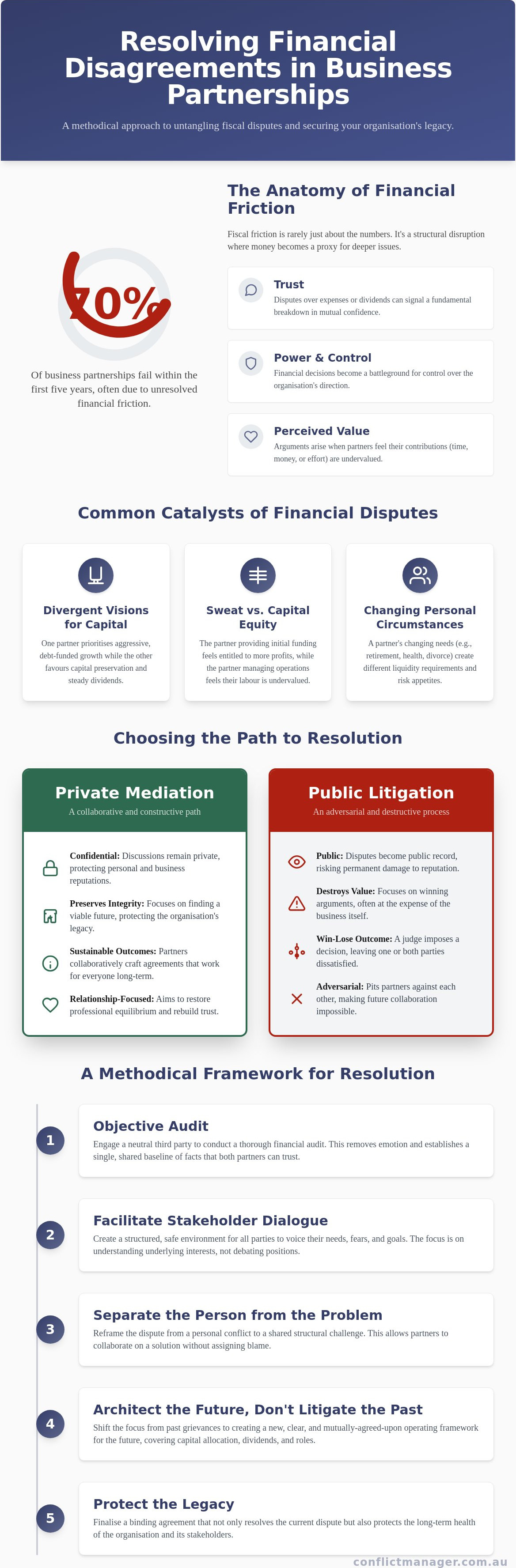
Stagnation. Friction. Erosion. A financial disagreement is rarely an isolated incident; it is a state of structural disruption where misaligned fiscal visions threaten the core integrity of the organisation. Money serves as a pervasive proxy for trust, power, and perceived value. Within a partnership, a dispute over a dividend payout or a capital injection is often a coded struggle for control or a reflection of differing risk appetites. Internal efforts to find a solution frequently buckle under the weight of historical grievances and the high-emotion stakes that accompany shared ownership. When partners attempt to resolve these issues alone, they often fall into the trap of litigating the past rather than architecting the future.
It is vital to distinguish between a healthy difference of opinion and a fundamental breach of strategic alignment. The former drives innovation and ensures rigorous decision-making; the latter creates a toxic environment that can lead to a breach of fiduciary duty. Resolving financial disagreements between business partners requires an objective lens that separates the person from the problem. Without this, the dispute shifts from a logical discussion about resource allocation to an existential threat to the partnership itself. This is why internal attempts at resolution often fail; the participants are too close to the friction to see the structural cracks forming in the foundation.
Defining the Fiscal Dispute
A financial partnership dispute is a systemic breakdown in resource allocation and strategic consensus. These disruptions ripple through day-to-day operations and long-term capital planning, manifesting as conflicting reinvestment priorities or micro-management of expenses. Healthy debate transitions into destructive conflict the moment one partner views the other's fiscal logic as a threat to the business's survival. At this juncture, understanding the various methods for resolving disputes becomes essential for restoring order.
The Impact on Organisational Stability
The consequences of unresolved fiscal tension extend far beyond the balance sheet. Internal friction creates a "wait and see" culture among staff and stakeholders, leading to missed opportunities and a paralysis of innovation. Capital is often depleted through mismanagement or reactive decision-making as partners focus on winning arguments rather than protecting the organisation’s legacy. Beyond the boardroom, these disputes lead to sleep deprivation, persistent anxiety, and the slow erosion of the joy of business. Resolving financial disagreements between business partners isn't just about the ledger; it's about protecting the assets and the people who built them.
Identifying the Catalysts: Why Partnership Finances Fracture
Ambition. Security. Legacy. These core drivers often coexist harmoniously during the inception of a venture, yet they can become diametrically opposed as the business matures. Financial fractures rarely appear overnight. Instead, they manifest as a slow drift in alignment, where unspoken expectations regarding reinvestment and risk begin to clash with the reality of the balance sheet. When suspicion takes root in the absence of clear communication, the process of resolving financial disagreements between business partners becomes significantly more complex. Identifying the specific catalyst of the friction is the first step toward restoring structural stability.
One of the most persistent triggers of dispute is the tension between "sweat equity" and "capital equity". A partner who provided the initial funding may feel entitled to a greater share of the profits in perpetuity, while the partner managing day-to-day operations feels their ongoing labour is undervalued. This disparity often leads to a perceived breach of fairness. Without a robust framework for valuation, these feelings of resentment can paralyse decision-making. If your partnership is struggling to bridge this gap, engaging in professional stakeholder facilitation can help re-establish a sense of equity and shared purpose.
Divergent Visions for Capital
Conflict often arises when risk appetites diverge. A risk-averse partner may prioritise capital preservation and steady dividends, while their counterpart seeks aggressive expansion through debt-funded growth. This tension is frequently exacerbated by changing personal circumstances. A partner facing a divorce, a health crisis, or approaching retirement will naturally have different liquidity requirements than someone in a different life stage. In smaller partnerships, the conflict between "lifestyle" draws and business sustainability often becomes the primary point of failure.
The Family Office Complication
In the context of family offices, the intersection of personal interests and professional corporate governance creates a unique set of challenges. Friction often occurs during multi-generational wealth transfers, where the "Old Money" philosophy of stewardship clashes with the "New Ideas" of younger members. Non-active family members can exert significant influence through emotional leverage, often complicating financial decisions that should be based on objective data. Maintaining asset integrity during these periods of internal family friction is paramount. Resolving financial disagreements between business partners within a family structure requires a "steady hand" to ensure that the legacy of the organisation is not sacrificed to interpersonal grievances. Clarity in financial reporting is the only antidote to the suspicion that thrives in these high-stakes, high-emotion environments.
Mediation vs Litigation: Choosing the Path to Resolution
Privacy. Discretion. Control. These are the primary casualties of the legal system. When fiscal friction reaches a boiling point, the instinct to enforce rights through the courts is understandable, yet it is often a blunt instrument for a delicate structural problem. Litigation is an inherently public, adversarial process. It demands a binary outcome where one side is declared a winner and the other a loser. While this might satisfy a narrow legal requirement, it rarely leaves a functioning partnership in its wake. For high-net-worth families and sensitive corporate entities, the public record of a court battle can be as damaging to the brand's reputation as the financial dispute itself.
The cost of conflict is measured in more than just legal fees. While litigation attorneys in 2026 typically charge between $200 and $550 per hour, the true expense lies in the months of diverted attention and stagnant growth. Research indicates that approximately 80 to 90 percent of commercial disputes are settled through negotiation or mediation before formal proceedings begin. This shift toward alternative resolution is driven by a desire for lower costs and faster outcomes. Mediation offers a private, facilitated dialogue designed to reach a sustainable, mutually agreed-upon result. It's an investment in the organisation's future rather than a sunk cost in legal warfare.
The Limitations of the Legal System
A court judgment might settle a specific debt, but it will fail to resolve the underlying partnership friction. Litigation often triggers a "scorched earth" effect on employee morale and stakeholder confidence. When you step into a courtroom, you effectively give a judge the power to decide the fate of your organisation. This loss of control is particularly dangerous for complex structures where a bespoke solution is required to protect the integrity of the assets. A legal ruling is final, but it is rarely nuanced.
The Logic of External Intervention
Resolving financial disagreements between business partners requires a neutral third party who brings total objectivity to a clouded, high-emotion environment. A facilitator acts as a steady hand, capable of viewing volatile situations without becoming emotionally entangled in them. Their role is to translate raw financial needs and fears into actionable strategic agreements. By opting for structured communication over legal threats, partners can achieve a level of clarity that is impossible to find in an adversarial setting. This methodical approach ensures that the path to resolution is both composed and sustainable, allowing the organisation to move forward with its structural integrity intact.
A Methodical Framework for Resolving Fiscal Disagreements
Clarity. Consensus. Continuity. Moving from a state of disruption to one of structured stability requires a disciplined approach that bypasses the circular arguments of the past. Resolving financial disagreements between business partners is not a matter of winning a debate; it's about re-establishing the structural integrity of the organisation. This process begins by stripping away the emotional weight of the dispute and focusing on the underlying fiscal reality. By following a four-step framework, partners can transition from a position of gridlock to one of mutual strategic alignment.
- Step 1: Objective Audit. Establish a shared set of financial facts as the baseline for all future discussions.
- Step 2: Stakeholder Facilitation. Identify the underlying needs, fears, and motivations of each party involved.
- Step 3: Option Generation. Explore creative financial structures that satisfy individual requirements while protecting the business.
- Step 4: Formalisation. Craft a clear, sustainable agreement that provides a roadmap for future fiscal governance.
Establishing the Financial Baseline
The first step in resolving financial disagreements between business partners is removing the "smoke and mirrors" that often surround internal accounting. Transparent, professional financial data is the only foundation upon which trust can be rebuilt. Partners must agree on a shared valuation of assets or the enterprise itself, ensuring that both parties are operating from the same ledger. A neutral audit acts as a psychological circuit breaker, transforming emotional accusations of mismanagement into objective data points that can be analysed without bias. This baseline allows the conversation to shift from personal blame to practical resource allocation.
Facilitating the "Difficult" Conversations
Once the facts are established, the focus must shift to the human element of the dispute. Effective resolution requires moving from the question of "Who is right?" to "What is right for the organisation?". Managing high-emotion triggers is critical during these sessions, as discussions about money are often proxies for deeper issues of power and respect. Identifying the subtext, including those unspoken fears regarding loss of status or financial security, is essential; these hidden drivers often manifest as stubbornness over minor line items. If your partnership is struggling to navigate these complex interpersonal dynamics, our expert Stakeholder Facilitation services provide the steady hand needed to guide you toward a sustainable outcome.
Generating options requires a degree of creative thinking that is often missing when partners are in a defensive posture. By exploring bespoke financial structures, such as revised buy-sell agreements or tiered dividend policies, partners can find middle ground that protects their individual interests without compromising the organisation's legacy. The final stage is formalisation. A well-drafted agreement doesn't just settle the current dispute; it establishes the protocols to prevent a recurrence, ensuring long-term structural stability.
Restoring Stability with Conflict Manager
When the internal mechanics of a partnership seize, the resulting gridlock can feel insurmountable. Conflict Manager acts as a steady hand for organisations navigating these high-stakes transitions and internal friction. We provide a composed, objective environment where clarity replaces the chaos of circular arguments. Resolving financial disagreements between business partners requires more than just technical proficiency; it necessitates a deep understanding of the human friction that underpins fiscal disputes. By introducing a neutral third party, we lower the pulse of the situation and build trust through a logical, methodical sequence that prioritises the health of the entity over individual grievances.
This progression from complexity to order is essential for protecting the organisation's core assets. We act as a wise, external counsellor, viewing volatile situations with total objectivity to identify the structural cracks that internal efforts often miss. Our personality is that of an authoritative expert who is also a compassionate guide. We understand the weight of responsibility you carry. We recognise the friction of interpersonal dynamics without becoming emotionally entangled in them, providing the stability needed to move forward with confidence.
Bespoke Solutions for Complex Partnerships
Off-the-shelf conflict resolution models often fail when applied to unique corporate or family structures. These rigid frameworks lack the nuance required to address the intersection of personal legacy and commercial asset management. Our expertise in family office mediation ensures that both the organisation's heritage and its capital remain protected throughout the process. A wise counsellor remains unruffled by volatile dynamics, viewing the situation with total objectivity to identify the path of least resistance toward resolution. We focus on sustainable outcomes that preserve the integrity of the business for the long term, ensuring that resolving financial disagreements between business partners results in a stronger, more resilient partnership.
Your Path Forward
Moving toward a vision of structured resolution begins with a single, confidential conversation. Engaging our services for a preliminary discussion allows you to step away from the emotional exhaustion of the dispute and toward a clear strategy for movement. During a facilitated engagement, you can expect a return to stability and a methodical path through the complexity that has previously clouded your decision-making. We don't just aim to settle a specific debt or dividend dispute; we aim to restore the professional composure of the partners involved. Achieve clarity in your partnership today with Conflict Manager and secure the future of your organisation's assets and legacy.
Securing the Future of Your Organisation
Clarity. Stability. Legacy. Achieving these outcomes requires a shift from internal friction toward a methodical, external perspective. You've explored how identifying catalysts like misaligned reinvestment and choosing private mediation over public litigation can protect your business's reputation. Establishing a shared financial baseline is the essential first step in resolving financial disagreements between business partners without sacrificing the structural integrity of the organisation.
Conflict Manager provides national coverage across Australia, offering a neutral and composed approach to high-stakes stakeholder facilitation. We specialise in high-net-worth family office mediation, ensuring that both commercial assets and familial bonds remain intact through periods of structural change. If your partnership is currently facing fiscal gridlock, request a confidential consultation with our expert facilitators to begin your journey toward a structured resolution. Restoring order is possible when you have a steady hand to guide the way.
Frequently Asked Questions
Can a business partnership survive a major financial disagreement?
Survival is possible when the focus shifts from past grievances to future structural alignment. Many partnerships falter not because the financial issue is inherently unsolvable, but because the interpersonal friction becomes a permanent fixture. By engaging a neutral party early, you can address the underlying misalignments and rebuild the trust necessary to move the organisation forward with renewed clarity. It's about restoring the professional composure required to make logical, asset-focused decisions.
What is the difference between a mediator and a lawyer in a financial dispute?
The process of resolving financial disagreements between business partners through a mediator ensures a focus on the shared future of the organisation. Unlike a lawyer, whose duty is to advocate for a single party's specific legal rights, a mediator is a neutral third party who facilitates a balanced dialogue. This distinction is crucial for those who wish to maintain a professional relationship or protect a family legacy after the fiscal dispute is settled.
How much does professional conflict resolution cost compared to litigation?
Professional conflict resolution is a strategic investment that typically results in significant savings compared to the open-ended nature of a court battle. Litigation attorneys in Australia often charge between $200 and $550 per hour; these costs are compounded by court filing fees and the price of diverted leadership attention. Facilitation offers a more efficient, private alternative that focuses on reaching a sustainable agreement before the organisation's capital is drained by public legal warfare.
How do we handle a partner who is misusing company funds or assets?
When resolving financial disagreements between business partners involving the misuse of assets, the process must begin with an objective verification of the facts. A facilitated environment allows for these difficult conversations to occur without the immediate escalation into public legal threats. This methodical approach identifies whether the issue is a systemic failure or an individual breach, allowing for a structured resolution that protects the remaining assets and the organisation's reputation.
Is mediation confidential for high-profile family offices?
Confidentiality is a cornerstone of the facilitated process, making it the preferred choice for high-profile family offices and sensitive corporate structures. Unlike the public record of a courtroom, all discussions and documents shared during mediation remain private. This ensures that internal friction, sensitive financial strategies, and the details of your family's wealth are shielded from public scrutiny, competitors, and the media, preserving the integrity of your organisation's public image.
What happens if we cannot reach an agreement through mediation?
If a consensus isn't reached through mediation, the parties still have the option to pursue litigation or arbitration. However, the process of facilitation often clarifies the core issues and narrows the scope of the dispute, making any future legal steps more focused and less costly. Statistics show that approximately 80 to 90 percent of commercial disputes reach a settlement before formal court proceedings begin, suggesting that a sustainable resolution is highly probable.
How long does the facilitated resolution process typically take?
The facilitated process is designed for efficiency, often concluding in a matter of days or weeks. This is a vital alternative to the Australian court system, where complex commercial disputes can remain unresolved for years. A rapid resolution ensures that the business doesn't remain in a state of paralysis, allowing partners to return their focus to growth and operational stability. It's a methodical path that respects the value of your time.
Can we engage a mediator if we have already started legal proceedings?
It's entirely possible to engage a mediator even if a legal claim has already been filed in court. Many Australian courts actually encourage parties to attempt mediation to avoid the strain on the judicial system and the high costs of a trial. Transitioning from an adversarial legal posture to a facilitated dialogue can lower the pulse of the dispute and provide a composed path toward a settlement that protects the organisation's remaining assets.


