

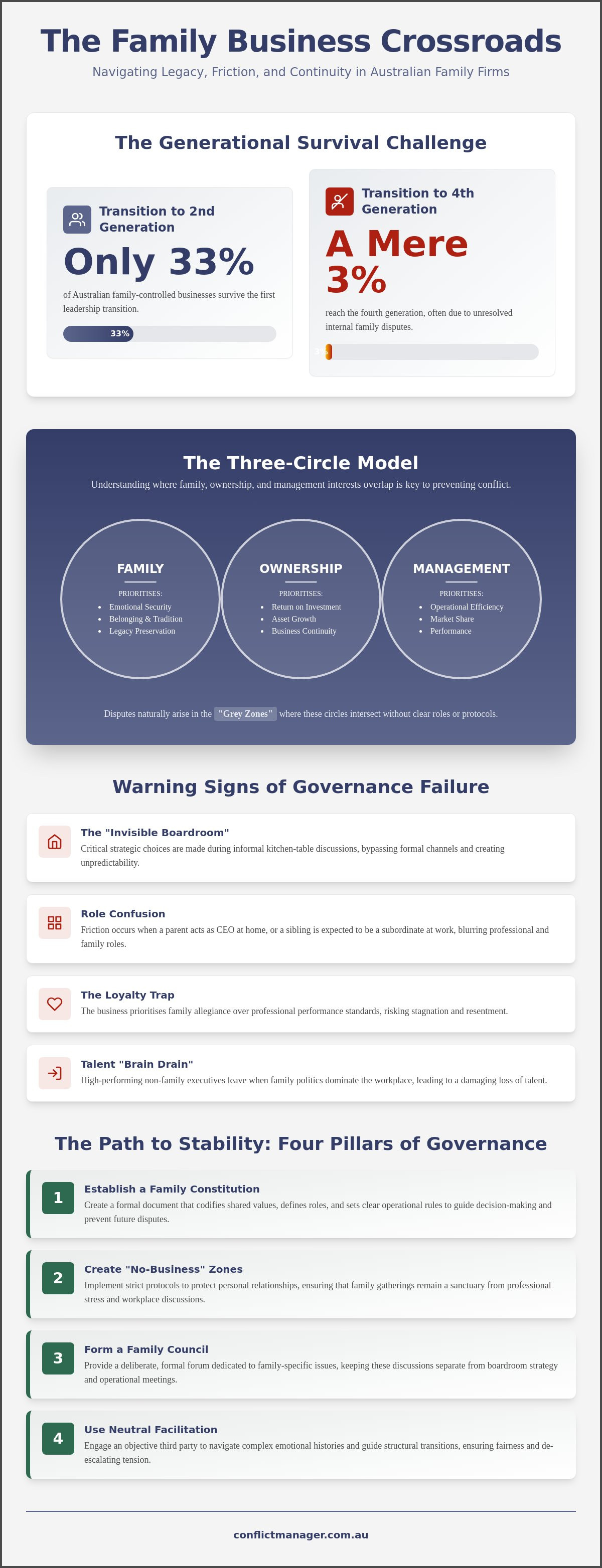
Only 33% of Australian family-controlled businesses survive the transition to the second generation, while a mere 3% reach the fourth. This decline is rarely the result of poor market conditions or inferior products. It often stems from the quiet erosion of relationships through unresolved family business governance disputes. Legacy. Friction. Continuity. These elements clash when the boundaries between the dining table and the boardroom vanish, leaving everyone uncertain of where their professional authority starts and their family obligations end.
You likely recognise the exhaustion of "always-on" conversations that transform every weekend into an unscheduled strategic planning session. It's difficult to balance the demands of meritocracy against the expectations of kin, particularly when succession remains a source of unspoken tension. This guide shows you how to implement professional governance and clear interpersonal boundaries to protect both your family legacy and business stability. We'll examine the structural changes required to separate boardroom decisions from family life, ensuring clear roles that everyone respects for generations to come.
Key Takeaways
- Identify the distinct interests of family, owners, and managers to map where loyalty and authority reside within your organisation.
- Reduce the risk of family business governance disputes by establishing a formal Family Constitution that codifies shared values and clear operational rules.
- Protect personal relationships through the use of "no-business" zones; these protocols ensure that family gatherings remain a sanctuary from professional stress.
- Adopt a Family Council structure to provide a deliberate, formal forum for family-specific issues, keeping these discussions separate from boardroom strategy.
- Understand the role of neutral facilitation in providing the objectivity required to navigate complex emotional histories and structural transitions.
The Complexity of Overlapping Systems in Australian Family Firms
Structure. Clarity. Continuity. These are the pillars of a resilient enterprise. In the Australian context, where family-run firms underpin the national economy, the absence of these pillars often leads to systemic instability. Boundary setting is the practice of defining where family rights end and business responsibilities begin. It is a necessary discipline that prevents the emotional weight of kinship from crushing the commercial logic of the firm. Without these boundaries, family enterprises become highly vulnerable to internal friction, despite their significant economic contributions to the local market.
The "Invisible Boardroom" is a common phenomenon where critical strategic choices are made during informal kitchen-table discussions rather than through formal channels. When a Sunday roast becomes the venue for debating a A$5 million capital expenditure or a change in leadership, the formal management structure is effectively bypassed. This devalues the business assets by creating an environment of unpredictability. Employees and stakeholders lose confidence when they realise that the real power resides in private conversations they cannot access. This leads to a "Role Confusion" trap. It's the friction that occurs when a parent attempts to act as a CEO at home, or when a younger sibling is expected to act as a subordinate at work while maintaining an equal status in family life. To understand these dynamics, many professionals refer to the Three-Circle Model of family business, which illustrates the constant overlap between family, ownership, and management interests.
The Founder’s Dilemma and the Loyalty Trap
Transitioning from a founder-led "command and control" style to structured governance is often the most difficult phase of scaling. Founders often view formalisation as a loss of personal agency rather than a gain in organisational stability. This hesitation creates a loyalty trap. When a firm prioritises family allegiance over professional performance standards, it risks stagnating. These informal beginnings, once the source of the business's agility, eventually create complex endings characterised by unspoken expectations and deep-seated resentment. Unresolved family business governance disputes frequently emerge from this tension between the old ways of operating and the requirements of a maturing company.
The Impact of Unchecked Friction on Asset Integrity
Internal disputes don't just hurt feelings; they actively devalue business assets and jeopardise the long-term family legacy. When family politics dominate the workplace, high-performing non-family executives often seek opportunities elsewhere, leading to a damaging "brain drain" of talent. The Family Business Paradox exists where the very intimacy that fuels a startup's passion becomes a destructive liability once the business lacks formal structure. Protecting the integrity of the business requires an objective lens that separates the value of the enterprise from the volatile nature of family disagreements.
Navigating the Three-Circle Model: Ownership, Family, and Management
Clarity. Alignment. Equilibrium. These qualities are the hallmarks of a well-governed family enterprise. To achieve them, one must first understand the architecture of the organisation through the Three-Circle Model. This framework identifies three distinct yet overlapping systems: the family unit, the owners, and the management team. While individuals within the firm often share a surname, their primary motivations frequently diverge based on which circle they occupy at any given moment. Owners typically seek a sustainable return on investment. Managers focus on operational efficiency and market share. Family members prioritise emotional security, belonging, and the preservation of tradition.
Conflict naturally arises in the "Grey Zones" where these circles intersect without clear protocols or role awareness. For example, a family member who owns shares but does not work in the business may struggle to understand why profits are being reinvested into infrastructure rather than paid out as dividends. Using this model as a diagnostic tool allows stakeholders to pinpoint the root cause of family business governance disputes before they escalate into irreparable friction. It provides a neutral, professional vocabulary that de-escalates tension. Establishing this common language allows a founder to say, "I am speaking to you now as the Managing Director, not as your father," which preserves the personal bond while maintaining the integrity of a business decision. When internal dynamics become too tangled to unravel alone, seeking stakeholder facilitation can provide the objective perspective needed to restore order.
The Family Circle vs. The Management Circle
The family unit is an emotional system built on unconditional support. Conversely, the management circle is a meritocracy built on performance. Confusing these two leads to the "nepotism" trap. Equality at the Christmas table is a non-negotiable value for family harmony; however, it has no place in a functional management structure. Professional standards must remain absolute. Extensive research on governance in family firms indicates that businesses applying identical KPIs to both family and non-family employees achieve significantly higher levels of long-term stability and executive retention.
The Ownership Circle: Responsibility and Rights
Ownership is a matter of stewardship rather than just possession. The role of the owner is to define the long-term vision and the risk appetite of the firm. They set the direction. They do not, however, interfere in the daily "how" of management. When owners overstep into operations, they stifle the management team and create a culture of second-guessing. By creating clear, merit-based pathways for promotion, the business ensures it remains competitive within the Australian market. This structural discipline is what allows a family to navigate high-stakes transitions and family business governance disputes without sacrificing their personal relationships or their commercial legacy.
Transitioning from Informal Agreements to Formal Governance
Governance. Structure. Resilience. These are the necessary evolutions of a maturing family firm. Moving from handshake deals to documented protocols is a critical step for any Australian enterprise. While informal agreements might suffice during the startup phase, they often become the catalyst for family business governance disputes as the organisation grows in complexity. Transitioning to formal governance is not about introducing bureaucracy; it's about creating a predictable environment where everyone knows the rules of engagement.
A central pillar of this transition is the "Rules of Entry." These are clear, pre-defined criteria for how and when the next generation can join the firm. Many successful Australian families now require family members to gain at least three to five years of external professional experience before they are eligible for a role in the family business. This boundary ensures that entry is based on merit rather than birthright. Similarly, succession planning acts as a vital boundary. By providing a clear roadmap for the future, the current leadership reduces the anxiety and speculation that often fuel internal friction.
The Role of the Family Council
A Family Council serves as a dedicated forum for family-specific issues, keeping these discussions entirely separate from the boardroom. While the Board of Directors focuses on commercial strategy and return on investment, the Council focuses on family harmony and the preservation of values. This distinction is vital. It allows the "Family Voice" to be heard in a structured way without interfering in daily operations. To maintain a professional atmosphere, these meetings should be held quarterly at a neutral location. They should follow a formal agenda, ensuring that every generation feels included and heard. This structured communication is a powerful tool for preventing family business governance disputes before they reach a point of crisis.
Drafting a Family Constitution
The Family Constitution is a living document that codifies the family’s mission, values, and business rules. It covers essential areas such as employment policies, dividend expectations, and conflict resolution protocols. However, the document itself is only half the value. The process of co-creation-the difficult, honest conversations required to draft it-is where the real alignment happens. When everyone has a hand in shaping the rules, they are far more likely to respect them. A Family Constitution acts as the ultimate structural safeguard, ensuring that multi-generational wealth is protected by agreed-upon principles rather than being subject to the unpredictable whims of individuals.
Establishing Practical Protocols for Communication and Conflict
Discipline. Boundaries. Sanctuaries. These are the defensive measures required to maintain a healthy separation between commercial pressure and family connection. In many Australian family firms, the absence of these barriers leads to a state of perpetual work, where business matters bleed into every dinner conversation and holiday gathering. Establishing "No-Business" zones is a practical way to professionalise the relationship. By designating specific times and places, such as the "Sunday Roast" or family celebrations, as off-limits for business talk, you allow the family unit to recharge its collective empathy. This structural discipline prevents the business from consuming the very relationships it was built to support.
Formalising internal communication is equally vital for long-term stability. Relying on informal WhatsApp groups or casual text messages for significant business decisions is a high-risk strategy that often leads to family business governance disputes. It's more effective to move these conversations to professional, secure platforms where a clear audit trail exists and where the tone remains objective. For high-friction decisions, implementing a "24-Hour Rule" provides the necessary space for emotions to settle before a response is required. If a consensus cannot be reached internally, a pre-defined "Dispute Escalation" pathway ensures that the matter is handled through structured family conflict resolution processes rather than escalating into a permanent rift.
Hat-Switching: A Tool for Clarity
Clarity of role is the antidote to defensiveness. Using verbal cues to signal which "hat" you are wearing, whether as a manager, an owner, or a parent, changes the entire register of a conversation. It allows a sibling to understand that a critique of their work performance is a business necessity rather than a personal attack; this distinction is critical for maintaining professional standards. Training the next generation in this role-awareness is essential for a smooth transition. It teaches them to view the business through an objective lens, ensuring that personal history does not cloud commercial logic during high-stakes transitions.
Managing the "Sunday Roast" Syndrome
Business talk at home is a slow-leak. It eventually drains the family's resilience and capacity for empathy, leaving members feeling as though they are always on the clock. The senior generation must lead by example here, redirecting business queries back to the office environment with a firm but gentle reminder of the current boundary. Practical redirection, such as saying "let's put that on the agenda for Monday morning," protects the family sanctuary. Respecting these interpersonal boundaries is not just about peace at home. It is about ensuring the business has a healthy, united family behind it for the next generation.
The Strategic Advantage of Neutral Mediation and Facilitation
Objectivity. Perspective. Resolution. These are the fundamental benefits of external intervention. Internal efforts to resolve conflict often fail because family members are too close to the friction. Decades of personal history create "blind spots" that prevent even the most rational executives from seeing a path forward. A neutral third party provides the objective lens necessary to navigate volatile or high-emotion situations without becoming entangled in the family's internal politics. This distance allows for a steady, methodical approach to complex problems that internal parties may find overwhelming.
Choosing the right level of intervention is essential for the long-term health of the firm. Stakeholder facilitation is often proactive. It involves guiding a family through the creation of governance structures, such as the Family Constitution or Council discussed previously, to ensure alignment before a crisis occurs. Mediation, conversely, is typically reactive. It is employed to resolve specific family business governance disputes that have already reached a point of impasse. Both methods aim to lower the emotional temperature and restore a sense of order to the organisation. Conflict Manager guides families through these structural changes with composed authority, ensuring that every voice is heard without allowing the conversation to deviate from the core business objectives.
When to Engage an External Expert
Signs of a stalemate are often subtle. Circular arguments, the avoidance of key topics, or a sense of "walking on eggshells" indicate that internal resources are exhausted. A steady, objective hand is particularly valuable during "high-pulse" transitions such as succession or a significant restructuring. During these periods, professional facilitation protects the long-term legacy from the immediate demands of the ego. It ensures that the transition is governed by commercial logic rather than personal grievance. This external presence acts as a stabilising force, allowing the family to navigate high-stakes decisions with total objectivity.
Achieving Sustainable Outcomes
True resolution moves beyond quick fixes. It seeks deep, structural stability that lasts for generations. External mediation provides a sense of order and reassurance to all stakeholders, including non-family employees and external investors who may be wary of internal friction. This clarity is the foundation of trust. By implementing professional governance and clear interpersonal boundaries, you protect the business from the volatility of human dynamics. To explore how a neutral third party can help your family business achieve clarity, contact Conflict Manager for a confidential discussion.
Securing the Future of the Family Enterprise
Legacy. Stability. Unity. These outcomes are not the result of chance; they are the products of intentional structural design. By transitioning from informal handshakes to the rigour of a Family Constitution and a formalised Council, you create the infrastructure necessary to withstand internal friction. Implementing practical protocols like "hat-switching" and designated business-free zones further protects the emotional health of the family unit. These boundaries ensure that professional disagreements remain within the boardroom, preventing them from spilling over into personal lives and devaluing your commercial assets.
When internal efforts reach a stalemate, the introduction of a neutral third party provides the clarity required to move forward. Professional facilitation is a strategic investment in the longevity of your organisation. It allows you to address family business governance disputes through an objective lens, prioritising the health of the enterprise over individual egos. At Conflict Manager, we bring specialised expertise in high-net-worth family office mediation and a proven track record in achieving sustainable outcomes for multi-generational Australian firms. Secure your family legacy with professional mediation and facilitation. Your legacy is worth the discipline of structure.
Frequently Asked Questions
How do I tell a family member they are not performing at work without hurting their feelings?
Clarity. Performance. Accountability. Address the issue through the lens of the management circle rather than the family circle. By explicitly stating you are speaking as a supervisor rather than a relative, you remove the personal sting. Focus on objective KPIs and the impact on the firm's health. This structural approach ensures the individual understands the feedback is about their professional role, not their place in the family.
What is the difference between a Family Council and a Board of Directors?
Strategy. Fiduciary. Governance. The Board of Directors carries a legal duty to the company, focusing on commercial strategy and financial performance. In contrast, a Family Council is a forum for family-specific concerns, such as shared values and education. This separation ensures that emotional family dynamics don't interfere with high-stakes commercial decisions, reducing the frequency of family business governance disputes.
Is a Family Constitution legally binding in Australia?
Intent. Alignment. Integrity. A Family Constitution is primarily a "moral contract" rather than a legally binding document under Australian law. Its strength lies in the alignment it creates among stakeholders. While it codifies values, specific clauses regarding share transfers should be formalised within a Shareholder Agreement or Company Constitution to ensure structural protection of assets and compliance with ASIC regulations.
How can we stop business talk from dominating our family holidays?
Sanctuary. Empathy. Resilience. Implement a strict "no-business" protocol for all family gatherings. This requires the senior generation to lead by example, gently redirecting any professional queries back to the office. By treating holiday time as a sanctuary for personal connection, you allow the family to recharge. This discipline prevents the "slow-leak" of business stress from eroding family harmony and long-term resilience.
What should we do if the founder refuses to set boundaries or follow protocols?
Legacy. Agency. Stewardship. Resistance from a founder often stems from a fear of losing personal agency. In these cases, introducing a neutral third party provides the objective lens needed to show that formalisation is a gain in stability. Framing boundaries as a way to protect their legacy usually resonates more effectively than focusing on the friction caused by their current informal approach.
Can a neutral mediator help with succession planning disputes?
Continuity. Objectivity. Transition. Neutral facilitators are essential for navigating the high-pulse transitions of succession. They provide a steady hand that prevents the legacy from being undermined by ego during periods of high stress. By facilitating objective discussions about merit and readiness, a mediator helps the family reach a consensus that prioritises the long-term health of the firm over individual expectations or birthright.
How do we manage non-family employees who are caught in the middle of family conflict?
Meritocracy. Stability. Retention. Protect non-family executives by maintaining clear, professional reporting lines that bypass family politics. When external hires are caught in the middle of family business governance disputes, it leads to a damaging "brain drain" of talent. Ensuring that all employees are held to the same KPIs provides a sense of order and reassurance that the business is run as a meritocracy.
When is it time to admit that a family member is not the right fit for the business?
Logic. Standards. Resolution. It's time to admit a family member isn't the right fit when their presence consistently undermines operational efficiency or team morale. This realisation is usually reached through objective performance reviews. By adhering to the professional standards set out in your Family Constitution, you can make these difficult decisions based on data and business logic rather than emotional guilt.


