

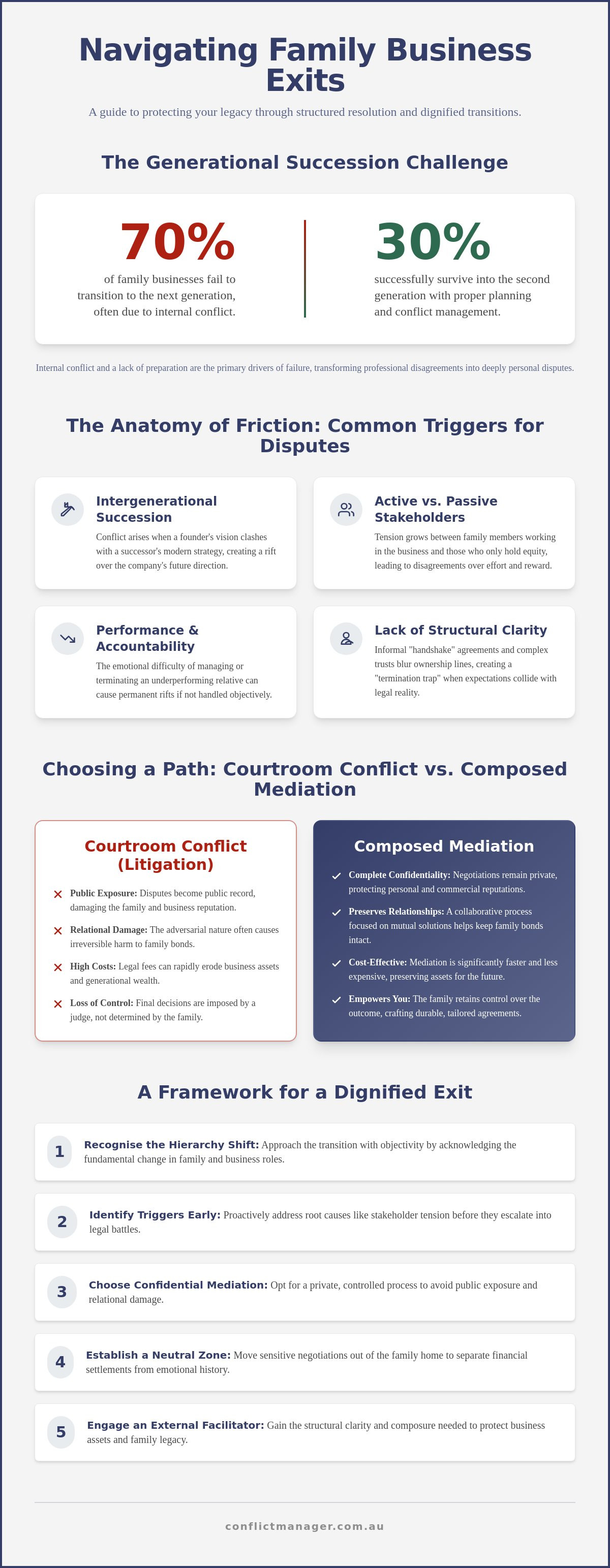
Only 30% of family businesses survive the transition to the second generation, while a staggering 70% fail due to internal conflict and a lack of preparation. When professional disagreements evolve into family business termination disputes, the stakes aren't just financial; they're deeply personal. It's understandable to feel a sense of dread as the boundary between the Sunday roast and the boardroom table dissolves. You likely want to protect the legacy you've built without watching hard-earned assets vanish into the pockets of litigators during a public battle.
Managing these transitions requires a steady hand and total objectivity. We'll show you how to achieve a dignified exit through expert-led mediation and structural clarity, ensuring your business remains stable while family bonds stay intact. By looking at the latest 2026 shifts in mediation trends and tax-free separation rulings, we'll outline a path that moves from emotional friction toward a vision of structured resolution. You can find a way to decouple equity from emotion and protect your family's future for generations to come.
Key Takeaways
- Learn how to recognise the fundamental shift in family hierarchy that occurs during a professional exit, allowing for a more objective approach to the transition.
- Identify common triggers like intergenerational friction and stakeholder tension to address the root causes of family business termination disputes before they escalate into legal battles.
- Discover why confidential mediation is the preferred path for high-net-worth families who wish to avoid the public exposure and relational damage caused by litigation.
- Establish a neutral zone to move sensitive negotiations out of the family home; this ensures that financial settlements are clearly separated from emotional history.
- Understand the value of engaging a wise, external facilitator to provide the structural clarity and composure needed to protect your business assets and family legacy.
Understanding the Nature of Family Business Termination Disputes
Termination. Exit. Dissolution. These words carry a heavy weight in any commercial setting, yet within a family enterprise, they signal far more than a contractual end. They represent a fundamental shift in the family hierarchy, often upending decades of established social order and personal identity. We define family business termination disputes as conflicts arising from the removal of a family member from an operational role, the winding up of a family-owned entity, or the forced exit of a shareholder. These are not merely legal disagreements; they are the collision of identity, legacy, and financial security. When these elements converge, the environment becomes volatile. Inaction is rarely a neutral choice. Unresolved friction leads to more than just a stagnant balance sheet. It risks permanent estrangement and the steady erosion of generational wealth.
The Intersection of Emotion and Equity
Old grievances often find new life during a business "divorce". A dispute over a board seat might actually be an echo of a sibling rivalry from thirty years ago. In these high-stakes environments, personal roles like parent, child, or sibling frequently cloud commercial decision-making. It's difficult to view a termination objectively when the person across the table is the same person you see at the Sunday roast. Understanding family business dynamics is essential for uncoupling these threads. The psychological weight of "leaving the legacy" feels far heavier than simply "leaving the job". It feels like a rejection of one's place in the family history, making the exit feel like an exile rather than a transition.
Structural Vulnerabilities in Australian Family Firms
Australian family enterprises often rely on informal "handshake" agreements. While these built the business, they rarely provide the clarity needed for a clean exit. Complex trust structures, common in the local landscape, further complicate matters by blurring the lines of beneficial ownership and control. This lack of formalisation creates a precarious foundation when the relationship sours.
- Discretionary trusts can make calculating a fair buyout price exceptionally difficult for all parties.
- Unwritten expectations regarding succession often contradict formal legal documents held by the firm.
- The absence of clear "bad leaver" clauses leaves the business vulnerable during a forced exit.
The "termination trap" occurs when rigid legal rights collide with unspoken family expectations, leaving all parties stranded in a state of costly, emotional limbo.
The Anatomy of Friction: Common Triggers for Family Exits
Friction in family enterprises is rarely spontaneous. It's the result of structural misalignment and shifting personal values. When we examine family business termination disputes, we see they often stem from predictable, yet deeply felt, points of pressure. These triggers aren't just business problems; they're family problems. They represent the moment where the shared dream of the past begins to fragment under the weight of the future. Recognising these patterns is the first step toward a composed resolution. Clarity. Objectivity. Stability.
- Intergenerational succession: Conflict arises when the founder’s vision for the firm no longer aligns with the successor’s modern strategy.
- Active versus Passive stakeholders: Tension grows between family members working in the business and those who merely hold equity.
- Performance and Accountability: The difficulty of terminating an underperforming relative can lead to a permanent rift if not handled with extreme care.
- Transparency issues: Disputes regarding the management of family trusts or the distribution of dividends often erode foundational trust.
Seeking professional stakeholder facilitation can provide the necessary distance to view these triggers through a commercial lens, preventing emotional escalation and protecting the firm's reputation.
The Founder’s Dilemma
Identity. Control. Legacy. Founders often find it difficult to step back. They built the legacy from the ground up, and the thought of removing a direct descendant from a leadership role feels like a personal failure. Maintaining asset integrity while ensuring family harmony is a delicate balancing act. This transition requires a fundamental shift in identity. The founder must move from being the primary operator to a governor within a family office structure. It's a move from direct control to strategic oversight. This shift ensures the business survives while the family relationships remain intact, avoiding the "scorched earth" outcomes of unmanaged exits.
Shareholder and Director Deadlocks
Equity. Control. Stagnation. What happens when 50/50 ownership leads to a total stall? Business operations can grind to a halt when two family members cannot agree on a path forward. These deadlocks are common in Australian family firms where equity was split equally for the sake of perceived fairness. Neutral third-party mediation is essential here. It allows for a breakthrough without the public exposure of a court battle. Addressing the rights of minority shareholders is also vital. In a family-dominated board, their voices are often sidelined, leading to resentment and, eventually, a forced exit. Establishing clear governance boundaries prevents the business from becoming a casualty of personal pride.
Courtroom Conflict vs. Composed Mediation: Choosing a Path
Publicity. Friction. Exhaustion. Choosing a path to resolve family business termination disputes often feels like choosing between two types of loss. Litigation is a public process, a matter of court records and open hearings. For high-net-worth families, this exposure is more than an inconvenience; it's a strategic vulnerability. Mediation, by contrast, offers the sanctuary of confidentiality. It allows for the quiet restructuring of equity without the glare of public scrutiny. While a courtroom seeks a victor, facilitated mediation seeks a sustainable outcome. It prioritises the ongoing integrity of the family unit over the narrow satisfaction of a legal win.
The True Cost of the Courtroom
The financial toll of litigation is well-documented. Legal fees, expert witnesses, and the sheer disruption of business operations can deplete assets at an alarming rate. Yet, the intangible costs are often more devastating. The family brand, built over generations, can be tarnished in a single afternoon of hostile testimony. A "win" in court often feels like a loss for the family legacy because it leaves the relationships in tatters. The adversarial nature of the legal system is designed to produce a survivor, not a family. It creates a "scorched earth" environment where reconciliation becomes impossible. Once the family history is laid bare in a public forum, the damage to reputation and internal trust is often permanent.
The Logic of External Facilitation
Order. Clarity. Equanimity. A neutral third party brings a sense of order to high-emotion business disputes. This external counsellor remains unruffled by the interpersonal history that often paralyses internal efforts. Before any termination paperwork is signed, the process of de-escalation must occur. We create a safe space for stakeholders to voice grievances without fear of immediate legal reprisal. This environment allows for the decoupling of personal hurt from commercial reality. By viewing volatile situations with total objectivity, an external facilitator helps the family move from a state of complexity toward a vision of structured resolution. This methodical approach ensures that family business termination disputes don't result in the destruction of the very assets they seek to protect. It's a move toward stability, acting as a neutral hand that brings clarity to clouded situations.
A Framework for a Dignified Exit and Sustainable Resolution
Neutrality. Order. Resolution. Resolving family business termination disputes requires a physical and psychological shift away from the domestic sphere. We begin by establishing a "Neutral Zone." This means moving all negotiations out of the family home and into a professional, facilitated environment. It's about creating a space where the logic of the boardroom prevails over the habits of the living room. Here, we clearly separate the emotional exit from the financial settlement. By defining the exit criteria early, we prevent the valuation of a family member’s contribution from being skewed by personal sentiment or historical disappointment. Communicating these changes requires a steady narrative that protects the individual’s dignity while reassuring the wider organisation of the firm's stability.
Step 1: The Objective Assessment
Precision. Facts. Discernment. The first stage involves gathering the data of the dispute without the filter of family bias. We identify the "core friction" points to determine if the conflict is truly about financial equity, or if it's rooted in a desire for power or respect. Independent facilitation is a non-negotiable requirement in high-stakes family transitions where the preservation of multi-generational assets depends entirely on the removal of subjective bias. This assessment provides the foundation for all subsequent negotiations, ensuring that the resolution is built on reality rather than resentment.
Step 2: The Facilitated Dialogue
Empathy. Authority. Balance. A neutral third party guides stakeholders through the resolution process with a steady hand. It's essential to ensure all voices are heard, especially the "quiet" stakeholders who are often overlooked in boisterous family dynamics. Stakeholder facilitation requires a delicate equilibrium; it balances the immediate emotional needs of the individual with the long-term structural integrity of the business. By creating this safe space, we allow for a de-escalation of tension. This ensures that the final agreement is reached through logic and mutual understanding rather than coercion or exhaustion.
Engaging in Family Conflict Resolution provides the structural clarity needed to manage these transitions without compromising the family's standing or the business's future.
Step 3: Implementing Governance
Structure. Longevity. Clarity. The final step is formalising the future. This involves drafting "Family Constitutions" or updating Shareholder Agreements to reflect the new reality of the firm. We establish clear protocols for any future exits or terminations to ensure that the current friction is never repeated. A sustainable outcome is only possible when it's documented and understood by all parties. This formalisation acts as a safeguard, protecting the business from future volatility and providing the family with a clear roadmap for generational success. It's the move from a state of disruption toward a vision of permanent order.
Securing the Legacy: Why Professional Mediation is the Logical Step
Integrity. Legacy. Stability. These are the foundational pillars of any successful multi-generational firm. When family business termination disputes threaten to undermine these structures, the presence of a wise, external counsellor becomes an indispensable asset. This intervention isn't merely about resolving a legal impasse; it's about providing a sense of order during periods of intense organisational friction. A seasoned professional remains unruffled by the high-stakes environment, viewing the situation with total objectivity to prevent the depletion of family wealth. This methodical progression moves the family from a state of disruption toward a vision of structured resolution, ensuring that the business remains a viable vehicle for the family's future.
A Reassuring Path Forward
Mediation acts as a steady hand for families navigating the complexities of structural change. It serves as a compassionate guide that understands the weight of responsibility without becoming emotionally entangled in the friction of interpersonal dynamics. Empathy is often the most direct route to achieving clarity. By acknowledging the human dynamics at play, we can move beyond the immediate crisis toward a vision of long-term stability. This process is essential for Managing Family Office Conflict, ensuring the integrity of the family office is preserved even through the most difficult transitions. The goal is to maintain the structural integrity of the enterprise while decoupling personal grievances from commercial equity.
The transition from a state of complexity toward a vision of structured resolution feels both inevitable and calming. It replaces the chaos of internal struggle with the predictability of a professional framework. When the lines between home and work have blurred to the point of exhaustion, the introduction of an objective third party acts as a circuit breaker. This allows stakeholders to step back from the emotional precipice and view their options through a lens of long-term sustainability. It's a shift from reactive conflict to proactive governance, where the focus remains on the preservation of the family's core values and commercial interests.
Taking the First Step Toward Resolution
Engaging a mediator early is a strategic business move. It allows for the de-escalation of tension before relationships are broken beyond repair or assets are wasted in public litigation. Australian high-net-worth families require a bespoke approach that respects their unique history, complex trust structures, and private reputation. This isn't a generic legal process; it's a methodical, logical progression from complexity toward order. By choosing a path of composed resolution, you protect the business's reputation and the family's shared history. Contact Conflict Manager to discuss a composed path to resolution and secure your family's legacy for the generations to follow.
Securing Your Family's Commercial and Emotional Future
Order. Clarity. Continuity. Resolving family business termination disputes is not merely a task of legal finality but a process of structural preservation. By moving negotiations into a neutral zone and decoupling emotional history from financial equity, you protect the legacy you've worked to build. We've explored how professional mediation provides the necessary distance to view volatile situations with total objectivity. This approach ensures that a departure becomes a dignified transition rather than a destructive event. It allows the business to remain stable while the family bonds are shielded from the friction of public litigation.
Our team provides a grounded and reassuring presence during periods of high organisational friction. We specialise in high-net-worth family office mediation, bringing expertise to high-emotion, high-stakes environments where asset integrity is paramount. If you're ready to transition from a state of complexity toward a vision of structured resolution, we provide the steady hand required to manage complex human dynamics. Explore our expert-led mediation services for family businesses to begin your path toward a composed and sustainable outcome. You can protect your family's future while ensuring a clear and orderly path forward for the generations to follow.
Frequently Asked Questions
How is family business mediation different from standard commercial mediation?
Family business mediation prioritises the preservation of relationships and legacy alongside commercial outcomes. Unlike standard commercial mediation, which focuses primarily on contractual obligations and financial settlements, this process acknowledges the psychological weight of family history. It requires a facilitator who can navigate the complex overlap between domestic roles and corporate responsibilities. This approach ensures that the resolution respects the family's shared values while securing the business's structural integrity.
Can a family business termination be resolved without going to court?
Yes, most family business termination disputes can be settled through professional mediation without the need for public litigation. Choosing a private, facilitated path allows the family to keep sensitive financial and personal details away from the public record. It avoids the adversarial nature of the courtroom. By focusing on a sustainable outcome, families can reach a dignified agreement that protects both their assets and their privacy.
What happens if there is no formal shareholders’ agreement in place?
The absence of a formal shareholders' agreement makes a neutral third party even more critical for establishing a fair resolution framework. Many Australian firms rely on informal handshake deals, which create vulnerabilities during an exit. In these cases, we work to define objective exit criteria based on current valuations and historical contributions. This process brings order to a situation that would otherwise be governed by conflicting memories and emotional expectations.
How do we handle the emotional fallout of terminating a family member?
Handling emotional fallout requires a clear separation between the family role and the commercial position. We move these difficult conversations into a "Neutral Zone" to prevent the dispute from contaminating the family home. By focusing on the functional needs of the business, we help stakeholders process the change as a structural transition rather than a personal rejection. This methodical approach helps maintain the family's long-term cohesion.
Who should be involved in the mediation process for a family business dispute?
The mediation process should involve all primary stakeholders whose interests are directly affected by the termination or exit. This often includes active directors, significant shareholders, and sometimes "quiet" family members who hold equity but don't work in the business. Including these voices ensures a comprehensive resolution that prevents future grievances. A neutral facilitator manages the dialogue to ensure that one dominant personality doesn't overshadow the needs of the collective.
How long does the facilitated resolution process typically take?
The timeline for a facilitated resolution varies based on the complexity of the business structure and the willingness of parties to engage. While some disputes find a path forward in a matter of weeks, more intricate family office restructures may take several months to fully formalise. It's almost always a more efficient process than litigation. Court battles in Australia can frequently drag on for years, depleting assets and destroying relationships in the process.
What are the benefits of using a neutral third party for family office friction?
A neutral third party provides the total objectivity required to de-escalate high-stakes friction. Internal efforts to resolve conflict often fail because the participants are too emotionally entangled in the family's history. An external counsellor brings a sense of order and equanimity, acting as a steady hand during periods of intense stress. This intervention allows the family to move from a state of disruption toward a vision of structured, sustainable resolution.


